
PUBLIC SPEECH WORKSHOP III So far You should
PUBLIC SPEECH WORKSHOP (III)
So far… You should have: � Opening � Body 1. Main point a. Subpoint 2. Main point a. Subpoint 3. Main point a. Subpoint
So far… You should have: � Opening: an intriguing, startling, or catchy opening Body (a very short personal story, interesting fact, thoughtprovoking question, or powerful statement/quotation) � 1. Main point: clear a. Subpoint: supportive, concise, specific � 2. Main point a. Subpoint � 3. Main point a. Subpoint
Practice Now, share your Speech Opening and Body with your partner Give your partner suggestions of how to improve: � Are his/her Speech Opening and Body clear? � Does his/her speech Body have supportive sub-points?
How to Conclude Your Speech
Conclusion The conclusion is your final opportunity to convey your message and main points in a manner that will help the audience remember them. Do: � Reinforce your ideas and leave listeners with a lasting impression. � Finish forcefully and confidently Don’t: � Introduce new material in the closing � Apologize for anything you may or may not have done or said during your talk
What You Can Do in Conclusion Hope for a better future Sell the benefits � What’s the good in your speech Call to action
Conclusion https: //youtu. be/Nk 44 -1 u. PUj. I � Stanford Graduate School of Business https: //www. npr. org/templates/transcript. ph p? story. Id=375663920 (Ignaz Semmelweis, Childbed fever, 1846)
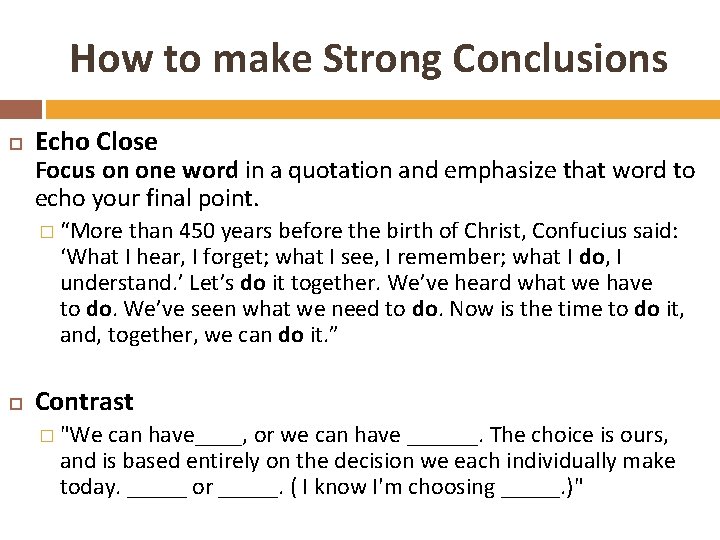
How to make Strong Conclusions Echo Close Focus on one word in a quotation and emphasize that word to echo your final point. � “More than 450 years before the birth of Christ, Confucius said: ‘What I hear, I forget; what I see, I remember; what I do, I understand. ’ Let’s do it together. We’ve heard what we have to do. We’ve seen what we need to do. Now is the time to do it, and, together, we can do it. ” Contrast � "We can have____, or we can have ______. The choice is ours, and is based entirely on the decision we each individually make today. _____ or _____. ( I know I'm choosing _____. )"
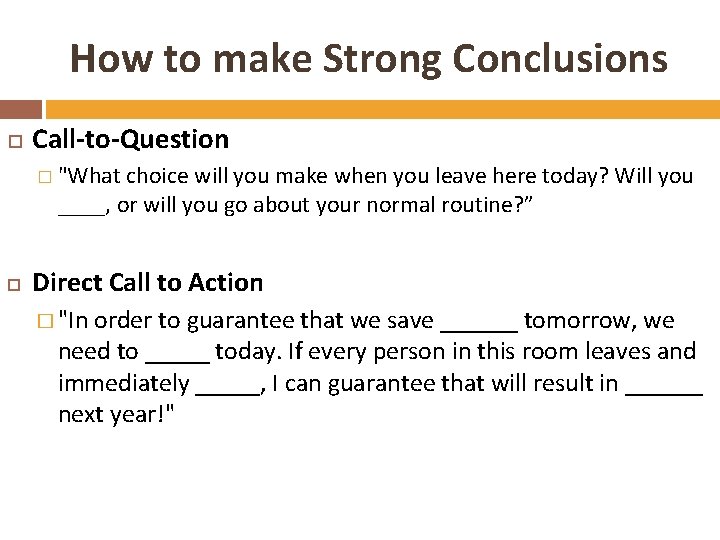
How to make Strong Conclusions Call-to-Question � "What choice will you make when you leave here today? Will you ____, or will you go about your normal routine? ” Direct Call to Action � "In order to guarantee that we save ______ tomorrow, we need to _____ today. If every person in this room leaves and immediately _____, I can guarantee that will result in ______ next year!"
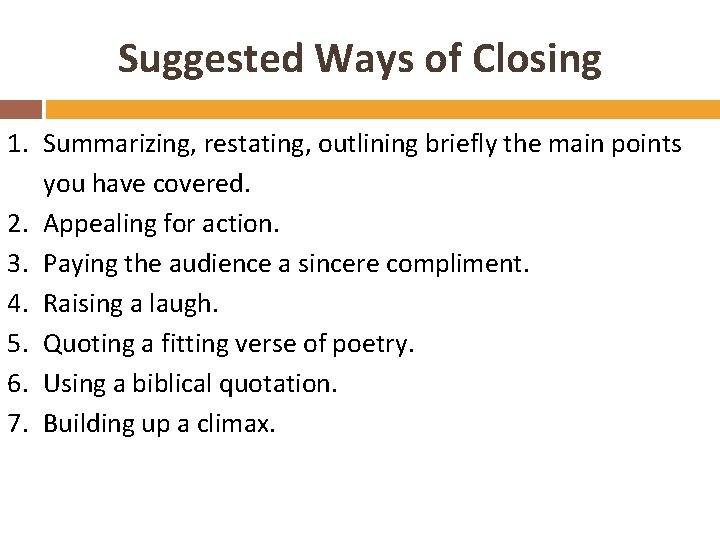
Suggested Ways of Closing 1. Summarizing, restating, outlining briefly the main points you have covered. 2. Appealing for action. 3. Paying the audience a sincere compliment. 4. Raising a laugh. 5. Quoting a fitting verse of poetry. 6. Using a biblical quotation. 7. Building up a climax.
Practice Use the above tips to develop your Conclusion. Do you want to review or summary? or do you want to call to action or memorable statement? Next time, you will need to share your Conclusion with your partner
The Use of Transition
Transition Audiences need help in moving smoothly from one topic to another. Transitions provide these valuable bridges, helping the audience to follow the ideas being presented and to see the relationship of those ideas. Transitions usually are used as you move � From the speech introduction to the body � From a main point to a subpoint � From a subpoint to supporting materials � From supporting materials to another main point � From the last supporting materials to the conclusion
Transition Transitions can be words, phrases, statements or questions. Some transitional words are � afterward, also, but, consequently, consider, finally, instead, later, meanwhile, moreover, next, then yet. Some transitional phrases are � According to, as a result, for example, for instance, in addition, let’s begin with, more importantly, this means, to illustrate. Some transitional questions are � “If this program is so valuable, why is everyone resisting it? ” � We must consider three things in developing this new product. First is. . . Second is. . . Third is. . .
Practice Now, use the above tips to examine your speech. Do you have proper transitions? Examine your partner’s speech to see if this speech has transitions � From the speech introduction to the body � From a main point to a subpoint � From a subpoint to support material � From support material to another main point � From the last support material to the conclusion
Reminders
Reminders: Do you… Select an outline that’s appropriate for your topic and allows your listeners to easily follow and understand your presentation? Make Your message clear to the audience? � The main points, sub-points and support materials should contribute to that message. Use appropriate transitional words, phrases, statements or questions as you move from one idea to another? Create a strong opening and conclusion?
Make Your Meaning Clear Avoid technical terms when addressing. Put ideas into language plain enough for any boy or girl to comprehend. Use exhibits, pictures, illustrations when possible. Restate your big ideas; but don’t repeat, don’t use the same phrases twice. Use specific instances and concrete cases to make abstract statement clear. Do not strive to cover too many points. Close with a brief summary.
Examples of Good Speeches

Two Examples for you The Speech that Made Obama President � https: //youtu. be/OFPw. De 22 Co. Y Toastmasters World Champion - Speech Analysis � https: //youtu. be/qg. Oh. BPtx 1 Vw
Little Tip: Why is Obama a good speaker? Rule of Three: The human brain seems to absorb and remember information more effectively when it is presented in threes. � "We believe in a generous America, in a compassionate America, in a tolerant America. ” � "Our economy is recovering. A decade of war is ending. A long campaign is now over. " � "Thank you for believing all the way, through every hill, through every valley. "
Little Tip: Why is Obama a good speaker? Contrast a problem and a solution. � “You hit singles, you hit doubles; every once in a while we may be able to hit a home run. ” Repetition � “You’ll hear the determination in the voice of a young field organizer… You’ll hear the pride in the voice of a volunteer… You’ll hear the deep patriotism in the voice of a military spouse…”
Homework Before next workshop, you should have the FIRST DRAFT of your speech. Workshop 4: First draft due Workshop 5: Final version due The Speech Marathon: Deliver the speech. � Speakers have to memorize the script. � PPT slides can ONLY be used to show pictures and other necessary materials. � No scripts or speech notes can be put on the PPT slides.
- Slides: 24