
PUBLIC SPEECH WORKSHOP I What Is a Good

PUBLIC SPEECH WORKSHOP (I)
What Is a Good Speech?
A Good Example One of the best commencement speeches: � Steve Jobs’ 2005 Stanford Commencement Speech: � https: //www. ted. com/talks/steve_jobs_how_to_live_ before_you_die
What is a Good Speech? Analyze Steve Jobs’ Stanford Commencement speech Group Discussion: � What are the good parts of this speech? � Do you think this speech is successful? Why? � Does the speech convey its message clearly? How does it do so? � Can you analyze the structure of this speech? Opening Body Conclusion
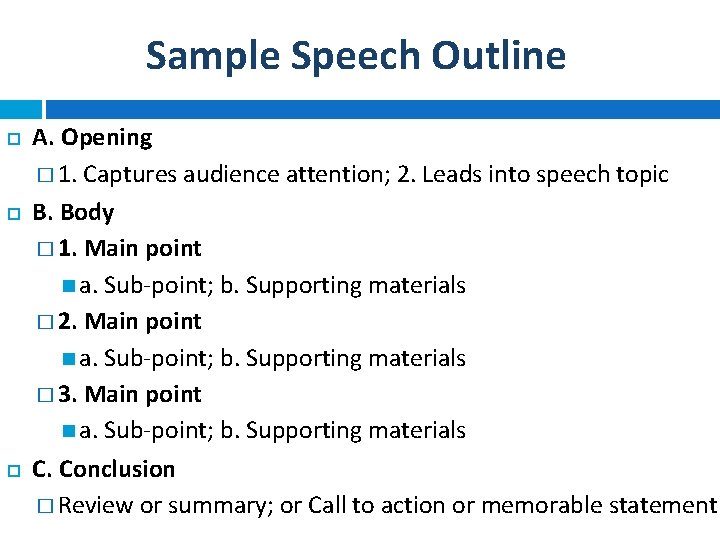
Sample Speech Outline A. Opening � 1. Captures audience attention; 2. Leads into speech topic B. Body � 1. Main point a. Sub-point; b. Supporting materials � 2. Main point a. Sub-point; b. Supporting materials � 3. Main point a. Sub-point; b. Supporting materials C. Conclusion � Review or summary; or Call to action or memorable statement

Why is it a Good Speech? The speech was short. As the TED conference has learned in its 30 -year history, 15 to 18 minutes is an ideal length of time. The speech had a theme that resonates with just about everyone who seeks meaning in their lives and their career: Do what you love. Jobs wrapped three lessons in three stories. Dividing a message into three parts or stories is a simple, memorable, and effective technique to structure a message.
What is a Good Speech? Let’s examine Jobs’ speech. Does he… � Talk about a few main points (three or four at the most)? � Emphasize the points by using examples, stories, or anecdotes? Tips learned from Jobs � Don’t just state a fact and then continue your audience will miss the point � Make a point, say it again in different words, illustrate the point, and then state it once more in order to be clearly understood.
Practice Select a point: � You need to be smart to ride a bike in NTU. � Drinking a cup of coffee a day makes us happy. � Sitting next to your crush without brushing teeth that morning is embarrassing. Develop your point � Now, make your point in different words. Give some details. Illustrate and elaborate your point.

How to Select Your Topic
Select Your Topic: What to talk about? Rule#1: Find something you are interested in, or something you are familiar with. If you have strong feeling about your topic, it is easier to prepare and present the speech. If you are enthusiastic about the subject, you will show more enthusiasm and sincerity. Your audience will pay attention to you and consider your viewpoint. Passion Is Important! You will become more involved with your talk and you will forget your nervousness. Find the BEST TOPIC for you and your audience!
Select Your Topic: What to talk about? Don’t be too broad � Love (X) too general � Narrow down Love between two lovers “How to confess your love successfully? ” � You need to fully develop a single facet of the larger subject in just a few minutes.
Select Your Topic: What to talk about? Determine the point you want to make: � Do you want to tell your audience how to confess your love successfully? Or � Do you want to convince your audience that confessing love is an easy task that needs no worry? Or � Do you want to tell your audience about the funny stories of confessing love?
What’s the General Purpose of Your Talk? Be absolutely clear about what you want the audience to do or know at the end of your talk. � To inform: you want your audience to learn or know about something � To persuade: you want to convince the audience to accept or approve your point of view � To entertain: you want to amuse or provide enjoyment for the audience � To inspire: you want to ask the audience to achieve noble goals or reach their highest potential.
Three Types of Speeches Informative Speeches: The purpose of informative communication is to increase the receiver’s knowledge and understanding of a subject. Persuasive Speeches: The major function of the persuasive speech is to induce the audience to think, feel, or act in a manner selected by the speaker. Entertaining Speeches: The purpose is to entertain the audience.
Examples Informative Speeches: � The procedures to be followed for adding new courses to the college curriculum. � How to grow vegetables in a greenhouse. Persuasive Speeches: � Final examinations in our colleges should be abolished. � The Government should condemn the actions of treason. Entertaining Speeches: p p The gourmet food served in the college cafeteria. How to write a political speech.
Practice Now, think about your general topic. List two or three topics that you may talk about � You are interested in this topic � You are familiar with this topic Explain your topic(s) to your partner, and ask him or her to give you opinions if the topic sounds interesting. Choose one of the best topics
How to Come Up with a Topic? Jot down notes, fragments, sentences that occur to you. Take one or two angles of a subject and attempt to cover them adequately. Take one and only one phase of your topic: expand enlarge it. Give a human interest narrative, a real life picture based on firsthand experiences.
How to Come Up with a Topic? A speech must grow. Select your topic early in the week, think over it during odd moments, brood over it, sleep over it, dream over it. Collect far more material than you intend to use.
Now, the Specific Purpose… Narrowing the general purpose into a more clearly defined specific purpose Make a one-sentence statement about what you hope to accomplish in your speech. This statement should be: � Written from the audience’s viewpoint � Specific and precise words � Realistic and possible to achieve Example: “After hearing my speech, the audience will be able to do three simple tasks that will make their love confessions successful. ”
Practice Now, write down your own Specific Purpose. � What do you want the audience to know/do/remember after your talk? � Be specific, precise, and concise. Share your sentence with your partner Review your partner’s sentence. Is it clear enough? Give him or her your opinion.
Before our next speech workshop Keep exploring your topic and your specific purpose. Bring your topic and your specific purpose to our next speech workshop class! � “After hearing my speech, the audience will be able to do three simple tasks that will make their love confessions successful. ”
- Slides: 21