
Public Speaking SPEECH AUDIENCE SPECIAL OCCASIONS PRESENTATIONS Standards

Public Speaking SPEECH | AUDIENCE | SPECIAL OCCASIONS | PRESENTATIONS
Standards This presentation is based on the competency standards for NVQ Level 4 Language and Communication (LAC 40117) Cluster 2 | Deliver Oral Presentations Unit | LLLCOM 0014 A Develop and apply oral expressions and critical listening Competency Elements: 1. Organise oral communication in a cogent manner 2. Apply inferential and evaluative listening 3. Deliver effective oral presentations to diverse audiences for varied purposes Content Writer | Alecia Campbell | 2019
Objectives After completing this presentation, the accompanying guide and activities you will be able to: Define at least three (3) types of audiences, outlining the needs and recommended strategies to meet their expectations Describe at least six (6) different speaking situations, outlining the purpose and expectations of the audience in each setting, Outline at least three (3) different points of view which could be employed while delivering a speech, Identify at least five (5) characteristics each of appropriate introductions, supporting details and effective conclusions needed to organize oral communication in a cogent manner. Categorize at least five (5) classes of transitional phrases used to show linkages in ideas Describe at least five (5) types of paralanguage List at least eight () verbal and non-verbal techniques to communicate information. Diagram at least three (3) sentence structures useful in avoiding monotony in speeches and oral presentations Distinguish between the strengths and weaknesses of speeches and oral presentations, in terms of content and context Describe at least five (5) digital media options which may be used strategically in presentations to enhance understanding of findings, reasoning and evidence and to add interest.

Objectives continued Outline expository speeches containing appropriate introductions, supporting details and effective conclusions Demonstrate at least three (3) techniques to avoid monotony in speech Showcase your ability to speak with clarity and persuasion while initiating and participating in discussions Demonstrate at least five (5) principles of active listening including effective note taking techniques Evaluate the content of selected local and international speeches by applying inferential and evaluative listening Demonstrate the correct pronunciation of at least twelve (12) commonly mispronounced words Explain the correct usage of at least twelve (12) commonly misused words Justify the need for using appropriate introductions, credible details and effective conclusions, by stating at least three (3) reasons for each Defend the need for an engaging delivery, by proposing at least three (3) strategies to avoid monotony and improve participation Convince your peers of the importance of context, background knowledge, values and experience on communication by outlining at least three (3) ways to avoid bias or find common ground
Required Reading Saylor Academy (2012) Stand Up and Speak Out – The Practice and Ethics of Public Speaking Chapter 4 – The importance of Listening Chapter 5 – Audience Analysis Chapter 6 – Finding a purpose and selecting a topic Chapter 7 – Researching Your Speech Chapter 8 – Supporting ideas and Building Arguments Chapter 9 – Introductions matter: How to begin a speech effectively Chapter 10 – Creating the body of your speech Chapter 11 - Concluding with power Chapter 12 – Outlining Chapter 14 – Delivering the Speech Chapter 15 – Presentation Aids: Design and Usage
Outline 1. 2. 3. Public Speaking 1. Types of speeches 2. Types of audiences 3. Speaking settings Writing Speeches 1. Outlines 2. Introductions 3. Body 4. Conclusion Delivering Speeches
Public Speaking Listen to an overview of this unit by clicking on the icon above.

TYPES OF SPEECHES

Ceremonial Speeches Ceremonial speeches are speeches given during a ceremony or a ritual marked by observance of formality or etiquette. There are different types of ceremonial speeches: introductions Presentations Acceptances Dedications Toasts Roasts Eulogies Farewells

Ceremonial Speeches of introduction are designed to introduce a speaker. Speeches of presentation are given when an individual is presenting an award of some kind. Speeches of acceptance are delivered by the person receiving an award or honor. Speeches of dedication are given when a new building or other place is being opened for the first time. Toasts are given to acknowledge and honor someone on a special occasion (e. g. , wedding, birthday, retirement). Roasts are speeches designed to both praise and good-naturedly insult a person being honored. Eulogies are given during funerals and memorial services. Speeches of farewell are delivered by an individual who is leaving a job, community, or organization, and wants to acknowledge how much the group has meant.
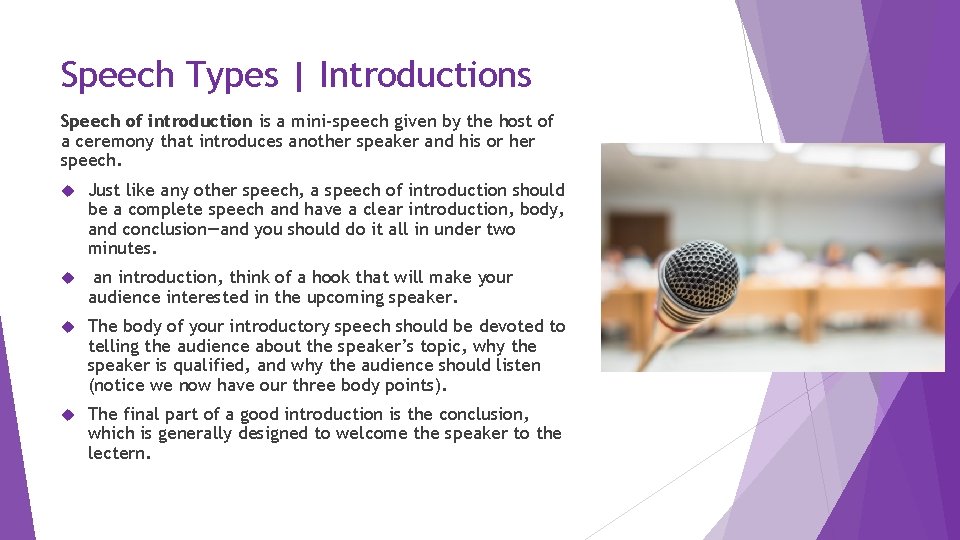
Speech Types | Introductions Speech of introduction is a mini-speech given by the host of a ceremony that introduces another speaker and his or her speech. Just like any other speech, a speech of introduction should be a complete speech and have a clear introduction, body, and conclusion—and you should do it all in under two minutes. an introduction, think of a hook that will make your audience interested in the upcoming speaker. The body of your introductory speech should be devoted to telling the audience about the speaker’s topic, why the speaker is qualified, and why the audience should listen (notice we now have our three body points). The final part of a good introduction is the conclusion, which is generally designed to welcome the speaker to the lectern.
Speech Types | Presentation A speech of presentation is a brief speech given to accompany a prize or honor. Speeches of presentation can be as simple as saying, “This year’s recipient of the HEART Trust Speaking prize is Kenya Campbell, ” or could last up to five minutes as the speaker explains why the honoree was chosen for the award. Always ask how long the speech should be. First, you should explain what the award or honor is and why the presentation is important. Second, you can explain what the recipient has accomplished in order for the award to be bestowed.
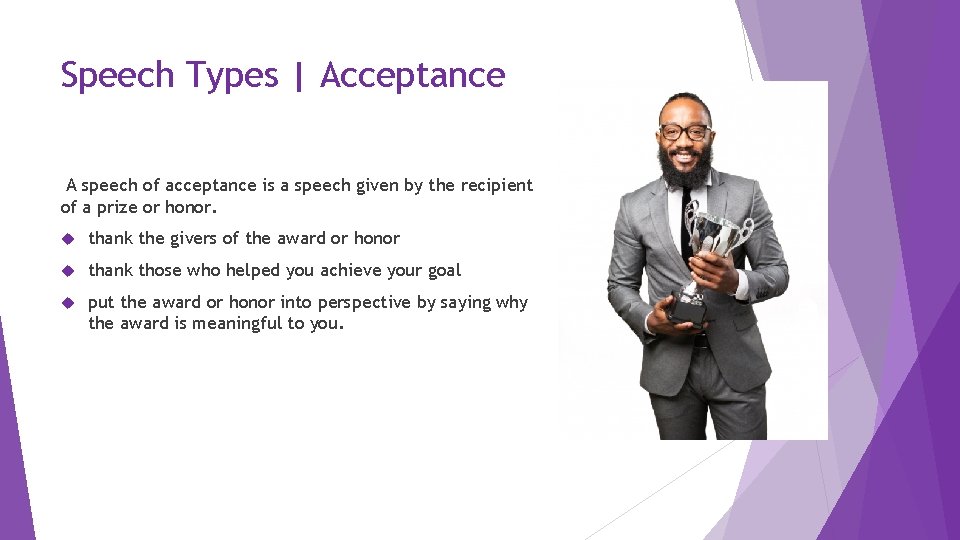
Speech Types | Acceptance A speech of acceptance is a speech given by the recipient of a prize or honor. thank the givers of the award or honor thank those who helped you achieve your goal put the award or honor into perspective by saying why the award is meaningful to you.
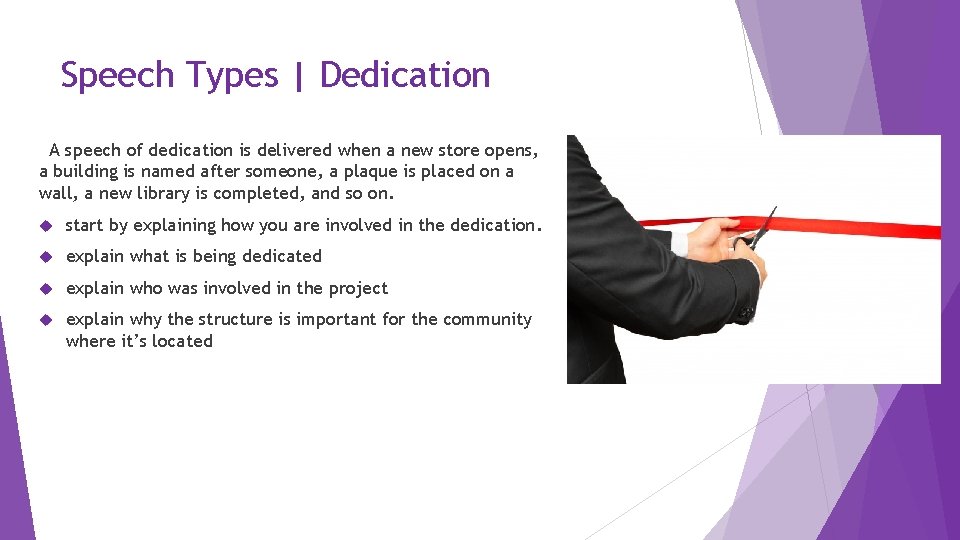
Speech Types | Dedication A speech of dedication is delivered when a new store opens, a building is named after someone, a plaque is placed on a wall, a new library is completed, and so on. start by explaining how you are involved in the dedication. explain what is being dedicated explain who was involved in the project explain why the structure is important for the community where it’s located
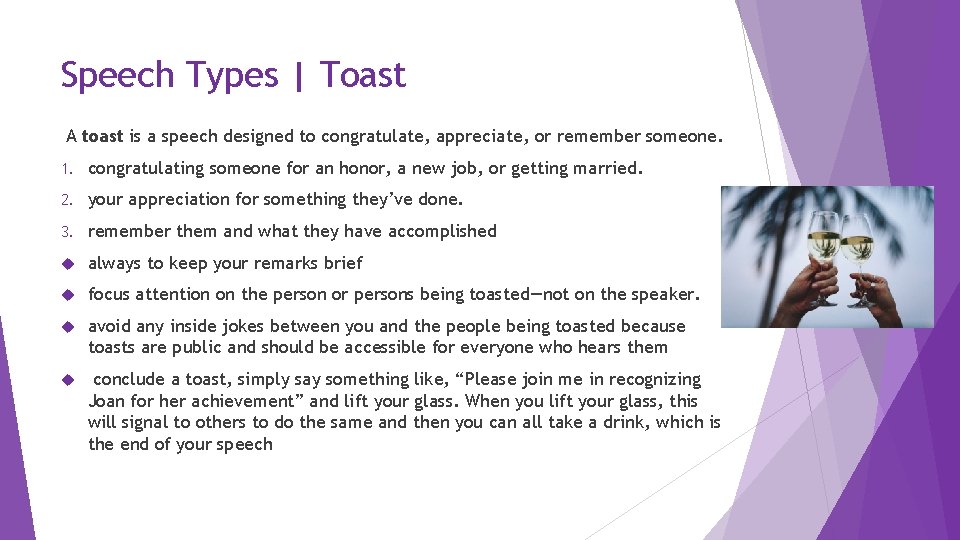
Speech Types | Toast A toast is a speech designed to congratulate, appreciate, or remember someone. 1. congratulating someone for an honor, a new job, or getting married. 2. your appreciation for something they’ve done. 3. remember them and what they have accomplished always to keep your remarks brief focus attention on the person or persons being toasted—not on the speaker. avoid any inside jokes between you and the people being toasted because toasts are public and should be accessible for everyone who hears them conclude a toast, simply say something like, “Please join me in recognizing Joan for her achievement” and lift your glass. When you lift your glass, this will signal to others to do the same and then you can all take a drink, which is the end of your speech
Speech Types | Roast The roast speech is a very interesting and peculiar speech because it is designed to both praise and good-naturedly insult a person being honored. Think about the person who is being roasted. Do they have any strange habits or amusing stories in their past that you can discuss? When you think through these things you want to make sure that you cross anything off your list that is truly private information or will really hurt the person Make sure that the items you choose are widely known by your audience. End on a positive note. While the jokes are definitely the fun part of a roast, you should leave the guest of honor knowing that you truly do care about and appreciate the person.
Speech Types | Eulogy A eulogy is a speech given in honor of someone who has died. Gather as much information about the deceased as possible. The more information you have about the person, the more personal you can make the eulogy. ask friends and relatives of the deceased for their memories although eulogies are delivered on the serious and sad occasion of a funeral or memorial service for the deceased, it is very helpful to look for at least one point to be lighter or humorous to relieve the tension that is created by the serious nature of the occasion. remember to tell the deceased’s story. Tell the audience about who this person was and what the person stood for in life. The eulogy should remind the audience to celebrate the person’s life as well as mourn their death.
Activity | Eulogy Listen to Barack Obama delivering a eulogy at the funeral of civil rights activist Rosa Parks in November of 2005. Draft the outline of this speech Explain how he was able to inject humor into a serious occasion
Speech Types | Farewell A speech of farewell is delivered by an individual who is leaving a job, community, or organization, and wants to acknowledge how much the group has meant. Maybe you’ve accepted a new job and are leaving your current job, or you’re graduating from college and entering the work force. thank the people in your current position and let them know how much you appreciate them as you make the move to your next position in life. express to your audience how much the experience has meant to you end on a high note
Activity: Ceremonial speeches Using You. Tube. com find one example of each of the following types of ceremonial speeches: Speech of introduction at a function Presenting the award at the Oscars Accepting the award at the Grammys or Oscars. Toasting a bridal party Roasting a celebrity
Special Occasion Speeches |Inspirational The goal of an inspirational speech is to elicit or arouse an emotional state within an audience. Types of inspirational speeches Public relation speech Speeches of apology Commencement speech
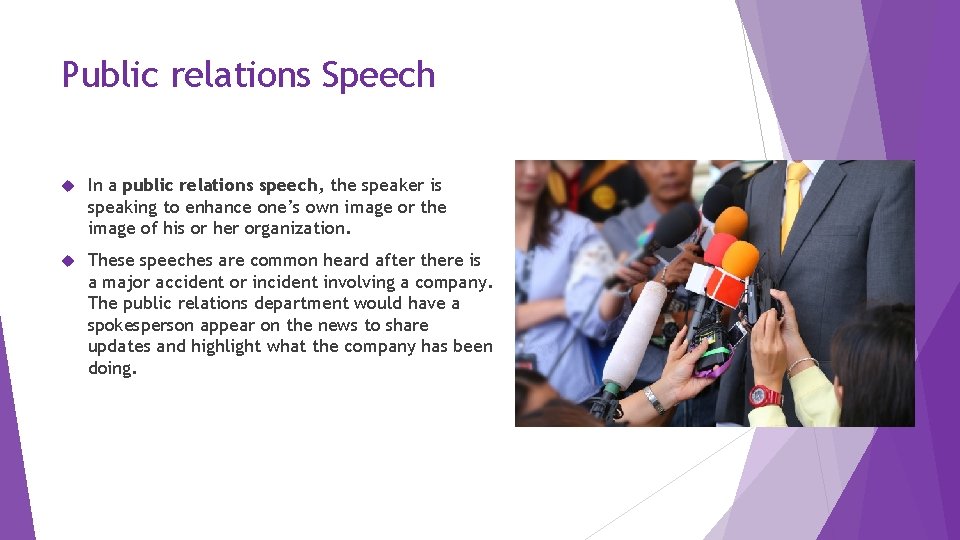
Public relations Speech In a public relations speech, the speaker is speaking to enhance one’s own image or the image of his or her organization. These speeches are common heard after there is a major accident or incident involving a company. The public relations department would have a spokesperson appear on the news to share updates and highlight what the company has been doing.
Activity You are the public relations director for a food distribution company. There has been a recent recall of one of your most popular products due to reports of food poisoning amongst consumers. Draft a four (4) minutes public relation speech highlighting how your company is addressing the situation.
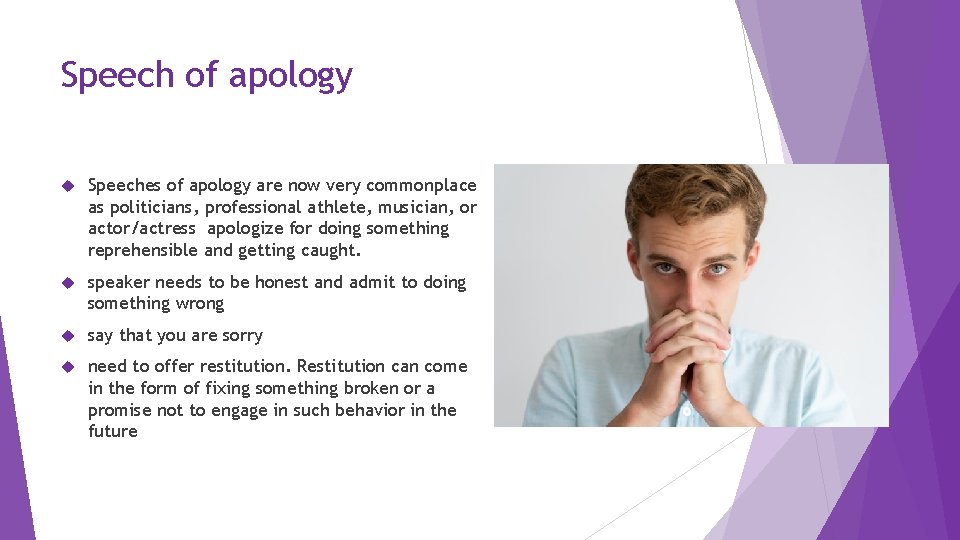
Speech of apology Speeches of apology are now very commonplace as politicians, professional athlete, musician, or actor/actress apologize for doing something reprehensible and getting caught. speaker needs to be honest and admit to doing something wrong say that you are sorry need to offer restitution. Restitution can come in the form of fixing something broken or a promise not to engage in such behavior in the future
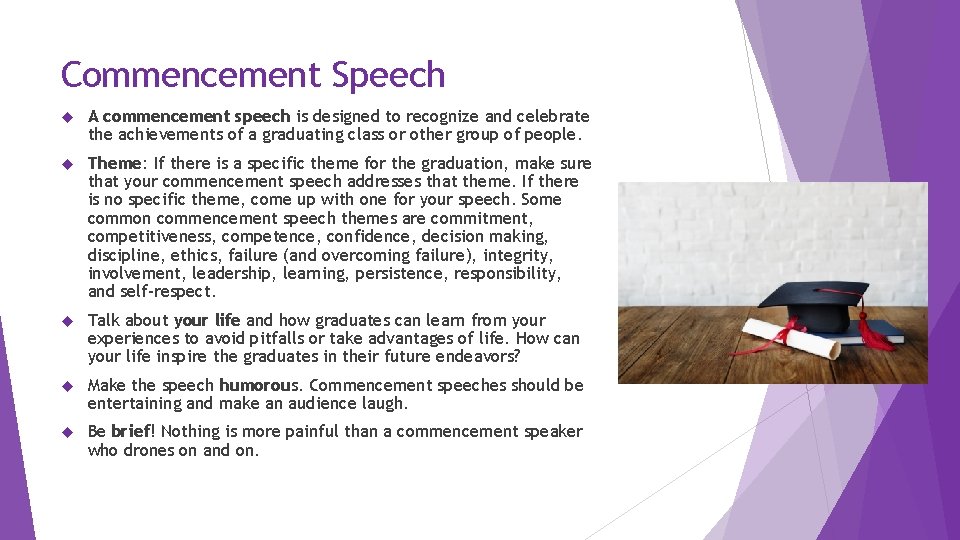
Commencement Speech A commencement speech is designed to recognize and celebrate the achievements of a graduating class or other group of people. Theme: If there is a specific theme for the graduation, make sure that your commencement speech addresses that theme. If there is no specific theme, come up with one for your speech. Some common commencement speech themes are commitment, competitiveness, competence, confidence, decision making, discipline, ethics, failure (and overcoming failure), integrity, involvement, leadership, learning, persistence, responsibility, and self-respect. Talk about your life and how graduates can learn from your experiences to avoid pitfalls or take advantages of life. How can your life inspire the graduates in their future endeavors? Make the speech humorous. Commencement speeches should be entertaining and make an audience laugh. Be brief! Nothing is more painful than a commencement speaker who drones on and on.
Activity At a conference, professional meeting, or formal celebration, you have been asked to introduce the keynote speaker. Think of a colleague or mentor whom you would like to introduce at a conference. 1. 2. Prepare an outline for a 1 -2 minute extemporaneous introduction. 1. Provide the audience with some background on the speaker (e. g. , formal education) 2. Provide information that modesty may prevent the speaker from sharing (e. g. , honors, accomplishments) 3. Appeal to the listeners' interest 4. Indicate the importance of the topic of the keynote speech to be delivered Deliver your speech of introduction at a formal occasion. 1. Research and use expected greetings for dignitaries present at a formal event
Audience TYPES | STRATEGIES | ANALYSIS
The audience is an important variable in any communication situation. Check about your audience’s range in ages, educational backgrounds, and occupations. The attributes of your audience that will have the greatest influence on your presentation are size, attitude toward you and your subject, and their previous knowledge about the subject.
Audience size The size of the audience is an important influence on any presentation. In general, the larger the group, the more difficult it is to satisfy everyone. Sometimes, just gaining the attention of a large group can be a challenge. The members of a large audience are less cohesive; hence the behavior of large audiences is less predictable than that of small groups. The members of a large audience are likely to have less in common with one another. Thus in any large group, some members of the audience will disagree with you. The members of a large group have a greater variation in attitudes, knowledge about the subject, and educational level.
Audience Attitude The attitude of the audience toward you and your subject can vary in several ways. The audience may: Like you and like your subject. Like you but dislike your subject. Dislike you but like your subject. Dislike both you and your subject. Like or dislike you and be neutral about your subject. Be neutral about you and like or dislike your subject. Be neutral about you and your subject. If the audience has a positive attitude toward either you or your subject, you are off to a good start.
Audience Knowledge When the audience is unfamiliar with the subject, or when the subject is complex given their educational background, you will need to make a special effort to help your audience understand: Use a vocabulary that everyone will understand. Explain technical terms. Make your organizational plan obvious, and make transitions clear. Repeat and emphasize key points.
Activity What kind of audience size, attitude and knowledge are you likely to encounter in the following settings: Speaking to the students at a local primary school on the topic of recycling Presenting a sales pitch to the executives of an international manufacturing company Delivering the eulogy at the funeral of a well-known and beloved public figure.
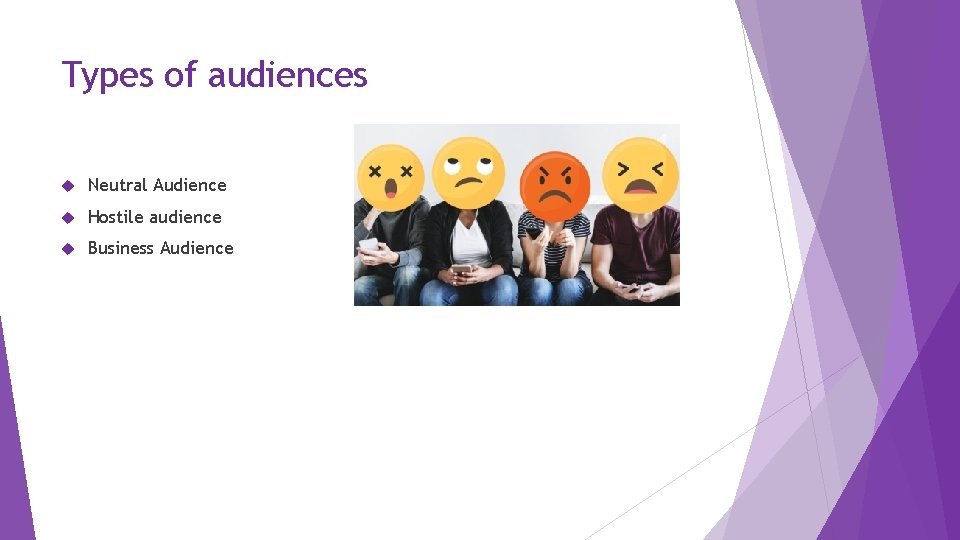
Types of audiences Neutral Audience Hostile audience Business Audience
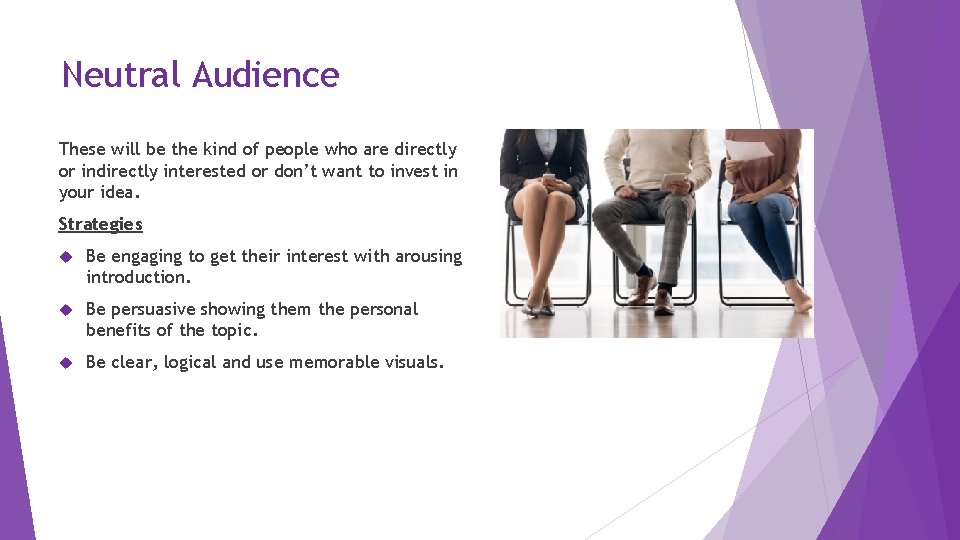
Neutral Audience These will be the kind of people who are directly or indirectly interested or don’t want to invest in your idea. Strategies Be engaging to get their interest with arousing introduction. Be persuasive showing them the personal benefits of the topic. Be clear, logical and use memorable visuals.
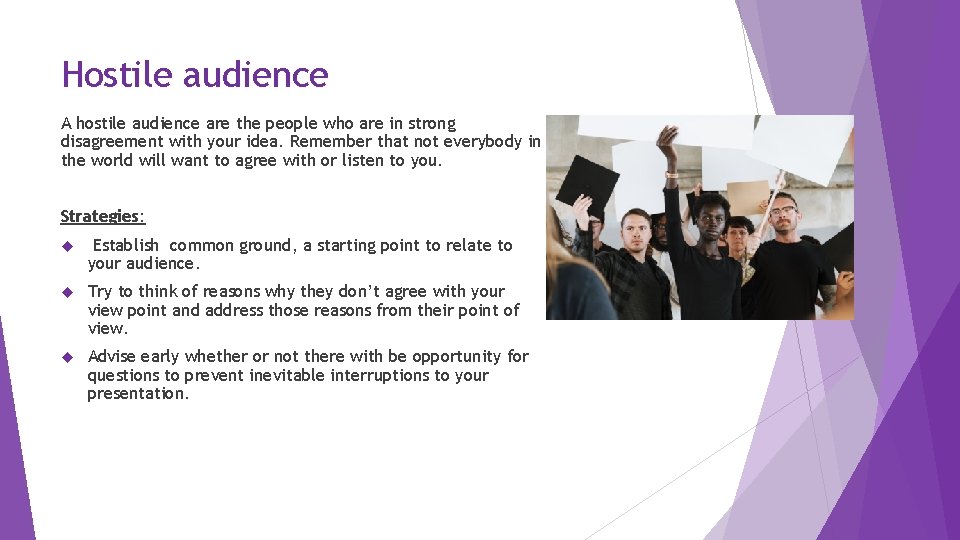
Hostile audience A hostile audience are the people who are in strong disagreement with your idea. Remember that not everybody in the world will want to agree with or listen to you. Strategies: Establish common ground, a starting point to relate to your audience. Try to think of reasons why they don’t agree with your view point and address those reasons from their point of view. Advise early whether or not there with be opportunity for questions to prevent inevitable interruptions to your presentation.
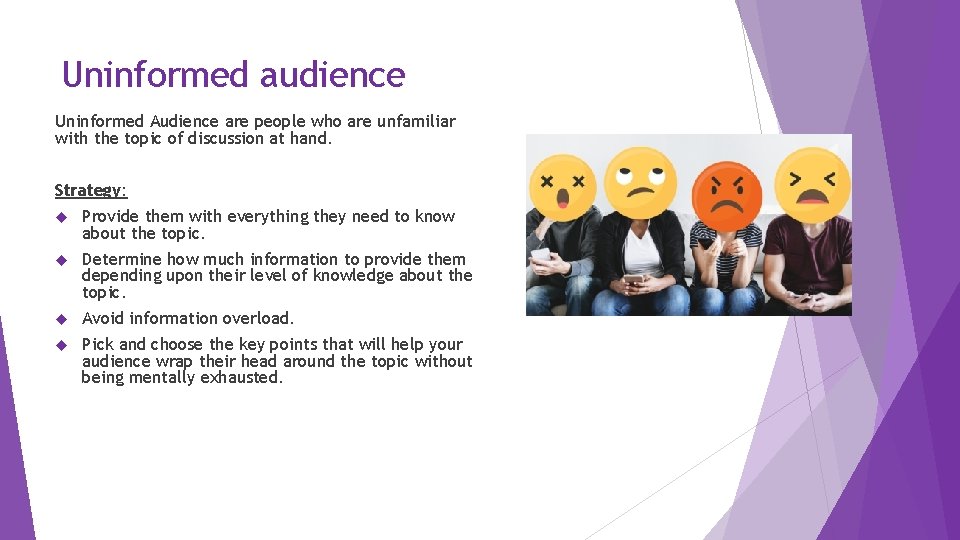
Uninformed audience Uninformed Audience are people who are unfamiliar with the topic of discussion at hand. Strategy: Provide them with everything they need to know about the topic. Determine how much information to provide them depending upon their level of knowledge about the topic. Avoid information overload. Pick and choose the key points that will help your audience wrap their head around the topic without being mentally exhausted.
Expert audience Experts in your audience already knows the background, common issues, current trends and more about the topic at hand. Strategies: Avoid providing a longwinded background of the topic. Ensure you are presenting new information, techniques, process or technology etc. which is worth their time or which addresses an issue they are aware of.
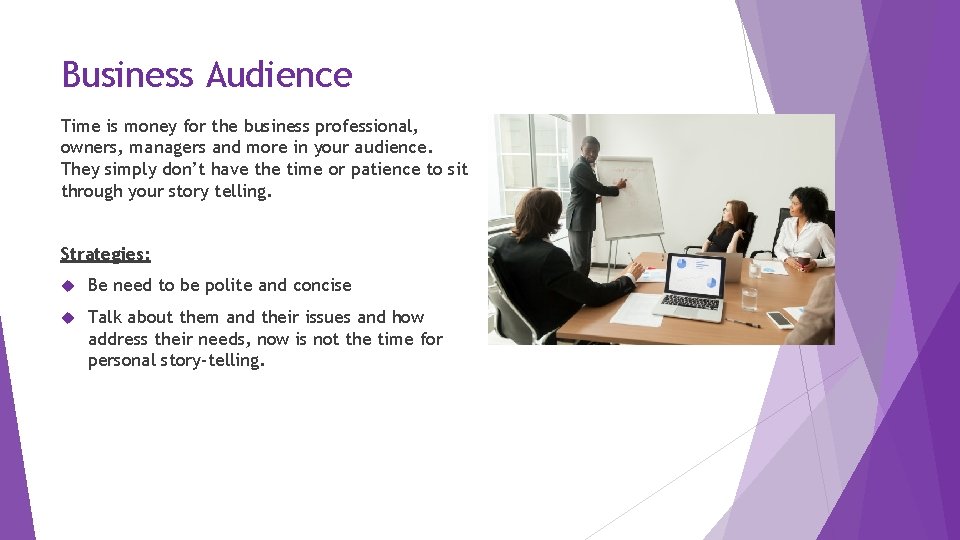
Business Audience Time is money for the business professional, owners, managers and more in your audience. They simply don’t have the time or patience to sit through your story telling. Strategies: Be need to be polite and concise Talk about them and their issues and how address their needs, now is not the time for personal story-telling.
Audience Analysis To find out whether an audience will find a speech useful and interesting, we go through a process called audience analysis. Just as the title implies, the goal of audience analysis is to literally analyze who is in your audience. The following are some common questions to ask yourself: Who are my audience members? What characteristics do my audience members have? What opinions and beliefs do they have? What do they already know? What would they be interested in knowing more about? What do they need?
SPEECH WRITING OUTLINE | INTRODUCTION | BODY | CONCLUSION
Speech purpose When preparing a speech the very first question you’ll want to ask yourself is this: what is the basic purpose of the speech you’re about to give? There are three general purposes people can have for giving public speeches: to inform to persuade, to entertain.
Topic Selection Once you have a general purpose for speaking (to inform, to persuade, or to entertain), you can start to develop the overarching topic for your speech. Here are the topics of some speeches: Lou Gehrig, “Farewell to Baseball Address” Jesus Christ, “Sermon on the Mount” Governor General, Commissioning of Justices of the Peace
Speech Preparation Once you’ve finished putting in place the foundational building blocks of the effective public speaking pyramid, it’s time to start building the second tier. . At this point, speakers really get to delve into the creation of the speech itself. This level of the pyramid contains three major building blocks: Research Organization support.
Speech Preparation | Research If you want to give a successful and effective speech, you’re going to need to research your topic. Even if you are considered an expert on the topic, you’re going to need do some research to organize your thoughts for the speech. Research is the process of investigating a range of sources to determine relevant facts, theories, examples, quotations, and arguments. The goal of research is to help you, as the speaker, to become very familiar with a specific topic area.
Speech Preparation | Organization The next step in speech preparation is determining the basic structure of your speech. Effective speeches all contain a basic structure: Introduction body conclusion
Speech Organization | Introduction The introduction is where you set up the main idea of your speech and get your audience members interested. An effective introduction section of a speech should capture your audience’s attention contain the basic idea or thesis of your speech
Speech Organization | Body The body of the speech is generally segmented into a series of main points that a speaker wants to make. When a speaker only has two or three main points, the likelihood that an audience member will recall those points at the conclusion of the speech increases. To help you think about your body section of your speech, ask yourself this question, “If I could only say three sentences, what would those sentences be? ” When you are able to clearly determine what the three most important sentences are, you’ve figured out what the three main points of your speech should also be. Once you have your two or three main topic areas, you then need to spend time developing those areas into segments that work individually but are even more meaningful when combined together. The result will form the body of your speech.
Speech Organization | Conclusion After you’ve finished talking about the two or three main points in your speech, it’s time to conclude the speech. At the beginning of the speech’s conclusion, you should start by clearly restating the basic idea of your speech (thesis). We restate thesis at this point to put everything back into perspective and show the three main points were used to help us understand the original thesis. For persuasive speeches, we also use the conclusion of the speech to make a direct call for people change their thought processes or behaviors (call to action). For informative speeches, you may want to refer back to the device you used to gain your audience’s attention at the beginning of the speech
Focus on Writing: Transitional phrases help to connect ideas within sentences and allow for a more logical and readable flow of information. Here are some categories of transitional phrases. Can you find more? cause and effect: consequently, therefore, accordingly, as a result, because, for this reason, hence, thus sequence: furthermore, in addition, moreover, first, second, third, finally, again, also, and, besides, further, in the first place, last, likewise, next, then, too comparison or contrast: similarly, also, in the same way, likewise, although, at the same time, but, conversely, even so, however, in contrast, nevertheless, nonetheless, notwithstanding, on the contrary, otherwise, still, yet example: for example, for instance, in fact, indeed, of course, specifically, that is, to illustrate purpose: for this purpose, for this reason, to this end, with this object time or location: nearby, above, adjacent to, below, beyond, farther on, here, opposite to, there, to the south, before, after, later, afterward, immediately, in the meantime, meanwhile, now, since, soon, then, while
Activity Watch this 5 minute video of Barak Obama’s first speech as president of the United States of America. Draft the outline of Obama’s speech showing Introduction Supporting points Conclusion State your opinion on the effectiveness of the speech
Activity Read the transcript of a speech by the Governor General of Jamaica available here. Draft the outline of Obama’s speech showing Introduction Supporting points Conclusion State your opinion on the effectiveness of the speech
Speech Delivery Types | Techniques | Visual
Types of speech delivery Impromptu speaking is the presentation of a short message without advance preparation. Extemporaneous speaking is the presentation of a carefully planned and rehearsed speech, spoken in a conversational manner using brief notes. Manuscript speaking is the word-for-word iteration of a written message. Memorized speaking is the rote recitation of a written message that the speaker has committed to memory.
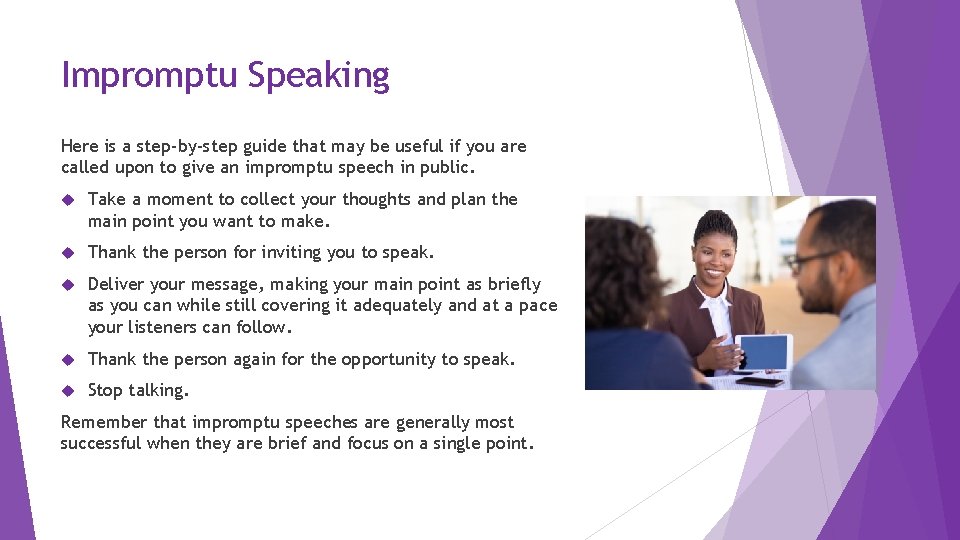
Impromptu Speaking Here is a step-by-step guide that may be useful if you are called upon to give an impromptu speech in public. Take a moment to collect your thoughts and plan the main point you want to make. Thank the person for inviting you to speak. Deliver your message, making your main point as briefly as you can while still covering it adequately and at a pace your listeners can follow. Thank the person again for the opportunity to speak. Stop talking. Remember that impromptu speeches are generally most successful when they are brief and focus on a single point.
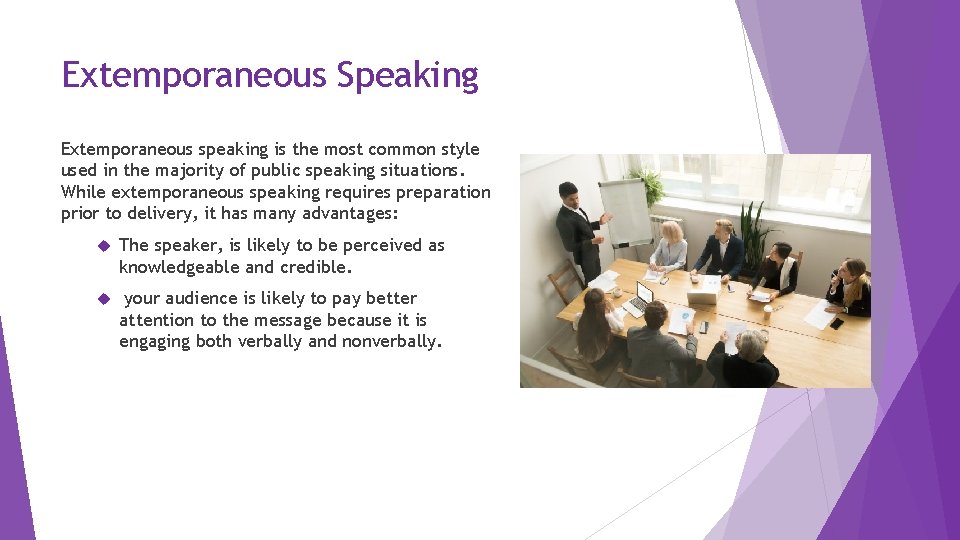
Extemporaneous Speaking Extemporaneous speaking is the most common style used in the majority of public speaking situations. While extemporaneous speaking requires preparation prior to delivery, it has many advantages: The speaker, is likely to be perceived as knowledgeable and credible. your audience is likely to pay better attention to the message because it is engaging both verbally and nonverbally.
Manuscript reading While reading exact working from a script may be an uninteresting way to present, there are situations in which this style of exact repetition of written words is crucial e. g. reading a statement about your organization’s legal responsibilities to customers or reading a press release after a disaster. Manuscript reading does not have to be monotonous. With practice and applying proper speech delivery techniques even a manuscript man y be delivered in a conversational and engaging manner.
Activity Professional speakers, actors, news reporters, and politicians often read verbatim from an autocue device, such as a Tele. Promp. Ter, especially when appearing on television, where eye contact with the camera is crucial. Watch the news report on a TV station and note a list of techniques used by the reporter/journalist to make the scripted delivery sound appealing and engaging.
Techniques It is not just what you say; it is how you say it. Understanding the nature of oral delivery and improving your own oral expressions and techniques are important in ensuring the success of your presentation. Actors, politicians, businessmen and women, and clerics all seek assistance to improve these speech delivery. The techniques and recommendations included in this section will help you to do the same.
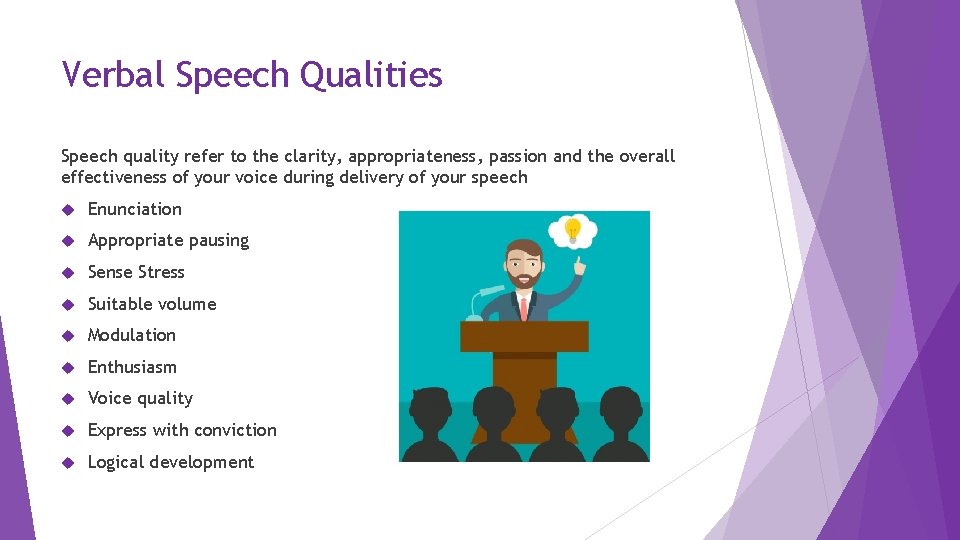
Verbal Speech Qualities Speech quality refer to the clarity, appropriateness, passion and the overall effectiveness of your voice during delivery of your speech Enunciation Appropriate pausing Sense Stress Suitable volume Modulation Enthusiasm Voice quality Express with conviction Logical development
Logistics of Speech delivery Something as mundane as a malfunctioning microphone, an inappropriate anecdote or tiny font on a visual slide can derail the most eloquent speaker. These are just some of the technical logistics to consider for a well-received speech or presentation Interest arousing introduction Accuracy of statement Effective conclusion Effective use of questions Effective use of visual aids Appropriate timing and pacing Sound argumentation
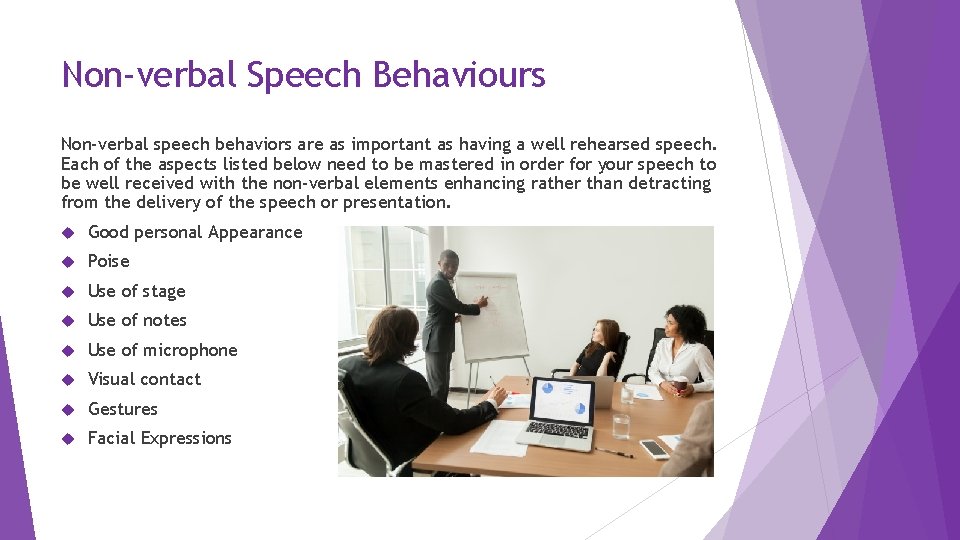
Non-verbal Speech Behaviours Non-verbal speech behaviors are as important as having a well rehearsed speech. Each of the aspects listed below need to be mastered in order for your speech to be well received with the non-verbal elements enhancing rather than detracting from the delivery of the speech or presentation. Good personal Appearance Poise Use of stage Use of notes Use of microphone Visual contact Gestures Facial Expressions
Activity Watch the following 5 minute video with highlights of Barack Obama's final speech as president. Make a list of the speech qualities you observe: 1. Verbal Speech qualities 2. Non-verbal speech behaviors
Glossary Impromptu speaking - presentation of a short message without advance preparation. Extemporaneous speaking - presentation of a carefully planned and rehearsed speech, spoken in a conversational manner using brief notes. Manuscript speaking - word-for-word iteration of a written message. Memorized speaking - rote recitation of a written message that the speaker has committed to memory.
References Saylor Academy (2012) Stand Up and Speak Out – The Practice and Ethics of Public Speaking. , Retrieved from https: //saylordotorg. github. io/text_stand-up-speak-out-the-practice-and-ethics-of-public-speaking/index. html Pronunciation Resources (n. d. ) Retrieved from: https: //speakingcenter. uiowa. edu/pronunciation-resources Why English pronunciation is so hard (2012, February 12). Retrieved from : https: //youtu. be/m. Ow 7 Cdp. K 44 w Confusing English Words! (2017, May 9) Retrieved from https: //youtu. be/Ovvj. J_d. JMms How to Hesitate like a native English speaker (2017, March 6, ) Retrieved from: https: //youtu. be/cj. VWpskglqs Bodie, G. D. , St. Cyr, K. , Pence, M. , Rold, M. , & Honeycutt, J. (2012). Listening competence in initial interactions I: Distinguishing between what listening is and what listeners do. International Journal of Listening, 26(1), 1 -28. Speeches by the Governor General of Jamaica Retrieved from https: //kingshouse. gov. jm/speeches/ Non-verbal communication Mr. Bean (2014, May 22) Retrieved from: https: //youtu. be/z. HWz. Sx. K-Vr. U Barak Obama Final speech as president (2017) Retrieved from: https: //youtu. be/k 0 j. JL_YFy. IU Obama gives first speech as President (2008) Retrieved from: https: //youtu. be/2 Nj. CQJPh 9 Pg Barak Obama deliver Eulogy of Rosa Parks (2005) Retrieved from http: //www. youtube. com/watch? v=p. Rs. H 92 s. JCr 4 How to Enunciate, (2019, March 19) Retrieved from: https: //m. wikihow. com/Enunciate Palomino, C. , How Improve Reading Fluency (2019, July 12) Retrieved from https: //www. wikihow. com/Improve-Reading-Fluency Types of Listening (n. d. ) Retrieved from: https: //www. skillsyouneed. com/ips/listening-types. html Linda, Linda Listen, Mateo Makes his cupcake case (2014) Retrieved from https: //youtu. be/JI 9 i. Egdujj. A 5 ways to listen better (2011, July 2) Retrieved from https: //youtu. be/c. Sohjl. YQI 2 A Big Bang theory Active Listening (2016, Oct 18) Video. Retrieved from https: //youtu. be/3_d. Ak. Ds. BQyk Pronunciation Guide for English and Academic Dictionaries (n. d. ) Retrieved from https: //www. oxfordlearnersdictionaries. com/about/english/pronunciation_english

Photo Credits Unless otherwise cited photos are sourced from https: //www. freepik. com/ which permits private and commercial use as long as the creator/website is attributed.
- Slides: 65