
Public Speaking Module 5 Choose and Research a
Public Speaking Module 5: Choose and Research a Speech Topic

Module Learning Outcomes Choose and research a speech topic 5. 1: Identify strategies for choosing a topic and identifying a purpose and thesis of the speech 5. 2: Identify strategies for researching and supporting a speech 5. 3: Explain key concepts for using statistics and data in your speech

Choosing a topic
Learning Outcomes: Choosing a topic 5. 1: Identify strategies for choosing a topic and identifying a purpose and thesis of the speech 5. 1. 1: Discuss methods for choosing a topic 5. 1. 2: Describe strategies for narrowing a topic 5. 1. 3: Identify the specific purpose of a speech 5. 1. 4: Identify the central idea of thesis for a speech
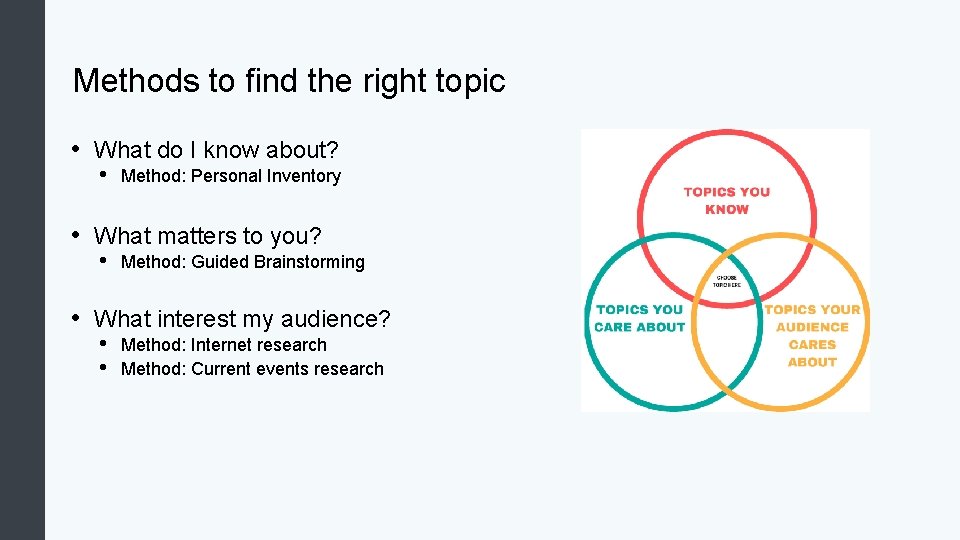
Methods to find the right topic • What do I know about? • Method: Personal Inventory • What matters to you? • Method: Guided Brainstorming • What interest my audience? • • Method: Internet research Method: Current events research
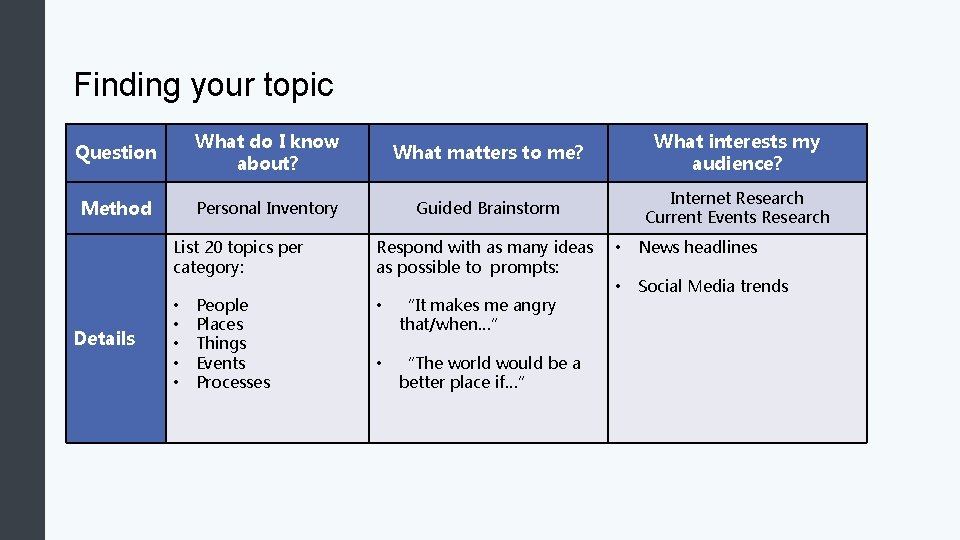
Finding your topic Question What do I know about? What matters to me? What interests my audience? Method Personal Inventory Guided Brainstorm Internet Research Current Events Research List 20 topics per category: Details • • • People Places Things Events Processes Respond with as many ideas as possible to prompts: • “It makes me angry that/when…” • “The world would be a better place if…” • News headlines • Social Media trends
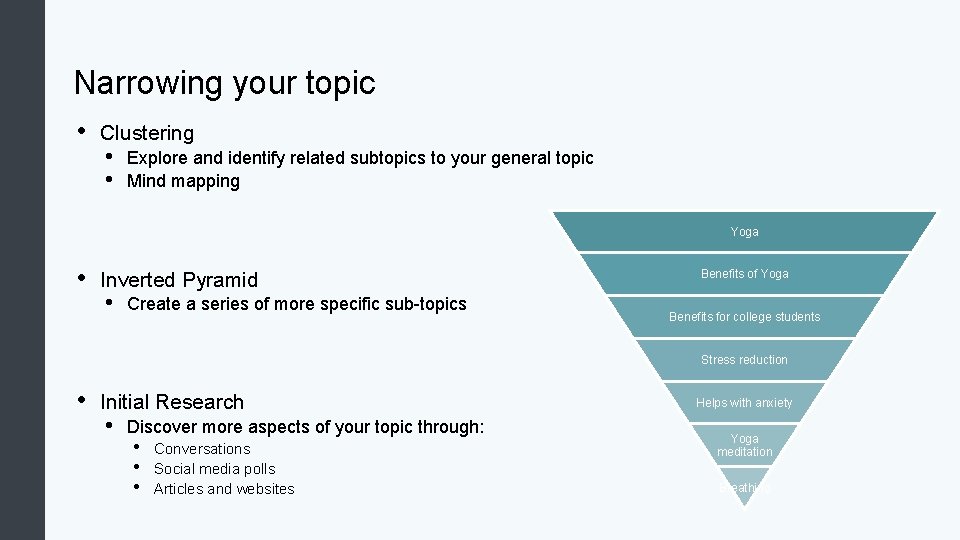
Narrowing your topic • Clustering • • Explore and identify related subtopics to your general topic Mind mapping Yoga • Inverted Pyramid • Create a series of more specific sub-topics Benefits of Yoga Benefits for college students Stress reduction • Initial Research • Discover more aspects of your topic through: • • • Conversations Social media polls Articles and websites Helps with anxiety Yoga meditation Breathing
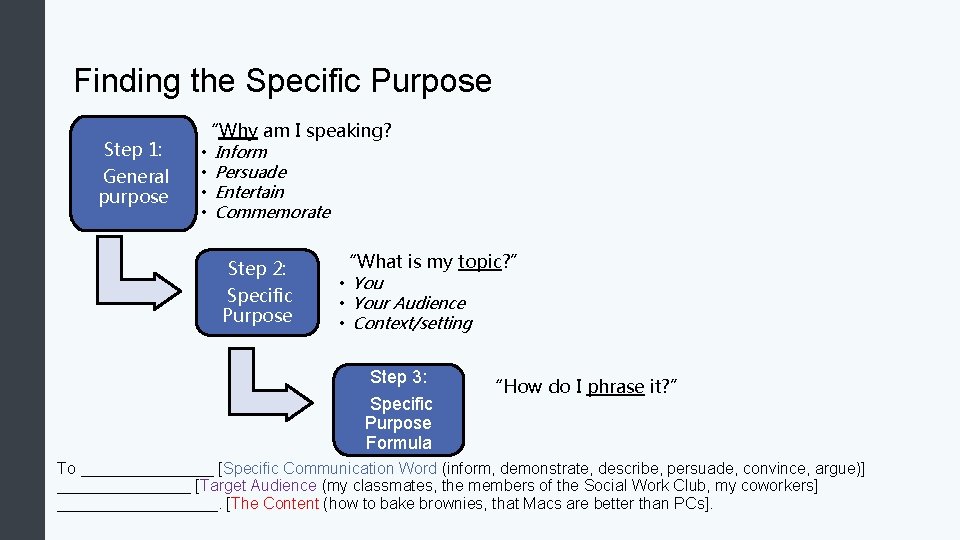
Finding the Specific Purpose Step 1: General purpose “Why am I speaking? • • Inform Persuade Entertain Commemorate Step 2: Specific Purpose “What is my topic? ” • Your Audience • Context/setting Step 3: Specific Purpose Formula “How do I phrase it? ” To ________ [Specific Communication Word (inform, demonstrate, describe, persuade, convince, argue)] ________ [Target Audience (my classmates, the members of the Social Work Club, my coworkers] _________. [The Content (how to bake brownies, that Macs are better than PCs].
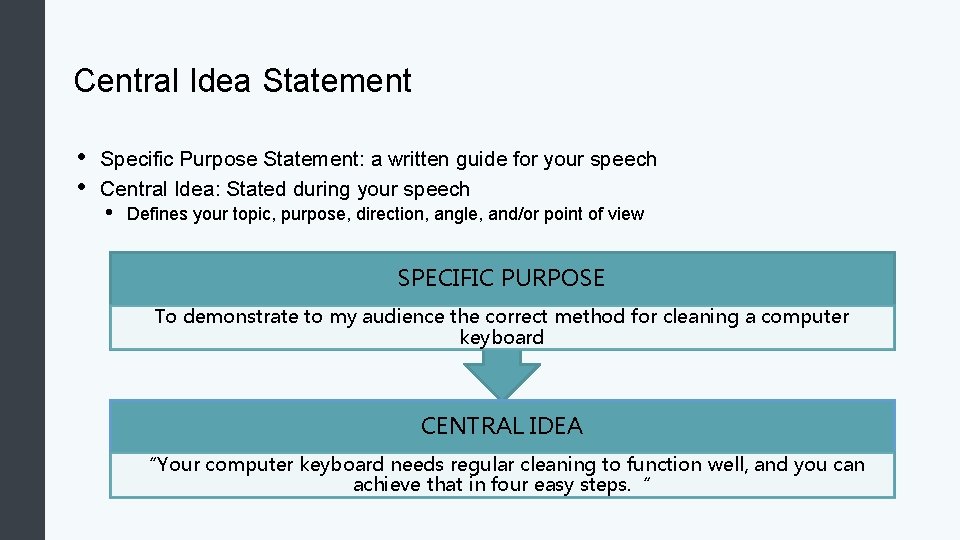
Central Idea Statement • • Specific Purpose Statement: a written guide for your speech Central Idea: Stated during your speech • Defines your topic, purpose, direction, angle, and/or point of view SPECIFIC PURPOSE To demonstrate to my audience the correct method for cleaning a computer keyboard CENTRAL IDEA “Your computer keyboard needs regular cleaning to function well, and you can achieve that in four easy steps. “
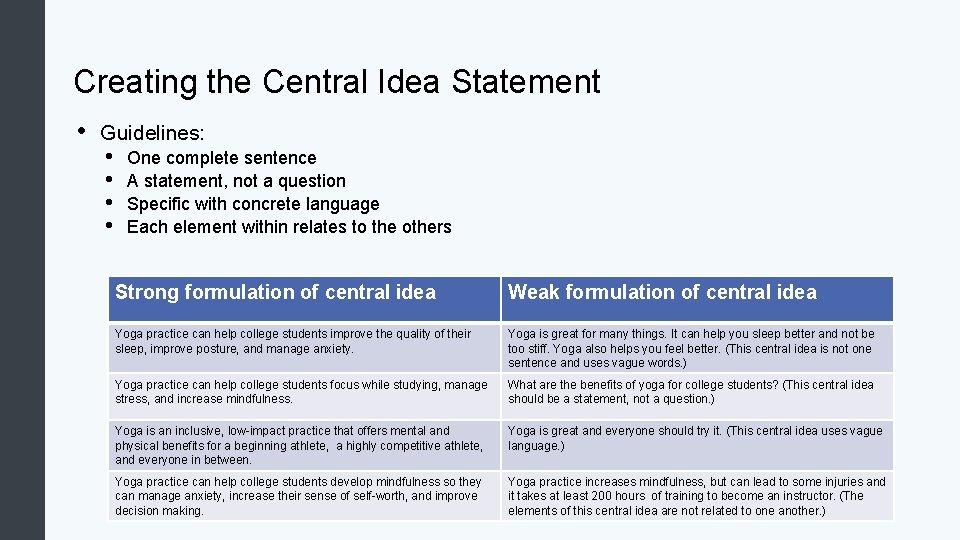
Creating the Central Idea Statement • Guidelines: • • One complete sentence A statement, not a question Specific with concrete language Each element within relates to the others Strong formulation of central idea Weak formulation of central idea Yoga practice can help college students improve the quality of their sleep, improve posture, and manage anxiety. Yoga is great for many things. It can help you sleep better and not be too stiff. Yoga also helps you feel better. (This central idea is not one sentence and uses vague words. ) Yoga practice can help college students focus while studying, manage stress, and increase mindfulness. What are the benefits of yoga for college students? (This central idea should be a statement, not a question. ) Yoga is an inclusive, low-impact practice that offers mental and physical benefits for a beginning athlete, a highly competitive athlete, and everyone in between. Yoga is great and everyone should try it. (This central idea uses vague language. ) Yoga practice can help college students develop mindfulness so they can manage anxiety, increase their sense of self-worth, and improve decision making. Yoga practice increases mindfulness, but can lead to some injuries and it takes at least 200 hours of training to become an instructor. (The elements of this central idea are not related to one another. )
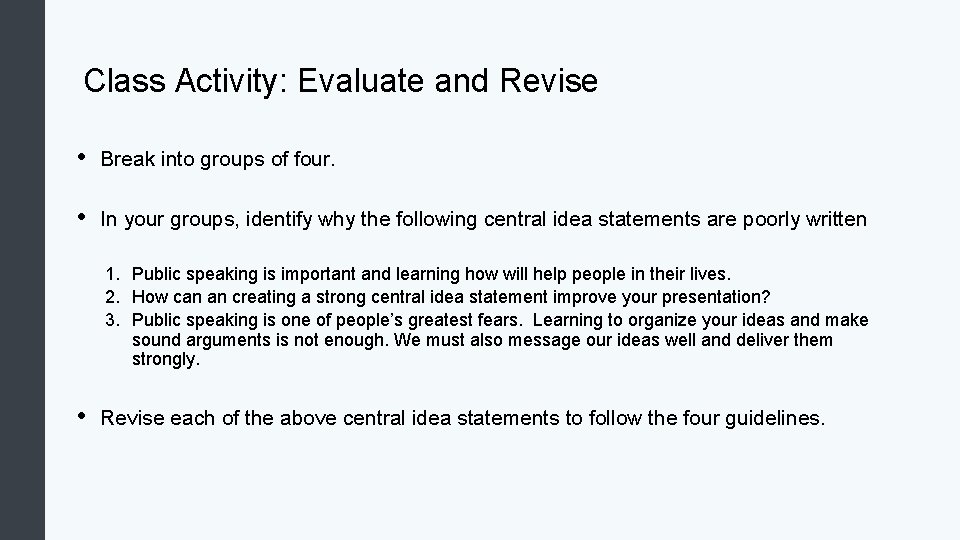
Class Activity: Evaluate and Revise • Break into groups of four. • In your groups, identify why the following central idea statements are poorly written 1. Public speaking is important and learning how will help people in their lives. 2. How can an creating a strong central idea statement improve your presentation? 3. Public speaking is one of people’s greatest fears. Learning to organize your ideas and make sound arguments is not enough. We must also message our ideas well and deliver them strongly. • Revise each of the above central idea statements to follow the four guidelines.
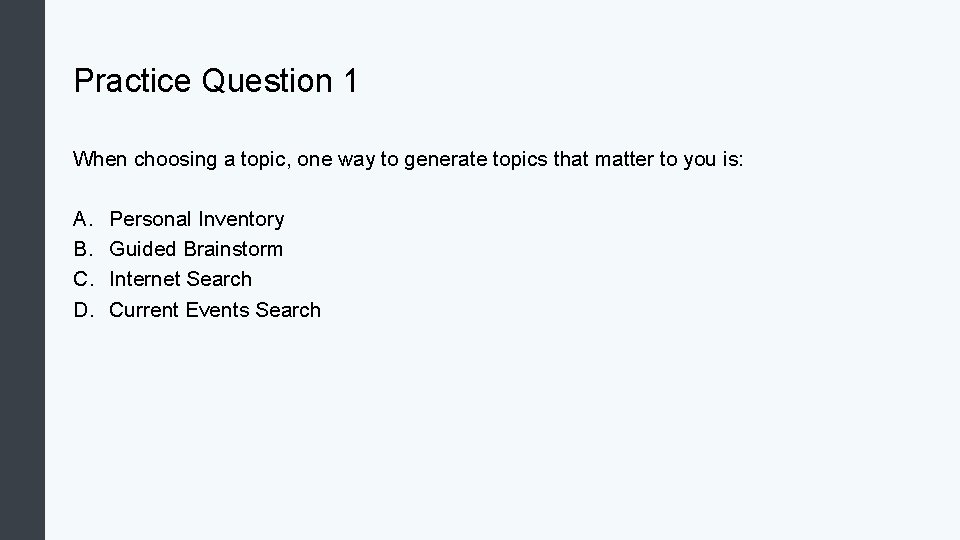
Practice Question 1 When choosing a topic, one way to generate topics that matter to you is: A. B. C. D. Personal Inventory Guided Brainstorm Internet Search Current Events Search
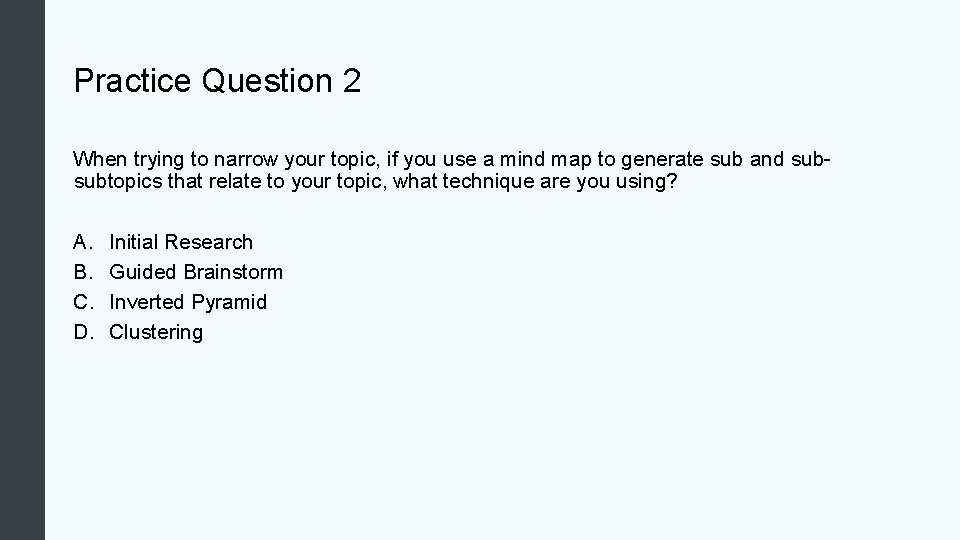
Practice Question 2 When trying to narrow your topic, if you use a mind map to generate sub and subsubtopics that relate to your topic, what technique are you using? A. B. C. D. Initial Research Guided Brainstorm Inverted Pyramid Clustering
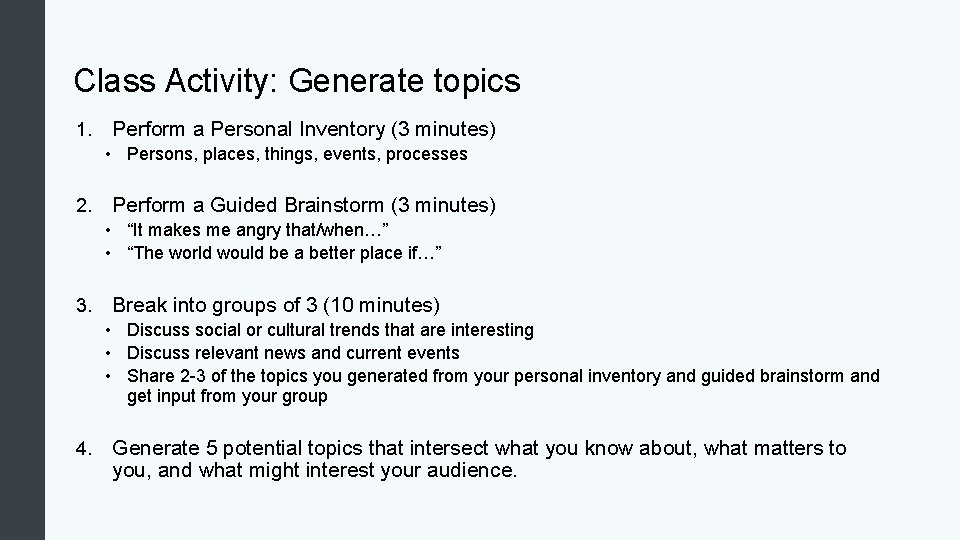
Class Activity: Generate topics 1. Perform a Personal Inventory (3 minutes) • Persons, places, things, events, processes 2. Perform a Guided Brainstorm (3 minutes) • “It makes me angry that/when…” • “The world would be a better place if…” 3. Break into groups of 3 (10 minutes) • Discuss social or cultural trends that are interesting • Discuss relevant news and current events • Share 2 -3 of the topics you generated from your personal inventory and guided brainstorm and get input from your group 4. Generate 5 potential topics that intersect what you know about, what matters to you, and what might interest your audience.
Researching your speech
Learning Outcomes: Researching your speech 5. 2: Identify strategies for researching and supporting a speech 5. 2. 1: Explain the uses of different types of supporting materials 5. 2. 2: Identify the different locations to find support for your speech 5. 2. 3: Assess the quality of supporting material 5. 2. 4: Explain how to take notes
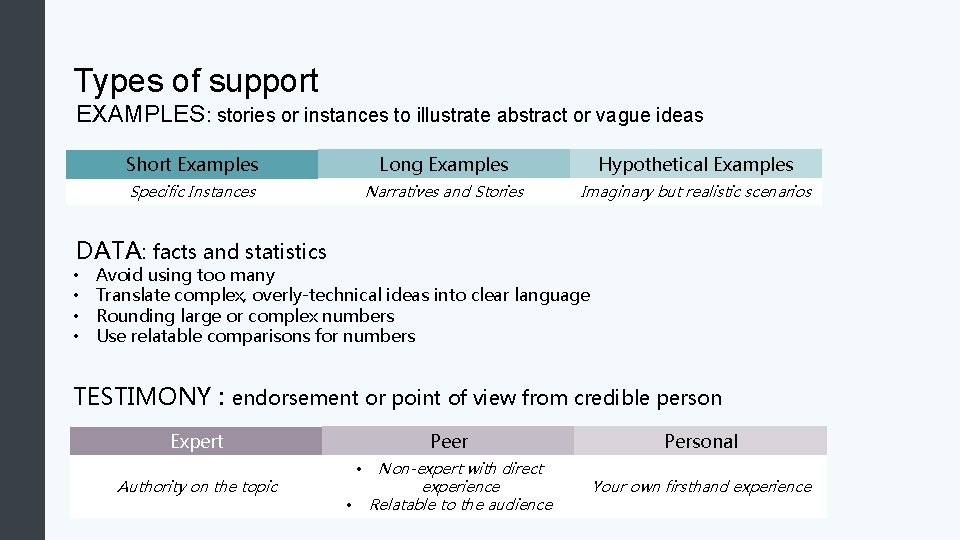
Types of support EXAMPLES: stories or instances to illustrate abstract or vague ideas Short Examples Long Examples Hypothetical Examples Specific Instances Narratives and Stories Imaginary but realistic scenarios DATA: facts and statistics • • Avoid using too many Translate complex, overly-technical ideas into clear language Rounding large or complex numbers Use relatable comparisons for numbers TESTIMONY : endorsement or point of view from credible person Peer Expert Authority on the topic • • Non-expert with direct experience Relatable to the audience Personal Your own firsthand experience
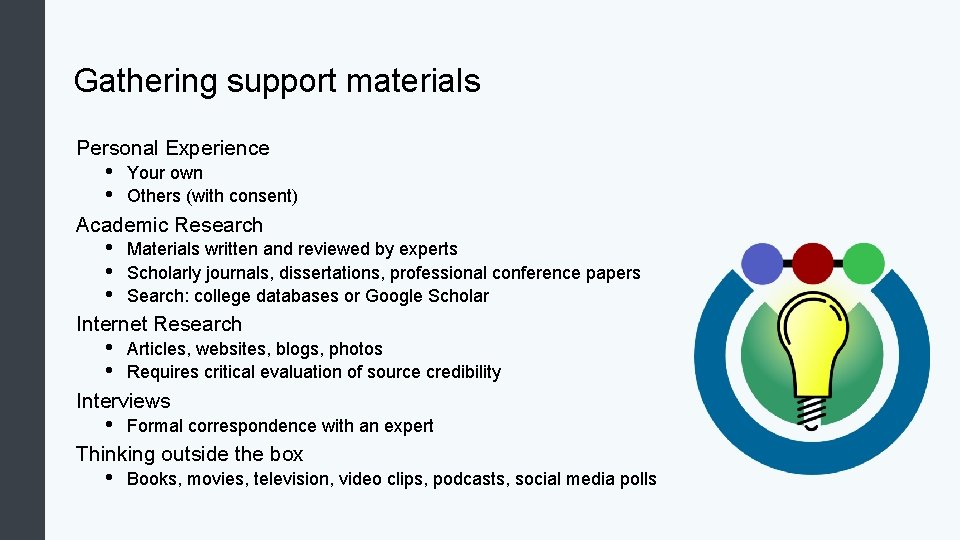
Gathering support materials Personal Experience • • Your own Others (with consent) Academic Research • • • Materials written and reviewed by experts Scholarly journals, dissertations, professional conference papers Search: college databases or Google Scholar Internet Research • • Articles, websites, blogs, photos Requires critical evaluation of source credibility Interviews • Formal correspondence with an expert Thinking outside the box • Books, movies, television, video clips, podcasts, social media polls
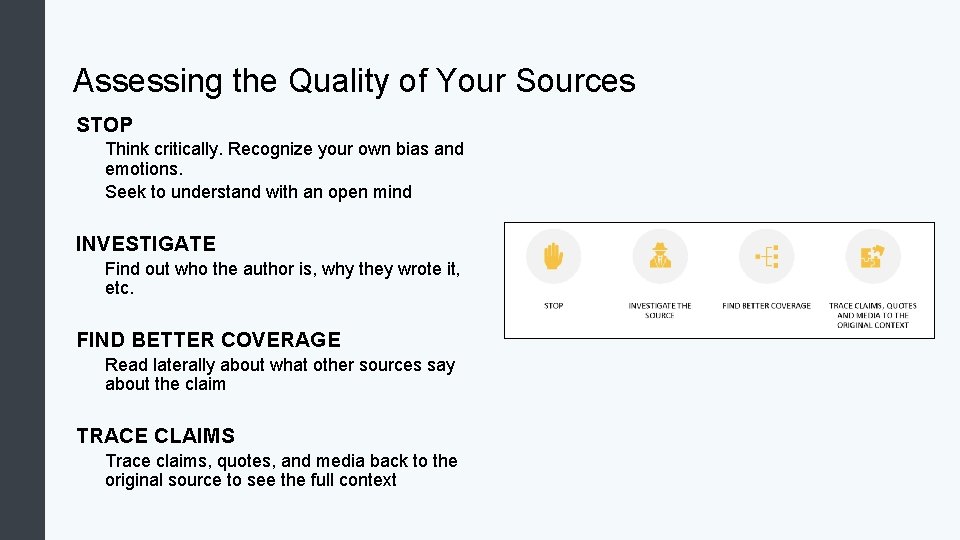
Assessing the Quality of Your Sources STOP Think critically. Recognize your own bias and emotions. Seek to understand with an open mind INVESTIGATE Find out who the author is, why they wrote it, etc. FIND BETTER COVERAGE Read laterally about what other sources say about the claim TRACE CLAIMS Trace claims, quotes, and media back to the original source to see the full context
Taking Notes Take lots of notes • • • Details of what it is and citation information Messages to yourself about where and how to use it Even if you’re not sure you’ll use the source Use a system • • • Maintain consistent formatting Format: Actual notes, source, where to put in speech Label the subject of the note Separate Entries • Each note is a separate entry, even from the same source Label Clearly • • Identify whether you are quoting, paraphrasing, or summarizing Source information
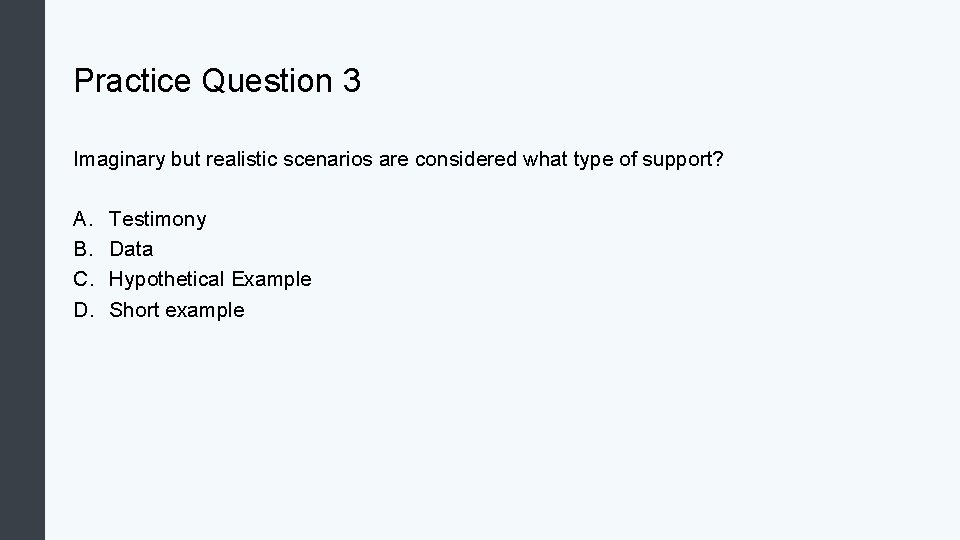
Practice Question 3 Imaginary but realistic scenarios are considered what type of support? A. B. C. D. Testimony Data Hypothetical Example Short example
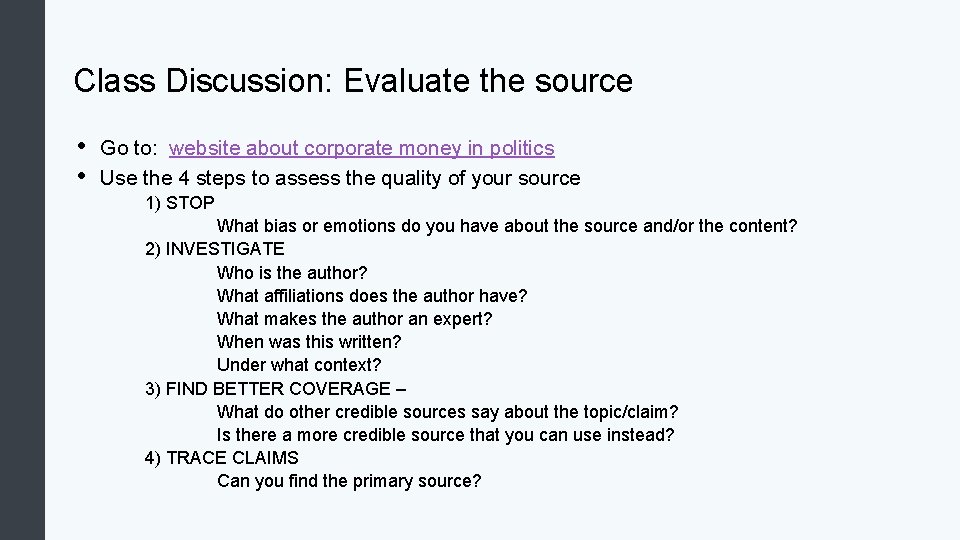
Class Discussion: Evaluate the source • • Go to: website about corporate money in politics Use the 4 steps to assess the quality of your source 1) STOP What bias or emotions do you have about the source and/or the content? 2) INVESTIGATE Who is the author? What affiliations does the author have? What makes the author an expert? When was this written? Under what context? 3) FIND BETTER COVERAGE – What do other credible sources say about the topic/claim? Is there a more credible source that you can use instead? 4) TRACE CLAIMS Can you find the primary source?
Using statistics and data
Learning Outcomes: Using statistics and data 5. 3: Explain key concepts for using statistics and data in your speech 5. 3. 1: Recognize key statistical terms and concepts 5. 3. 2: Recognize how statistics are used (or misused) to tell a story 5. 3. 3: Explain how to use statistics and data in your speech
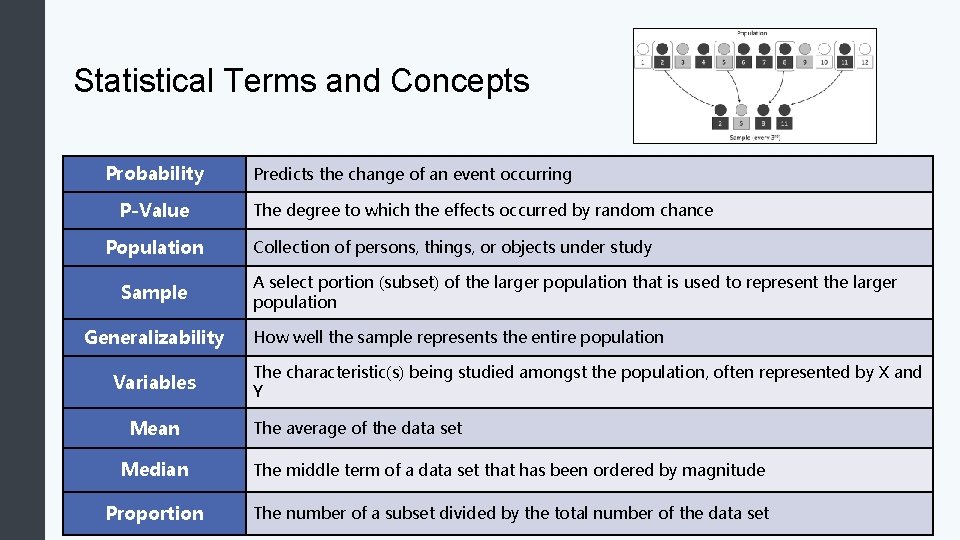
Statistical Terms and Concepts Probability P-Value Population Sample Generalizability Variables Mean Predicts the change of an event occurring The degree to which the effects occurred by random chance Collection of persons, things, or objects under study A select portion (subset) of the larger population that is used to represent the larger population How well the sample represents the entire population The characteristic(s) being studied amongst the population, often represented by X and Y The average of the data set Median The middle term of a data set that has been ordered by magnitude Proportion The number of a subset divided by the total number of the data set
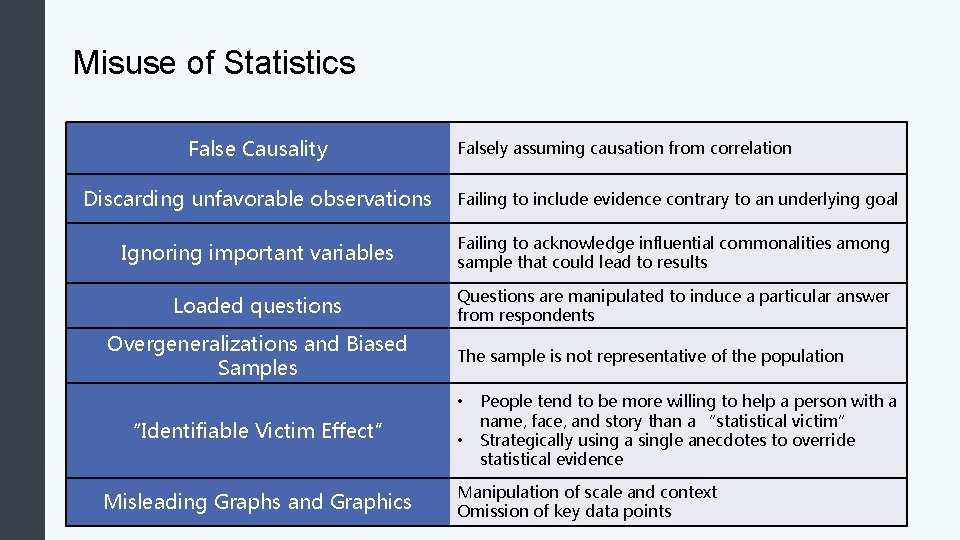
Misuse of Statistics False Causality Falsely assuming causation from correlation Discarding unfavorable observations Failing to include evidence contrary to an underlying goal Ignoring important variables Failing to acknowledge influential commonalities among sample that could lead to results Loaded questions Questions are manipulated to induce a particular answer from respondents Overgeneralizations and Biased Samples The sample is not representative of the population • “Identifiable Victim Effect” Misleading Graphs and Graphics • People tend to be more willing to help a person with a name, face, and story than a “statistical victim” Strategically using a single anecdotes to override statistical evidence Manipulation of scale and context Omission of key data points
Using Statistics and Data • Contextualize Statistics • • Translate numbers into a tangible representation Highlight the relationship the numbers describe Ex: 12% of people = at least 3 people in this class • Visualize statistical findings • Tables, Graphs, Maps • • Simplify them Include only necessary information Use clustering and patterns to highlight relationships Use colors to represent different variables
Practice Question 4 The Great Pacific garbage patch is about 1. 6 million square kilometers in size. How can this number be contextualized? A. B. C. D. Twice the size of Texas or three times the size of France 617, 763. 4537 square miles 620, 000 square miles Bigger than you can imagine
Practice Question 5 A study that found an increase in ice cream sales correlated with an increase in forest fires. Which finding is an example of ignoring important variables? A. Increased ice cream sales cause an increase in forest fires B. An increase in drowning accidents is also correlated with an increase in both ice cream sales and forest fires C. Strawberry ice cream has the highest rate of sale among flavors D. Both ice cream sales and forest fires increase in hotter weather
Quick Review • A good speech topic is something the speaker is knowledgeable about, important to the speaker, and interesting to the audience. • • It should be narrow enough that the central idea statement defines your topic, purpose, direction, angle, and point of view to the audience in one sentence A well supported speech uses a mixture of three main types of support throughout • Examples, Data, Testimony Support can be gathered from: • • • Personal experience Academic research Internet research Interviews Media Sources must be critically evaluated and used ethically
- Slides: 30