
Public Speaking Chapter 8 Outlining Your Speech Objectives
Public Speaking Chapter 8: Outlining Your Speech
Objectives l Upon completing this session, you will be able to: Develop a Working Outline l Develop a Formal Outline l Develop a key-Word Outline l The reasons for outlining are clear. Outlining objectifies your thinking: It takes ideas out of your head where they can get all tangled up … Osborn/ Osborne, 2003
Outlining Your Speech l Developing a Working Outline: A Tentative Plan for Your Speech. l l l It is not rigid but a work in progress It is a disposable tool Start with writing the foundation of your speech: l l Your specific purpose Your thesis statement
Outlining Your Speech l Developing a Working Outline l Developing Your Main Points l l List your main points (3 or 4 for class) Ask the following: l l l Will these make my message clear to the audience? Is this the right order in which to develop them? Have I left out anything important?
Outlining Your Speech l Developing a Working Outline l l Developing Your Main Points Developing Your Sub-points l l l More specific statements that support the main statement to which they belong Usually 2 or more per main point Should explain to the listener who’s thinking: l l What does it mean? Why should I care? How do I know it’s true? Will a speech based on this outline satisfy my thesis statement and in time allotted?
Outlining Your Speech l Developing a Working Outline l l l Developing Your Main Points Developing Your Sub-points Completing Your working Outline l Prepare an introduction that: l l Gains attention Establishes credibility Previews speech Review outline from audience P. O. V. l l l Main points arranged to ease understanding & recall? Enough Supporting Material? Variety of support for each main point?
Outlining Your Speech l Developing a Formal Outline l The final step in planning the substance of your speech. l l Imposes discipline Indicates to instructor that your research and planning are complete.
Outlining Your Speech l Developing a Formal Outline l l l l Stating Topic-Specific Purpose and Thesis Separating the Speech Parts Numbering and Lettering Your Outline Wording Your Outline Supporting Your Main Points Deciding on a Title Changing a Working to a Formal Outline Listing Your references
Outlining Your Speech l Developing a Formal Outline l Stating Topic-Specific Purpose and Thesis l l Write out at top of outline Do not state exactly that way in your introduction
Outlining Your Speech l Developing a Formal Outline l l Stating Topic-Specific Purpose and Thesis Separating the Speech Parts l Separate Introduction, Body and Conclusion in the outline
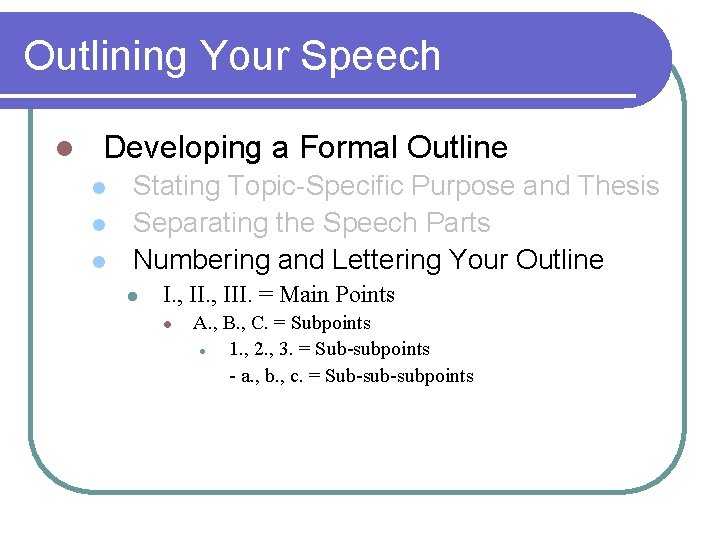
Outlining Your Speech l Developing a Formal Outline l l l Stating Topic-Specific Purpose and Thesis Separating the Speech Parts Numbering and Lettering Your Outline l I. , III. = Main Points l A. , B. , C. = Subpoints l 1. , 2. , 3. = Sub-subpoints - a. , b. , c. = Sub-subpoints
Outlining Your Speech l Developing a Formal Outline l l Stating Topic-Specific Purpose and Thesis Separating the Speech Parts Numbering and Lettering Your Outline Wording Your Outline l l l Simple declarative sentences No subordinate clauses (make subpoints) Use parallel construction
Outlining Your Speech l Developing a Formal Outline l l l Stating Topic-Specific Purpose and Thesis Separating the Speech Parts Numbering and Lettering Your Outline Wording Your Outline Supporting Your Main Points l l Include sources, statements of fact, quotes Use what is required to prove the point
Outlining Your Speech l Developing a Formal Outline l l l Stating Topic-Specific Purpose and Thesis Separating the Speech Parts Numbering and Lettering Your Outline Wording Your Outline Supporting Your Main Points Deciding on a Title l l Not key in classroom speeches. Select after outline is complete
Outlining Your Speech l Developing a Formal Outline l l l l Stating Topic-Specific Purpose and Thesis Separating the Speech Parts Numbering and Lettering Your Outline Wording Your Outline Supporting Your Main Points Deciding on a Title Changing a Working to a Formal Outline l Use proper numbering system, full sentences and source citations
Outlining Your Speech l Developing a Formal Outline l l l l Stating Topic-Specific Purpose and Thesis Separating the Speech Parts Numbering and Lettering Your Outline Wording Your Outline Supporting Your Main Points Deciding on a Title Changing a Working to a Formal Outline Listing Your references l Works Cited and Works Consulted section
Outlining Your Speech l Developing a Key-Word Outline l l l Fit on a few sheets of paper or index cards Number the pages/cards 14 pt Type or larger and Bold Text Follow same lettering/numbering format Include source citations to deliver orally l l l (Time, 1995) “Brief Quote Intact” or memorize Reduce number of key words via practice Use “stage directions” (Pause, Slow down, etc. ) in different color/style
Summary l Having completed this session, you are able to: Develop a Working Outline l Develop a Formal Outline l Develop a key-Word Outline l
- Slides: 18