
PUBLIC SERVICE COMMISSION STRATEGIC PLAN AND ANNUAL PERFORMANCE

PUBLIC SERVICE COMMISSION STRATEGIC PLAN AND ANNUAL PERFORMANCE PLAN 2020/21 Presentation to the Portfolio Committee on Public Service and Administration, Planning/Monitoring & Evaluation May 2020 1
PRESENTATION OUTLINE • Strategic Plan 2020/21 to 2024/25 • Annual Performance Plan for 2020/21 2
STRATEGIC PLAN 2020/21 to 2024/25 3

OUR MANDATE • The PSC is an independent institution established in terms of Chapter 10 of the Constitution. • It derives its mandate from Sections 195 and 196 of the Constitution, 1996, which set out the values and principles governing public administration, which should be promoted by the PSC, as well as the powers and functions of the PSC. • The PSC is required by the Constitution to exercise its powers and to perform its functions without fear, favour or prejudice. • The Constitution links the PSC’s independence firmly with its impartiality and no organ of state may interfere with the functioning of the PSC. • The PSC is accountable to the National Assembly and must annually report to the National Assembly on its activities and performance, and to Provincial Legislatures on its activities in a province. 4
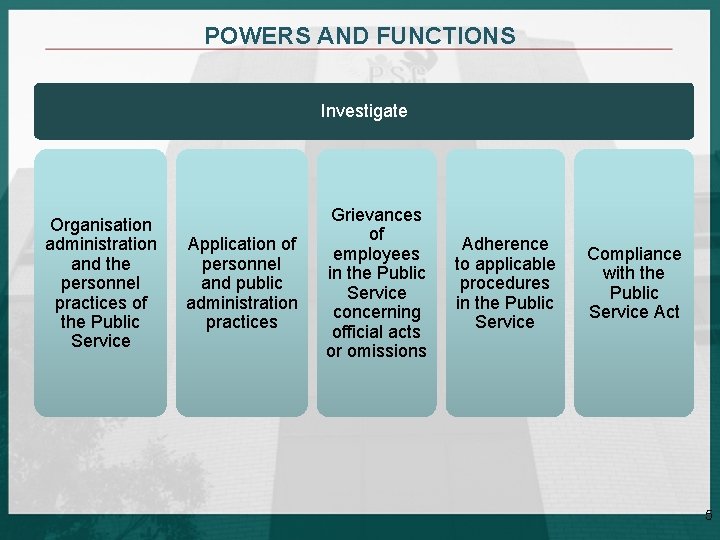
POWERS AND FUNCTIONS Investigate Organisation administration and the personnel practices of the Public Service Application of personnel and public administration practices Grievances of employees in the Public Service concerning official acts or omissions Adherence to applicable procedures in the Public Service Compliance with the Public Service Act 5
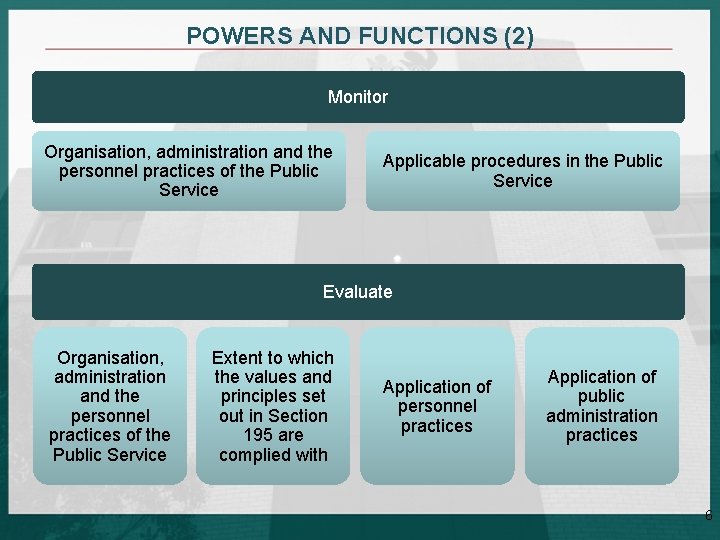
POWERS AND FUNCTIONS (2) Monitor Organisation, administration and the personnel practices of the Public Service Applicable procedures in the Public Service Evaluate Organisation, administration and the personnel practices of the Public Service Extent to which the values and principles set out in Section 195 are complied with Application of personnel practices Application of public administration practices 6
POWERS AND FUNCTIONS (3) Promote Values and principles, as set out in Sections 1 and 195 throughout the public service Ethical conduct amongst members of the SMS and to supplement the Code of Conduct and the Financial Disclosure Framework Propose measures Ensure effective and efficient performance within the Public Service 7
POWERS AND FUNCTIONS (4) Advise Regarding personnel practices in the public service, including those relating to the recruitment, appointment, transfer, discharge and other aspects of the careers of employees in the Public Service The MPSA on issuing directives to promote ethical conduct amongst members of the SMS and to supplement the Code of Conduct and the Financial Disclosure Framework Recommend Appropriate remedies regarding the resolution of grievances of employees in the public service That EAs act in terms of a particular provision(s) of the Public Service Act or any other law in resolving a particular grievance. 8
POWERS AND FUNCTIONS (5) Give directions Aimed at ensuring that personnel procedures relating to recruitment, transfers, promotions and dismissals comply with the CVPs Relating to personnel procedures - to ensure compliance with the Public Service Act and in order to provide advice to promote sound public administration These directions are binding and should be implemented within 60 days Report On its activities and the performance of its functions Evaluation of the extent to which the CVPs are complied with To the relevant EA and legislature on its investigations and evaluation of the application of personnel and public administration practices 9
STRATEGIES OVER THE FIVE YEAR PLANNING PERIOD • A NDP 5 -year Implementation Plan and a more focused Medium Term Strategic Framework have been developed by the Presidency which consists of 7 Priorities • Although the PSC can play a role in most of these priorities, the initiatives in Priority 6: A capable, ethical and developmental state, find very specific application to the mandate of the PSC, and involves the following, among other things: ü 80% case resolution of cases from the National Anti-Corruption Hotline ü 100% compliance to e-disclosure of financial interests. ü Strengthening the oversight role of Parliament and provincial legislatures. ü Managing performance of Executive Authorities and Heads of Departments, and provide necessary capacity building around the management of the political-administrative interface. ü Adopting and implementing six strategic pillars of the National Anti-Corruption Strategy. 10

INSTITUTIONAL POLICIES • • Governance Rules of the PSC These Rules, inter alia, define the powers and duties of commissioners; delegations and assignment of powers and duties; and the manner in which the meetings of the PSC must be convened. Rules for the summonsing of witnesses in connection with inquiries and investigations of the Public Service Commission, The Rules provide for the process that should be followed when a person is summonsed to appear before an inquiry of the PSC. Rules on Referral and Investigation of Grievances of Employees in Public Service These Rules provide for the procedures and service standards in the investigation of grievances by the PSC, timeframes within which grievances may be referred to or lodged with the PSC and mechanisms of monitoring grievance management by departments. PSC Rules on Conducting Investigations The Rules describe the matters that may be investigated and evaluated by the PSC, those matters that will not be investigated, the procedure to be followed before lodging a complaint with the PSC and the information 11 required when lodging a complaint with the PSC.
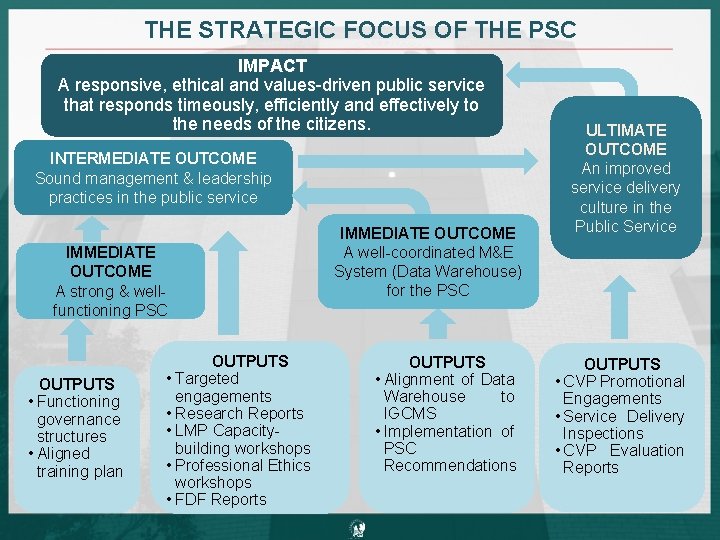
THE STRATEGIC FOCUS OF THE PSC IMPACT A responsive, ethical and values-driven public service that responds timeously, efficiently and effectively to the needs of the citizens. INTERMEDIATE OUTCOME Sound management & leadership practices in the public service IMMEDIATE OUTCOME A strong & wellfunctioning PSC OUTPUTS • Functioning governance structures • Aligned training plan OUTPUTS • Targeted engagements • Research Reports • LMP Capacitybuilding workshops • Professional Ethics workshops • FDF Reports IMMEDIATE OUTCOME A well-coordinated M&E System (Data Warehouse) for the PSC OUTPUTS • Alignment of Data Warehouse to IGCMS • Implementation of PSC Recommendations ULTIMATE OUTCOME An improved service delivery culture in the Public Service OUTPUTS • CVP Promotional Engagements • Service Delivery Inspections • CVP Evaluation Reports 12
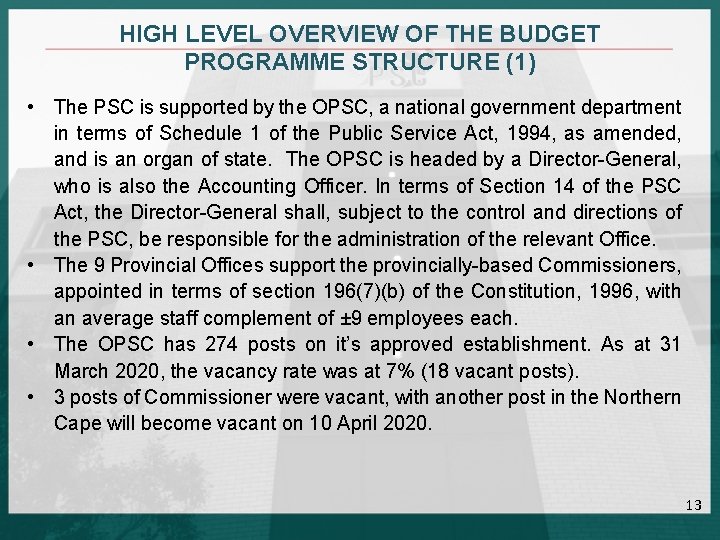
HIGH LEVEL OVERVIEW OF THE BUDGET PROGRAMME STRUCTURE (1) • The PSC is supported by the OPSC, a national government department in terms of Schedule 1 of the Public Service Act, 1994, as amended, and is an organ of state. The OPSC is headed by a Director-General, who is also the Accounting Officer. In terms of Section 14 of the PSC Act, the Director-General shall, subject to the control and directions of the PSC, be responsible for the administration of the relevant Office. • The 9 Provincial Offices support the provincially-based Commissioners, appointed in terms of section 196(7)(b) of the Constitution, 1996, with an average staff complement of ± 9 employees each. • The OPSC has 274 posts on it’s approved establishment. As at 31 March 2020, the vacancy rate was at 7% (18 vacant posts). • 3 posts of Commissioner were vacant, with another post in the Northern Cape will become vacant on 10 April 2020. 13
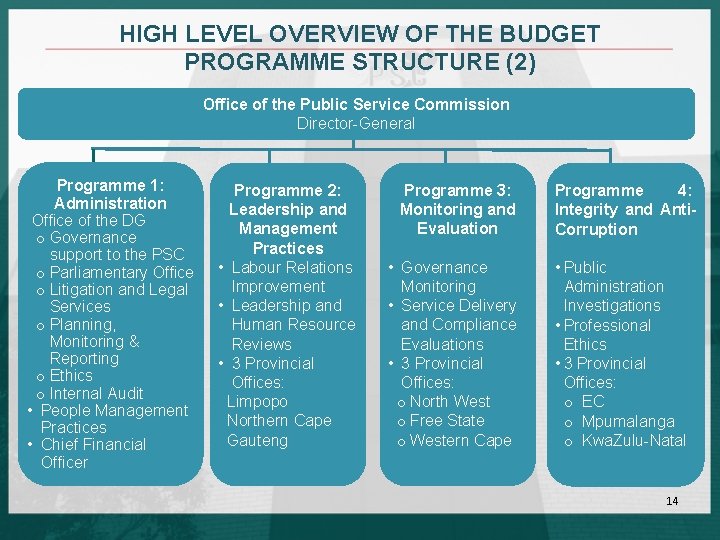
HIGH LEVEL OVERVIEW OF THE BUDGET PROGRAMME STRUCTURE (2) Office of the Public Service Commission Director-General Programme 1: Administration Office of the DG o Governance support to the PSC o Parliamentary Office o Litigation and Legal Services o Planning, Monitoring & Reporting o Ethics o Internal Audit • People Management Practices • Chief Financial Officer Programme 2: Leadership and Management Practices • Labour Relations Improvement • Leadership and Human Resource Reviews • 3 Provincial Offices: Limpopo Northern Cape Gauteng Programme 3: Monitoring and Evaluation • Governance Monitoring • Service Delivery and Compliance Evaluations • 3 Provincial Offices: o North West o Free State o Western Cape Programme 4: Integrity and Anti. Corruption • Public Administration Investigations • Professional Ethics • 3 Provincial Offices: o EC o Mpumalanga o Kwa. Zulu-Natal 14
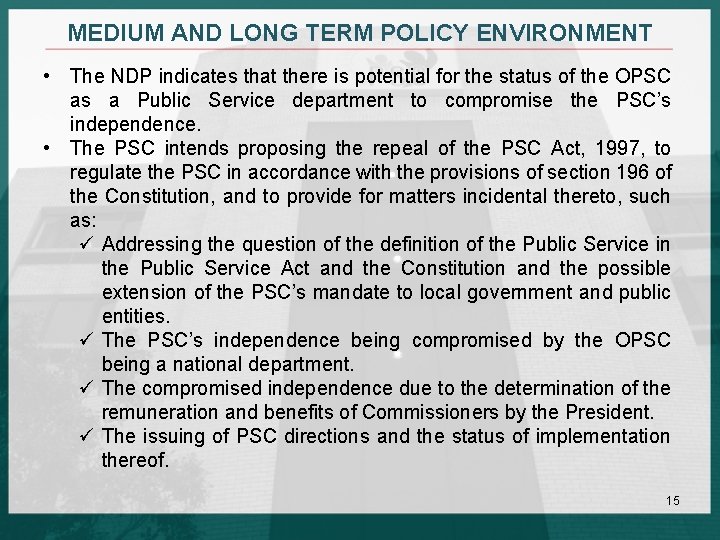
MEDIUM AND LONG TERM POLICY ENVIRONMENT • The NDP indicates that there is potential for the status of the OPSC as a Public Service department to compromise the PSC’s independence. • The PSC intends proposing the repeal of the PSC Act, 1997, to regulate the PSC in accordance with the provisions of section 196 of the Constitution, and to provide for matters incidental thereto, such as: ü Addressing the question of the definition of the Public Service in the Public Service Act and the Constitution and the possible extension of the PSC’s mandate to local government and public entities. ü The PSC’s independence being compromised by the OPSC being a national department. ü The compromised independence due to the determination of the remuneration and benefits of Commissioners by the President. ü The issuing of PSC directions and the status of implementation thereof. 15
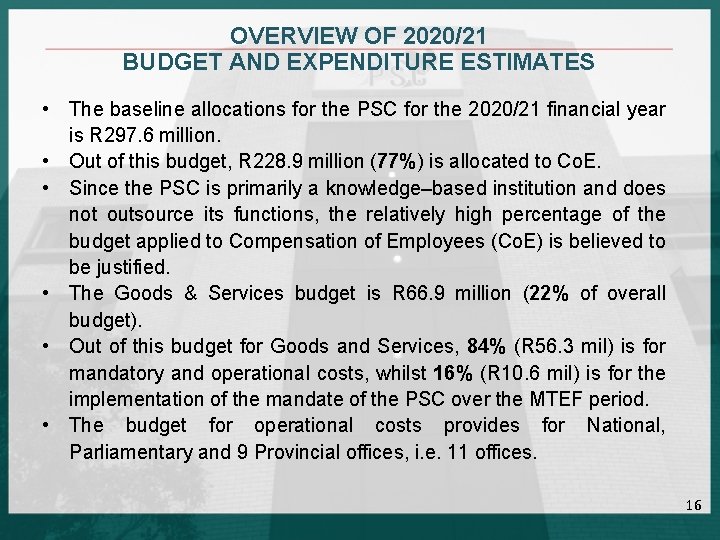
OVERVIEW OF 2020/21 BUDGET AND EXPENDITURE ESTIMATES • The baseline allocations for the PSC for the 2020/21 financial year is R 297. 6 million. • Out of this budget, R 228. 9 million (77%) is allocated to Co. E. • Since the PSC is primarily a knowledge–based institution and does not outsource its functions, the relatively high percentage of the budget applied to Compensation of Employees (Co. E) is believed to be justified. • The Goods & Services budget is R 66. 9 million (22% of overall budget). • Out of this budget for Goods and Services, 84% (R 56. 3 mil) is for mandatory and operational costs, whilst 16% (R 10. 6 mil) is for the implementation of the mandate of the PSC over the MTEF period. • The budget for operational costs provides for National, Parliamentary and 9 Provincial offices, i. e. 11 offices. 16
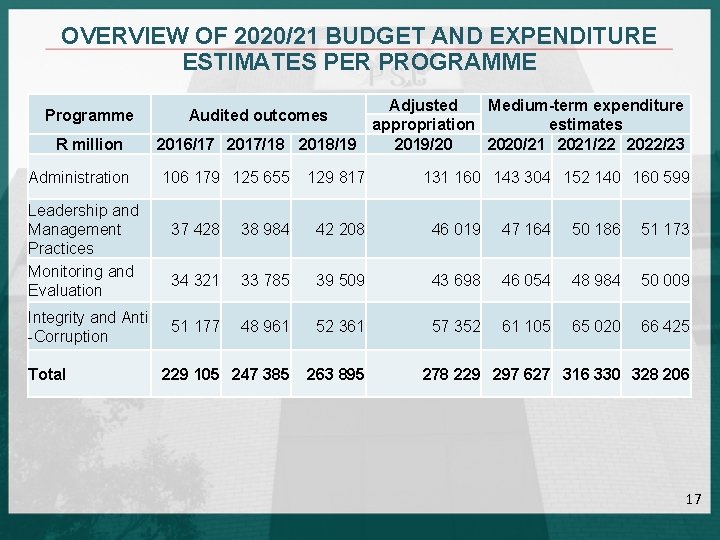
OVERVIEW OF 2020/21 BUDGET AND EXPENDITURE ESTIMATES PER PROGRAMME Programme R million Administration Leadership and Management Practices Monitoring and Evaluation Integrity and Anti -Corruption Total Adjusted Medium-term expenditure estimates appropriation 2016/17 2017/18 2018/19 2019/20 2020/21 2021/22 2022/23 Audited outcomes 106 179 125 655 129 817 131 160 143 304 152 140 160 599 37 428 38 984 42 208 46 019 47 164 50 186 51 173 34 321 33 785 39 509 43 698 46 054 48 984 50 009 51 177 48 961 52 361 57 352 61 105 65 020 66 425 229 105 247 385 263 895 278 229 297 627 316 330 328 206 17
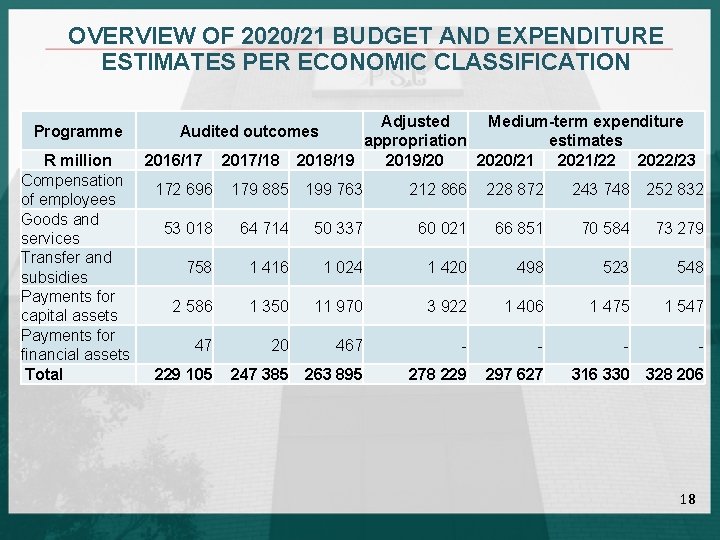
OVERVIEW OF 2020/21 BUDGET AND EXPENDITURE ESTIMATES PER ECONOMIC CLASSIFICATION Programme Adjusted Medium-term expenditure appropriation estimates 2018/19 2019/20 2020/21 2021/22 2022/23 Audited outcomes R million 2016/17 2017/18 Compensation 172 696 179 885 199 763 of employees Goods and 53 018 64 714 50 337 services Transfer and 758 1 416 1 024 subsidies Payments for 2 586 1 350 11 970 capital assets Payments for 47 20 467 financial assets Total 229 105 247 385 263 895 212 866 228 872 243 748 252 832 60 021 66 851 70 584 73 279 1 420 498 523 548 3 922 1 406 1 475 1 547 - - 278 229 297 627 316 330 328 206 18
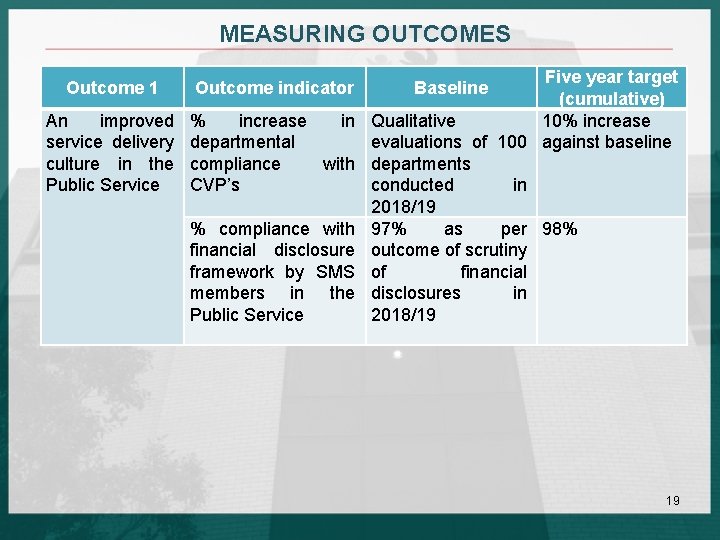
MEASURING OUTCOMES Outcome 1 Outcome indicator An improved service delivery culture in the Public Service % increase in departmental compliance with CVP’s % compliance with financial disclosure framework by SMS members in the Public Service Five year target (cumulative) Qualitative 10% increase evaluations of 100 against baseline departments conducted in 2018/19 97% as per 98% outcome of scrutiny of financial disclosures in 2018/19 Baseline 19
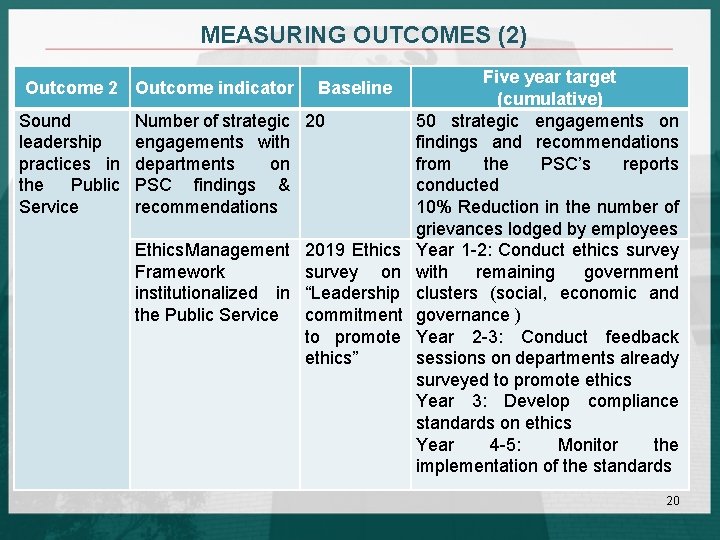
MEASURING OUTCOMES (2) Outcome 2 Outcome indicator Sound leadership practices in the Public Service Baseline Number of strategic 20 engagements with departments on PSC findings & recommendations Ethics Management Framework institutionalized in the Public Service 2019 Ethics survey on “Leadership commitment to promote ethics” Five year target (cumulative) 50 strategic engagements on findings and recommendations from the PSC’s reports conducted 10% Reduction in the number of grievances lodged by employees Year 1 -2: Conduct ethics survey with remaining government clusters (social, economic and governance ) Year 2 -3: Conduct feedback sessions on departments already surveyed to promote ethics Year 3: Develop compliance standards on ethics Year 4 -5: Monitor the implementation of the standards 20
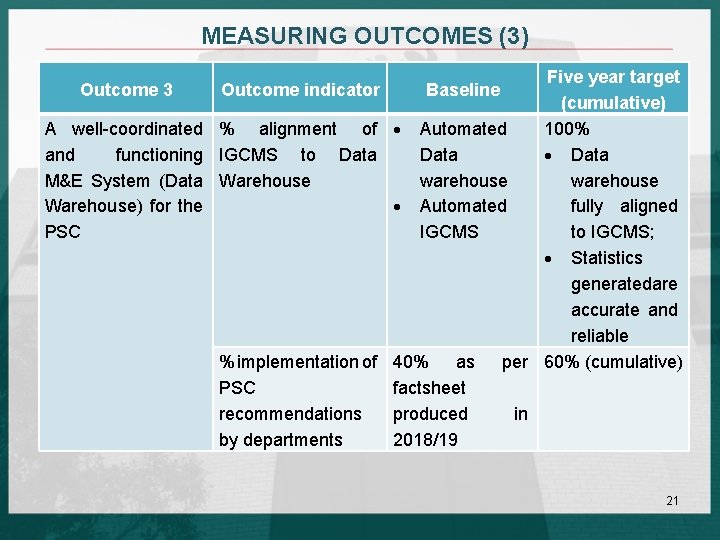
MEASURING OUTCOMES (3) Outcome 3 A well-coordinated and functioning M&E System (Data Warehouse) for the PSC Five year target (cumulative) % alignment of Automated 100% IGCMS to Data Warehouse warehouse Automated fully aligned IGCMS to IGCMS; Statistics generated are accurate and reliable % implementation of 40% as per 60% (cumulative) PSC factsheet recommendations produced in by departments 2018/19 Outcome indicator Baseline 21
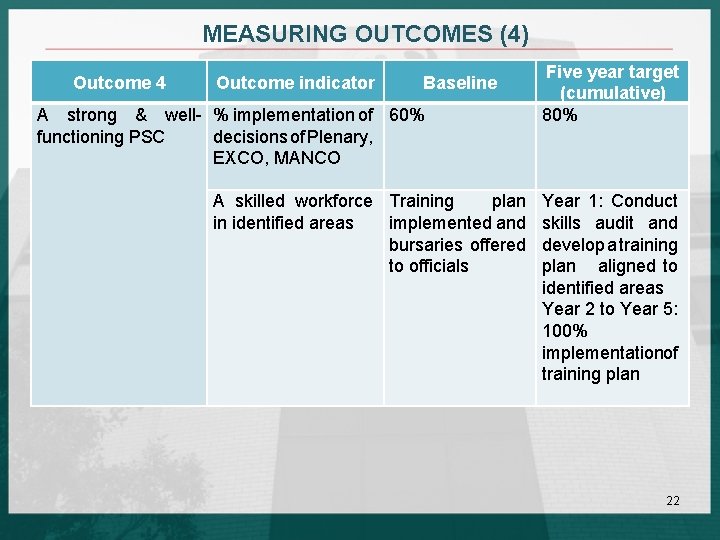
MEASURING OUTCOMES (4) Outcome 4 Outcome indicator Baseline A strong & well- % implementation of 60% functioning PSC decisions of Plenary, EXCO, MANCO A skilled workforce Training plan in identified areas implemented and bursaries offered to officials Five year target (cumulative) 80% Year 1: Conduct skills audit and develop a training plan aligned to identified areas Year 2 to Year 5: 100% implementationof training plan 22
ANNUAL PERFORMANCE PLAN 2020/21 23
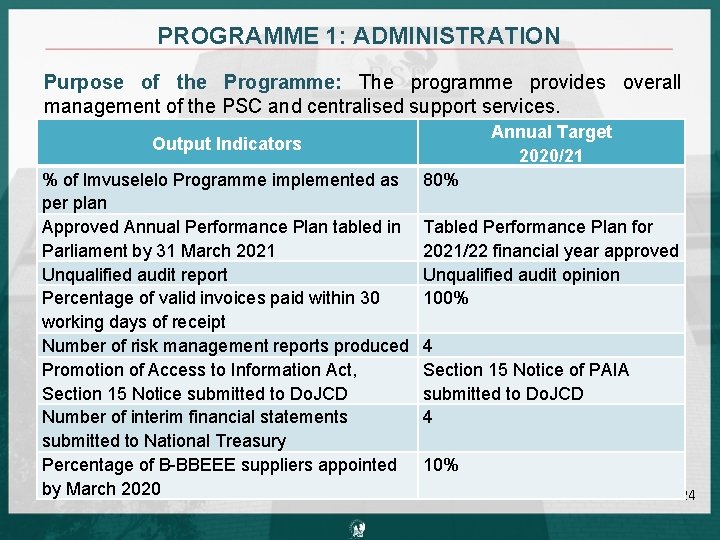
PROGRAMME 1: ADMINISTRATION Purpose of the Programme: The programme provides overall management of the PSC and centralised support services. Annual Target 2020/21 Output Indicators % of Imvuselelo Programme implemented as per plan Approved Annual Performance Plan tabled in Parliament by 31 March 2021 Unqualified audit report Percentage of valid invoices paid within 30 working days of receipt Number of risk management reports produced Promotion of Access to Information Act, Section 15 Notice submitted to Do. JCD Number of interim financial statements submitted to National Treasury Percentage of B-BBEEE suppliers appointed by March 2020 80% Tabled Performance Plan for 2021/22 financial year approved Unqualified audit opinion 100% 4 Section 15 Notice of PAIA submitted to Do. JCD 4 10% 24
PROGRAMME 2: LMP • Purpose of the Programme: The programme promotes sound Public Service leadership, human resource management, labour relations and labour practices. • Planned Performance Over the Medium Term Period ü The PSC will focus on professionalization of the public service through promoting meritocracy and ethical conduct in the areas of HRM and Leadership practices. ü Effective HRM and Leadership practices would contribute towards sound labour relations, employee productivity and organizational performance. ü The PSC’s contribution will be facilitated through research, monitoring and capacity development on key topical issues relating to, among others, ethical practice in the recruitment process, effective discipline management, the strategic repositioning of HR in departments as well as the effective management of continuous employee development. 25
PROGRAMME 2: LMP (2) ü The PSC’s focus will be on capacitating departments, inclusive of the employees, through advocacy sessions, strategic engagements and workshops, with the aim of enhancing employee skills and the overall capabilities of departments to actively address their operational and strategic challenges in order to facilitate service. ü Furthermore, the PSC will support the establishments of the administrative Head of the Public Service as this is an essential step in professionalizing the Public Service and managing the career incidents of HODs and other senior management service members. 26
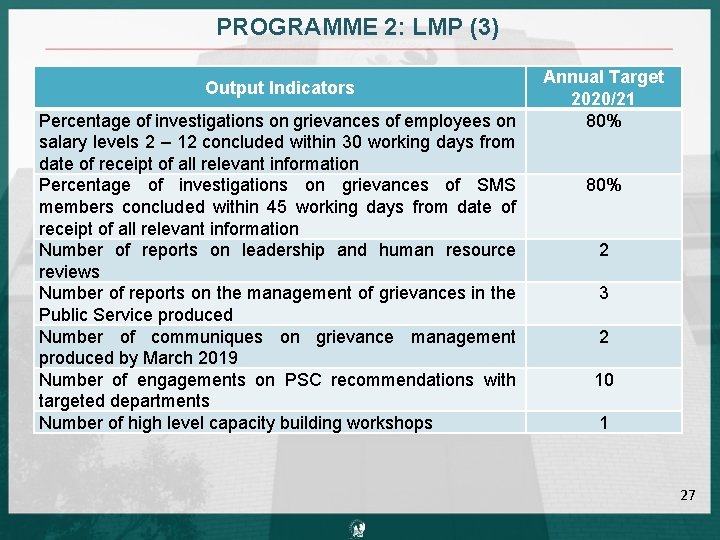
PROGRAMME 2: LMP (3) Output Indicators Percentage of investigations on grievances of employees on salary levels 2 – 12 concluded within 30 working days from date of receipt of all relevant information Percentage of investigations on grievances of SMS members concluded within 45 working days from date of receipt of all relevant information Number of reports on leadership and human resource reviews Number of reports on the management of grievances in the Public Service produced Number of communiques on grievance management produced by March 2019 Number of engagements on PSC recommendations with targeted departments Number of high level capacity building workshops Annual Target 2020/21 80% 2 3 2 10 1 27
PROGRAMME 3: M&E • Purpose of the Programme: To improve the functionality of the Public Service through institutional and service delivery evaluations. • Planned Performance Over the Medium Term Period ü The PSC will monitor departmental compliance with the CVPs in order to ensure that the Public Service is responsive to the needs of the citizens. One of the mechanisms the PSC intends to use to measure the responsiveness of the Public Services through monitoring departmental performance against their respective service standards. ü The PSC’s work on building stronger institutions will be complemented by service delivery inspections, so that the institutions can also be evaluated from the perspective of the citizen and that solutions to real world service delivery problems can be developed. The service delivery inspections methodology has over the years proven to be a vital mechanism of steering departments into addressing emerging service delivery challenges in a swift manner and thus effectively responding to people’s needs. 28
PROGRAMME 3: M&E (2) ü Despite limited resource available, the PSC aims to continue with sector specific service delivery inspections for the next five financial years. The PSC certainly cannot discontinue these inspections and strong monitoring or oversight in sectors such as Education and Health. Therefore, the PSC will enhance its knowledge base through lessons learnt in the rollout of District Service Delivery Model (DSDM) by the Presidency as articulated by the President in the 2019 State of the Nation Address. ü The PSC will also develop solutions to public administration problems. Solutions would require that the PSC defines exactly the change in administrative practice that is required for the bureaucracy, with its multiple structures, systems, frameworks, processes and rules, to better conform to the public administration principles. A first project in this regard will be to develop an effective accountability framework for the public service. 29
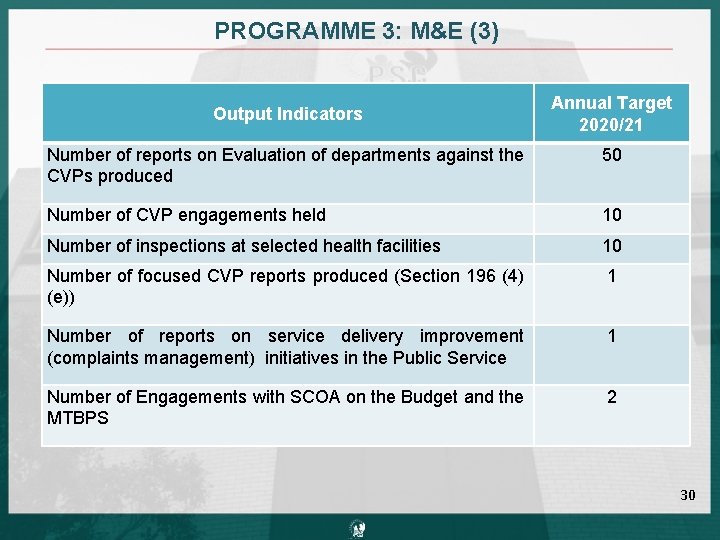
PROGRAMME 3: M&E (3) Output Indicators Annual Target 2020/21 Number of reports on Evaluation of departments against the CVPs produced 50 Number of CVP engagements held 10 Number of inspections at selected health facilities 10 Number of focused CVP reports produced (Section 196 (4) (e)) 1 Number of reports on service delivery improvement (complaints management) initiatives in the Public Service 1 Number of Engagements with SCOA on the Budget and the MTBPS 2 30
PROGRAMME 4: IAC • Purpose of the Programme: The programme is responsible for undertaking public administration investigations, promoting a high standard of professional ethical conduct amongst public servants and contributing to the prevention and combating of corruption. • Planned Performance Over the Medium Term Period ü It is believed that a responsive, ethical and values driven Public Service depends on, among other things, the investigative function of the PSC on public administration malpractices particularly in the areas of irregular appointments and curbing of corruption in government departments. ü The PSC will continue to conduct investigations on public administration practices, scrutinise compliance with the financial disclosure framework, manage the NACH and conduct investigative research on professional ethics, among other things. 31
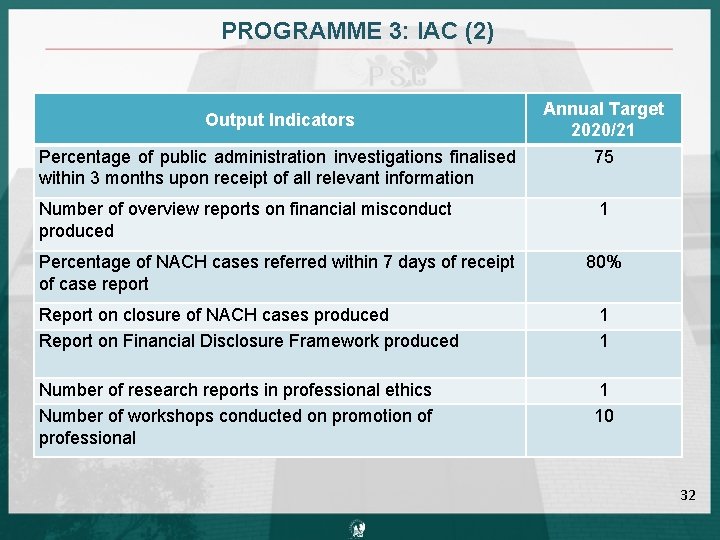
PROGRAMME 3: IAC (2) Output Indicators Percentage of public administration investigations finalised within 3 months upon receipt of all relevant information Number of overview reports on financial misconduct produced Percentage of NACH cases referred within 7 days of receipt of case report Annual Target 2020/21 75 1 80% Report on closure of NACH cases produced Report on Financial Disclosure Framework produced 1 1 Number of research reports in professional ethics Number of workshops conducted on promotion of professional 1 10 32

33
- Slides: 33