
Public Service Charter Implementation Presentation to Public Service
Public Service Charter Implementation Presentation to Public Service Portfolio Committee 18 February 2015 Leading the Public Service to Higher Productivity
2 Presentation Outline _______________ 1. 2. 3. 4. 5. 6. Definition of the Service Charter Objectives of the Charter Legislative Context Public Services What happened so far Consultation processes on the (consolidated) implementation of the Service Charter Accountability Implications 7. Next steps 8. Recommendations Leading the Public Service to Higher Productivity
3 Definition of the Charter ___________________ • The Service Charter is an accord between the State as Employer and the public service unions represented in the PSCBC • A social contract, pledge, commitment/covenant between the State and public servants; • Sets out roles and responsibilities of parties; • Enables service beneficiaries to understand what they can expect from the State; and • Will form basis of engagement between government and citizens. Leading the Public Service to Higher Productivity
4 Articles in the Charter ___________________ • • Purpose of the Charter Articles in the Charter are; Where the partners to the Charter are found; List of services offered by the State; Service standards; Commitments by the State as Employer; and Commitments by public servants. Leading the Public Service to Higher Productivity
5 Objectives of the Charter • Improve service delivery programmes; • Reinforce the partners’ commitment to service delivery improvement for the benefit of all citizens; • Professionalise and encourage excellence in the public service; • Enhance performance; • Strengthen processes and initiatives that prevent and combat corruption; • Facilitate social dialogue among the partners; • Help government departments rise to the challenge of treating citizens with dignity and expectations meeting their demands equitably and fairly; and • Improve service delivery programmes and enhance productivity; • Facilitate social dialogue and strengthen the social partnership; • Encourage citizen participation in the delivery of public services; Leading the Public Service to Higher Productivity
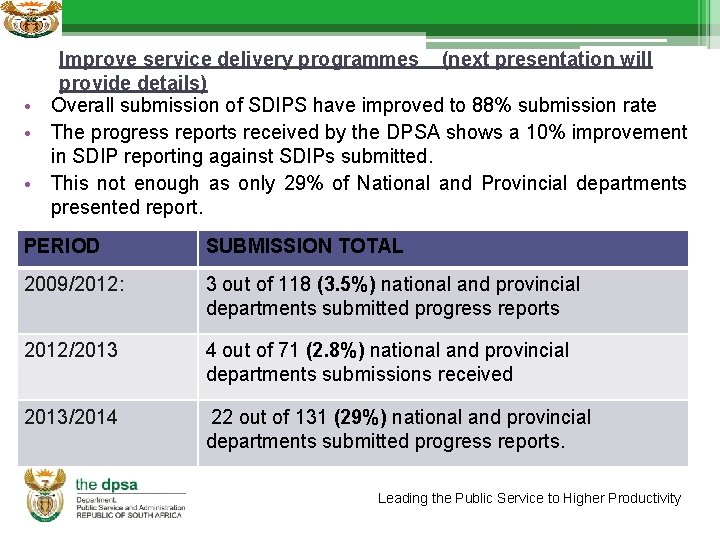
Improve service delivery programmes (next presentation will provide details) • Overall submission of SDIPS have improved to 88% submission rate • The progress reports received by the DPSA shows a 10% improvement in SDIP reporting against SDIPs submitted. • This not enough as only 29% of National and Provincial departments presented report. PERIOD SUBMISSION TOTAL 2009/2012: 3 out of 118 (3. 5%) national and provincial departments submitted progress reports 2012/2013 4 out of 71 (2. 8%) national and provincial departments submissions received 2013/2014 22 out of 131 (29%) national and provincial departments submitted progress reports. Leading the Public Service to Higher Productivity
Improve service delivery programmes Provincial Service Delivery Programmes/Initiatives • Integrated service delivery initiatives ▫ OSS, Setsokotsane, Ntirisano, Halasela ▫ National Provincial. Thusong Service Centres (Concept of Maponya Mall) ▫ Municial Level Back to Basiscs Leading the Public Service to Higher Productivity 7
8 Reinforce the partners’ commitment to service delivery improvement for the benefit of all citizens ___________________ • The Minister for the Public Service and Administration, together with all the signatory trade unions, successfully launched the Service Charter on 29 August 2013. • The Charter was welcomed, supported and lauded by: ▫ COSATU; ▫ Federation of Democratic Unions of South Africa; ▫ The Independent Labour Caucus; ▫ Business (Business Unity South Africa and Black Business Council); and ▫ NEDLAC. • Cabinet endorsed the Charter on 4 September 2013. Leading the Public Service to Higher Productivity
9 • popularisation of the Charter as part ▫ Public Service month ▫ Provincial engagement with OTPs ▫ National enegemenets SALGA, COGTA Leading the Public Service to Higher Productivity
10 Professionalise and encourage excellence in the public service • The Public Service Administration Act was signed and approved by the Presidency 1. which among others establishes the NSG 2. Outlaws Public Servants from engaging in business with government 3. The Compulsory Induction Programme by NSG has started 4. Alignment with Sector Training Academies e. g. SAPS College in Paarl, SETAs • Institutionalisation of Batho-Pele Service Excellence Awards: ▫ 2 nd Awards hosted by MPSA in partnership with Private Sector 2012 -2013 and 2013 -2014 Leading the Public Service to Higher Productivity
11 Enhance Performance • Existing Performance Management System is implemented as an ongoing concern • Batho Pele principles integrated in personal performance framework • SMS members are required to sign Performance Agreements with Personal Development Plans by May each calendar year • Management Performance Assessment Tools Management (Presidency) to monitor organisational performance • Institutionalisation of Operations Management planning with implementation tools and M&E tools • Consolidated Charter implemented plan is to ensure coherence and impact evaluation of Integrated Service Delivery Improvement across there spheres of Public Service • Regional AU priorities like Africa Public Service Charter. Leading the Public Service to Higher Productivity
12 Strengthen processes and initiatives that prevent and combat corruption; • Public Administration Act approved by the Presidency (Prohibit doing business, disclosure, and vetteing) • Public Service Integrity Framework was developed and approved by Cabinet 2013 -2014 • Disciplinary Process against Public Servants who transgress law, policy in terms of PFMA are being conducted and where possible money mismanaged or fraudulently accrued is recouped • Capacity Development on Anticorruption Investigations in the Public Service by the DPSA Leading the Public Service to Higher Productivity
13 Facilitate social dialogue among the partners • DPSA is leading on the Open Governance Programme and APRM • DM is Focal Point for APRM at AU level ▫ developed and submitted the 2 nd Africa Peer Review Mechanism report in consultation with Civil Society, Business, and Labour • Ongoing Citizen Satisfaction Surveys at National, Provincial and Local level • Coordinated Presidential and Sector-Hotlines and regular feedbacks on Service Delivery Issues (see encouraging citizens participation bellow) • Strategies for early warning systems: Public Service Watch, Un announced visits, Imbizos, outreach programmes etc. • Regular updates on implementation of the PSCBC resolutions. Leading the Public Service to Higher Productivity
14 Help government departments rise to the challenge of treating citizens with dignity and expectations meeting their demands equitably and fairly • Collaborative War Room Machinery aims to ensure: ▫ Servicing people where they live, incl. household & street level ▫ Effective deployment and coordination (e. g. Building of Project Khaedu, Batho Pele foundations) ▫ Role definition and clarification ▫ Faster turn-around times ▫ Incremental approach Leading the Public Service to Higher Productivity
15 Help government departments rise to the challenge of treating citizens with dignity and expectations meeting their demands equitably and fairly • Key components of War Room system (1) Central War Room and Central Information Centre(2) Public Hotline and integrated Rapid Response AND (3) Impemenetation The War Room Machinery Leading the Public Service to Higher Productivity
16 Help government departments rise to the challenge of treating citizens with dignity and expectations meeting their demands equitably and fairly Institutionalise/ Strenthen Public Hotline and integrated Rapid Response System Linkages with dept & municipal Rapid Response managers Cases through multiple channels, incl. Hotline, household visits, ward response centres, public walk-in centres in municipalities and Depts, CDWs, Izimbizo, hotspots etc. Links with field workers (cellphones) and local response centres Resolution and escalation procedures Leading the Public Service to Higher Productivity
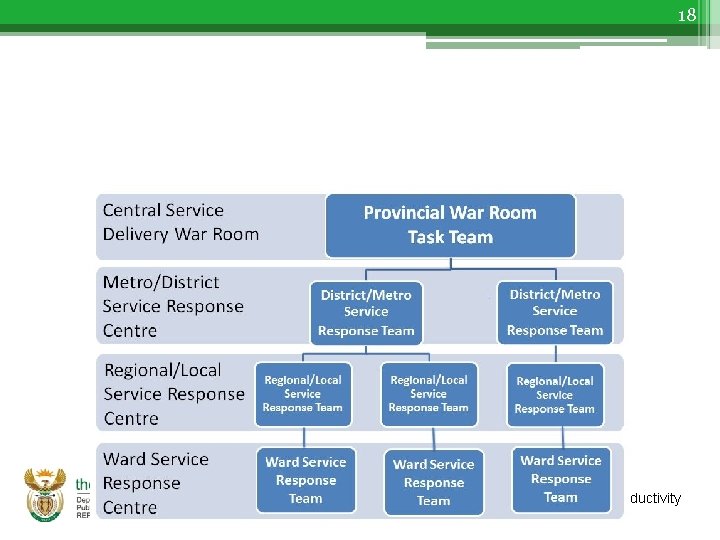
17 Help government departments rise to the challenge of treating citizens with dignity and expectations meeting their demands equitably and fairly War Room Service Machinery ▫ National>>Province>> Metro/District>> Regions/locals>> Wards (PAM Act enabled for seamless implementation) ▫ Different Government priorities: Phakisa, OSS/ Setsokotsane, Back To Basics Elevates accountability to the President OSS/Provincial To the Premier Back Basics Coordinates all National, Provincial and Local government (To enhance access, accountability, IGR for improved citizens satisfaction ) ▫ Service Response Teams: problem-solving and action oriented structures and people tasked with service delivery responses ▫ Service Response Centers: Facilities in every ward serving as a base for activities ▫ Leveraging on Technology to ensure real-time data capturing and use Leading the Public Service to Higher Productivity
18 Leading the Public Service to Higher Productivity
19 Help government departments rise to the challenge of treating citizens with dignity and expectations meeting their demands equitably and fairly War Room applies to all public services, with key focus on: • (Back To Basics) ▫ Basic services: water, sanitation, electricity, indigent policies, social grants ▫ Social wage: ECD, education, health care, social development, food security, safety, public transport and recreation etc. • Broadening economic participation (Phakisa e. g. the Ocean Economy) ▫ Local economic participation esp. youth, women, poor & unemployed ▫ Activation of unemployed within township economies revitalization, SMMEs & coops, skills development, EPWP and CWP and Welfare to Work • Clean, healthy and livable environments (Municipalities, SANATION of the Department of Water and Sanitation Affairs Cross line with African Charter) Leading the Public Service to Higher Productivity
20 ▫ Refuse removal, preventing illegal dumping, greening communities, clean up campaigns • Partnerships and behavior change ▫ All activities and campaigns should encourage and build community partnerships incl. NGOs, CBOs, social solidarity and positive behavior change Leading the Public Service to Higher Productivity
21 Improve service delivery programmes and enhance productivity • Productivity management framework for the Public Service developed • Operations Management Tools inclusive of Service Delivery Model and SOPs , Business Process Mapping Service Standards are utilised and sent to DPSA as part of the Integrated three year Service Delivery Improvement Plan. Leading the Public Service to Higher Productivity
22 Empowerment and Encourage citizen participation in the delivery of public services • Provinces Knowledge and Information Management Systems ▫ Geographic Information Systems (GIS): GDARD, COGTA, Human settlements, DPSA (research and Analysis), incl. detailed GIS data sets ▫ Police information systems ▫ Municipal and provincial monitoring systems ▫ Media monitoring ▫ Ward-level data incl: Quality of Life survey mapping of 50 poorest wards etc. Leading the Public Service to Higher Productivity
23 Encourage citizen participation in the delivery of public services ▫ Know Your Service Rights Programme (DPSA), Strengthening Intergrated Service Delivery Improvement support programme. ▫ Know Your Ward: Ward profiling including socio-economic profiles, local organisations, public service facilities and field workers ▫ Daily household profiling, including proactively identifying households needing immediate intervention and support (every week) ▫ Referral and action, including referring needs to the relevant public service entity for action ▫ Service provided and report back to WSTT/CC ▫ Tracking and monitoring of action (horizontal and vertical) Leading the Public Service to Higher Productivity ▫ Reporting back to individuals, households and structures on
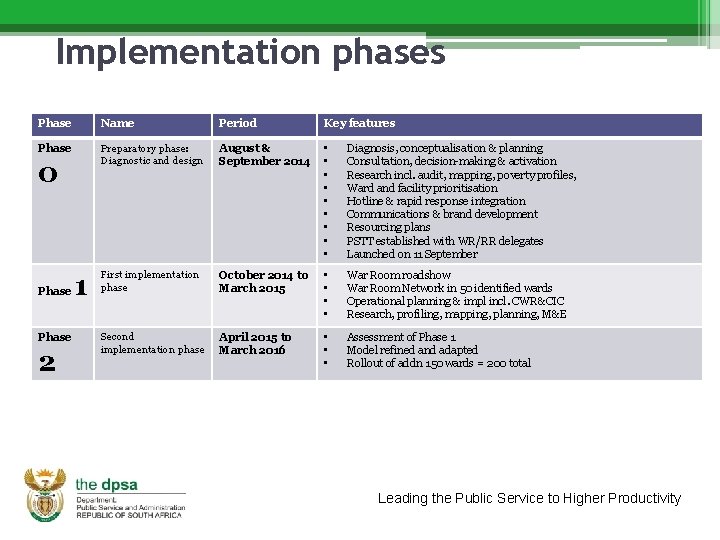
Implementation phases Phase Name Period Key features Phase Preparatory phase: Diagnostic and design August & September 2014 • • • Diagnosis, conceptualisation & planning Consultation, decision-making & activation Research incl. audit, mapping, poverty profiles, Ward and facility prioritisation Hotline & rapid response integration Communications & brand development Resourcing plans PSTT established with WR/RR delegates Launched on 11 September First implementation phase October 2014 to March 2015 • • War Room roadshow War Room Network in 50 identified wards Operational planning & impl incl. CWR&CIC Research, profiling, mapping, planning, M&E Second implementation phase April 2015 to March 2016 • • • Assessment of Phase 1 Model refined and adapted Rollout of addn 150 wards = 200 total 0 Phase 2 1 Leading the Public Service to Higher Productivity
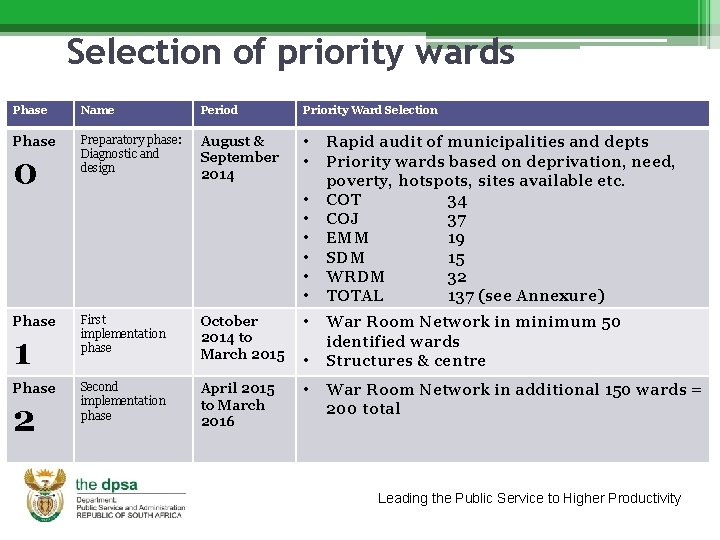
Selection of priority wards Phase Name Period Priority Ward Selection Phase Preparatory phase: Diagnostic and design August & September 2014 • • 0 Phase 1 Phase 2 • • • First implementation phase October 2014 to March 2015 • Second implementation phase April 2015 to March 2016 • • Rapid audit of municipalities and depts Priority wards based on deprivation, need, poverty, hotspots, sites available etc. COT 34 COJ 37 EMM 19 SDM 15 WRDM 32 TOTAL 137 (see Annexure) War Room Network in minimum 50 identified wards Structures & centre War Room Network in additional 150 wards = 200 total Leading the Public Service to Higher Productivity
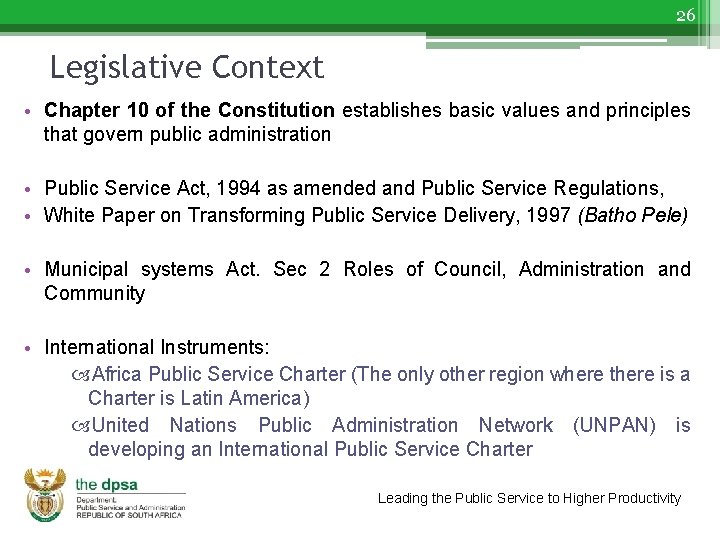
26 Legislative Context • Chapter 10 of the Constitution establishes basic values and principles that govern public administration • Public Service Act, 1994 as amended and Public Service Regulations, • White Paper on Transforming Public Service Delivery, 1997 (Batho Pele) • Municipal systems Act. Sec 2 Roles of Council, Administration and Community • International Instruments: Africa Public Service Charter (The only other region where there is a Charter is Latin America) United Nations Public Administration Network (UNPAN) is developing an International Public Service Charter Leading the Public Service to Higher Productivity
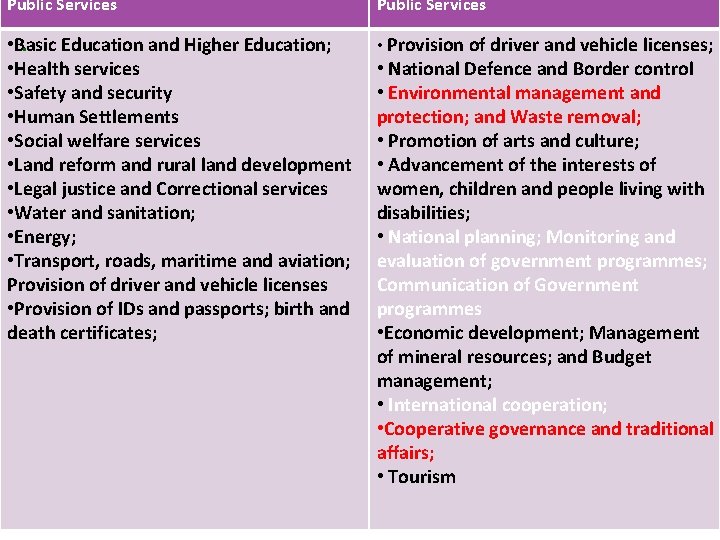
Public Services . • Basic Education and Higher Education; • Health services • Safety and security • Human Settlements • Social welfare services • Land reform and rural land development • Legal justice and Correctional services • Water and sanitation; • Energy; • Transport, roads, maritime and aviation; Provision of driver and vehicle licenses • Provision of IDs and passports; birth and death certificates; • Provision of driver and vehicle licenses; • National Defence and Border control • Environmental management and protection; and Waste removal; • Promotion of arts and culture; • Advancement of the interests of women, children and people living with disabilities; • National planning; Monitoring and evaluation of government programmes; Communication of Government programmes • Economic development; Management of mineral resources; and Budget management; • International cooperation; • Cooperative governance and traditional affairs; • Tourism Leading the Public Service to Higher Productivity
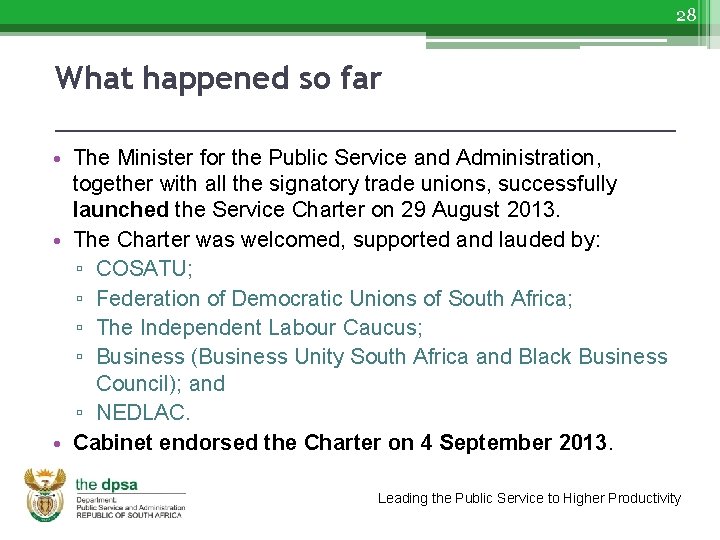
28 What happened so far ___________________ • The Minister for the Public Service and Administration, together with all the signatory trade unions, successfully launched the Service Charter on 29 August 2013. • The Charter was welcomed, supported and lauded by: ▫ COSATU; ▫ Federation of Democratic Unions of South Africa; ▫ The Independent Labour Caucus; ▫ Business (Business Unity South Africa and Black Business Council); and ▫ NEDLAC. • Cabinet endorsed the Charter on 4 September 2013. Leading the Public Service to Higher Productivity
29 What happened so far • Public Service Transformation Priority interventions stated in the President’s reply to SONA 2014 debate. ▫ Public Service Charter ▫ Batho Pele Management ▫ Operation Phakisa • Steering Committee within DPSA plus NSG • State of the Public Service Report compiled as part of Implementation of Africa Public Service Charter • Communications Strategy implemented in Public Service month related activities • Study Visits by DPSA plus NSG, to KZN, Gauteng, SA, Mozambique and Senegal and Engagement's with Presidency, COGTA and Malaysian Government Leading the Public Service to Higher Productivity
30 What happened so far • MPSA and Premiers have began to lead the provincial popularisation of the charter • Campaigns: ▫ To educate all public servants on the Charter are conducted (e. g. Provincial visits as part of Public Service month) ▫ To educate the public on the contents of the Charter in order for them to monitor implementation and provide feedback (Thusong Center Launch-Maponya Mall, Soweto; Mohlakeng and in other parts in the country) • Public Servants have began signing the Charter and this is ongoing (e. g. OTP Gauteng). • The signing will be rolled out to other National and Provincial departments Leading the Public Service to Higher Productivity
31 Consultation processes on the Consolidated implementation of the Service Charter • Conducted, and are continuing, between DPSA and strategic partners to ensure that its implementation is mainstreamed into four initiatives: ▫ Africa Service Charter, ▫ Operation Phakisa, ▫ Operation Sukuma Sakhe ▫ Back to basics programme for municipalities. • Study Tours were conducted to consult with: ▫ Office of the Malaysian Prime Minister Big Fast Methodology ▫ The Presidency in SA on the Malaysian now translated into South African Operation Phakisa, ▫ Provinces: Ntirisano –Gauteng, Operation Sukuma Sakhe-KZN, Setsokotsane-N. West • Consultation processes has began among DPSA, SALGA and COGTA to mainstream the Service Charter implementation into the Back to Basics programme for the Municipalities • Possible standing agenda on Service delivery IMC with MPSA as additional member Leading the Public Service to Higher Productivity
32 Next Steps • Draft (Consolidated) Implementation Plan development in consultation with Presidency, Provinces, SALGA and COGTA. • Approval on the plan and implementation, monitoring and evaluation • Mobilisation of secretariat and project team. • Joint monitoring role G&A cluster • Regular briefing Portfolio Committee on Public Service and Administration and IMC on Service Delivery Leading the Public Service to Higher Productivity
33 Recommendations 1. Note the Progress in Service Charter Implementation 2. Approve the concept of mainstreaming into Operation Phakisa, War room, Back to Basics. 3. Approve inclusion of MPSA into IMC for Service delivery 4. MPSA to report back to Portfolio Committee on the Service Charter Multiyear Operational Plan and M&E. Leading the Public Service to Higher Productivity
- Slides: 33