
PUBLIC SECTOR PARTNERSHIPS A MODEL FOR SUCCESS Sarah
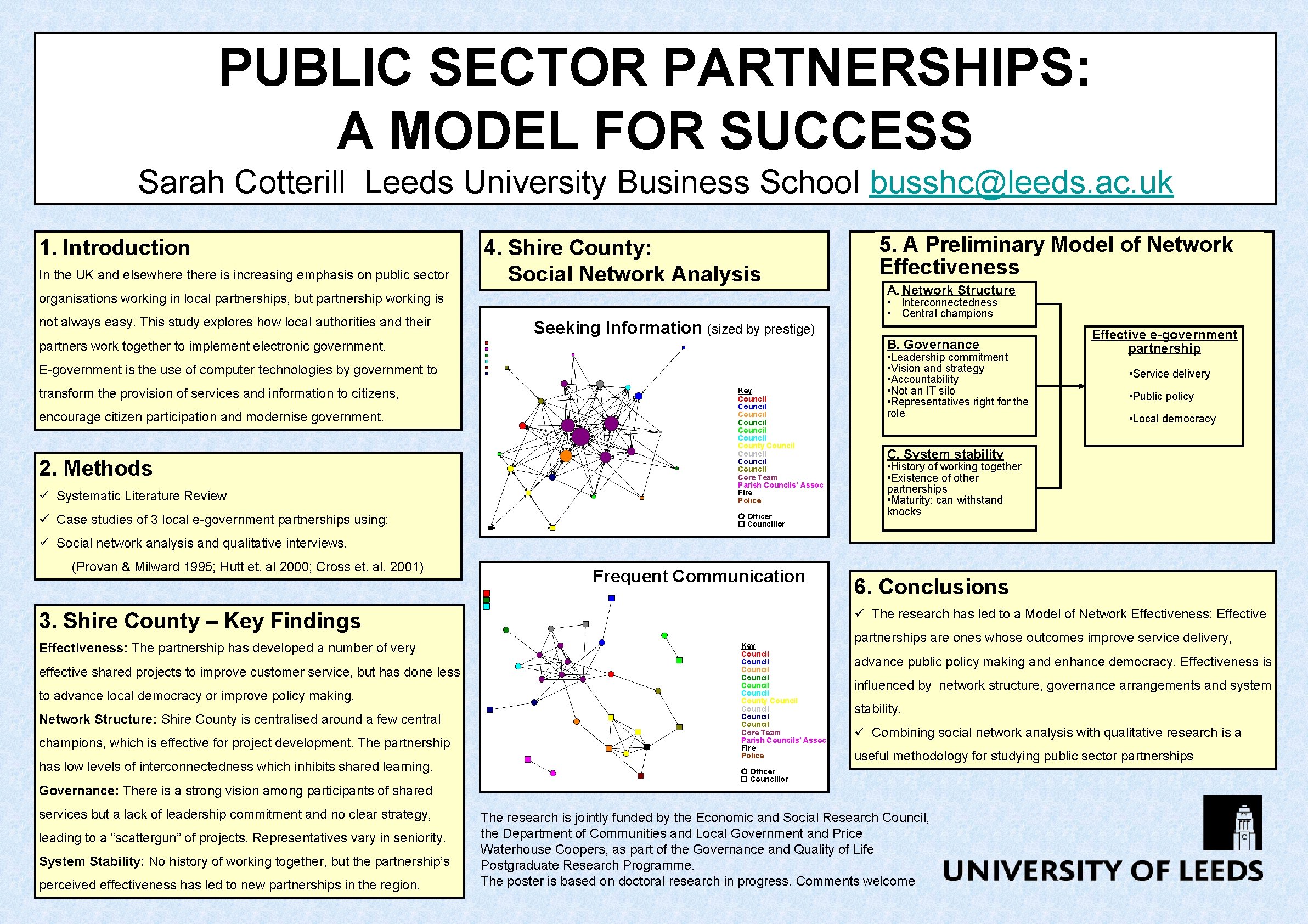
PUBLIC SECTOR PARTNERSHIPS: A MODEL FOR SUCCESS Sarah Cotterill Leeds University Business School busshc@leeds. ac. uk 1. Introduction In the UK and elsewhere there is increasing emphasis on public sector 4. Shire County: Social Network Analysis organisations working in local partnerships, but partnership working is not always easy. This study explores how local authorities and their Seeking Information (sized by prestige) partners work together to implement electronic government. E-government is the use of computer technologies by government to transform the provision of services and information to citizens, Systematic Literature Review Key Council Council County Council Core Team Parish Councils’ Assoc Fire Police Case studies of 3 local e-government partnerships using: Officer Councillor encourage citizen participation and modernise government. 2. Methods 5. A Preliminary Model of Network Effectiveness A. Network Structure • Interconnectedness • Central champions B. Governance • Leadership commitment • Vision and strategy • Accountability • Not an IT silo • Representatives right for the role Effective e-government partnership • Service delivery • Public policy • Local democracy C. System stability • History of working together • Existence of other partnerships • Maturity: can withstand knocks Social network analysis and qualitative interviews. (Provan & Milward 1995; Hutt et. al 2000; Cross et. al. 2001) Frequent Communication The research has led to a Model of Network Effectiveness: Effective 3. Shire County – Key Findings Effectiveness: The partnership has developed a number of very effective shared projects to improve customer service, but has done less to advance local democracy or improve policy making. Network Structure: Shire County is centralised around a few central champions, which is effective for project development. The partnership has low levels of interconnectedness which inhibits shared learning. Governance: There is a strong vision among participants of shared services but a lack of leadership commitment and no clear strategy, leading to a “scattergun” of projects. Representatives vary in seniority. System Stability: No history of working together, but the partnership’s perceived effectiveness has led to new partnerships in the region. 6. Conclusions Key Council Council County Council Core Team Parish Councils’ Assoc Fire Police partnerships are ones whose outcomes improve service delivery, advance public policy making and enhance democracy. Effectiveness is influenced by network structure, governance arrangements and system stability. Combining social network analysis with qualitative research is a useful methodology for studying public sector partnerships Officer Councillor The research is jointly funded by the Economic and Social Research Council, the Department of Communities and Local Government and Price Waterhouse Coopers, as part of the Governance and Quality of Life Postgraduate Research Programme. The poster is based on doctoral research in progress. Comments welcome
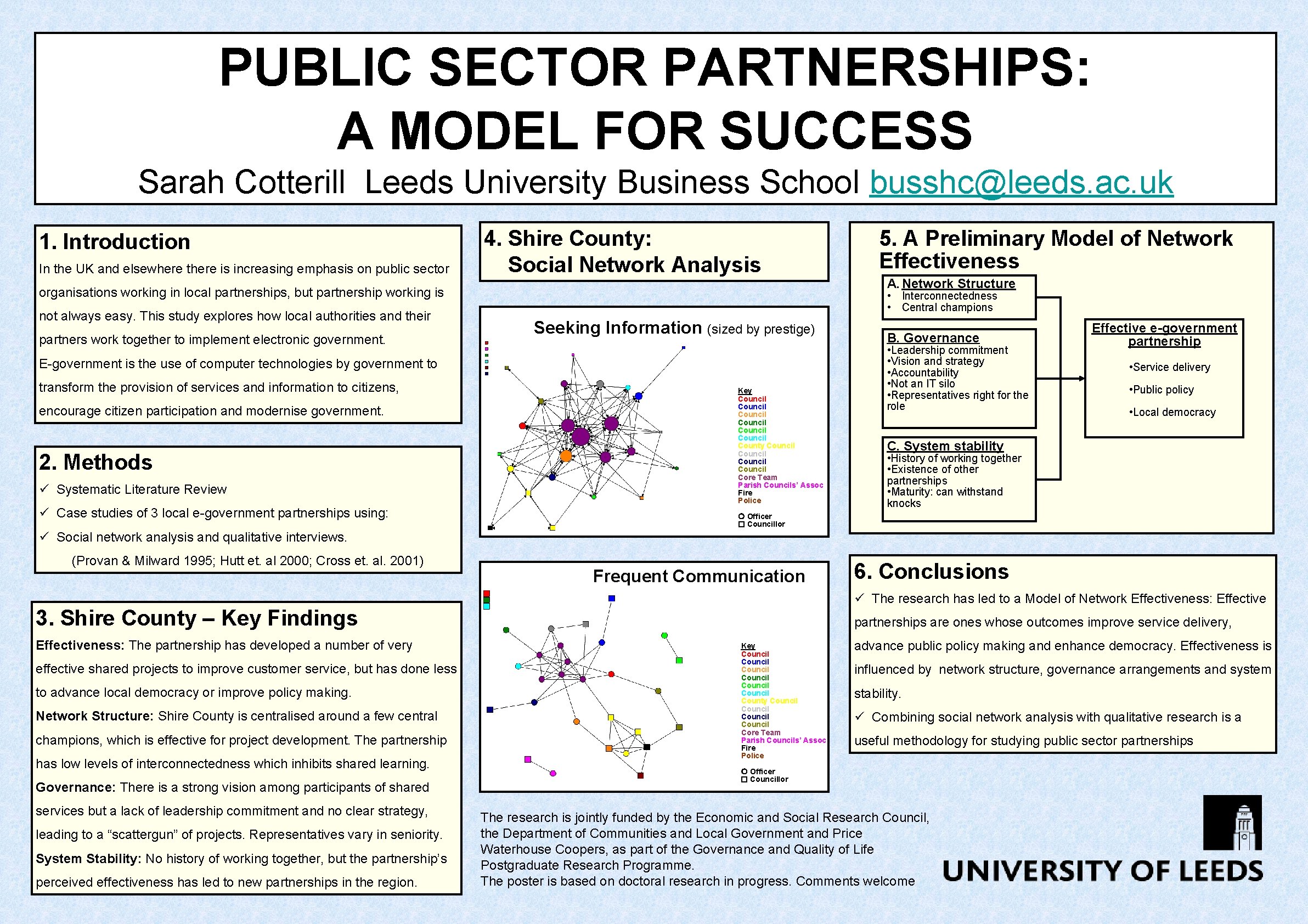
PUBLIC SECTOR PARTNERSHIPS: A MODEL FOR SUCCESS Sarah Cotterill Leeds University Business School busshc@leeds. ac. uk 1. Introduction In the UK and elsewhere there is increasing emphasis on public sector 4. Shire County: Social Network Analysis organisations working in local partnerships, but partnership working is not always easy. This study explores how local authorities and their partners work together to implement electronic government. encourage citizen participation and modernise government. 2. Methods Systematic Literature Review Case studies of 3 local e-government partnerships using: A. Network Structure • Interconnectedness • Central champions Seeking Information (sized by prestige) E-government is the use of computer technologies by government to transform the provision of services and information to citizens, 5. A Preliminary Model of Network Effectiveness Key Council Council County Council Core Team Parish Councils’ Assoc Fire Police B. Governance • Leadership commitment • Vision and strategy • Accountability • Not an IT silo • Representatives right for the role Effective e-government partnership • Service delivery • Public policy • Local democracy C. System stability • History of working together • Existence of other partnerships • Maturity: can withstand knocks Officer Councillor Social network analysis and qualitative interviews. (Provan & Milward 1995; Hutt et. al 2000; Cross et. al. 2001) Frequent Communication The research has led to a Model of Network Effectiveness: Effective 3. Shire County – Key Findings Effectiveness: The partnership has developed a number of very effective shared projects to improve customer service, but has done less to advance local democracy or improve policy making. Network Structure: Shire County is centralised around a few central champions, which is effective for project development. The partnership has low levels of interconnectedness which inhibits shared learning. Governance: There is a strong vision among participants of shared services but a lack of leadership commitment and no clear strategy, leading to a “scattergun” of projects. Representatives vary in seniority. System Stability: No history of working together, but the partnership’s perceived effectiveness has led to new partnerships in the region. 6. Conclusions partnerships are ones whose outcomes improve service delivery, Key Council Council County Council Core Team Parish Councils’ Assoc Fire Police advance public policy making and enhance democracy. Effectiveness is influenced by network structure, governance arrangements and system stability. Combining social network analysis with qualitative research is a useful methodology for studying public sector partnerships Officer Councillor The research is jointly funded by the Economic and Social Research Council, the Department of Communities and Local Government and Price Waterhouse Coopers, as part of the Governance and Quality of Life Postgraduate Research Programme. The poster is based on doctoral research in progress. Comments welcome
- Slides: 2