
PUBLIC SECTOR MOTIVATION IN THE ITALIAN PUBLIC ADMINISTRATION
PUBLIC SECTOR MOTIVATION IN THE ITALIAN PUBLIC ADMINISTRATION Alberto Petrucci DISPA Meeting – Vilnius, 24 -25 October 2013
In this presentation, the main results of a SNA–SDA Bocconi School of Management research on Public Sector Motivation (PSM) in the Italian Public Administration will be discussed. This is research is a part of a larger scientific project developed by SNA and SDA Bocconi involving two lines of analysis on Italian Public Administration at a central level: a) one on PSM; b) one on Public Sector Performance. 2
Research questions and aims of the analysis • Research questions • What is the relationship between PSM and performance? • What are the main determinants of PSM? • What is the PSM role for attacting and motivating public employee? • Research aims • Empirical analysis of PSM, extrinsic motivation as well as intrinsic motivation for the Italian Public Adminstration at a central level • Consequences for the Italian public management • Public Administration policy implications 3
Searching for a theoretical framework Perfomance depends on • Ability • Task understanding • Motivation • Environment • Work motivation is related to • Job importance • Mission valence (perceived importance of inst. goals) • Extrinsic elements (rewards, carrer, etc. ) • Self-efficacy (capacity to organize and execute actions requited to attain a designated performance level) • Job difficultty • Job specificity 4
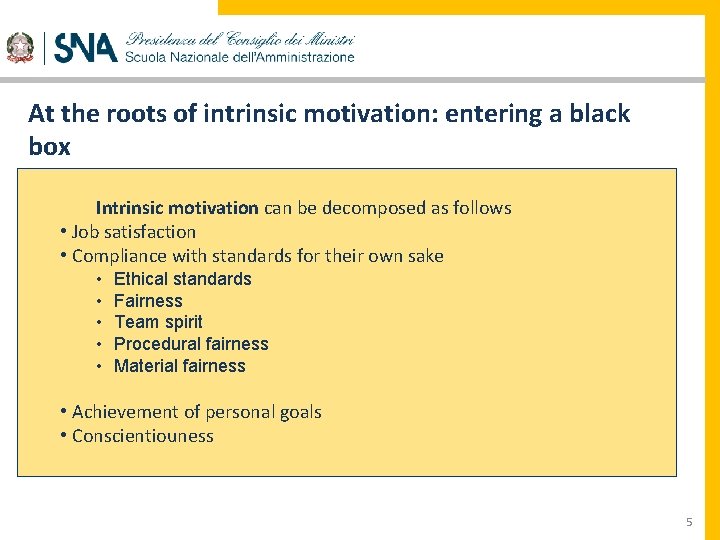
At the roots of intrinsic motivation: entering a black box Intrinsic motivation can be decomposed as follows • Job satisfaction • Compliance with standards for their own sake • • • Ethical standards Fairness Team spirit Procedural fairness Material fairness • Achievement of personal goals • Conscientiouness 5
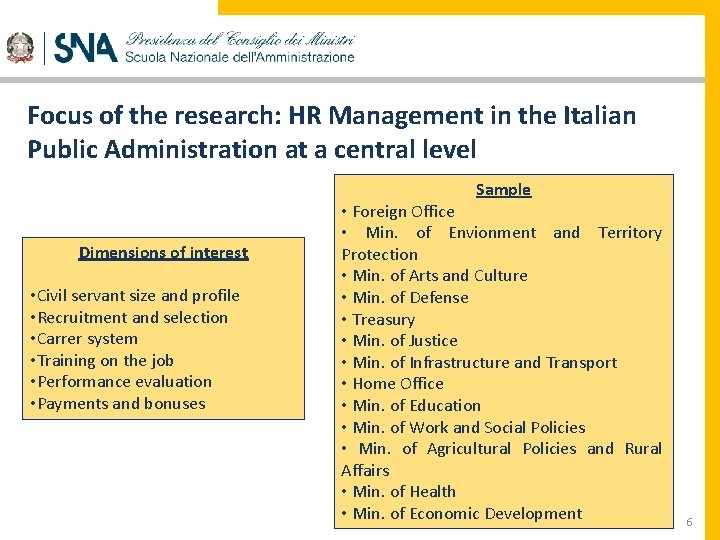
Focus of the research: HR Management in the Italian Public Administration at a central level Sample Dimensions of interest • Civil servant size and profile • Recruitment and selection • Carrer system • Training on the job • Performance evaluation • Payments and bonuses • Foreign Office • Min. of Envionment and Territory Protection • Min. of Arts and Culture • Min. of Defense • Treasury • Min. of Justice • Min. of Infrastructure and Transport • Home Office • Min. of Education • Min. of Work and Social Policies • Min. of Agricultural Policies and Rural Affairs • Min. of Health • Min. of Economic Development 6
Data and Methodology Quantitative and qualitative analysis based on online survey – Experimental studies Eclectic approach that combines Management, Labor Psychology, Behavioral Economics, Sociology, etc. • Cross section: Survey for 2012 • Technical ingredients: Factorial analysis 7
Online survey – Variables (1/4) • Money incentives work effort Consider the following situation. You are currently working in a system in which the assessment of your perfomance is fair and reliable. Suppose that from next year on you may receive according to your perfomance a bonus equal to 50% of your base salary that has to be added to your current pay. How much will you change your future work effort next year? Work effort: from 0 to 100 8
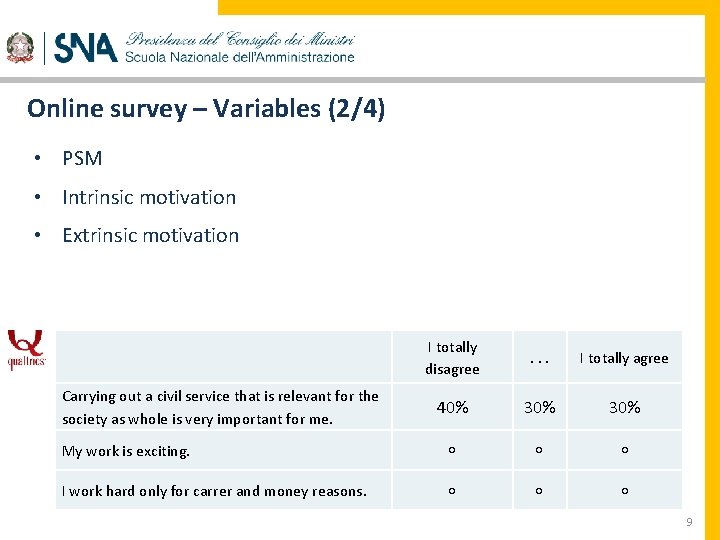
Online survey – Variables (2/4) • PSM • Intrinsic motivation • Extrinsic motivation I totally disagree . . . I totally agree 40% 30% My work is exciting. O O O I work hard only for carrer and money reasons. O O O Carrying out a civil service that is relevant for the society as whole is very important for me. 9
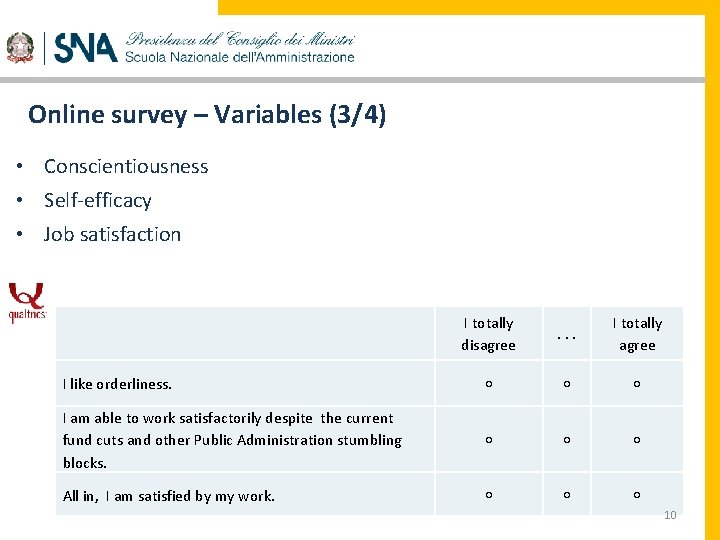
Online survey – Variables (3/4) • Conscientiousness • Self-efficacy • Job satisfaction I totally disagree . . . I totally agree I like orderliness. O O O I am able to work satisfactorily despite the current fund cuts and other Public Administration stumbling blocks. O O O All in, I am satisfied by my work. O O O 10
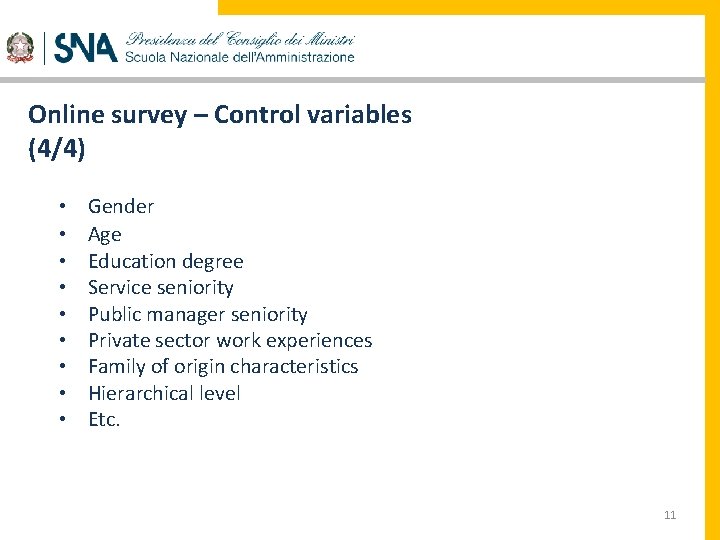
Online survey – Control variables (4/4) • • • Gender Age Education degree Service seniority Public manager seniority Private sector work experiences Family of origin characteristics Hierarchical level Etc. 11
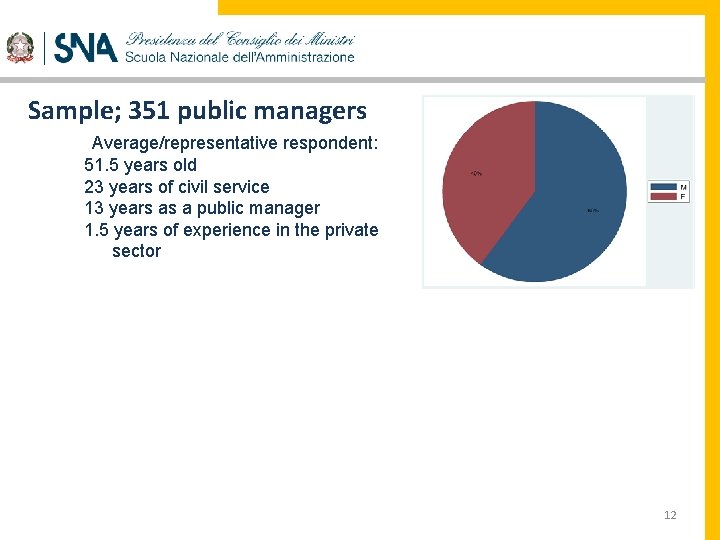
Sample; 351 public managers Average/representative respondent: 51. 5 years old 23 years of civil service 13 years as a public manager 1. 5 years of experience in the private sector 12
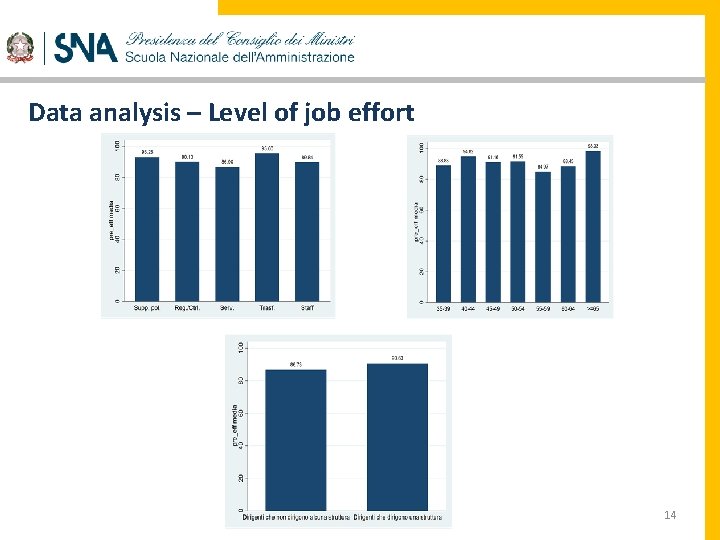
Data analysis – Level of job effort • Mean 90. 03/100 (st. dev. 12. 45) • Negative correlation with PA seniority • Positive correlation with executive seniority • Positive correlation with intrinsec motivation 13
Data analysis – Level of job effort 14
Analysis of the results– PSM • Mean 5. 44/7 – 77%– (st. dev. 0. 72) (other studies 0. 78 EC) • Positive correlation with hierarchical level • Correlation with academic education (e. g. higher level of PSM among people with law or political science degrees) • Higher PSM among female managers • Negative correlation with extrinsic motivation 15
Analysis of the results – Intrinsic motivation Mean 5. 34/7 – 76. 28% – (st. dev. 1. 16) • Lower for Directors General • Higher for public employees’ descendants • Positive correlation with conscientiousness • Positive correlation with job satisfaction 16
Analysis of the results – Extrinsic motivation • Mean 2. 46/7 – 35. 14% – (st. dev. 1. 17) • Positive correlation with public manager seniority • Negative correlation with PSM 17
Data analysis – Job satisfaction • Mean 4. 86/7 – 69. 42% – (dev st: 1. 23) • Higher for public managers with an academic degree • Lower for public managers that descend from civil servant families • Positive correlation with intrinsic motivation 18
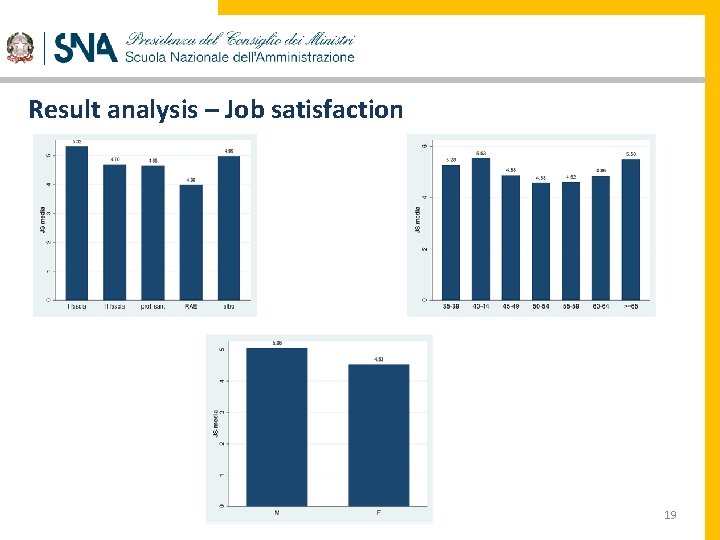
Result analysis – Job satisfaction 19
CONCLUDING REMARKS 1) Monitoring motivational capital • Untested and erroneous hypotheses regarding public managers motivations are at the basis of many public sectors’ failures • Mismatch incentives–motivations • This is the first photograph of motivational capital in the Italian PA at a central level (like in many other advanced countries) • Future challenges: systemic and continuous monitor of motivational capital: i) Level; ii) Distribution; iii) Evolution 20
2) Stimulating of motivational capital • Individuals with different motivational profiles respond differently to the same organizational conditions (one size does not fit all) • The present analysis adds new experimental/empirical evidence on how the motivational profile reduces the effects of: • Pecuniary incentives • Contacts with beneficiaries • Measures that induce self-persuasion • Transformative leadership 21
3) Accumulating motivational capital • Today Public managers • Close the motivational deficit • Dynamic PSM • Future Public managers • Select and keep talents with high PSM • Personality test • Simulation of situational judgment • Background analysis • Direct observation of behaviors 22
4) Adoption of an evidence-based approach • Public management policy of the past • Motivational hypotheses untested • Fragmentary data • Public management policy of the future • Longitudinal monitor of motivations • Experimental methods 23
The analysis demonstrates that the problema of PA performance and PSM should be analyzed through a richer framework. A very fruitful standpoint is provided by the Amartya Sen (1998 Nobel prize) “capabilities approach”, which ensures a sustainable PA as it recognizes: i) The importance of real freedoms in the assessment of a person's advantage ii) Individual differences in the ability to transform resources into valuable activities iii) The multi-variate nature of activities giving rise to happiness iv) A balance of materialistic and nonmaterialistic factors in evaluating human welfare v) Concern for the distribution of opportunities within society. 24
Philosophically speaking, our research confirm the Karl R. Popper (1902 -1994) dictum: “Institutions are like fortresses: they resist if garrisons are good”. 25
- Slides: 25