
Public Sector Innovation trends in OECD countries and
Public Sector Innovation trends in OECD countries and beyond Santiago González, Policy Analyst Santiago. GONZALEZ@oecd. org oe. cd/opsi @OPSIgov opsi@oecd. org
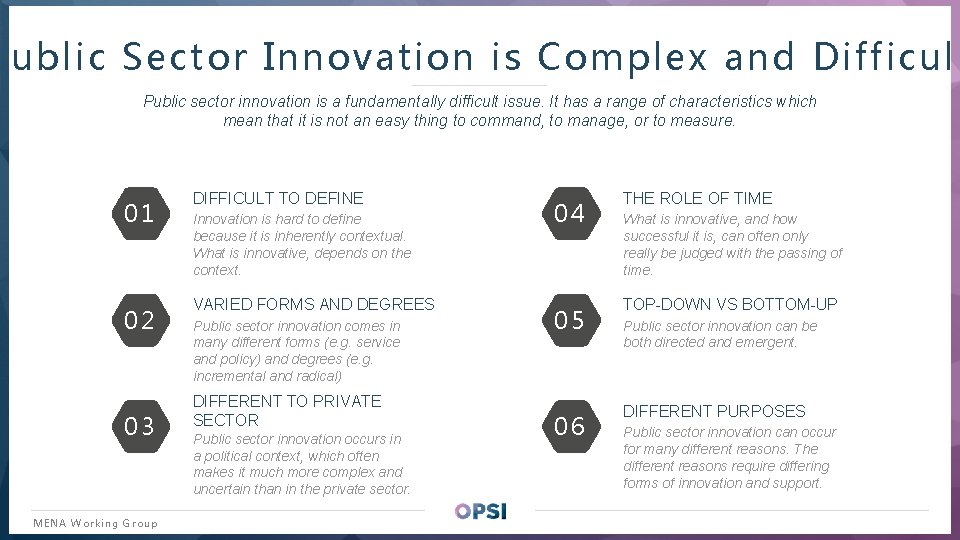
Public Sector Innovation is Complex and Difficult Public sector innovation is a fundamentally difficult issue. It has a range of characteristics which mean that it is not an easy thing to command, to manage, or to measure. 01 DIFFICULT TO DEFINE 02 VARIED FORMS AND DEGREES 03 MENA Work ing Group Innovation is hard to define because it is inherently contextual. What is innovative, depends on the context. Public sector innovation comes in many different forms (e. g. service and policy) and degrees (e. g. incremental and radical) DIFFERENT TO PRIVATE SECTOR Public sector innovation occurs in a political context, which often makes it much more complex and uncertain than in the private sector. 04 THE ROLE OF TIME 05 TOP-DOWN VS BOTTOM-UP 06 DIFFERENT PURPOSES What is innovative, and how successful it is, can often only really be judged with the passing of time. Public sector innovation can be both directed and emergent. Public sector innovation can occur for many different reasons. The different reasons require differing forms of innovation and support.
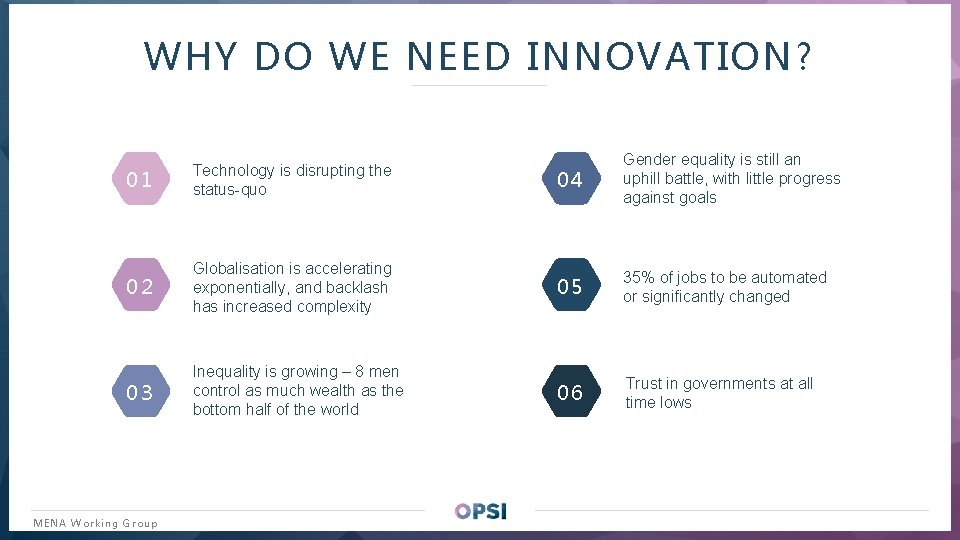
WHY DO WE NEED INNOVATION? 01 Technology is disrupting the status-quo 04 Gender equality is still an uphill battle, with little progress against goals 02 Globalisation is accelerating exponentially, and backlash has increased complexity 05 35% of jobs to be automated or significantly changed 03 Inequality is growing – 8 men control as much wealth as the bottom half of the world 06 Trust in governments at all time lows MENA Work ing Group
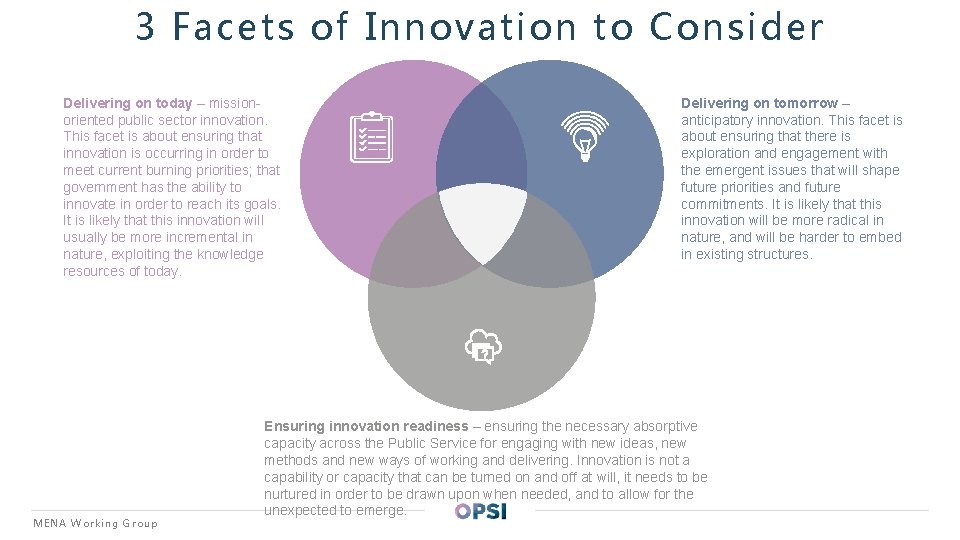
3 Facets of Innovation to Consider Delivering on today – missionoriented public sector innovation. This facet is about ensuring that innovation is occurring in order to meet current burning priorities; that government has the ability to innovate in order to reach its goals. It is likely that this innovation will usually be more incremental in nature, exploiting the knowledge resources of today. MENA Work ing Group Delivering on tomorrow – anticipatory innovation. This facet is about ensuring that there is exploration and engagement with the emergent issues that will shape future priorities and future commitments. It is likely that this innovation will be more radical in nature, and will be harder to embed in existing structures. Ensuring innovation readiness – ensuring the necessary absorptive capacity across the Public Service for engaging with new ideas, new methods and new ways of working and delivering. Innovation is not a capability or capacity that can be turned on and off at will, it needs to be nurtured in order to be drawn upon when needed, and to allow for the unexpected to emerge.

The Observatory for Public Sector Innovation (OPSI) team are specialists in public sector innovation. Since 2014, the team has worked with governments to understand encourage new approaches to address society’s complex problems, providing a collective resource to identify, collect and analyse new ways of designing and delivering policies and services. UNCOVERING WHAT IS NEXT Identifying new practices, connecting those engaging in new ways of thinking and acting, and considering what these new approaches mean for the public sector. 1 PROVIDING TRUSTED ADVICE TO FOSTER INNOVATION Sharing guidance and resources so governments can support innovation to drive better outcomes. MENA Work ing Group 3 2 TURNING THE NEW INTO NORMAL Studying innovation in different contexts and investigating potential frameworks and methods to encourage innovation in the daily work of public servants.
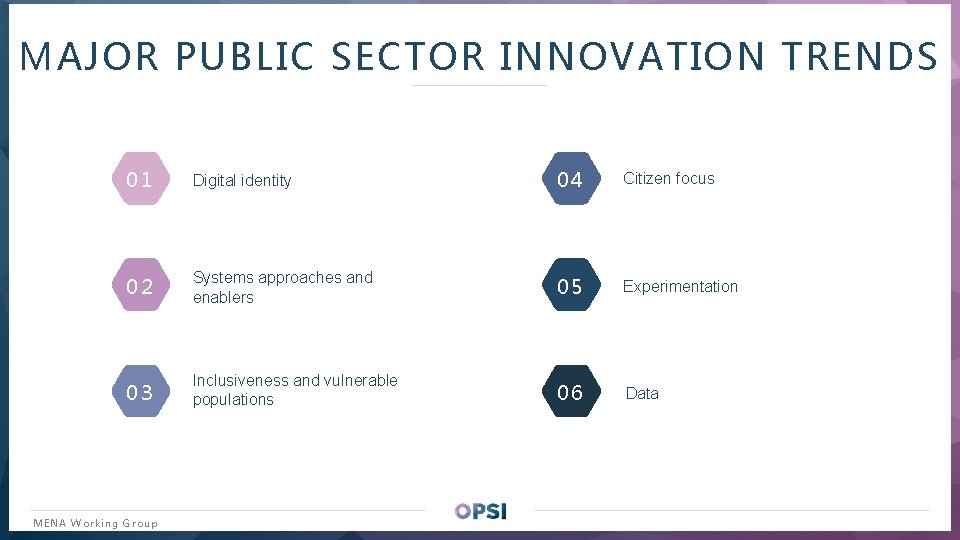
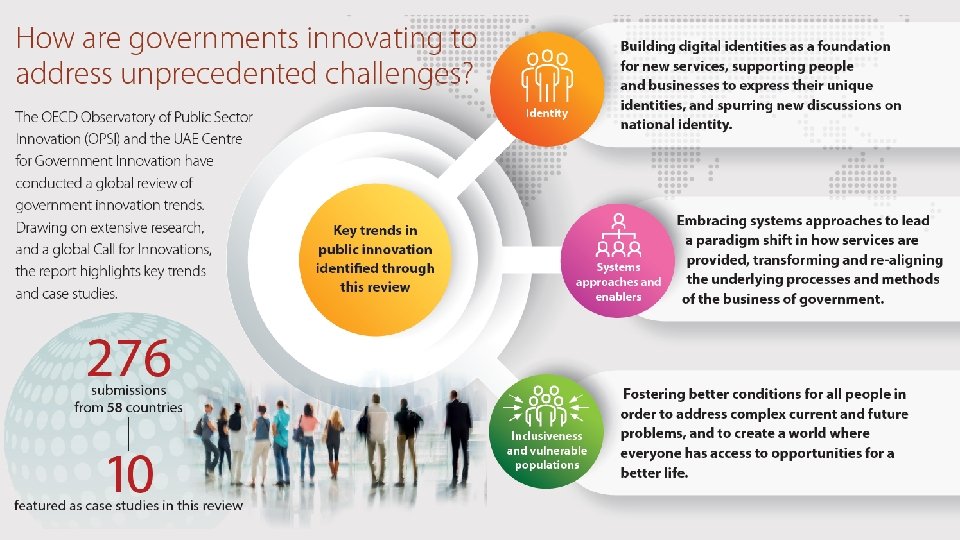
MAJOR PUBLIC SECTOR INNOVATION TRENDS 01 Digital identity 04 Citizen focus 02 Systems approaches and enablers 05 Experimentation 03 Inclusiveness and vulnerable populations 06 Data MENA Work ing Group
MENA Work ing Group
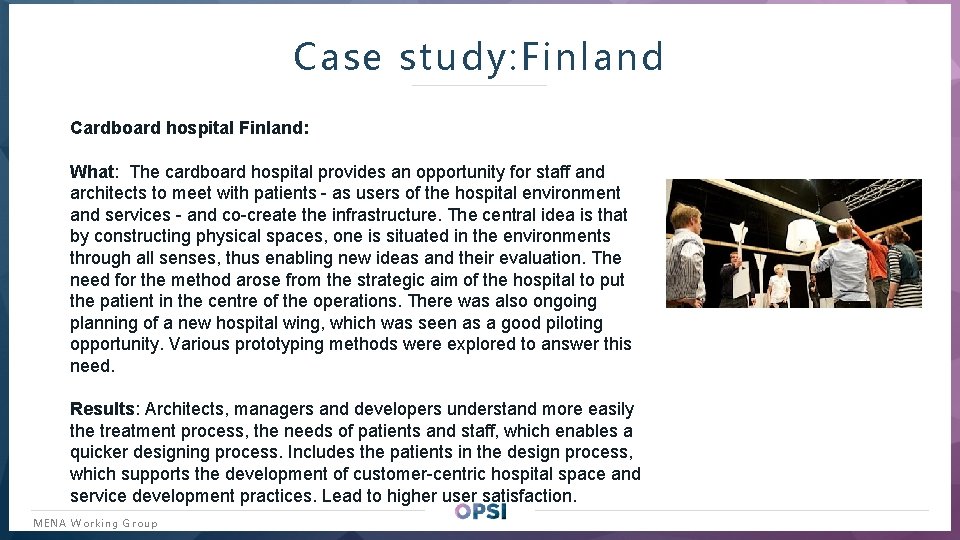
Case study: Finland Cardboard hospital Finland: What: The cardboard hospital provides an opportunity for staff and architects to meet with patients - as users of the hospital environment and services - and co-create the infrastructure. The central idea is that by constructing physical spaces, one is situated in the environments through all senses, thus enabling new ideas and their evaluation. The need for the method arose from the strategic aim of the hospital to put the patient in the centre of the operations. There was also ongoing planning of a new hospital wing, which was seen as a good piloting opportunity. Various prototyping methods were explored to answer this need. Results: Architects, managers and developers understand more easily the treatment process, the needs of patients and staff, which enables a quicker designing process. Includes the patients in the design process, which supports the development of customer-centric hospital space and service development practices. Lead to higher user satisfaction. MENA Work ing Group
Case study: Sweden Pension rights and information: Min Pension in Sweden What: Min Pension is a service which on a daily basis helps Swedish people to get an overall picture of their earned pension rights, and helps them make a projection on their old age pension. The website can be accessed by one click from external internet sites, such as the Swedish Pensions Agency, several banks and pension companies. Results: People are provided with comprehensive information on their pension rights and the Swedish pension system. More than 2. 1 million registered users and more than 12 million pension agreements collected in the database guarantee transparency. A well organised platform for the public and the private sector in the pension area. MENA Work ing Group
Case study: South Africa Social insurance institutional arrangements: NSSF in South Africa What: Agency approach for the delivery of social insurance schemes to redress incoherence and fragmentation of the different administrations administering social insurance schemes in the country. An institutional design for the implementation of the mandatory National Social Security Fund (NSSF) in the delivery of death, disability and retirement benefits was created. Results: The Agency Approach consolidates the different administrations into a single hub of delivery, preventing double or triple dipping, and savings administrative costs. This improved efficiency and effectiveness in social insurance delivery and improved capability to identify trends in resource allocation. MENA Work ing Group
MENA Work ing Group
Join our newsletter at http: //tiny. cc/opsinewsletter oe. cd/opsi @OPSIgov opsi@oecd. org
- Slides: 12