
Public Sector Duty Putting Equality and Human Rights
Public Sector Duty: Putting Equality and Human Rights at the Heart of the National Drugs Strategy NIALL CROWLEY
Topics ØThe Public Sector Duty. ØA Values Based Approach to Implementing the Public Sector Duty. ØUsing an Equality and Human Rights Statement. ØTaking Difference into Account. ØQuestions for Discussion.
Public Sector Duty on Equality and Human Rights Duty
What is a Public Sector Duty? ØA legal requirement on public bodies ØBeyond previous legal requirement not to discriminate ØA legal requirement to take proactive steps ØPrevent discrimination and promote equality and protect human rights ØPublic bodies as policy makers, plans, employers and service providers and procurement work
Potential ØProactive : goes beyond simply avoiding discrimination ØReinforce and compliment current legislative model ØEnhance the provision of quality, inclusive, accessible and accountable public services that can reduce inequalities and advance the fulfillment of human rights ØDrive cultural change ØEvidence-based outcomes for equality and human rights
Legislative Context Equality Human Rights §Employment Equality Acts §Irish Constitution (1998 - 2012) §European Convention on §Equal Status Acts (2000 – Human Rights Act (2003) 2011) §Charter Fundamental Rights §Intoxicating Liquor Act § ICESCR, ICCPR, CRC; CEDAW, (2003) CERD, & UNCRPD (to ratify).
IHREC Act 2014 - Section 42 A public body shall, in the performance of its functions, have regard to the need to— üEliminate discrimination üPromote equality of opportunity and treatment of staff and service users üProtect the human rights of its staff and service users.
IHREC Act 2014 - Section 42 A public body shall, having regard to its functions, purpose, size and resources: üSet out in its strategic plan an assessment of the relevant human rights and equality issues, üSet out the policies, plans and actions in place or proposed to be put in place to address those issues, üReport on developments and achievements in that regard in its annual report.
A Values-Based Approach to Implementing the Public Sector Equality and Human Rights Duty
The Challenge Ø Encompassing civil, political, economic, social, and cultural rights. Ø Integrating of two distinct traditions. ü Individuals and Groups. ü Social change and minimum standards. Ø Addressing grounds of: gender, civil status, family status, age, disability, sexual orientation, race, religion, Traveller and socio-economic status
Values Ø Values are those beliefs, ideals, principles that we hold to be important Ø Personal values guide our attitudes and behaviours Ø They inform our choices Ø Shared values guide the organisations we work in Ø They inform the issues that organisations prioritise Ø They shape the way organisations work on issues
A Values-Based Approach Ø Human worth is a foundation for both equality and human rights. Ø The potential in values to integrate equality and human rights. Ø The capacity of values to give expression to an ambition to achieve equality and fulfill human rights. Ø Cultural change through prioritising new values.
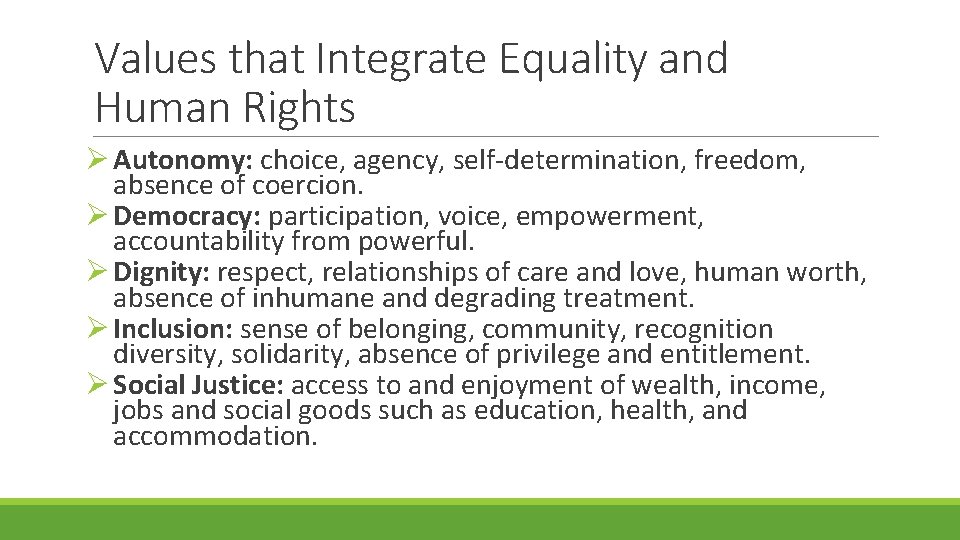
Values that Integrate Equality and Human Rights Ø Autonomy: choice, agency, self-determination, freedom, absence of coercion. Ø Democracy: participation, voice, empowerment, accountability from powerful. Ø Dignity: respect, relationships of care and love, human worth, absence of inhumane and degrading treatment. Ø Inclusion: sense of belonging, community, recognition diversity, solidarity, absence of privilege and entitlement. Ø Social Justice: access to and enjoyment of wealth, income, jobs and social goods such as education, health, and accommodation.
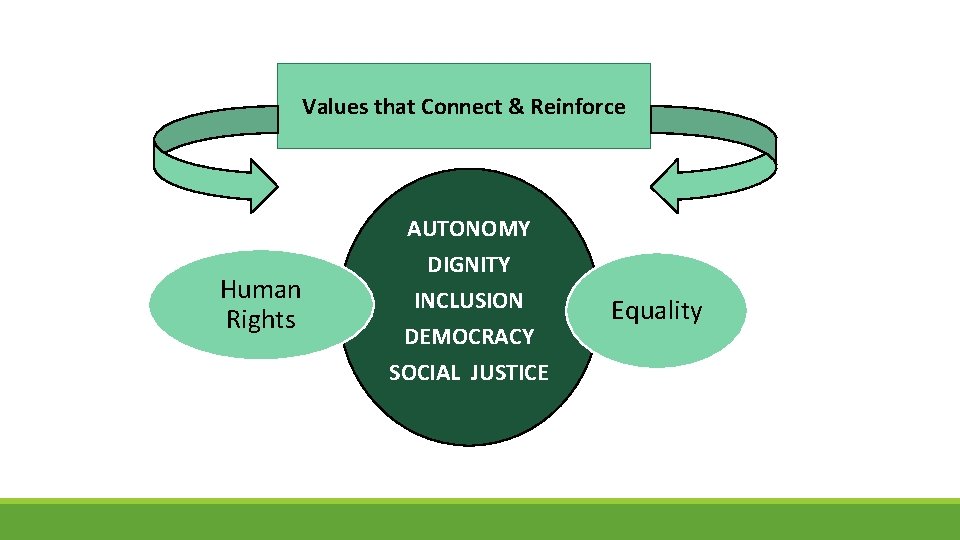
Values that Connect & Reinforce Human Rights AUTONOMY DIGNITY INCLUSION DEMOCRACY SOCIAL JUSTICE Equality
An Equality and Human Rights Statement for the National Drugs Strategy
What is it for? ØPutting equality and human rights values into play in the planning, implementing, and evaluating the National Drugs Strategy. ØEstablishing objectives to be pursued to give expression to these values in the National Drugs Strategy. ØIdentifying the issues to address through the National Drugs Strategy in order to give expression to these values.
Equality and Human Rights Statement Ø Defines equality and human rights values: Dignity; Autonomy; Social Justice; Inclusion; Democracy. Ø Identifies the objectives to be pursued in relation to each of these values in the National Drugs Strategy. Ø Sets out the equality and human rights issues to be address in the National Drugs Strategy for each objective. Ø Identifies how the statement will be used in preparing, implementing and evaluating the strategy.
Preparing the Statement ØAn internal working group within the Department to: üAgree a definition for the values chosen üSet objectives for each value üGather data relevant to the objectives and to diversity üIdentify the issues for each objective ØEngage in dialogue with representative organisations. ØComplete the Equality and Human Rights Statement.
Using an Equality and Human Rights Statement Ø Deploy the statement in planning: consultation, data gathering, priorities, and indicators for the strategy. Ø Deploy the statement in implementation: coordination meetings, track progress on the issues, and feedback mechanisms. Ø Deploy the statement in evaluation: Identify the outputs, outcomes and impacts that relate to the objectives set and issues identified for each value.
Taking Account of Difference ØIdentity üWhat makes the group unique: values, beliefs, worldview, ways of communicating, particular needs, ØExperience üHow other groups and institutions relate to the group, ØSituation üHow the group fares in society: economic, social, political and cultural status.
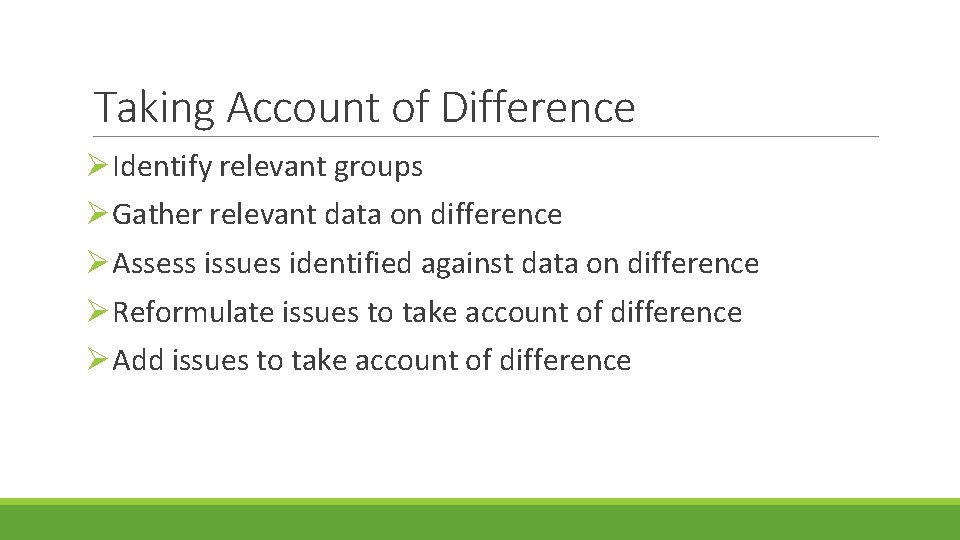
Taking Account of Difference ØIdentify relevant groups ØGather relevant data on difference ØAssess issues identified against data on difference ØReformulate issues to take account of difference ØAdd issues to take account of difference
Questions ØDoes the public sector duty hold potential to ensure the National Drugs Strategy includes a diversity of groups? ØHow can civil society mobilise an effective demand for the implementation of the public sector duty? ØHow can civil society ensure that the public sector duty is implemented in an effective and useful manner? ØWhat recommendations should we make?
- Slides: 22