
Public Sector Combinations IPSAS 40 The Handbook of

Public Sector Combinations IPSAS® 40
The Handbook of International Public Sector Accounting Pronouncements is the primary authoritative source of international generally accepted accounting principles for public sector entities. All information in this presentation is proprietary and copyrighted. Public Sector Combinations
Learning Objective • Be able to identify public sector combinations • Be able to classify public sector combinations as either an amalgamation or an acquisition • Understand how to account for amalgamations • Understand how to account for acquisitions. Public Sector Combinations
Public Sector Combinations • A public sector combination is the bringing together of separate operations into one public sector entity. • An operation is an integrated set of activities and related assets and/or liabilities that is capable of being conducted and managed for the purpose of achieving an entity’s objectives, by providing goods and/or services. Public Sector Combinations
Examples Public Sector Combinations Not Public Sector Combinations • Nationalizations: • Purchases • Seizures • Transactions that do not include operations • Bailouts • Joint arrangements • Reorganizations of local or regional governments • Transfers of operations from one government to another. • Restructurings of central government ministries
Discussion Question A public sector entity purchases a site to be used for landfill waste disposal. The purchase includes the land buildings on the site. The public sector entity assumes the liability to restore the site at the end of its useful life. No staff or processes are transferred as a result of the purchase. Does the purchase of the landfill waste disposal site constitute a public sector combination? Explain your reasoning. Public Sector Combinations
Types of Public Sector Combination An amalgamation gives rise to a resulting entity and is either: (a) A public sector combination in which no party to the combination gains control of one or more operations; or (b) A public sector combination in which one party to the combination gains control of one or more operations, and in which there is evidence that the combination has the economic substance of an amalgamation. An acquisition is a public sector combination in which one party to the combination gains control of one or more operations, and there is evidence that the combination is not an amalgamation. Public Sector Combinations
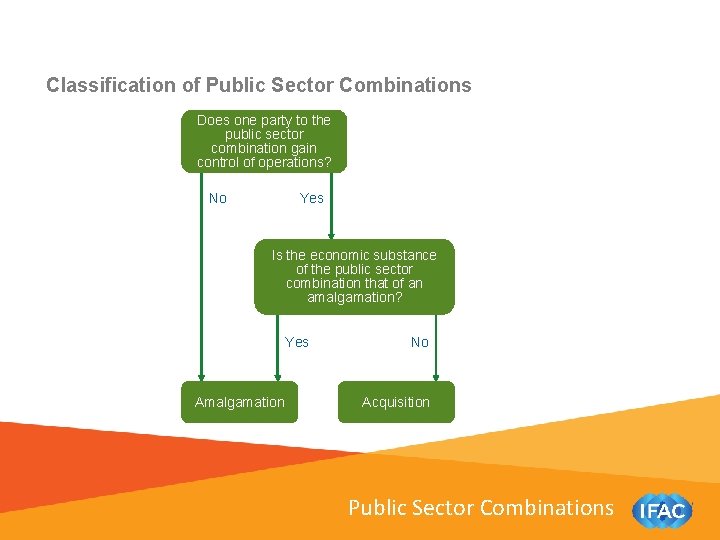
Classification of Public Sector Combinations Does one party to the public sector combination gain control of operations? No Yes Is the economic substance of the public sector combination that of an amalgamation? Yes Amalgamation No Acquisition Public Sector Combinations
Entity Gains Control An entity gains control of an operation if and only if the entity gains all the following: (a) Power over the operation (b) Exposure, or rights, to variable benefits from its involvement with the operation (c) The ability to use its power over the operation to affect the nature or amount of the benefits from its involvement with the operation Public Sector Combinations
Assessing the Economic Substance of a Combination • Consideration • Other than to compensate for transfer of net assets • No consideration paid • No (former) owners • Decision Making • Under common control • Imposed by third party • Approval by referenda Public Sector Combinations
Example 1 The territorial boundaries of two existing municipalities, A and B, are redrawn by Parliament through legislation; neither Parliament nor Central Government controls A or B. Responsibility for part of each municipality’s former territory is transferred to a new municipality, C. Operations in respect of the transferred territories are combined to form C. A and B remain otherwise unchanged and retain their governing bodies. A new governing body (unrelated to the governing bodies of A and B) is elected for C to manage the operations that are transferred from the other municipalities. Should this public sector combination be classified as an amalgamation or an acquisition? Public Sector Combinations
Example 2 The Primary School Nutrition operation is transferred from the Government’s Department of Health to its Department of Education. Both departments are controlled by the Government prior to and after the combination. As the Government controls the same operations both before and after the public sector combination, the Government does not report a combination in its consolidated financial statements. The combination is reported by the Department of Education. Should this public sector combination be classified as an amalgamation or an acquisition? Public Sector Combinations
Accounting for Amalgamations • The resulting entity accounts for each amalgamation by applying the modified pooling of interests method of accounting. • The resulting entity is defined as “the entity that is the result of two or more operations combining in an amalgamation. ” Public Sector Combinations
Modified Pooling of Interests Method • Identify the resulting entity • Determine the amalgamation date • Recognize and measure the assets received, the liabilities assumed any non-controlling interest in the combining operations; and • Recognize and measure components of net assets/equity and other adjustments. Public Sector Combinations
Accounting for Acquisitions • The acquirer accounts for each acquisition by applying the acquisition method of accounting. • The acquirer is the entity that gains control of one or more operations in an acquisition. Public Sector Combinations
Acquisition Method • Identify the acquirer; • Determine the acquisition date; • Recognize and measure the identifiable assets acquired, the liabilities assumed any non-controlling interest in the acquired operation; and • Recognize and measure goodwill, a gain or a loss from an acquisition. Public Sector Combinations
Disclosures • The resulting entity discloses information that enables users of its financial statements to evaluate the nature and financial effect of an amalgamation • The acquirer discloses information that enables users of its financial statements to evaluate the nature and financial effect of an acquisition that occurs either: • During the current reporting period; or • After the end of the reporting period but before the financial statements are authorized for issue. Public Sector Combinations
Questions and Discussion • Visit the IPSASB web site http: //www. ipsasb. org Public Sector Combinations
- Slides: 18