
Public Sector Accounting Part 1 Introduction to Public
Public Sector Accounting Part 1 Introduction to Public Sector Accounting 1
BOOKS: PUBLIC SECTOR ACCOUNTING, ROWAN JONES AKUNTANSI SEKTOR PUBLIK, MARDIASMO
WHAT IS PUBLIC SECTOR? Ø “Those industries and services in a country that are owned and run by the state, such as (by many countries) the education services and the railways …” Longman Dictionary of Contemporary English Ø “a device for regulating human activities so that man and women can live together in reasonable harmony… Derbyshire (1987) Ø “any entities, established owned by central, state or local government and any entity established under any Act of Parliament, which requires the presentation of the annual financial statement to the Parliament…” MACPA Guideline No. 1 1990 3
Forms of Government &Absolute monarchy One person rule &Aristocracy wealthy minority rule &Democracy based on a belief in the value of the individual eg choice of selecting representatives Make criticism? Rights being protected? Taking part in politics? Public interest is a priority? 4 June 2004
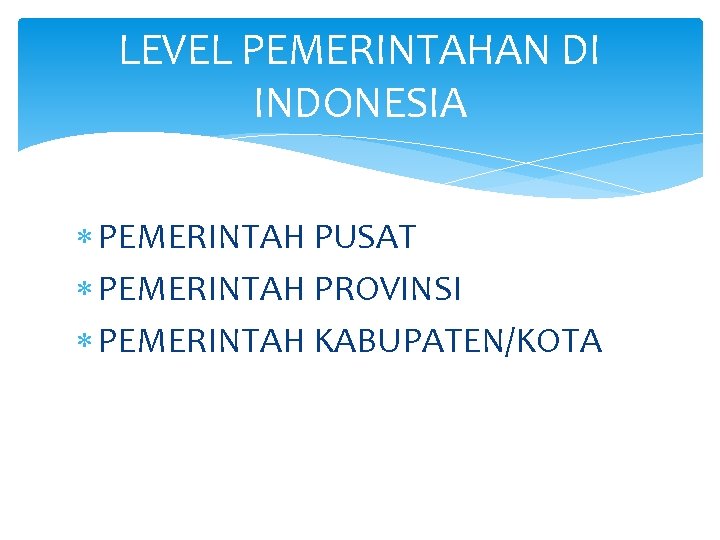
LEVEL PEMERINTAHAN DI INDONESIA PEMERINTAH PUSAT PEMERINTAH PROVINSI PEMERINTAH KABUPATEN/KOTA
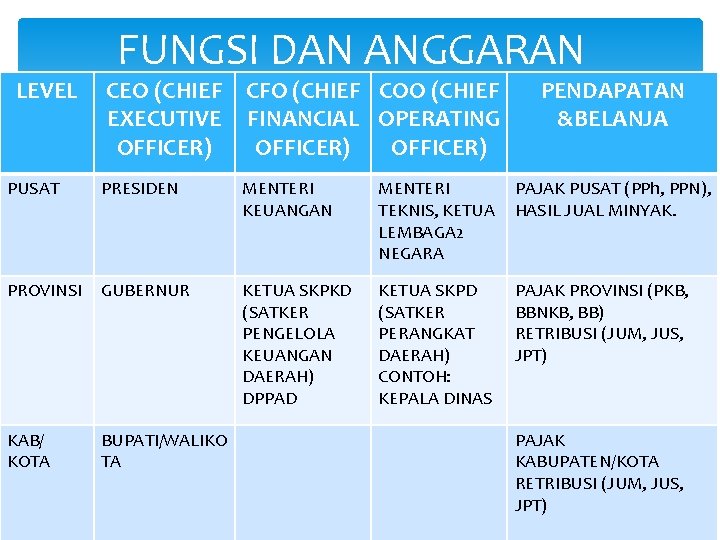
LEVEL FUNGSI DAN ANGGARAN CEO (CHIEF CFO (CHIEF COO (CHIEF EXECUTIVE FINANCIAL OPERATING OFFICER) PENDAPATAN &BELANJA PUSAT PRESIDEN MENTERI KEUANGAN MENTERI TEKNIS, KETUA LEMBAGA 2 NEGARA PAJAK PUSAT (PPh, PPN), HASIL JUAL MINYAK. PROVINSI GUBERNUR KETUA SKPKD (SATKER PENGELOLA KEUANGAN DAERAH) DPPAD KETUA SKPD (SATKER PERANGKAT DAERAH) CONTOH: KEPALA DINAS PAJAK PROVINSI (PKB, BBNKB, BB) RETRIBUSI (JUM, JUS, JPT) KAB/ KOTA BUPATI/WALIKO TA PAJAK KABUPATEN/KOTA RETRIBUSI (JUM, JUS, JPT)
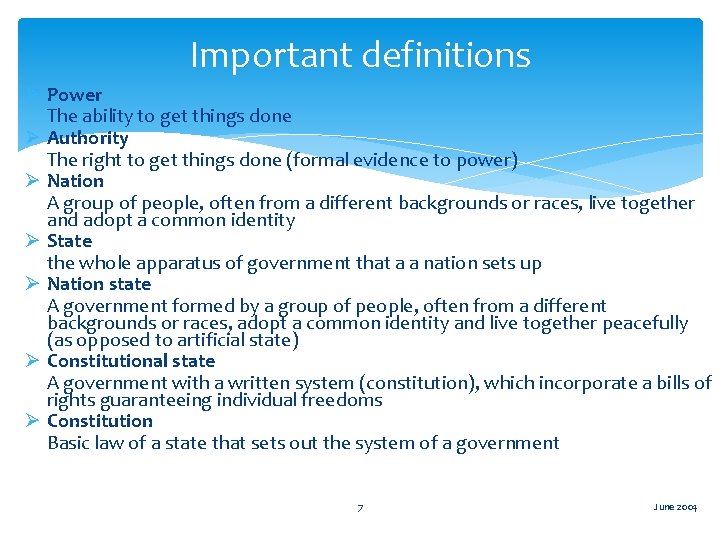
Important definitions Ø Power The ability to get things done Ø Authority The right to get things done (formal evidence to power) Ø Nation A group of people, often from a different backgrounds or races, live together and adopt a common identity Ø State the whole apparatus of government that a a nation sets up Ø Nation state A government formed by a group of people, often from a different backgrounds or races, adopt a common identity and live together peacefully (as opposed to artificial state) Ø Constitutional state A government with a written system (constitution), which incorporate a bills of rights guaranteeing individual freedoms Ø Constitution Basic law of a state that sets out the system of a government 7 June 2004

Objectives of Public Sector To preserve law and order minimum interference in social affair; Regulating aspects of industry and economy; The provision of services and public goods to the society or the people; FDefence, security, law, health, education, transportation, international diplomacy etc. FVarious agencies, government departments and public enterprises were set up to realise the provision of the services and public goods FPublic administration, defence, internal security and laws 8 June 2004

Features of Public Sector J No individual shares of ownership J Operate within a framework of public authorization and control J Plurality of objectives J No direct financial interest or benefits to the contributors of resources J Varying accounting principles and practices J Political rather than financial control 9 June 2004

Components of Public Sector Central Government FMinistries FGovernment Departments FStatutory Bodies FNon-statutory Bodies (Government linked companies (GLCs)) Province Government FState Departments FStatutory Bodies Local Government FCity Council FMunicipal Council FDistrict Council 10 June 2004
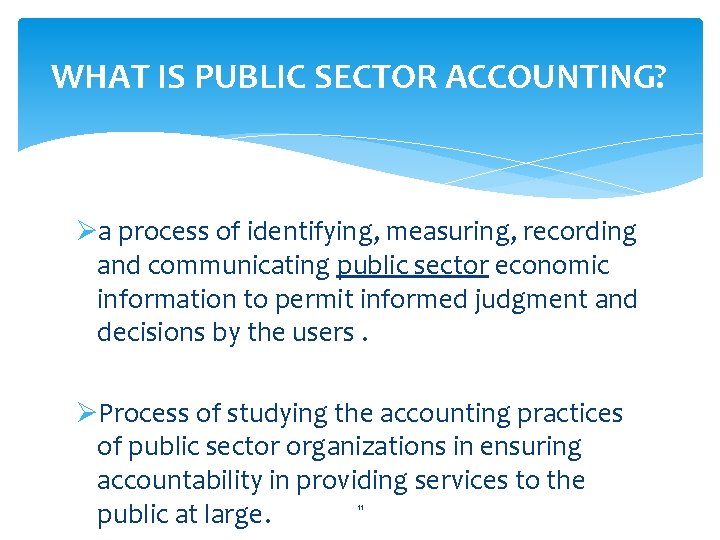
WHAT IS PUBLIC SECTOR ACCOUNTING? Øa process of identifying, measuring, recording and communicating public sector economic information to permit informed judgment and decisions by the users. ØProcess of studying the accounting practices of public sector organizations in ensuring accountability in providing services to the public at large. 11
Objectives of PSA To execute the function of custodianship and stewardship over public resources To discharge public accountability over all kind of public resources To establish an appropriate accounting system for the purpose of accounting public monies and assets 12
Economy, Effectiveness and Efficiency (3 Es) LEconomy Concern with inputs (costs) A relative measure LEffectiveness The meeting of certain objectives – concern only with outputs A relative measure LEfficiency The most important concept and all-embracing of the three Efficiency can be measured by ratio OUTPUT/INPUT or INPUT/OUTPUT e. g ROCE = Profit/Capital Employed 13
3 Es 4 ways to improve efficiency: i. increasing output of the same input ii. Increasing output by a greater proportion than the proportionate increase in input iii. Decreasing input for the same output iv. Decreasing input by a greater proportion than a proportionate decrease in output
3 Es § In theory, ‘efficiency’ provides the basis of relative performance evaluation § There are problems in comparability as public sectors are different in size, nature and objectives § Factors to be considered in making comparison of performance of public sectors: § § § Quality of services? Performance over time? Performance of geographical areas? Reliability of financial information? Differences in political and ideological belief? 15
LEGAL BASIS v v v v v UU No. 17/2003 tentang Keuangan Negara; UU No. 1/2004 tentang Perbendaharaan Negara; UU No. 15/2004 tentang Pemeriksaan Pengelolaan dan Tanggung Jawab Keuangan Negara; UU No. 25/2004 tentang Sistem Perencanaan Pembangunan Nasional; UU No. 32/2004 tentang Pemerintahan Daerah; UU No. 33/2004 tentang Perimbangan Keuangan antara Pemerintah Pusat dan Pemerintahan Daerah; PP No. 23/2005 tentang Pengelolaan Keuangan BLU; PP No. 24/2005 tentang Standar Akuntansi Pemerintahan; PP No. 58/2005 tentang Pengelolaan Keuangan Daerah; PP No. 8/2006 tentang Pelaporan Keuangan dan Kinerja Instansi Pemerintah. 16
RUANG LINGKUP KEUANGAN DAERAH a. hak daerah memungut pajak-retribusi daerah & melakukan pinjaman b. kewajiban daerah menyelenggarakan urusan pemerintahan daerah dan membayar tagihan c. penerimaan daerah d. pengeluaran daerah e. kekayaan daerah yang dikelola sendiri atau oleh pihak lain: uang, surat berharga, piutang, barang, serta hak-hak lain f. kekayaan pihak lain yang dikuasai oleh pemerintah daerah 17
ASAS UMUM v v Akuntabiltas : keuangan & kinerja Profesionalitas: di lingkungan pengelola keuangan & pengguna anggaran/barang v v v Proporsionalitas: alokasi sesuai target kinerja Keterbukaan Pemeriksaan secara independen 18
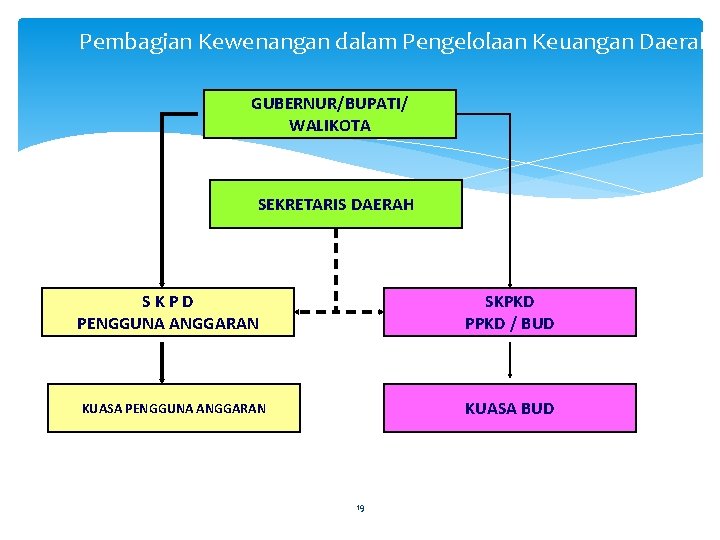
Pembagian Kewenangan dalam Pengelolaan Keuangan Daerah GUBERNUR/BUPATI/ WALIKOTA SEKRETARIS DAERAH SKPD PENGGUNA ANGGARAN SKPKD PPKD / BUD KUASA PENGGUNA ANGGARAN 19
KEKUASAAN PKD ü ü ü Kepala SKPKD selaku pejabat pengelola keuangan daerah/PPKD Kepala Satuan Kerja Perangkat Daerah/SKPD selaku pejabat Pengguna Anggaran/Barang Daerah Sekretaris Daerah selaku koordinator (PP 58/2005) 20
SIKLUS PKD ü ü ü Penganggaran Pelaksanaan Anggaran/Perbendaharaan Akuntansi Pemeriksaan Pertanggungjawaban 21
PENDEKATAN PERENCANAAN DAN PENGANGGARAN ü ü ü Terintegrasi Penyatuan Anggaran Berbasis Kinerja Kerangka Pengeluaran Jangka Menengah (KPJM) Klasifikasi: fungsi, organisasi, jenis 22
PELAKSANAAN ANGGARAN Berdasar DIPA/DPA-SKPD ü Untuk daerah diperlukan Surat Penyediaan Dana (SPD) ü Pendapatan diakui setelah masuk ke rekening Kas Umum Daerah ü Sistem pembayaran: ü ü Dana kas kecil (Uang Persediaan/UP) ü Pembayaran Langsung (LS) 23
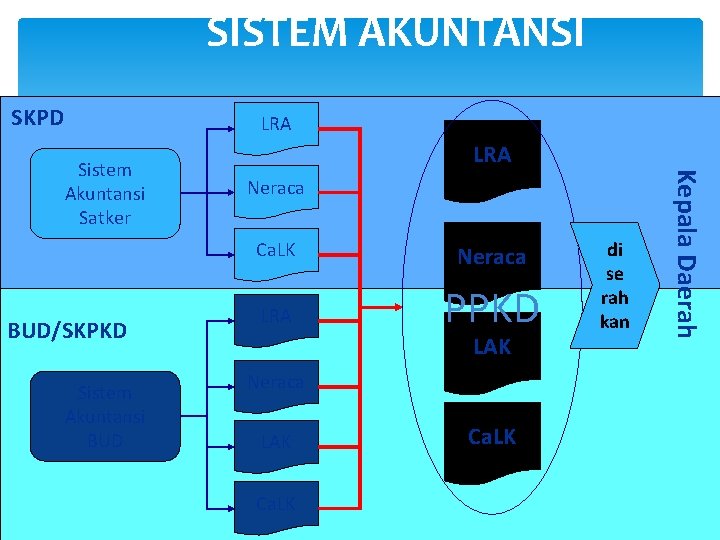
SISTEM AKUNTANSI SKPD LRA BUD/SKPKD Sistem Akuntansi BUD LRA Neraca Ca. LK Neraca LRA PPKD LAK Neraca Ca. LK LAK Ca. LK 24 di se rah kan Kepala Daerah Sistem Akuntansi Satker
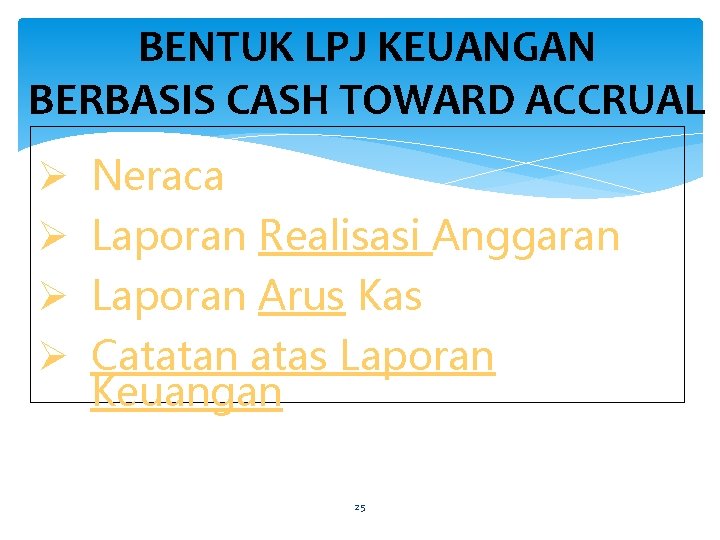
BENTUK LPJ KEUANGAN BERBASIS CASH TOWARD ACCRUAL Ø Ø Neraca Laporan Realisasi Anggaran Laporan Arus Kas Catatan atas Laporan Keuangan 25
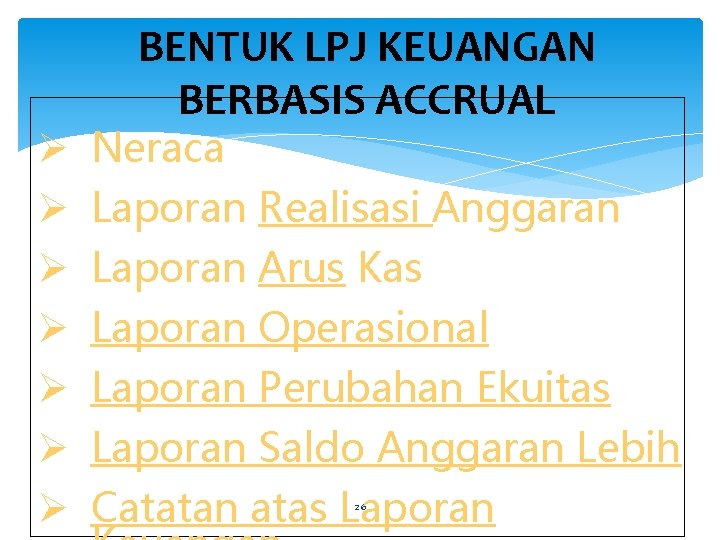
Ø Ø Ø Ø BENTUK LPJ KEUANGAN BERBASIS ACCRUAL Neraca Laporan Realisasi Anggaran Laporan Arus Kas Laporan Operasional Laporan Perubahan Ekuitas Laporan Saldo Anggaran Lebih Catatan atas Laporan 26
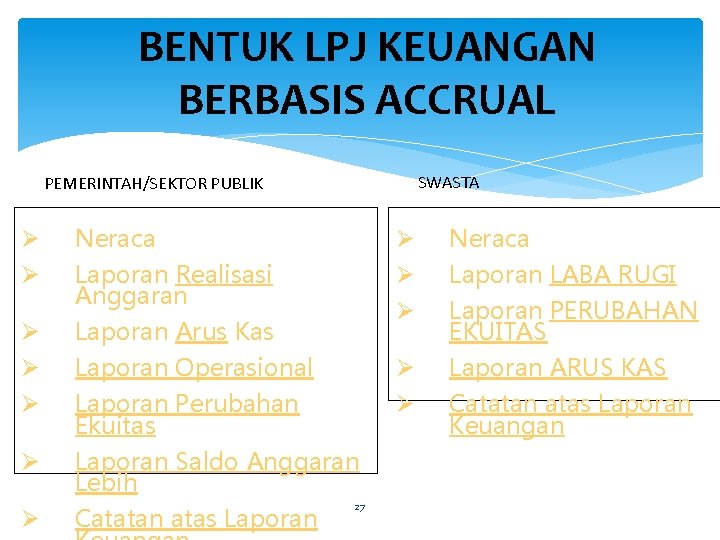
BENTUK LPJ KEUANGAN BERBASIS ACCRUAL SWASTA PEMERINTAH/SEKTOR PUBLIK Ø Ø Ø Ø Neraca Laporan Realisasi Anggaran Laporan Arus Kas Laporan Operasional Laporan Perubahan Ekuitas Laporan Saldo Anggaran Lebih 27 Catatan atas Laporan Ø Ø Ø Neraca Laporan LABA RUGI Laporan PERUBAHAN EKUITAS Laporan ARUS KAS Catatan atas Laporan Keuangan
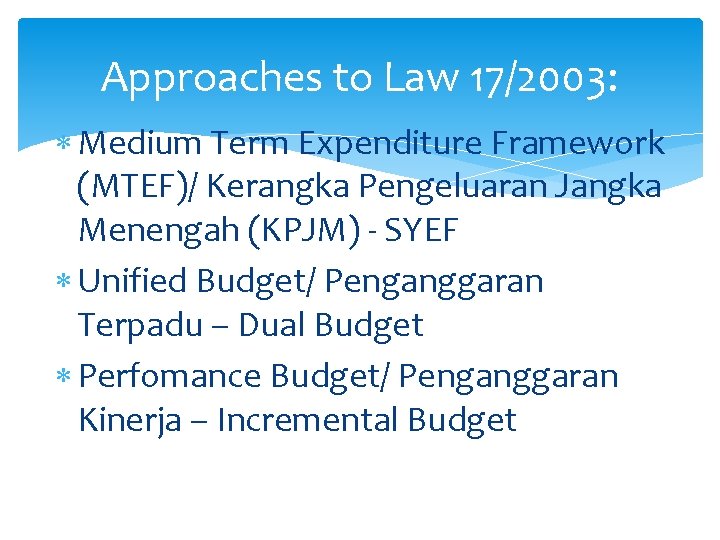
Approaches to Law 17/2003: Medium Term Expenditure Framework (MTEF)/ Kerangka Pengeluaran Jangka Menengah (KPJM) - SYEF Unified Budget/ Penganggaran Terpadu – Dual Budget Perfomance Budget/ Penganggaran Kinerja – Incremental Budget
COMPARISON BETWEEN PUBLIC AND PRIVATE SECTOR ACCOUNTING
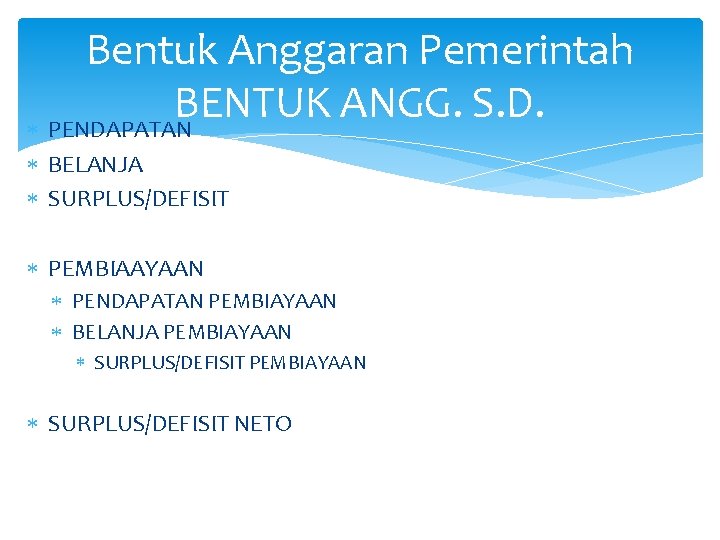
Bentuk Anggaran Pemerintah BENTUK ANGG. S. D. PENDAPATAN BELANJA SURPLUS/DEFISIT PEMBIAAYAAN PENDAPATAN PEMBIAYAAN BELANJA PEMBIAYAAN SURPLUS/DEFISIT NETO
TUGAS MERINGKAS UU 17 TAHUN 2003 DAN PP 71 TAHUN 2010. RINGKASAN TUGAS DIPOSTING DI Omanrusmana. blog. unsoed. ac. id Sertakan alamat email jika posting.
- Slides: 31