
PUBLIC REPORTING AND DISCLOSURE OF HAI RATES POSITIVE
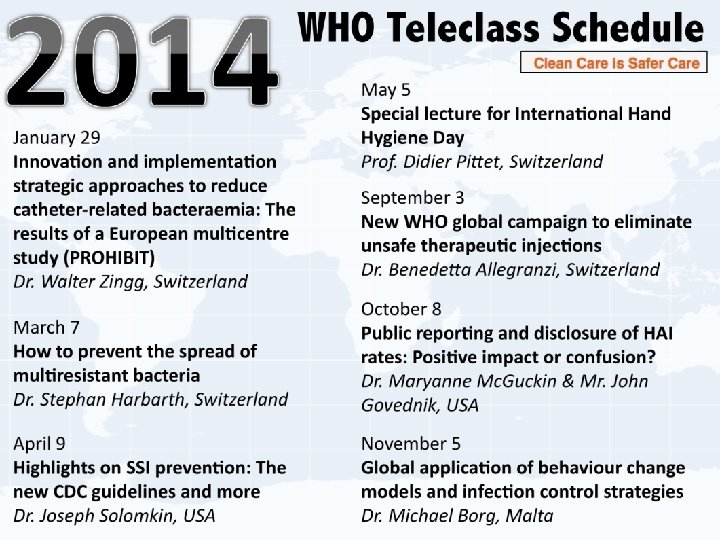
PUBLIC REPORTING AND DISCLOSURE OF HAI RATES: POSITIVE IMPACT OR CONFUSION? MARYANNE MCGUCKIN, DR. SCED, FSHEA JOHN GOVEDNIK, MS PROJECT TEAM/CO-AUTHORS: DAVID HYMAN, MD, JD, BERNARD BLACK, JD, MS JESSICA BUNSON, MT (ASCP), MS, CIC Hosted by Dr. Walter Zingg Hôpitaux Universitaires de Genève SUPPORT FOR THIS STUDY WAS PROVIDED BY A GRANT FROM THE ROBERT WOOD JOHNSON FOUNDATION’S PUBLIC HEALTH LAW RESEARCH PROGRAM. THE PRESENTERS HAVE NOTHING TO DISCLOSE. Sponsored by WHO Patient Safety Challenge Clean Care is Safer Care www. webbertraining. com October 8, 2014
OUTLINE 1. 2. 3. 4. 5. 6. Background /Study Components Infection Preventionist perspectives Epidemiologist perspectives State HAI Coordinator perspectives Consumer websites usability Consumer awareness, engagement, and intent © MCGUCKIN METHODS INTERNATIONAL, INC. WWW. MCGUCKINMETHODS. COM 2
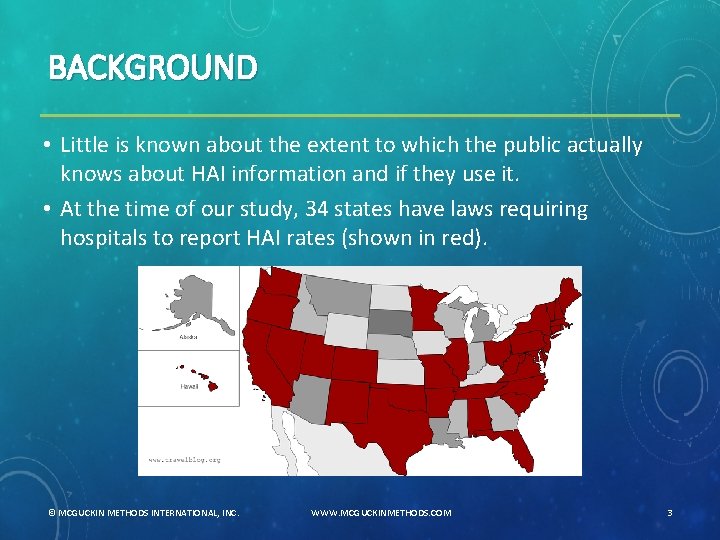
BACKGROUND • Little is known about the extent to which the public actually knows about HAI information and if they use it. • At the time of our study, 34 states have laws requiring hospitals to report HAI rates (shown in red). © MCGUCKIN METHODS INTERNATIONAL, INC. WWW. MCGUCKINMETHODS. COM 3
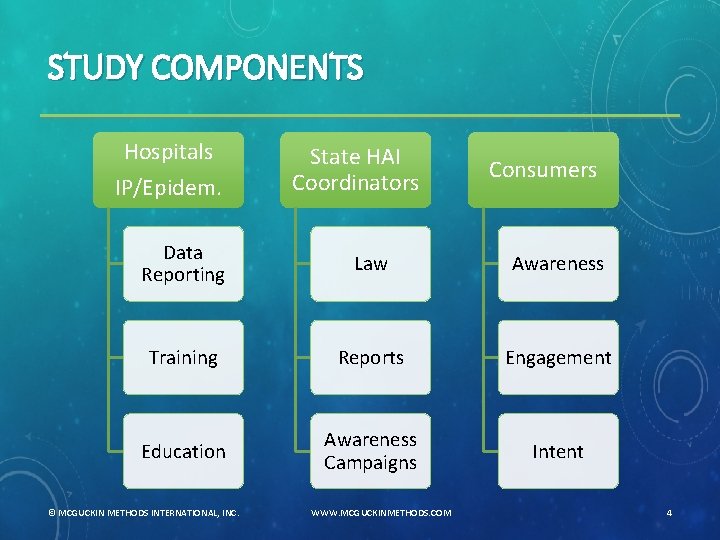
STUDY COMPONENTS Hospitals IP/Epidem. State HAI Coordinators Consumers Data Reporting Law Awareness Training Reports Engagement Education Awareness Campaigns Intent © MCGUCKIN METHODS INTERNATIONAL, INC. WWW. MCGUCKINMETHODS. COM 4

STUDY COMPONENTS Hospitals IP/Epidem. State HAI Coordinators Consumers Data Reporting Law Awareness Training Reports Engagement Education Awareness Campaigns Intent © MCGUCKIN METHODS INTERNATIONAL, INC. WWW. MCGUCKINMETHODS. COM 5
INFECTION PREVENTIONIST INTERVIEWS WHY: - Key process stakeholders - State comparisons HOW: - Phone interviews WHO: - By Ms. Bunson, IP, CIC - APIC Chapter Presidents - MMI’s IP Consortium © MCGUCKIN METHODS INTERNATIONAL, INC. WWW. MCGUCKINMETHODS. COM 6
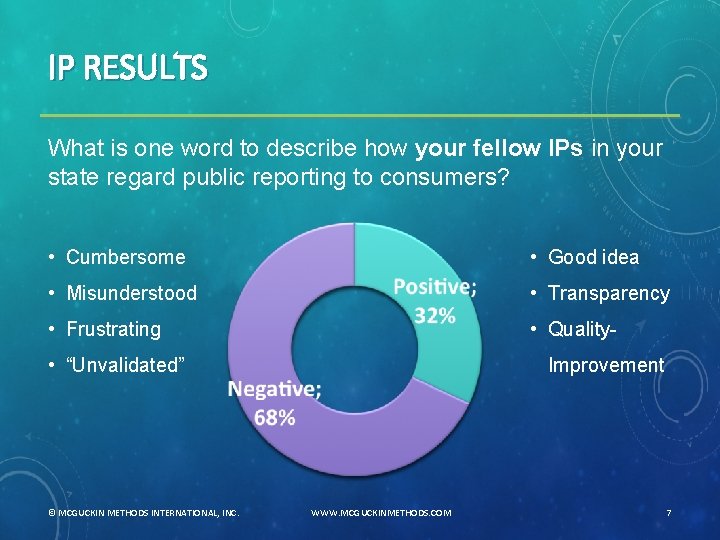
IP RESULTS What is one word to describe how your fellow IPs in your state regard public reporting to consumers? • Cumbersome • Good idea • Misunderstood • Transparency • Frustrating • Quality- • “Unvalidated” © MCGUCKIN METHODS INTERNATIONAL, INC. Improvement WWW. MCGUCKINMETHODS. COM 7
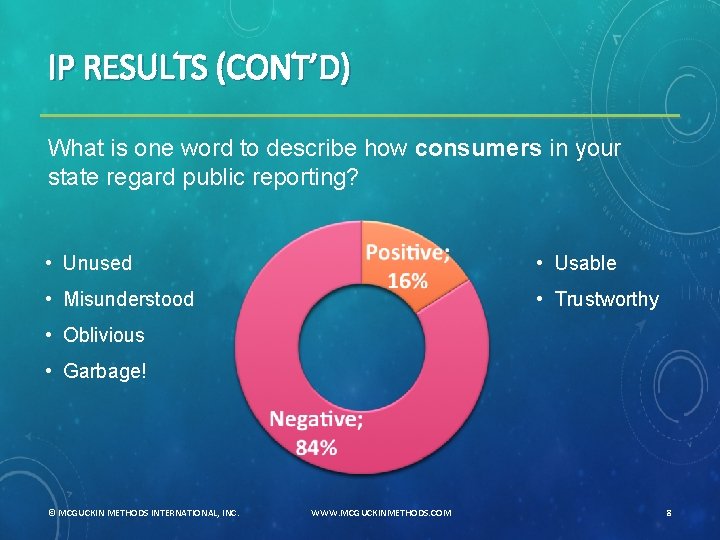
IP RESULTS (CONT’D) What is one word to describe how consumers in your state regard public reporting? • Unused • Usable • Misunderstood • Trustworthy • Oblivious • Garbage! © MCGUCKIN METHODS INTERNATIONAL, INC. WWW. MCGUCKINMETHODS. COM 8
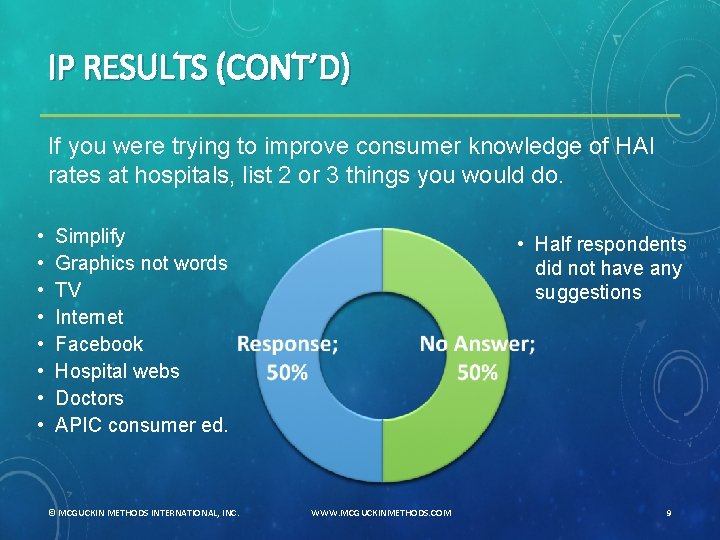
IP RESULTS (CONT’D) If you were trying to improve consumer knowledge of HAI rates at hospitals, list 2 or 3 things you would do. • • Simplify Graphics not words TV Internet Facebook Hospital webs Doctors APIC consumer ed. © MCGUCKIN METHODS INTERNATIONAL, INC. • Half respondents did not have any suggestions WWW. MCGUCKINMETHODS. COM 9
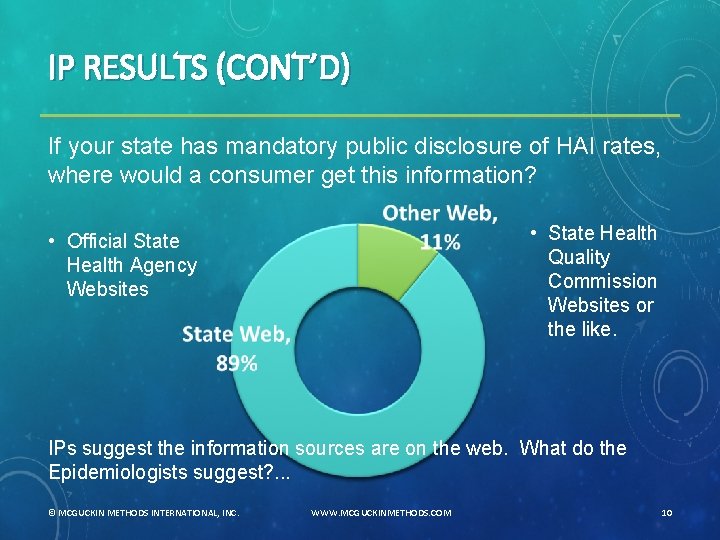
IP RESULTS (CONT’D) If your state has mandatory public disclosure of HAI rates, where would a consumer get this information? • State Health Quality Commission Websites or the like. • Official State Health Agency Websites IPs suggest the information sources are on the web. What do the Epidemiologists suggest? . . . © MCGUCKIN METHODS INTERNATIONAL, INC. WWW. MCGUCKINMETHODS. COM 10
EPIDEMIOLOGIST SURVEY • Partnered with SHEA Research Network • Online survey • Healthcare worker use • Consumer understanding © MCGUCKIN METHODS INTERNATIONAL, INC. WWW. MCGUCKINMETHODS. COM 11
EPIDEMIOLOGIST RESPONSES • 165 invites to SRN members • 53 responses from reporting states 31%: 1 -300 beds 25%: 301 -500 beds 44%: 500+ beds • April-May 2013 © MCGUCKIN METHODS INTERNATIONAL, INC. WWW. MCGUCKINMETHODS. COM 12
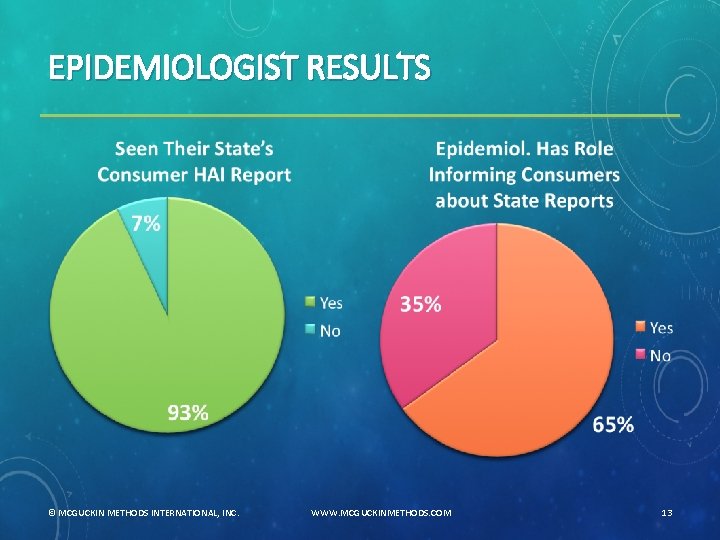
EPIDEMIOLOGIST RESULTS © MCGUCKIN METHODS INTERNATIONAL, INC. WWW. MCGUCKINMETHODS. COM 13
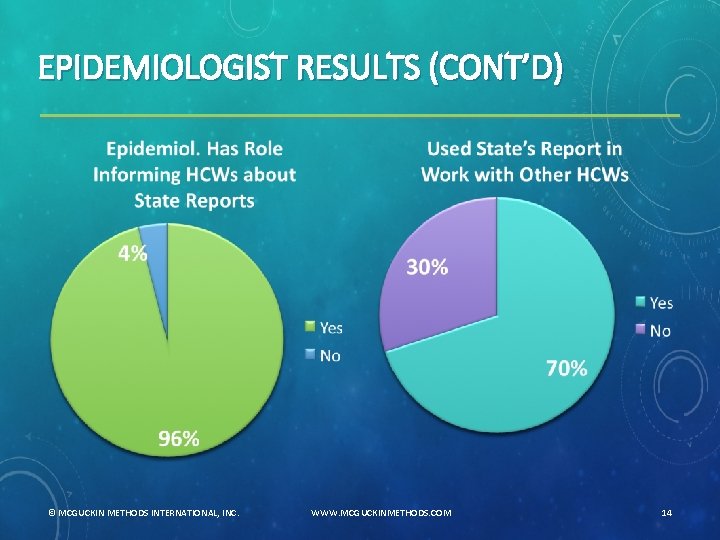
EPIDEMIOLOGIST RESULTS (CONT’D) © MCGUCKIN METHODS INTERNATIONAL, INC. WWW. MCGUCKINMETHODS. COM 14
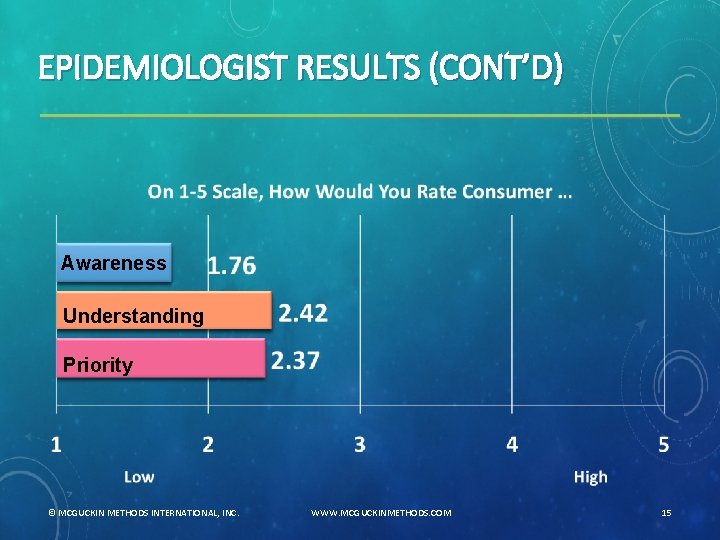
EPIDEMIOLOGIST RESULTS (CONT’D) Awareness Understanding Priority © MCGUCKIN METHODS INTERNATIONAL, INC. WWW. MCGUCKINMETHODS. COM 15
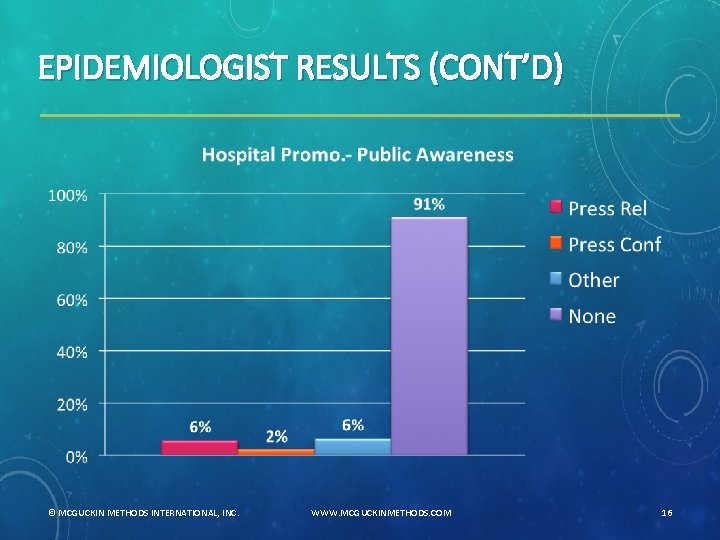
EPIDEMIOLOGIST RESULTS (CONT’D) © MCGUCKIN METHODS INTERNATIONAL, INC. WWW. MCGUCKINMETHODS. COM 16
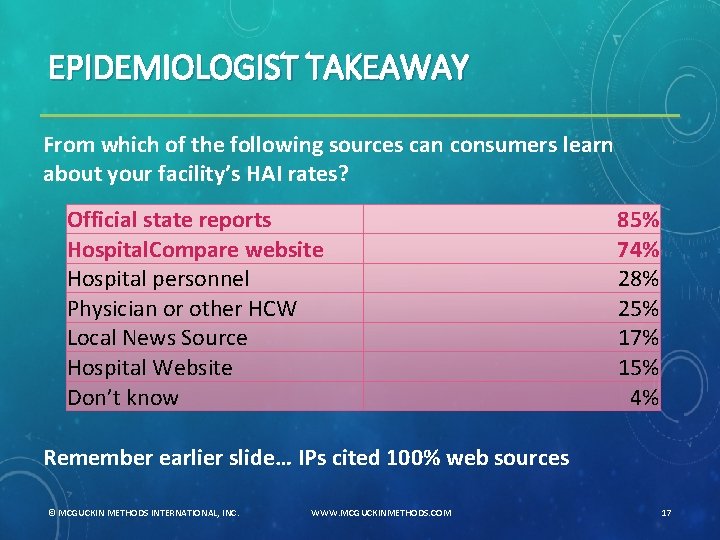
EPIDEMIOLOGIST TAKEAWAY From which of the following sources can consumers learn about your facility’s HAI rates? Official state reports Hospital. Compare website Hospital personnel Physician or other HCW Local News Source Hospital Website Don’t know 85% 74% 28% 25% 17% 15% 4% Remember earlier slide… IPs cited 100% web sources © MCGUCKIN METHODS INTERNATIONAL, INC. WWW. MCGUCKINMETHODS. COM 17
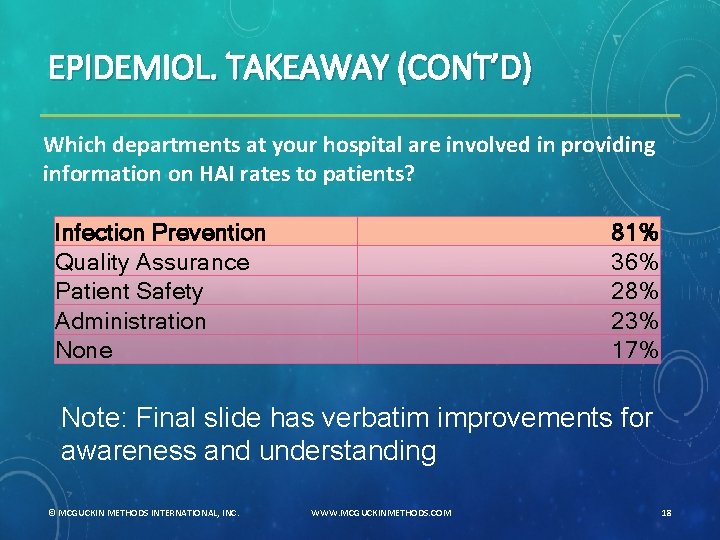
EPIDEMIOL. TAKEAWAY (CONT’D) Which departments at your hospital are involved in providing information on HAI rates to patients? Infection Prevention Quality Assurance Patient Safety Administration None 81% 36% 28% 23% 17% Note: Final slide has verbatim improvements for awareness and understanding © MCGUCKIN METHODS INTERNATIONAL, INC. WWW. MCGUCKINMETHODS. COM 18
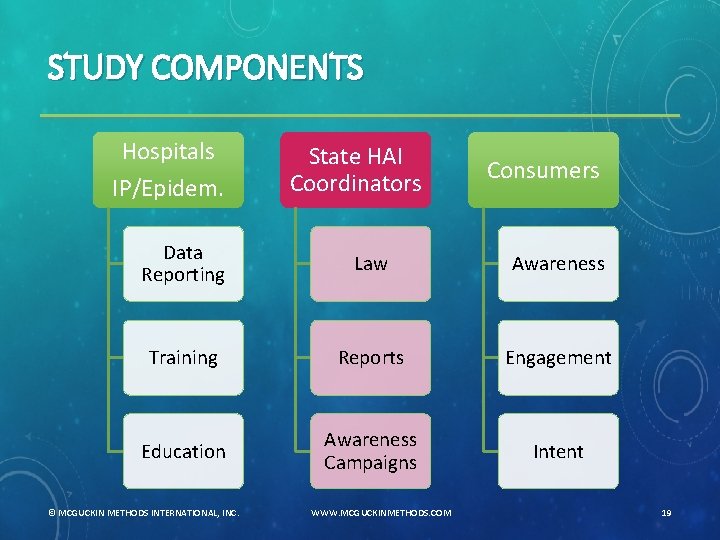
STUDY COMPONENTS Hospitals IP/Epidem. State HAI Coordinators Consumers Data Reporting Law Awareness Training Reports Engagement Education Awareness Campaigns Intent © MCGUCKIN METHODS INTERNATIONAL, INC. WWW. MCGUCKINMETHODS. COM 19
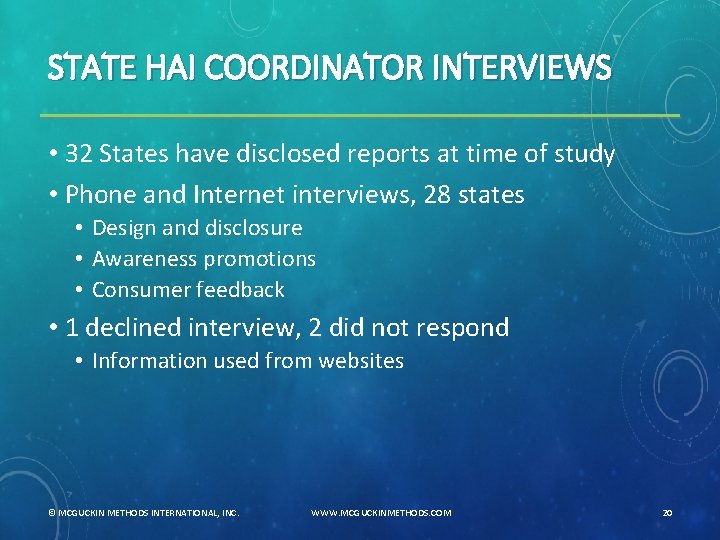
STATE HAI COORDINATOR INTERVIEWS • 32 States have disclosed reports at time of study • Phone and Internet interviews, 28 states • Design and disclosure • Awareness promotions • Consumer feedback • 1 declined interview, 2 did not respond • Information used from websites © MCGUCKIN METHODS INTERNATIONAL, INC. WWW. MCGUCKINMETHODS. COM 20
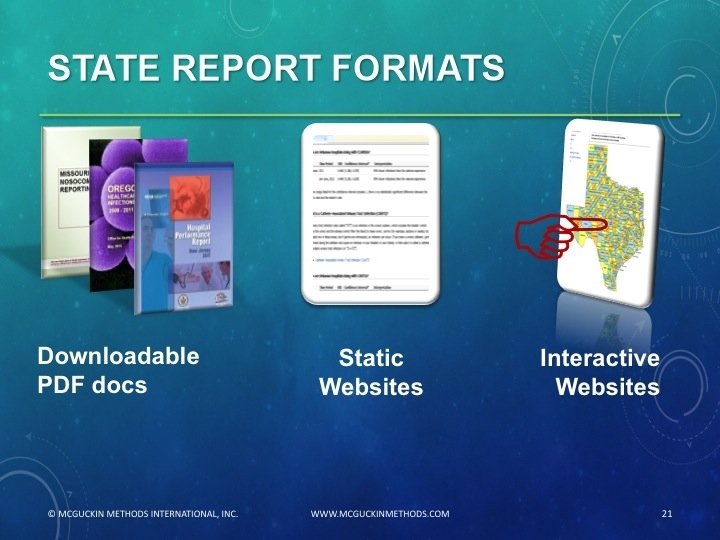
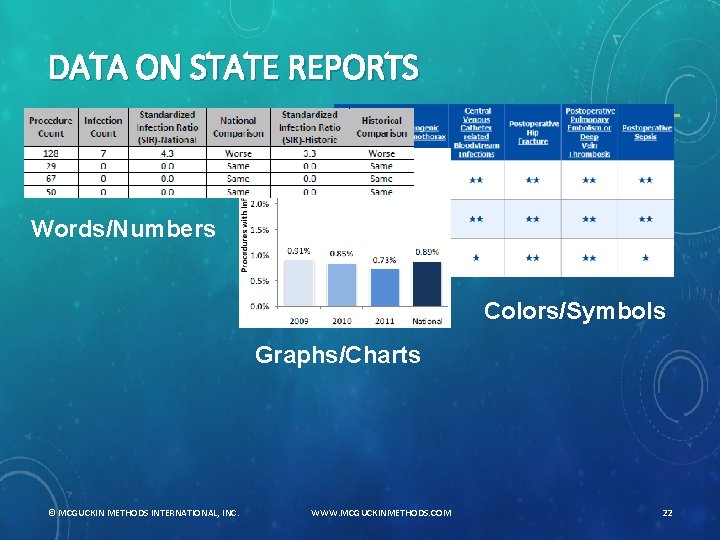
DATA ON STATE REPORTS Words/Numbers Colors/Symbols Graphs/Charts © MCGUCKIN METHODS INTERNATIONAL, INC. WWW. MCGUCKINMETHODS. COM 22
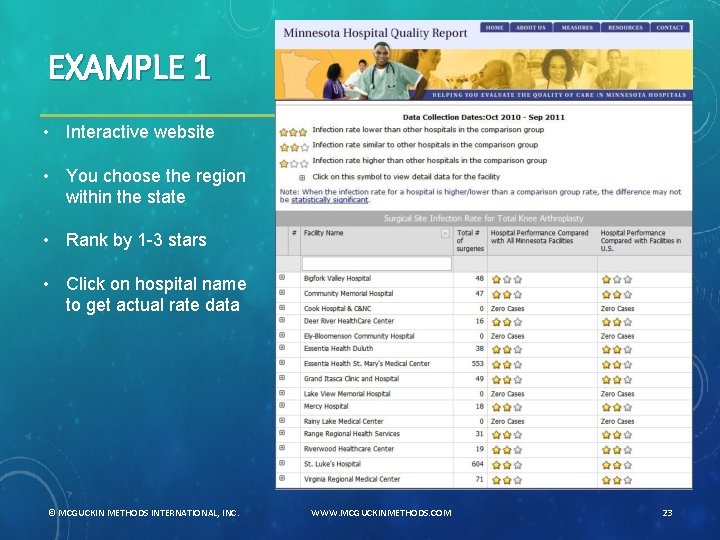
EXAMPLE 1 • Interactive website • You choose the region within the state • Rank by 1 -3 stars • Click on hospital name to get actual rate data © MCGUCKIN METHODS INTERNATIONAL, INC. WWW. MCGUCKINMETHODS. COM 23
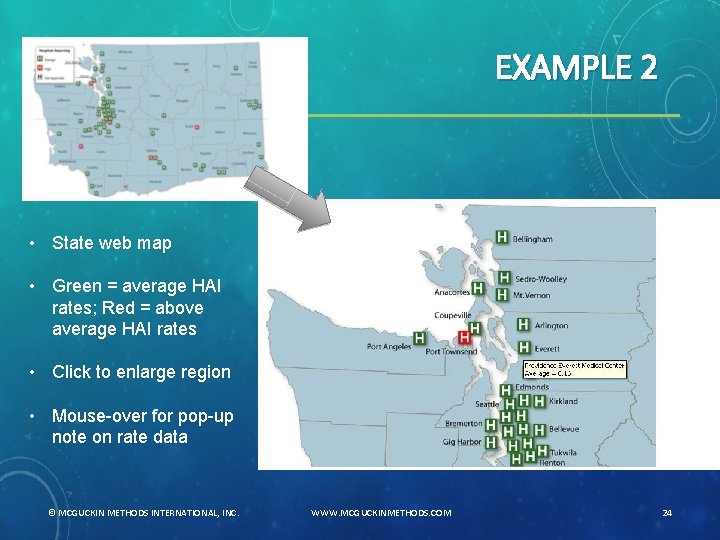
EXAMPLE 2 • State web map • Green = average HAI rates; Red = above average HAI rates • Click to enlarge region • Mouse-over for pop-up note on rate data © MCGUCKIN METHODS INTERNATIONAL, INC. WWW. MCGUCKINMETHODS. COM 24
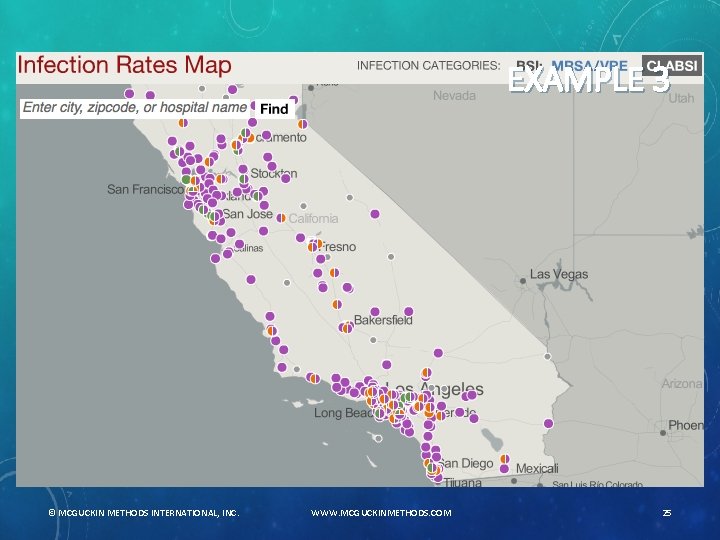
EXAMPLE 3 © MCGUCKIN METHODS INTERNATIONAL, INC. WWW. MCGUCKINMETHODS. COM 25
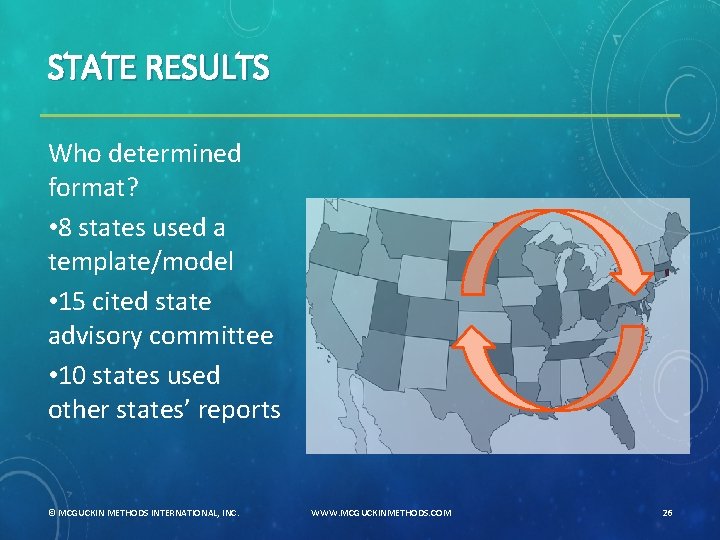
STATE RESULTS Who determined format? • 8 states used a template/model • 15 cited state advisory committee • 10 states used other states’ reports © MCGUCKIN METHODS INTERNATIONAL, INC. WWW. MCGUCKINMETHODS. COM 26
STATE RESULTS (CONT’D) • 25 states have consumers on advisory board • 7 of those had laws requiring consumer participation • 9 Used consumers in report design • Regional panel for multistate • Multiple panels for different educ. levels © MCGUCKIN METHODS INTERNATIONAL, INC. WWW. MCGUCKINMETHODS. COM 27
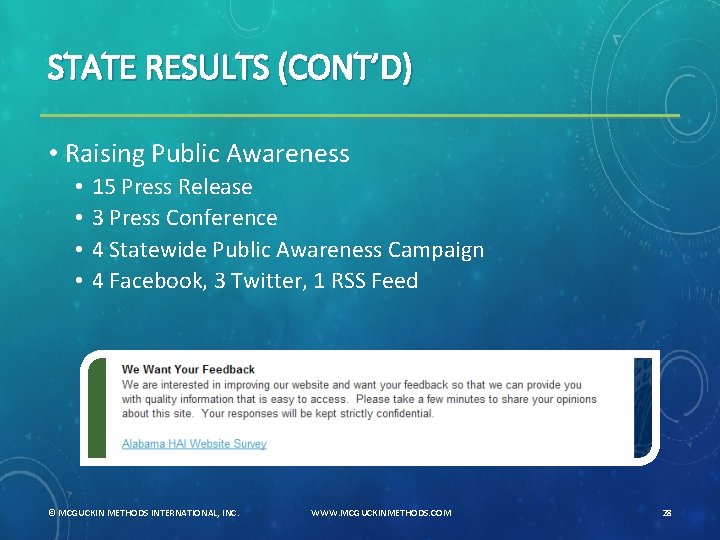
STATE RESULTS (CONT’D) • Raising Public Awareness • • 15 Press Release 3 Press Conference 4 Statewide Public Awareness Campaign 4 Facebook, 3 Twitter, 1 RSS Feed © MCGUCKIN METHODS INTERNATIONAL, INC. WWW. MCGUCKINMETHODS. COM 28
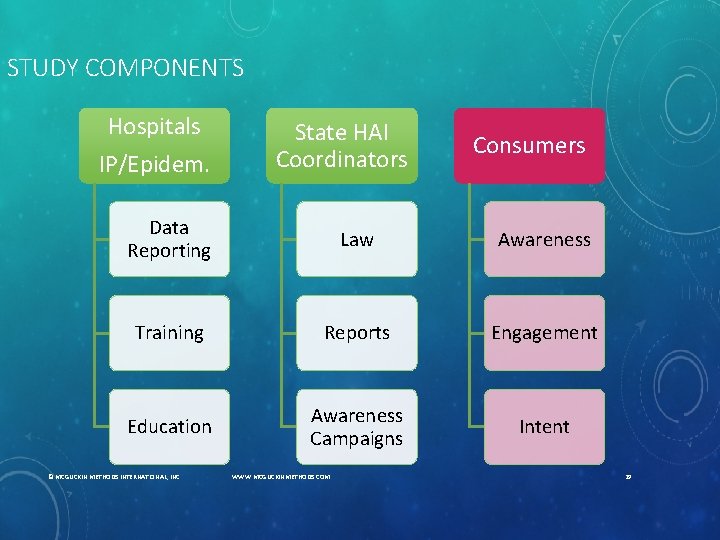
STUDY COMPONENTS Hospitals IP/Epidem. State HAI Coordinators Consumers Data Reporting Law Awareness Training Reports Engagement Education Awareness Campaigns Intent © MCGUCKIN METHODS INTERNATIONAL, INC. WWW. MCGUCKINMETHODS. COM 29
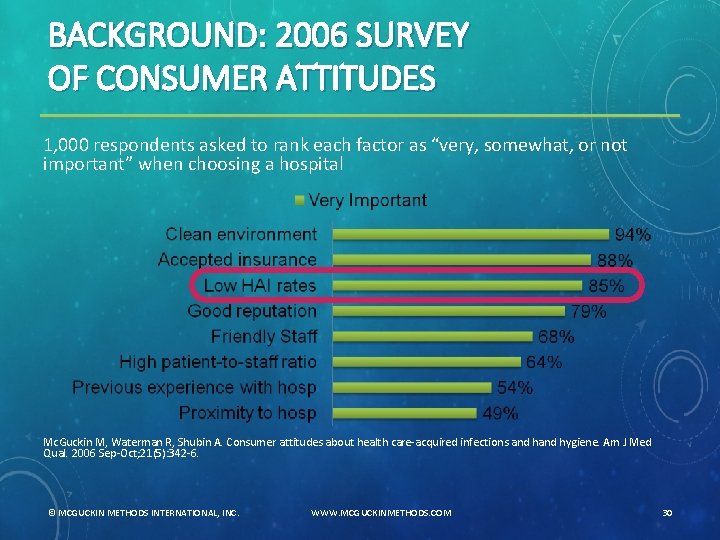
BACKGROUND: 2006 SURVEY OF CONSUMER ATTITUDES 1, 000 respondents asked to rank each factor as “very, somewhat, or not important” when choosing a hospital Mc. Guckin M, Waterman R, Shubin A. Consumer attitudes about health care-acquired infections and hygiene. Am J Med Qual. 2006 Sep-Oct; 21(5): 342 -6. © MCGUCKIN METHODS INTERNATIONAL, INC. WWW. MCGUCKINMETHODS. COM 30
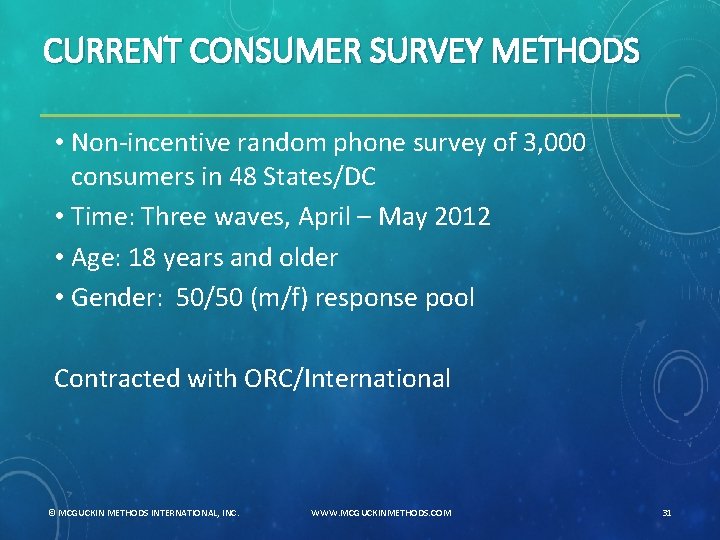
CURRENT CONSUMER SURVEY METHODS • Non-incentive random phone survey of 3, 000 consumers in 48 States/DC • Time: Three waves, April – May 2012 • Age: 18 years and older • Gender: 50/50 (m/f) response pool Contracted with ORC/International © MCGUCKIN METHODS INTERNATIONAL, INC. WWW. MCGUCKINMETHODS. COM 31
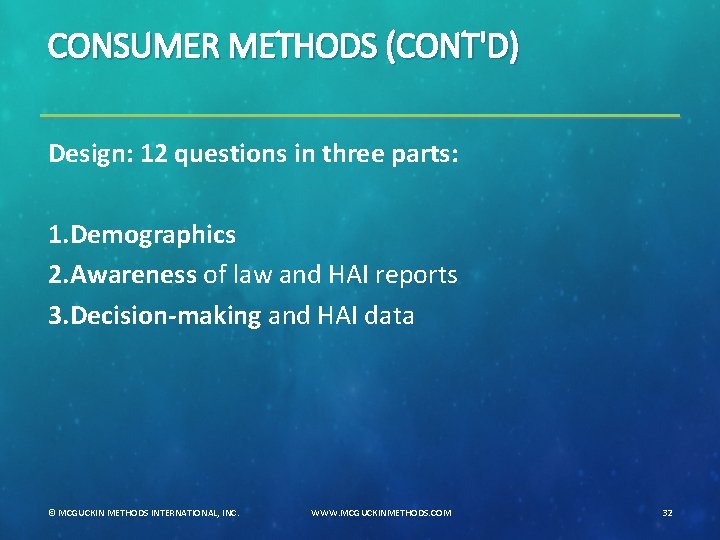
CONSUMER METHODS (CONT'D) Design: 12 questions in three parts: 1. Demographics 2. Awareness of law and HAI reports 3. Decision-making and HAI data © MCGUCKIN METHODS INTERNATIONAL, INC. WWW. MCGUCKINMETHODS. COM 32
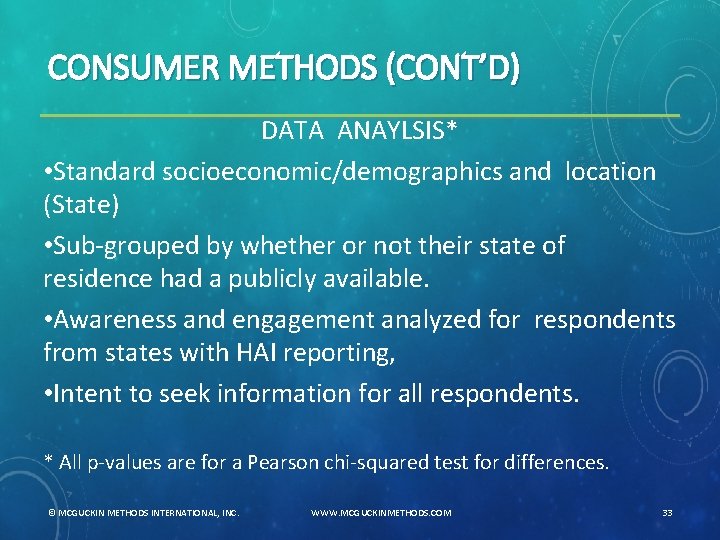
CONSUMER METHODS (CONT’D) DATA ANAYLSIS* • Standard socioeconomic/demographics and location (State) • Sub-grouped by whether or not their state of residence had a publicly available. • Awareness and engagement analyzed for respondents from states with HAI reporting, • Intent to seek information for all respondents. * All p-values are for a Pearson chi-squared test for differences. © MCGUCKIN METHODS INTERNATIONAL, INC. WWW. MCGUCKINMETHODS. COM 33
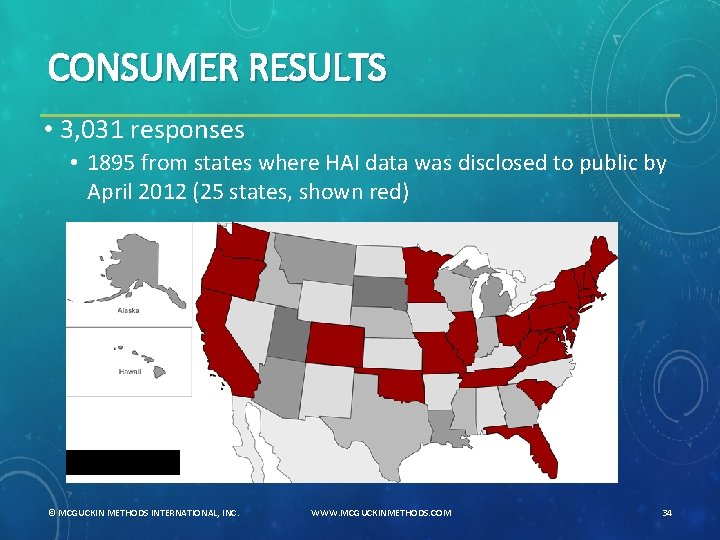
CONSUMER RESULTS • 3, 031 responses • 1895 from states where HAI data was disclosed to public by April 2012 (25 states, shown red) © MCGUCKIN METHODS INTERNATIONAL, INC. WWW. MCGUCKINMETHODS. COM 34
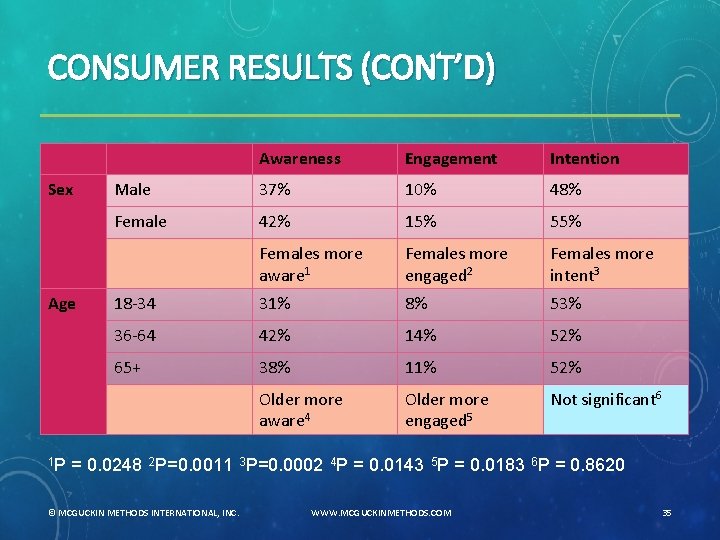
CONSUMER RESULTS (CONT’D) Sex Age 1 P Awareness Engagement Intention Male 37% 10% 48% Female 42% 15% 55% Females more aware 1 Females more engaged 2 Females more intent 3 18 -34 31% 8% 53% 36 -64 42% 14% 52% 65+ 38% 11% 52% Older more aware 4 Older more engaged 5 Not significant 6 = 0. 0248 2 P=0. 0011 3 P=0. 0002 4 P = 0. 0143 5 P = 0. 0183 6 P = 0. 8620 © MCGUCKIN METHODS INTERNATIONAL, INC. WWW. MCGUCKINMETHODS. COM 35
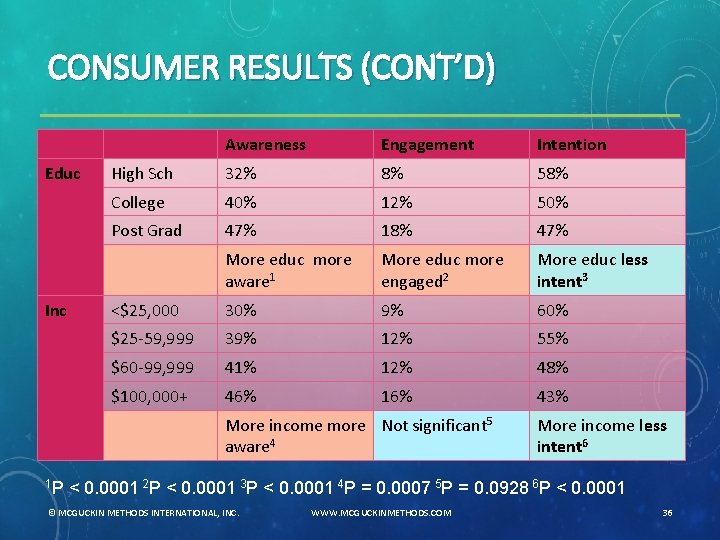
CONSUMER RESULTS (CONT’D) Educ Inc Awareness Engagement Intention High Sch 32% 8% 58% College 40% 12% 50% Post Grad 47% 18% 47% More educ more aware 1 More educ more engaged 2 More educ less intent 3 <$25, 000 30% 9% 60% $25 -59, 999 39% 12% 55% $60 -99, 999 41% 12% 48% $100, 000+ 46% 16% 43% More income more Not significant 5 aware 4 1 P More income less intent 6 < 0. 0001 2 P < 0. 0001 3 P < 0. 0001 4 P = 0. 0007 5 P = 0. 0928 6 P < 0. 0001 © MCGUCKIN METHODS INTERNATIONAL, INC. WWW. MCGUCKINMETHODS. COM 36
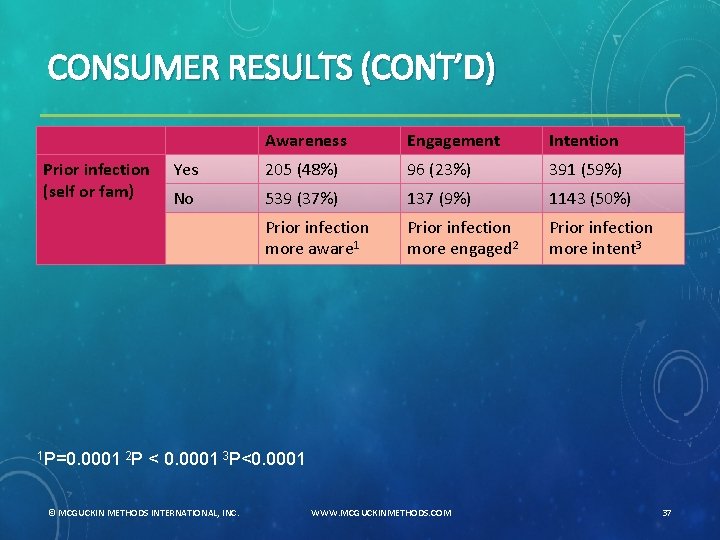
CONSUMER RESULTS (CONT’D) Prior infection (self or fam) 1 P=0. 0001 2 P Awareness Engagement Intention Yes 205 (48%) 96 (23%) 391 (59%) No 539 (37%) 137 (9%) 1143 (50%) Prior infection more aware 1 Prior infection more engaged 2 Prior infection more intent 3 < 0. 0001 3 P<0. 0001 © MCGUCKIN METHODS INTERNATIONAL, INC. WWW. MCGUCKINMETHODS. COM 37
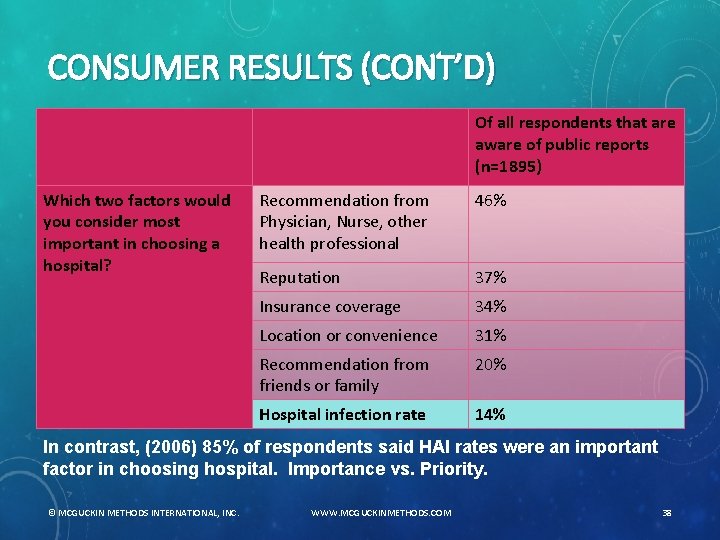
CONSUMER RESULTS (CONT’D) Of all respondents that are aware of public reports (n=1895) Which two factors would you consider most important in choosing a hospital? Recommendation from Physician, Nurse, other health professional 46% Reputation 37% Insurance coverage 34% Location or convenience 31% Recommendation from friends or family 20% Hospital infection rate 14% In contrast, (2006) 85% of respondents said HAI rates were an important factor in choosing hospital. Importance vs. Priority. © MCGUCKIN METHODS INTERNATIONAL, INC. WWW. MCGUCKINMETHODS. COM 38
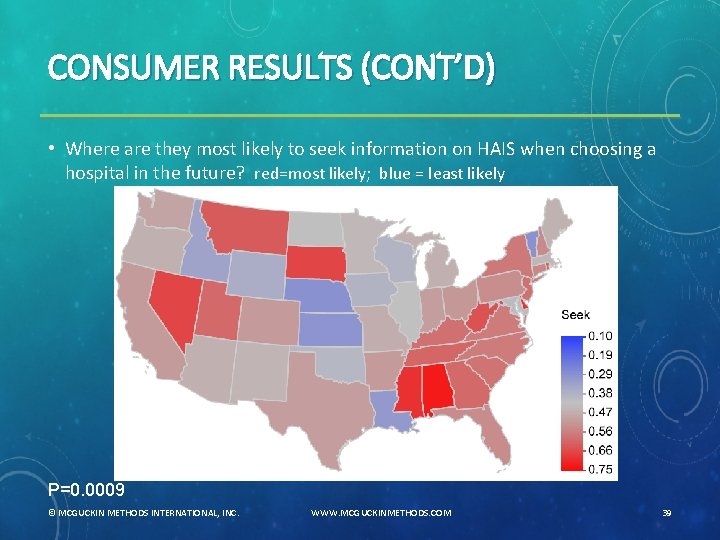
CONSUMER RESULTS (CONT’D) • Where are they most likely to seek information on HAIS when choosing a hospital in the future? red=most likely; blue = least likely P=0. 0009 © MCGUCKIN METHODS INTERNATIONAL, INC. WWW. MCGUCKINMETHODS. COM 39
CONSUMER RESULTS (CONT’D) • What can hospitals do to help move states to have more intent? • • Ownership Consumer empowerment Process Opportunities for APIC chapters © MCGUCKIN METHODS INTERNATIONAL, INC. WWW. MCGUCKINMETHODS. COM 40
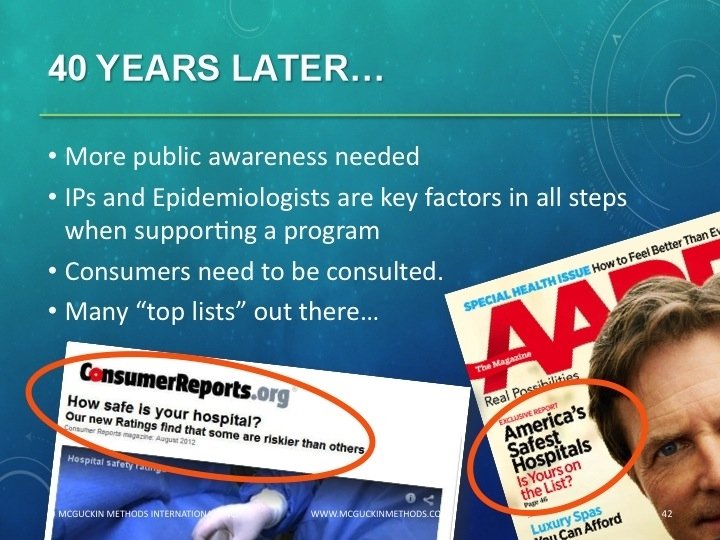
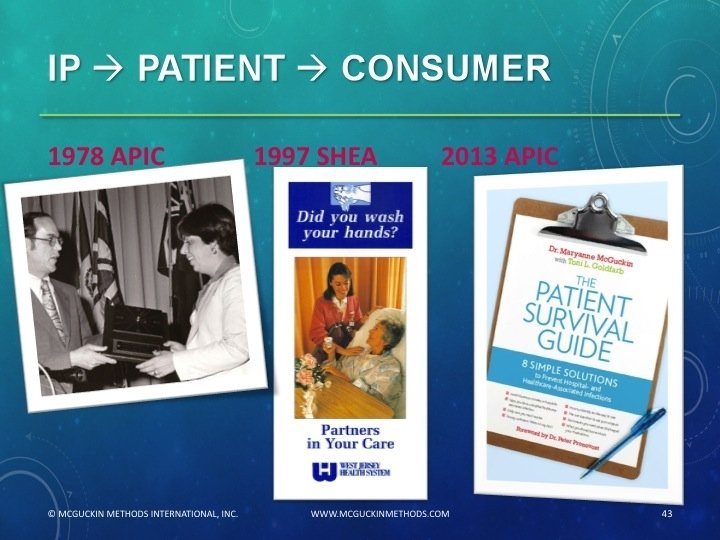
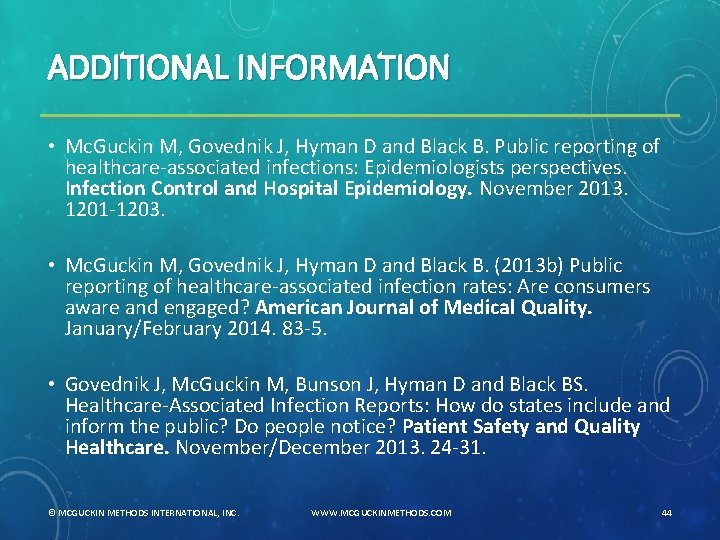
ADDITIONAL INFORMATION • Mc. Guckin M, Govednik J, Hyman D and Black B. Public reporting of healthcare-associated infections: Epidemiologists perspectives. Infection Control and Hospital Epidemiology. November 2013. 1201 -1203. • Mc. Guckin M, Govednik J, Hyman D and Black B. (2013 b) Public reporting of healthcare-associated infection rates: Are consumers aware and engaged? American Journal of Medical Quality. January/February 2014. 83 -5. • Govednik J, Mc. Guckin M, Bunson J, Hyman D and Black BS. Healthcare-Associated Infection Reports: How do states include and inform the public? Do people notice? Patient Safety and Quality Healthcare. November/December 2013. 24 -31. © MCGUCKIN METHODS INTERNATIONAL, INC. WWW. MCGUCKINMETHODS. COM 44
THANK YOU • We thank the Robert Wood Johnson Foundation for their support • RWJF Grant Title: Does Mandatory Public Reporting Affect Hospital Infection Rates? • Grant I. D. : 6375 • Maryanne@mcguckinmethods. com • Govednik@hhreports. com © MCGUCKIN METHODS INTERNATIONAL, INC. WWW. MCGUCKINMETHODS. COM 45
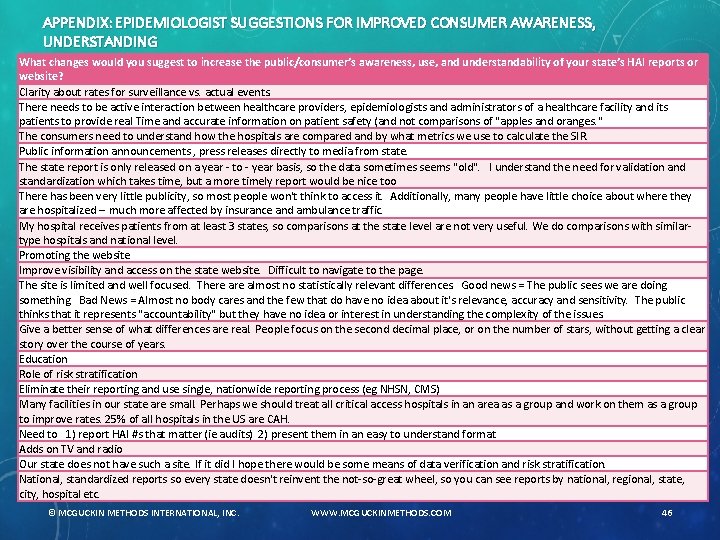
APPENDIX: EPIDEMIOLOGIST SUGGESTIONS FOR IMPROVED CONSUMER AWARENESS, UNDERSTANDING What changes would you suggest to increase the public/consumer’s awareness, use, and understandability of your state’s HAI reports or website? Clarity about rates for surveillance vs. actual events. There needs to be active interaction between healthcare providers, epidemiologists and administrators of a healthcare facility and its patients to provide real Time and accurate information on patient safety (and not comparisons of "apples and oranges. " The consumers need to understand how the hospitals are compared and by what metrics we use to calculate the SIR. Public information announcements , press releases directly to media from state. The state report is only released on a year - to - year basis, so the data sometimes seems "old". I understand the need for validation and standardization which takes time, but a more timely report would be nice too There has been very little publicity, so most people won't think to access it. Additionally, many people have little choice about where they are hospitalized -- much more affected by insurance and ambulance traffic. My hospital receives patients from at least 3 states, so comparisons at the state level are not very useful. We do comparisons with similartype hospitals and national level. Promoting the website Improve visibility and access on the state website. Difficult to navigate to the page. The site is limited and well focused. There almost no statistically relevant differences. Good news = The public sees we are doing something. Bad News = Almost no body cares and the few that do have no idea about it's relevance, accuracy and sensitivity. The public thinks that it represents "accountability" but they have no idea or interest in understanding the complexity of the issues. Give a better sense of what differences are real. People focus on the second decimal place, or on the number of stars, without getting a clear story over the course of years. Education Role of risk stratification Eliminate their reporting and use single, nationwide reporting process (eg NHSN, CMS) Many facilities in our state are small. Perhaps we should treat all critical access hospitals in an area as a group and work on them as a group to improve rates. 25% of all hospitals in the US are CAH. Need to 1) report HAI #s that matter (ie audits) 2) present them in an easy to understand format Adds on TV and radio Our state does not have such a site. If it did I hope there would be some means of data verification and risk stratification. National, standardized reports so every state doesn't reinvent the not-so-great wheel, so you can see reports by national, regional, state, city, hospital etc. © MCGUCKIN METHODS INTERNATIONAL, INC. WWW. MCGUCKINMETHODS. COM 46
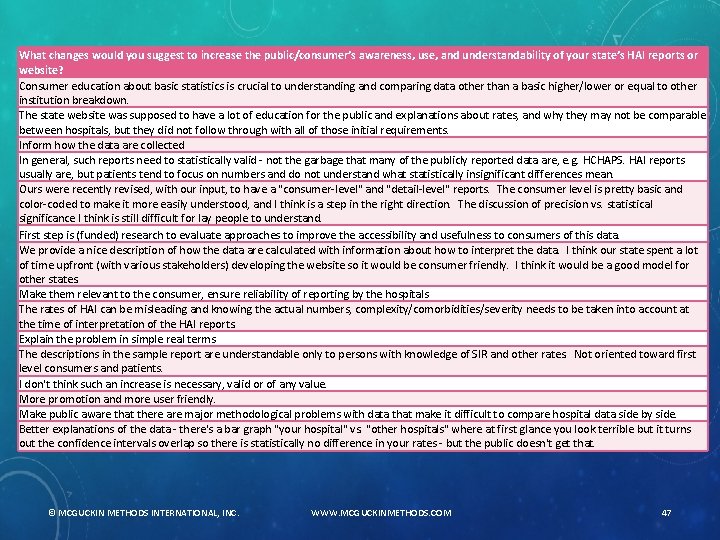
What changes would you suggest to increase the public/consumer’s awareness, use, and understandability of your state’s HAI reports or website? Consumer education about basic statistics is crucial to understanding and comparing data other than a basic higher/lower or equal to other institution breakdown. The state website was supposed to have a lot of education for the public and explanations about rates, and why they may not be comparable between hospitals, but they did not follow through with all of those initial requirements. Inform how the data are collected In general, such reports need to statistically valid - not the garbage that many of the publicly reported data are, e. g. HCHAPS. HAI reports usually are, but patients tend to focus on numbers and do not understand what statistically insignificant differences mean. Ours were recently revised, with our input, to have a "consumer-level" and "detail-level" reports. The consumer level is pretty basic and color-coded to make it more easily understood, and I think is a step in the right direction. The discussion of precision vs. statistical significance I think is still difficult for lay people to understand. First step is (funded) research to evaluate approaches to improve the accessibility and usefulness to consumers of this data. We provide a nice description of how the data are calculated with information about how to interpret the data. I think our state spent a lot of time upfront (with various stakeholders) developing the website so it would be consumer friendly. I think it would be a good model for other states. Make them relevant to the consumer, ensure reliability of reporting by the hospitals The rates of HAI can be misleading and knowing the actual numbers, complexity/comorbidities/severity needs to be taken into account at the time of interpretation of the HAI reports. Explain the problem in simple real terms The descriptions in the sample report are understandable only to persons with knowledge of SIR and other rates. Not oriented toward first level consumers and patients. I don't think such an increase is necessary, valid or of any value. More promotion and more user friendly. Make public aware that there are major methodological problems with data that make it difficult to compare hospital data side by side. Better explanations of the data - there's a bar graph "your hospital" vs. "other hospitals" where at first glance you look terrible but it turns out the confidence intervals overlap so there is statistically no difference in your rates - but the public doesn't get that. © MCGUCKIN METHODS INTERNATIONAL, INC. WWW. MCGUCKINMETHODS. COM 47
© MCGUCKIN METHODS INTERNATIONAL, INC. WWW. MCGUCKINMETHODS. COM 48

© MCGUCKIN METHODS INTERNATIONAL, INC. WWW. MCGUCKINMETHODS. COM 49
- Slides: 49