
Public Policy Impact in the Arts and Humanities
Public Policy Impact in the Arts and Humanities ‘Sensing Endings’ TECHNE Conference, 25 -26 June 2018 Dr Beatrice Turner, Research Manager for Impact and Environment, Roehampton University beatrice. turner@Roehampton. ac. uk
What is public policy? ‘The actions of government and the intentions that determine those actions’ (Cochran et al in Birkland, 2005: 18) ‘Public policy can be generally defined as a system of laws, regulatory measures, courses of action, and funding priorities concerning a given topic promulgated by a governmental entity or its representatives. ’ (Kilpatrick, ‘Defining Public Policy and the Law’) ‘Public policy […] is a composite of different processes that cross-cut most branches of government and involve many decision makers. ’ (John, 1998: 9)
Who makes public policy? ¤ The executive branch of government ¤ The legislative branch ¤ Central government departments and the civil servants who work in them ¤ Political advisors and political parties ¤ International organisations (UN, WHO, European Commission…) ¤ Local government ¤ Third sector ¤ Special interest groups/lobbyists ¤ Members of the public ¤ and, of course, academics
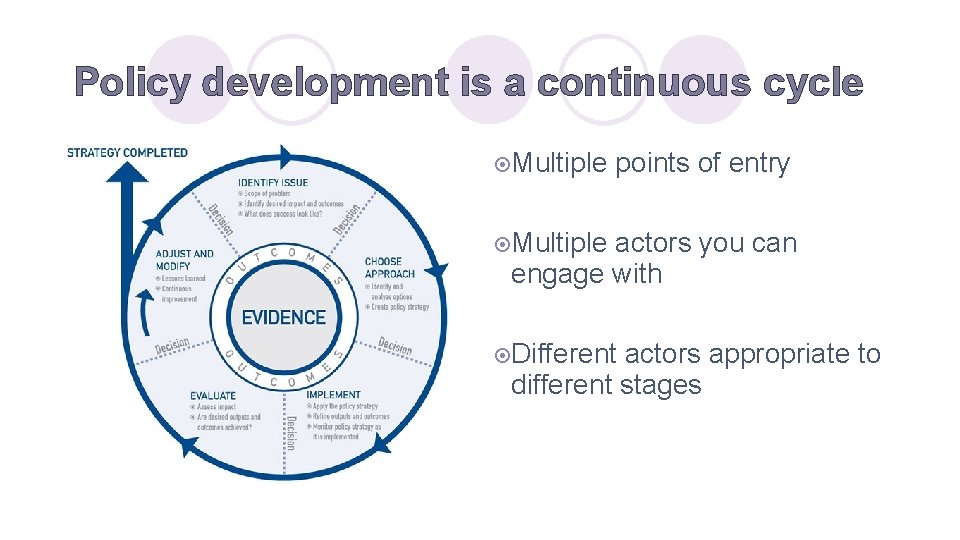
Policy development is a continuous cycle ¤Multiple points of entry ¤Multiple actors you can engage with ¤Different actors appropriate to different stages
Why public policy impact? ¤Potential for impact is extremely high ¤Your research can genuinely help solve problems society faces ¤Urgent need for unique perspectives offered by arts and humanities disciplines to inform public policy ¤Your own research can be transformed in surprising and wonderful ways through collaboration with policymakers
'For the purposes of the REF, impact is defined as an effect on, change or benefit to the economy, society, culture, public policy or services, health, the environment or quality of life, beyond academia' (HEFCE et al 2012 a)
‘Literary Thinking and psychosis’ impact case study ¤ Professor Pat Waugh and Dr Angela Woods (English Literature, Durham University) explore how trauma or psychosis is registered in the ‘inner voice’ of Modernist fiction ¤ Working with academics in Psychology and clinicians and counsellors at the Tees Valley NHS Trust, they used these literary critical insights to develop new bio-cultural model for understanding paranoid schizophrenia and ‘voice-hearing’ ¤ Narrative model places voice-hearer’s experience alongside clinician’s diagnosis ¤ They developed narrative-based therapies for patients, and training for clinicians. These are now used by NHS Trusts and the Doctorate in Clinical Social Care at Rutgers University http: //hearingthevoice. org/
Questions to ask yourself ¤What has changed as a result of your research/what do you hope will be different? ¤Which groups will be affected? ¤Who is responsible for that policy area? ¤Do the same actors develop, set, implement, and evaluate the policy? ¤Think outside the obvious disciplinary boundaries
Local Government ¤Local government implements national policy at local level ¤Councils evaluate policy impact ¤Devolved powers mean increasingly they set policy, too (education, transport, arts funding, libraries) ¤Increasing funding pressures: up to 40% cuts over last 5 years, with more planned ¤Local bodies increasingly look to partner organisations to develop policy and deliver services
Local government: how to engage ¤Pick up the phone ¤Seriously, pick up the phone ¤Invite policy officers to your seminar/public discussion/exhibition ¤Get local government involved early: seek comments on your proposals/ideas ¤Be aware of funding issues when proposing collaboration ¤Write a 1 -page executive summary of your research/proposed project, designed for a lay audience
Central government ¤Executive branch (Cabinet plus some Ministers of State) sets legislative agenda and strategic priorities ¤Government departments advise Secretaries of State and develop national policy and legislation ¤Departments also carry out strategic national overviews, respond to current issues, horizon scan for future issues ¤Departments are stable, long term, apolitical – in theory! ¤High impact potential, but very difficult to get an ‘in’ ¤Competing priorities (academics, other departments, other agencies)
Central government: how to engage ¤Network, go to events ¤Trust is important, for future collaborations and for getting contacts ¤Respond to white/green papers (published on gov. uk) ¤Make use of departmental outreach officers ¤Government timeframes are much shorter – be prepared to move fast ¤Communication styles differ hugely – see policy toolkit guidelines https: //www. gov. uk
Parliament: some problems Parliament scrutinises and passes legislation, holds the government to account, represents the people ¤An MP who takes up your issue is a powerful ally; a Minister even more ¤MPs can only receive public communications from constituents about constituency issues ¤Ministers are a fortress unless you know their Special Advisor/s ¤Direct political engagement is always high-risk ¤Lack of control over what the MP does ¤
Select Committees ¤Politically-balanced group of MPs who consider bills and conduct enquiries within particular remit ¤All bills go to relevant Select Committee after 2 nd reading ¤Public make submissions, as witnesses or expert witnesses ¤Submissions and deliberations a matter of public record ¤Committee report will make recommendations and reflect on evidence received ¤Committee reports legally non-binding but very influential ¤Committees carry out special enquiries (Leveson; antidoping)
Select Committees: how to engage ¤Check Parliamentary website for upcoming enquiries and bills ¤Website has advice about how to prepare a submission ¤Contact Committee staff – suggest an enquiry topic ¤High-quality impact evidence – especially if you are subsequently invited to give evidence in person as witness www. parliament. uk http: //toolkit. northernbridge. ac. uk/engagingwithpolicymakers/eng agingwithparliament/selectcommittees
‘Protecting cultural property in armed conflict’ impact case study ¤ Professor Peter Stone OBE (Arts and Culture, Newcastle) carried out research into destruction of cultural heritage in armed conflict zones ¤ The Destruction of Cultural Heritage in Iraq (2008) made recommendations for future action based on observations during 2003 invasion ¤ Professor Stone was expert witness to Committee considering Draft Cultural Property (Armed Conflict) Bill 2008 on basis of submission ¤ ‘The Committee noted the value of the book in providing an informed context for their deliberations and referred specifically to information in the book in paragraph 9 of the report’ (REF submission)
All-party Parliamentary Groups ¤Informal groups of MPs and Lords who are interested in a specific topic ¤ 3 rd sector and academics often sit on APPGs ¤No formal powers but influential ¤Commission exploratory research ¤Easy to contact ¤https: //www. publications. parliament. uk/pa/cm/cmallparty/1 70502/contents. htm
Third sector actors: charities ¤Carry out research, lobby, advocate, campaign ¤Central and local government services increasingly contracted out to charities ¤Often have excellent networks you can plug into ¤Sector under intense funding pressure ¤Offer research, not collaboration ¤Engage early in research design process – invite comment ¤Will have own priorities
Third sector actors: think-tanks ¤Work extensively with politicians and civil service, as well as providing media commentary ¤Many are highly influential ¤Carry out and commission research ¤Many academics have long-standing associations with think-tanks, and they always want to hear from you ¤Consider image, fit, academic independence
Final points ¤Make sure you/your research can be found! Develop a strong online profile ¤Get assistance from your Communications department ¤Talk to your friendly Research Facilitator/Impact Manager/Research Manager (titles may vary) http: //toolkit. northernbridge. ac. uk http: //www. parliament. uk http: //www. gov. uk https: //www. policy. manchester. ac. uk
Communicating for policymakers ¤Keep it SHORT (one to three pages) ¤Key messages/findings/outcomes first ¤Avoid footnotes, literature reviews, methodologies etc (unless central to your key message) ¤Plain, jargon-free language ¤Bullet points ¤Have a purpose: never send anything ‘FYI’ ¤ALWAYS suggest next steps: what do you want to happen as a result now? In six months’ time? What’s your ideal outcome?
Pitching exercise: executive summaries A senior civil servant is interested in your Ph. D research and asks you to send them an executive summary. In ONE page, answer the following: ¤ What is the single most important finding/argument/aim of your research? ¤What issues can it address, and how? ¤What groups, individuals, or organisations might be affected? ¤What are the next steps to make that happen? ¤What decisions or actions do you want the civil servant to do now that they’ve read your executive summary?
- Slides: 22