
Public Policy 101 Presented by United Advocates for
Public Policy 101 Presented by United Advocates for Children and Families Leadership Institute & Young Minds Advocacy CMHACY Conference May 2016 ©United Advocates for Children and Families 2012
United Advocates for Children and Families (UACF) is a statewide nonprofit organization with a mission to improve the quality of life for all children and youth with mental, emotional, and behavioral challenges and to eliminate institutional discrimination and social stigma. ©United Advocates for Children and Families 2012 2
United Advocates for Children and Families Leadership Institute The UACF Leadership Institute is dedicated to ensuring the family voice is present at all levels of decision making through effective advocacy, education, and community outreach. We work to empower parents, youth, and peer professionals working in the mental health system through education, training, and technical assistance. ©United Advocates for Children and Families 2012 3
Young Minds Advocacy breaks down barriers to quality mental healthcare for youth and their families through policy action and research, impact litigation, and strategic communications ©United Advocates for Children and Families 2012 4
Training Overview How does the Legislative process effect you? Why is your input important? What is a bill? How a Bill becomes a law Getting involved with public policy 5 ©United Advocates for Children and Families 2012
Training overview (continued) How to Contact Your Representative or Senator How to Write a Letter to Your Representative or Senator The “Do’s and Don’ts” of corresponding with elected officials Other ways to get involved How to tell your story to drive social change Glossary of Terms ©United Advocates for Children and Families 2012 6
What IS Policy? A plan or course of action, as of a government, political party, or business, intended to influence and determine decisions, actions, and other matters: American foreign policy; the company's personnel policy. A course of action, guiding principle, or procedure considered expedient, prudent, or advantageous: Honesty is the best policy. Prudence, shrewdness, or knowledge in practical matters. 7 ©United Advocates for Children and Families 2012
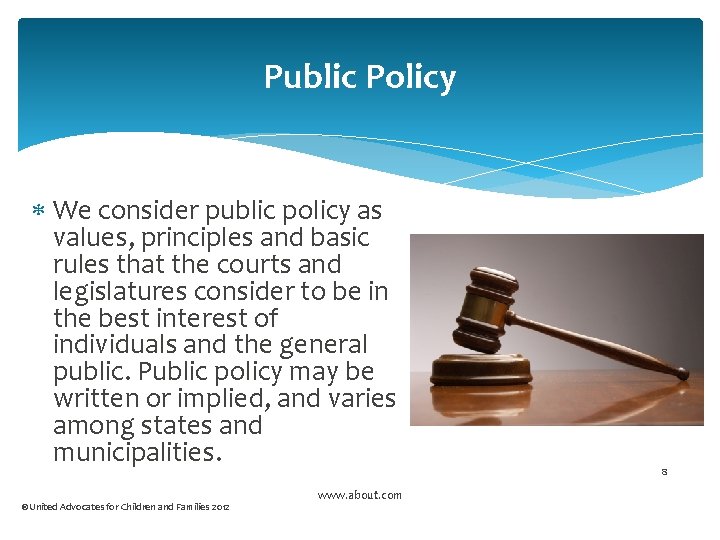
Public Policy We consider public policy as values, principles and basic rules that the courts and legislatures consider to be in the best interest of individuals and the general public. Public policy may be written or implied, and varies among states and municipalities. ©United Advocates for Children and Families 2012 www. about. com 8
How the Legislative Process Effects You Laws that are passed by the Legislature have a direct impact on all our lives. They effect all areas of our daily life including education, taxes, child welfare, as well as our mental health care. ©United Advocates for Children and Families 2012 We live the laws that are passed at the capitol. 9 They govern how, when, where, and if we receive services.
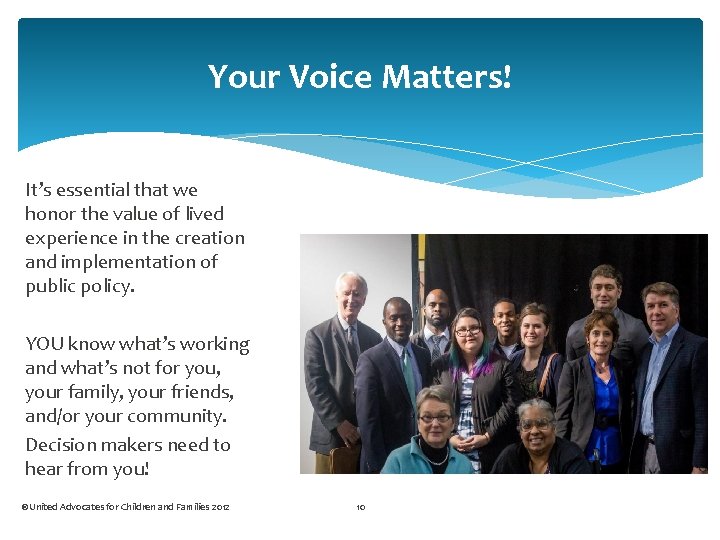
Your Voice Matters! It’s essential that we honor the value of lived experience in the creation and implementation of public policy. YOU know what’s working and what’s not for you, your family, your friends, and/or your community. Decision makers need to hear from you! ©United Advocates for Children and Families 2012 10
Case Study Psychotropic Medications & Foster Youth Articles in the San Jose Mercury News in 2015 highlighted a need for policy change. These were stories of young people who were over prescribed psychotropic medication, particularly in group homes and foster care. ©United Advocates for Children and Families 2012 11
Case Study (continued) Youth & allies advocated in state and local committees about the dangers of the over use of medications in the foster care system NCYL (National Center for Youth Law) and others drafted and passed legislation to improve oversight ©United Advocates for Children and Families 2012 12
Legislation Passed in 2015 regarding the restricted use of Psychotropic Medication SB 484 - requires the identification of group homes suspected of using psychotropic medications inappropriately and specifies the factors to be used in pinpointing those facilities. SB 319 -Expands the duties of the foster care public health nurse to include monitoring and oversight of the administration of psychotropic medication to foster children. These bills were a direct result of public outcry due to the information released in the series of articles by the San Jose Mercury News. The articles went nationwide. ©United Advocates for Children and Families 2012 13
Other Examples? Do you have another example of when stakeholders influenced public policy? Why was their involvement important? ©United Advocates for Children and Families 2012 14
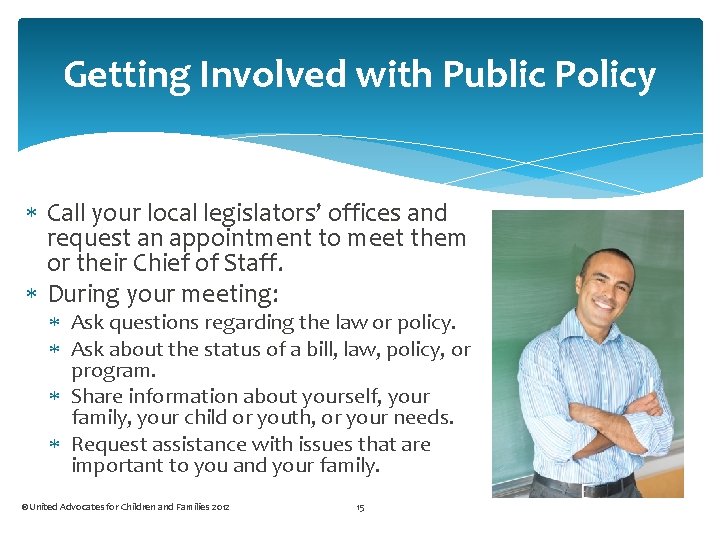
Getting Involved with Public Policy Call your local legislators’ offices and request an appointment to meet them or their Chief of Staff. During your meeting: Ask questions regarding the law or policy. Ask about the status of a bill, law, policy, or program. Share information about yourself, your family, your child or youth, or your needs. Request assistance with issues that are important to you and your family. ©United Advocates for Children and Families 2012 15
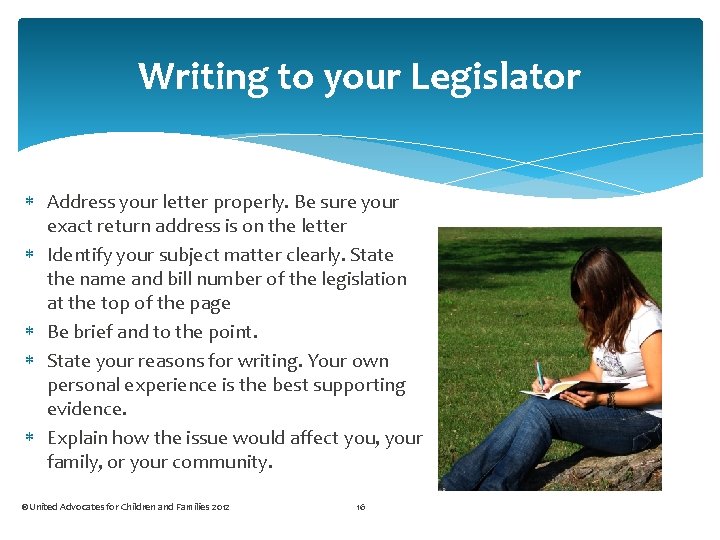
Writing to your Legislator Address your letter properly. Be sure your exact return address is on the letter Identify your subject matter clearly. State the name and bill number of the legislation at the top of the page Be brief and to the point. State your reasons for writing. Your own personal experience is the best supporting evidence. Explain how the issue would affect you, your family, or your community. ©United Advocates for Children and Families 2012 16
The “Do’s and Don’ts” Do: Put your thoughts in writing Address your representative properly Be brief and to the point and spell check your letter Include your name and address on the letter Write if you need help with governmental departments or agencies Show the local effects and tangible positive results of your position Include articles from your local news paper to reinforce your concerns Find out which committee your bill will be assigned to for approval Write the committees chair person and the members of the committee before they read the bill during the hearing Always say “Thank You” And be willing to compromise and open to discussion ©United Advocates for Children and Families 2012 17
The “Do’s and Don’ts” Don’ts Rely on just making a phone call to legislators. Follow up with emails and/or letters. Send your letter to only one legislator - if you are commenting on a current bill, send a letter to each committee member. Be rude, threatening or intimidating. Complain – always try to offer solutions to the issue you are addressing. Give up – always keep trying to get your bill passed. ©United Advocates for Children and Families 2012 18
Finding Your Legislator There are many ways of finding your legislator, even if you do not know their name. Find Your United States Representative: http: //www. house. gov/representatives/find/ Find Your United States Senator: http: //www. senate. gov/general/contact_infor mation/senators_cfm. cfm One helpful site is the CA State Legislature website, which can be found at: http: //www. legislature. ca. gov/legislators_and_dis tricts/legislators/your_legislator. html ©United Advocates for Children and Families 2012 19
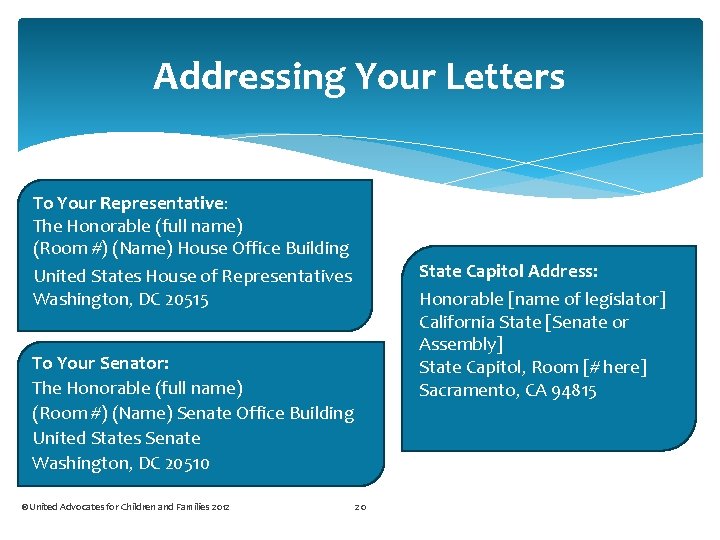
Addressing Your Letters To Your Representative: The Honorable (full name) (Room #) (Name) House Office Building United States House of Representatives Washington, DC 20515 State Capitol Address: Honorable [name of legislator] California State [Senate or Assembly] State Capitol, Room [# here] Sacramento, CA 94815 To Your Senator: The Honorable (full name) (Room #) (Name) Senate Office Building United States Senate Washington, DC 20510 ©United Advocates for Children and Families 2012 20
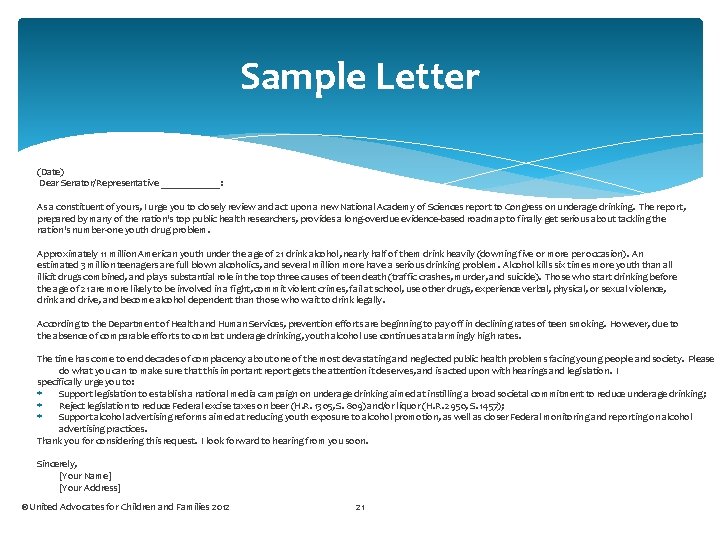
Sample Letter (Date) Dear Senator/Representative ______: As a constituent of yours, I urge you to closely review and act upon a new National Academy of Sciences report to Congress on underage drinking. The report, prepared by many of the nation's top public health researchers, provides a long-overdue evidence-based roadmap to finally get serious about tackling the nation's number-one youth drug problem. Approximately 11 million American youth under the age of 21 drink alcohol, nearly half of them drink heavily (downing five or more per occasion). An estimated 3 million teenagers are full blown alcoholics, and several million more have a serious drinking problem. Alcohol kills six times more youth than all illicit drugs combined, and plays substantial role in the top three causes of teen death (traffic crashes, murder, and suicide). Those who start drinking before the age of 21 are more likely to be involved in a fight, commit violent crimes, fail at school, use other drugs, experience verbal, physical, or sexual violence, drink and drive, and become alcohol dependent than those who wait to drink legally. According to the Department of Health and Human Services, prevention efforts are beginning to pay off in declining rates of teen smoking. However, due to the absence of comparable efforts to combat underage drinking, youth alcohol use continues at alarmingly high rates. The time has come to end decades of complacency about one of the most devastating and neglected public health problems facing young people and society. Please do what you can to make sure that this important report gets the attention it deserves, and is acted upon with hearings and legislation. I specifically urge you to: Support legislation to establish a national media campaign on underage drinking aimed at instilling a broad societal commitment to reduce underage drinking; Reject legislation to reduce Federal excise taxes on beer (H. R. 1305, S. 809) and/or liquor (H. R. 2950, S. 1457); Support alcohol advertising reforms aimed at reducing youth exposure to alcohol promotion, as well as closer Federal monitoring and reporting on alcohol advertising practices. Thank you for considering this request. I look forward to hearing from you soon. Sincerely, [Your Name] [Your Address] 21 ©United Advocates for Children and Families 2012
Email Most legislators have an email address listed on their website. Remember your email is read by staff not usually your legislator. Think short, short. Identify the issue or problem in the first sentence of the letter, and state your position. Support your position with your experiences. Be patient but persistent. ©United Advocates for Children and Families 2012 22
What is a Bill? A bill starts as an idea that an individual or a group has come up with. In order for the bill process to begin, the individual/group must find someone to author the bill. The author must be a member of the State or U. S. Senate, a State Assembly Member, or member of Congress. ©United Advocates for Children and Families 2012 23
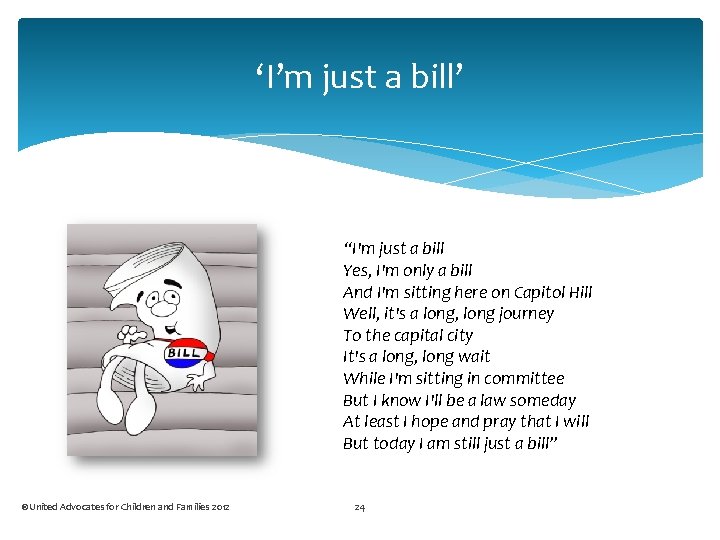
‘I’m just a bill’ “I'm just a bill Yes, I'm only a bill And I'm sitting here on Capitol Hill Well, it's a long, long journey To the capital city It's a long, long wait While I'm sitting in committee But I know I'll be a law someday At least I hope and pray that I will But today I am still just a bill” ©United Advocates for Children and Families 2012 24
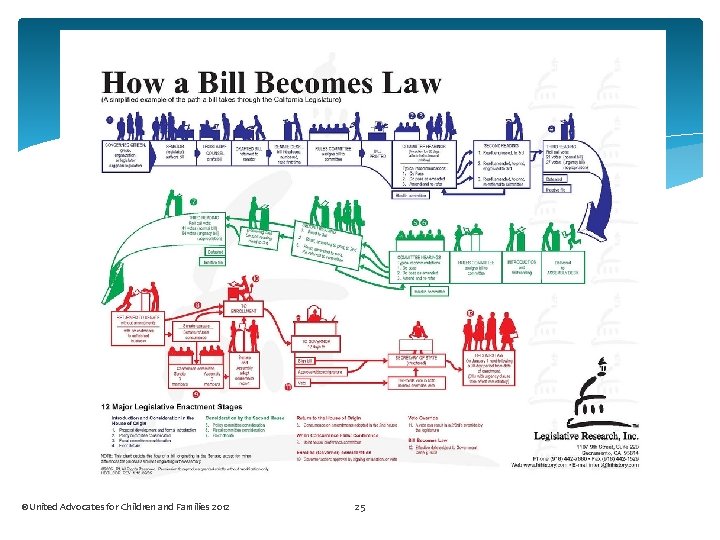
©United Advocates for Children and Families 2012 25
Prescribed Process Authored/Written First Reading/Introduction Committee Hearings Second and Third Reading Repeat Process in other House Resolution of Differences Governor Signs California Law ©United Advocates for Children and Families 2012 26
Authored/Written A Legislator sends the idea for the bill to the Legislative Counsel where it is drafted into the actual bill. The draft of the bill is returned to the Legislator for introduction. If the author is a Senator, the bill is introduced in the Senate. If the author is an Assembly Member, the bill is introduced in the Assembly. ©United Advocates for Children and Families 2012 27
First Reading/Introduction A bill is introduced or read the first time with: the bill number; the name of the author; the descriptive title of the bill is read on the floor of the house. Then it is sent to the Office of State Printing. It may not be acted upon until 30 days has passed from the date of its introduction. ©United Advocates for Children and Families 2012 28
Committee Hearings The bill heads to the Rules Committee of the house of origin to be assigned to the appropriate policy committee for its first hearing. Bills are assigned to policy committees according to subject area of the bill. Each house has a number of policy committees and a fiscal committee. Each committee is made up of a specified number of Senators or Assembly Members. ©United Advocates for Children and Families 2012 29
Committee Hearings Process Author presents the bill to the committee and testimony provided in support of or opposition to the bill. Committee votes by passing the bill, passing the bill as amended, or defeating the bill. Bills can be amended several times. A majority vote of the full committee membership is needed for a bill to be passed by the committee. This is a public process and sometimes the committee will take public comment in favor or opposition of the bill. ©United Advocates for Children and Families 2012 30
Committee Meetings Committees meet throughout the year. You can check Committee meeting schedules at: http: //www. leginfo. ca. gov/todevnt. html ©United Advocates for Children and Families 2012 31
Second and Third Reading When a bill is read the third time it is explained by the author, discussed by the Members and voted on by a roll call vote. Bills passed by committees are read a second time on the floor in the house of origin and then assigned to third reading. ©United Advocates for Children and Families 2012 32
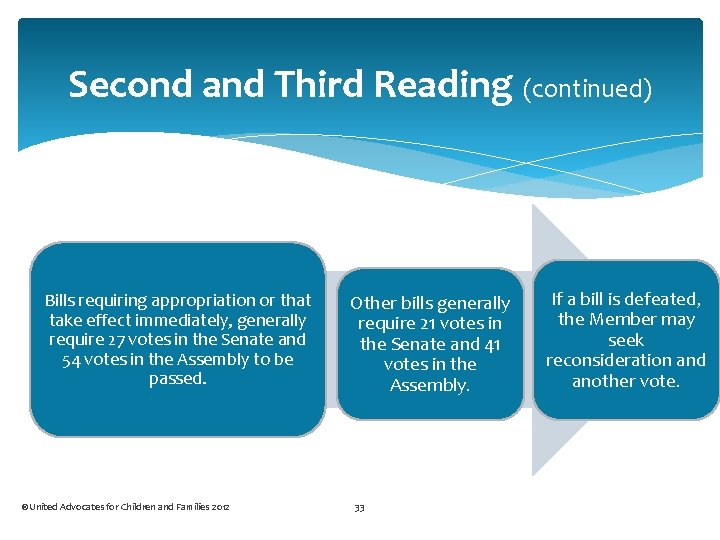
Second and Third Reading (continued) Bills requiring appropriation or that take effect immediately, generally require 27 votes in the Senate and 54 votes in the Assembly to be passed. ©United Advocates for Children and Families 2012 Other bills generally require 21 votes in the Senate and 41 votes in the Assembly. 33 If a bill is defeated, the Member may seek reconsideration and another vote.
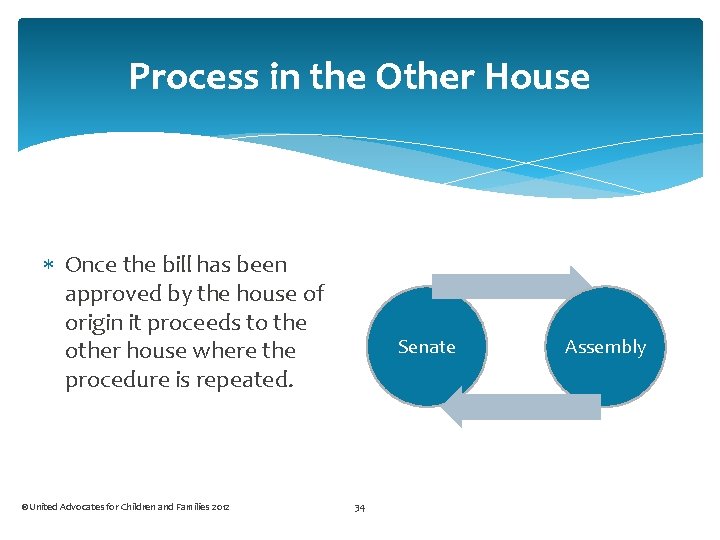
Process in the Other House Once the bill has been approved by the house of origin it proceeds to the other house where the procedure is repeated. ©United Advocates for Children and Families 2012 Senate 34 Assembly
Resolution of Differences Amended bills in the 2 nd House go back to the House of origin for agreement on the amendments. If agreement cannot be reached, the bill is referred to a House conference committee to resolve differences. Three members of the committee are from both sides of the House. If a compromise is reached, the bill is returned to both Houses for a vote. ©United Advocates for Children and Families 2012 35
Governor If both houses approve a bill, it then goes to the Governor. The Governor has three choices: Sign the bill into law Allow it to become law without a signature Veto the bill Once passed/signed, most bills go into effect on the first day of January of the next year. Urgency measures take effect immediately after they are signed or allowed to become law without signature. ©United Advocates for Children and Families 2012 36
The Veto The Governor may also exercise a line item veto, whereby the amount of an appropriation is reduced or eliminated, while the rest of the bill is approved (also referred to as the “Blue Pencil”). A governor's veto can be overridden by a two thirds vote in both houses. ©United Advocates for Children and Families 2012 37
California Law Bills that are passed by the Legislature and approved by the Governor are assigned a chapter number by the Secretary of State. These Chaptered Bills (also referred to as Statutes of the year they were enacted) then become part of the California Codes. The California Codes are a comprehensive collection of laws grouped by subject matter. The California Constitution sets forth the fundamental laws by which the State of California is governed. All amendments to the Constitution come about as a result of constitutional amendments presented to the people for their approval. ©United Advocates for Children and Families 2012 38
Tracking a California Bill’s Progress State Authored Legislation Tracking: You can read actual Bills that have been introduced and track them as they make their was through the legislative process www. senate. ca. gov www. assembly. ca. gov ©United Advocates for Children and Families 2012 39
Legislative Tracking Resources Open Congress: http: //www. opencongress. org/ Open Congress allows anyone to follow legislation in Congress, from bill introduction to floor vote. How To Identify a Bill Currently Being Considered in Congress: http: //www. ehow. com/how_5369182_identify-currently-beingconsidered-congress. html#ixzz 0 r 2 Pe. Vi. Dl The Library of Congress: http: //beta. congress. gov/ This website offers federal legislative information, including Congressional schedules and activities. ©United Advocates for Children and Families 2012 40
Other Ways to Get Involved 1. Attend your local mental health board meetings Champions the rights of people with mental illness Reviews and evaluates the community’s mental health needs, services, facilities, and special interests Advises the county Board of Supervisors about local mental health programs and issues Reviews and makes recommendations of applicants for the appointment of a local mental health director Reviews and comments on county performance outcome data ©United Advocates for Children and Families 2012 41
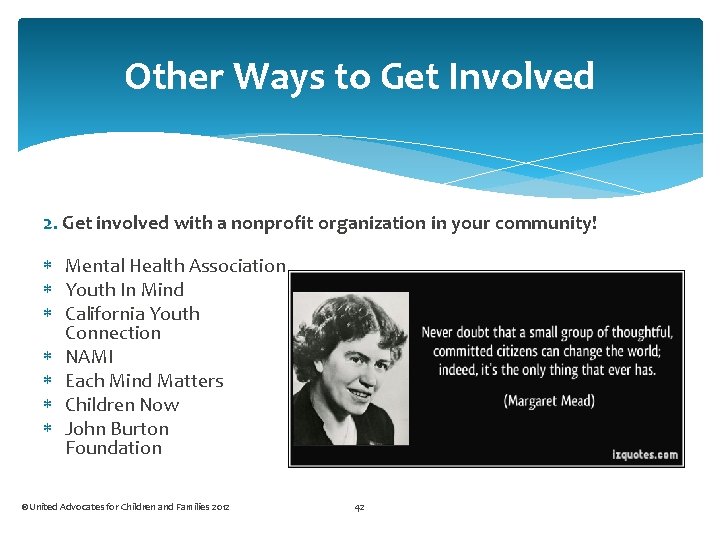
Other Ways to Get Involved 2. Get involved with a nonprofit organization in your community! Mental Health Association Youth In Mind California Youth Connection NAMI Each Mind Matters Children Now John Burton Foundation ©United Advocates for Children and Families 2012 42
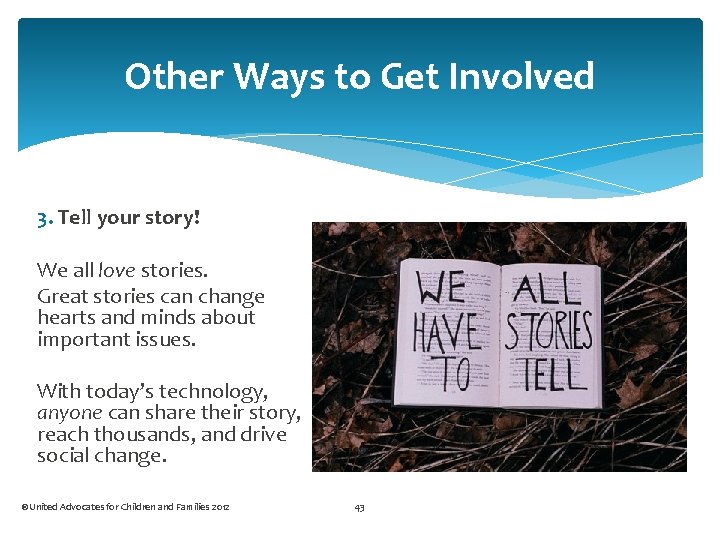
Other Ways to Get Involved 3. Tell your story! We all love stories. Great stories can change hearts and minds about important issues. With today’s technology, anyone can share their story, reach thousands, and drive social change. ©United Advocates for Children and Families 2012 43
Get a GAME Plan Goals What do you want to achieve? Are you setting SMART goals? Audience Who needs to hear your message? The “general public” is like a unicorn—they don’t exist! Message What are you going to say to motivate people towards your goal? Engagement How will you get your message to your audience? ©United Advocates for Children and Families 2012 44
SMART Goals Specific: Concrete, detailed, and well defined so that you know where you are going and what to expect when you arrive Measureable: Numbers and quantities provide means of measurement and comparison Achievable: Feasible and easy to put into action Realistic: Considers constraints such as resources, personnel, cost, and time frame Time-Bound: A time frame helps to set boundaries around the objective ©United Advocates for Children and Families 2012 45
Tools to Sharing Your Story Social media Blogging Op-Eds Commenting Radio Podcasts Video ©United Advocates for Children and Families 2012 46
One Girl’s Story Becomes a Movement Active Minds Founded by Alison Malmon when she was a junior at the University of Pennsylvania, following the suicide of her brother, Brian Started as a campus group and gained enough support that it expanded onto other campuses It now has over 400 campus chapters and has impacted hundreds of thousands of young adults ©United Advocates for Children and Families 2012 47
Do you have a story to tell? Tell us about a time you shared your story or the stories of others to make an impact. What was your goal? Who was your audience? What did you think about the experience? ©United Advocates for Children and Families 2012 48
Wrap Up Getting involved in public policy is an opportunity for YOU to impact thousands Reach out to ally organizations for support Get a GAME plan Set SMART goals Don’t try and reach EVERYONE (Remember the unicorn) REMEMBER: You ARE an expert in your own lived experiences and your input matters…a lot ©United Advocates for Children and Families 2012 49
Glossary of Terms AB-Assembly Bill SB-Senate Bill ACA-Assembly Constitutional Amendments SCA-Senate Constitutional Amendment AJR-Assembly Joint Resolution SJR-Senate Joint Resolution ACR-Assembly Concurrent Resolution SCR-Senate Concurrent Resolution HR-House Resolution(Assembly) SR-Senate Resolution ACT-a bill passed by the Legislature ©United Advocates for Children and Families 2012 50
For More Information For additional information please contact: United Advocates for Children and Families 2035 Hurley Way, Suite 290 Sacramento, CA 95825 (916) 643 -1530 (866) 643 -1530 www. uacf 4 hope. org ©United Advocates for Children and Families 2012 51
For More Information Young Minds Advocacy 275 5 th Street San Francisco, CA 94103 (415) 466 -2991 info@youngmindsadvocacy. org www. youngmindsadvocacy. org @Young. Minds. Advoc ©United Advocates for Children and Families 2012 52
- Slides: 52