
Public Opinion Political Beliefs Chapter 5 By Ciani
Public Opinion & Political Beliefs Chapter 5 By: Ciani Upchurch & Nianxin Guan
Introduction Government action and inaction do not always match public opinion. This apparent contradiction to the animating principle of democratic government occurs for many different reasons. o the framers of the Constitution set up a government that did not give the majority what they wanted o participants in government are more apt to achieve their goals than the general public
Public Opinion and Political Beliefs Key Concept o Defining public opinion in the United States is a difficult task o Political attitudes are derived from many sources, among them family, religion, gender, and education o Social class, race, and ethnicity, and religion create cleavages in public opinion o Political ideology is a coherent and consistent set of beliefs o Political elites has a great influnce on American public opinion
The Problem of Defining Public Opinion Public opinion can be defined as the complex collection of opinions of many different people. Everyone is different and has different opinions. Interest groups are small groups of people whose opinions are asked and are not always representative of the public at large.
Sources of Political Attitudes Political attitudes are grounded in values. We learn our values by a process known as political socialization. Factors that influence our political choices o Family - majority of young people identify with their parents political party o Religion- Religious tradition can have an impact on political orientation, most often through the family o Gender- A gender gap exists in American politics. The extent of that gap and its tendencies vary according to the different time periods
Cleavages in Public Opinion The process of political socialization helps explain why political cleavages exist among Americans. Today there are cleavages based on: o Social class- is playing a diminishing role because of the increasing importance of noneconomic factors in our ideologies o Race and Ethnicity- young African Americans are identifying themselves as Republicans. Latinos generally identify themselves as Democrats. Asian Americans are more identified with the Republican party than the whites. o Region- the most significant regional cleavage in
Cleavages in Public Opinion cont. American politics has been between southern and northern voters. The South, West, and Midwest continue to be conservative, while the Northeast and West Coast tend to be more liberal.

Political Ideology When we refer to people as liberals or conservative, we assume they have a coherent and consistent set of beliefs a political ideology. The definitions of liberal and conservative have changed over time. Originally, a liberal was a person who favored personal and economic liberty, free from the controls and power of the government. The term conservative was first applied to those who opposed the excesses of the French Revolution.
Political Elites and Public Opinion Elites influence public opinion in two ways: those who have access to the media raise political issues; elites state the norms by which issues should be settled. Elites do not define economics problems, but they may define the problem as well as the policy options with respect to foreign affairs.
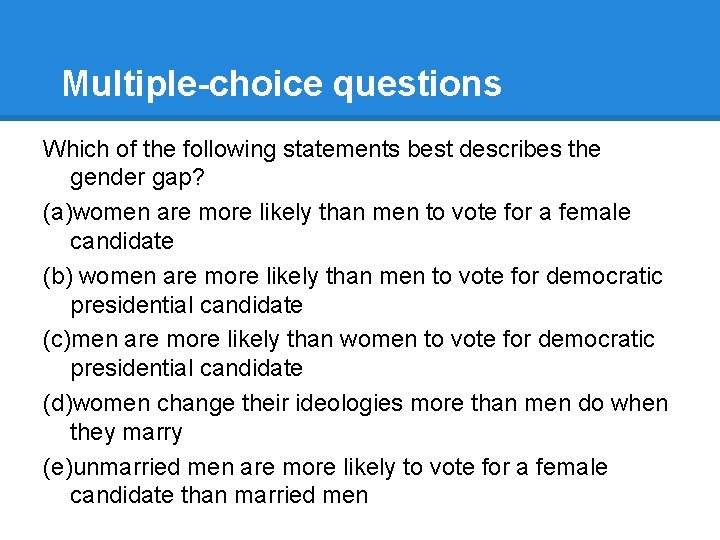
Multiple-choice questions Which of the following statements best describes the gender gap? (a)women are more likely than men to vote for a female candidate (b) women are more likely than men to vote for democratic presidential candidate (c)men are more likely than women to vote for democratic presidential candidate (d)women change their ideologies more than men do when they marry (e)unmarried men are more likely to vote for a female candidate than married men
The gender gap can be explained by major difference in policy views on all of the following issues EXCEPT (a)homelessness (b)gun control (c)abortion (d)size government (e) gay rights
which of the following has the greatest impact on political socialization? (a)peers (b)the media (c)the community (d)parents (e)college professors
Political Participation By: Ciani & Ivy
Introduction • The low rate of participation in national elections in comparison with European democracies is a source of great embarrassment to the United States. This problem may be based on less apathy and moreon problems of voter registration. •
Key Concepts • The American electorate has expanded through extended voting rights for minorities, women, and youth. • Voter turnout in the United States is relatively low, and the relatively difficult process of voter registration • There are many levels and forms of participation in the American political system
• The American Electorate The Framers of the Constitution, were unable to reach a compromise on voter eligibility, so they left the matter in the hands of the States Control of the voting process has moved gradually from state to federal control • http: //www. hippocampus. org/Hippo. Campus/History%20%26%20 Government; jsessionid=45961 A 84473 B 88 E 6 FEC 916 AF 13 C 964 DD
• • several states passed a law to deny suffrage to african americans for example , literacy test, and poll taxes the grandfather clause suffrage for women was slowly developing, several states in west had given women the right to vote in 1915 immediately after the ratification of the amendment candidates courted the youth vote
participation • • • Inactive about one-fifth of the population does not participate in any way voting special are people who vote but do not participate in any other substantial way campaigners are people who not only vote but enjoy getting involved in from campaigns communalist these have social background similar to campaigners but are far more nonpartisan parochials stays away from elections but often contact local politicians activists constituting about one-ninth of the population
voter turnout For the past several decades the voter turnout has remained the same between 50 and 60 percent of those eligible and lags behind the larger turnouts of the latter part of the nineteenth century.
Reasons for the Voter Turnout • • • A popular decline in interest in elections had a weakening of the competitiveness of the two major parties have occurred decline in turnout is misleading voting fraud during the late nineteenth century was more commonplace. only two-thirds of the voting age population is registered to vote, while in European registration is done automatically.
Multiple choice questions All of the following were used to keep blacks from voting EXCEPT (a)segregation (b)literacy tests (c)poll taxes (d)grandfather clauses (e)intimidation and threats
What is the impact of religion on political participation? (a)religious people are less likely to vote, because they put their faith in a higher power (b)religious people are less likely to give money to charities, but less likely to vote (c)being active in a religious organization increases the likeihood of charitable volunteer work as well as voting (d)being active in a religious organization increases the likelihood of voting (e)religion has no measurable impact on the likelihood of voting

Resources • • • Fast track to a 5 ( review book ) Hippo Campus (videos) United States Government book
- Slides: 23