
Public Opinion Chapter 7 Public Opinion Political Socialization
Public Opinion Chapter 7 Public Opinion & Political Socialization Theme A
Why is public policy at odds with public opinion? n Examples? created to achieve goals, NOT do what people want. n Checks & balances put in place to guard against factions, so no one could dominate (Pluralist) n Public opinion is hard to measure. n Political elites carry more weight & think differently than the average American. n Gov’t
Public Opinion n What is it? – The ideas and attitudes shared by a portion of the population n What does it take to measure public opinion? – Reliability and validity (Ex. Cincinnati) – Saliency (Ex. ) – Unbiased questions (Ex. ) – Significant numbers & unbiased samples – Informed public
Qualities of Public Opinion 1. 2. 3. 4. 5. 6. 7. Intensity- strength of position Fluidity- ability to interpret position Stability- extent to which public opinion stays constant Relevance- extent to which an issue is of concern at a particular time Political knowledge- the more active and knowledgeable someone is about politics Diversity-How do you get diverse sample? Direction-positive or negative Do Effects of Polling Sheet & Discuss!
Discuss Project Assignment n Process: – Word non-biased, open-ended question – Determine polling locations – Take down as many demographics as possible – Interpret results & information – Compile into a presentation – E-mail product/link or share with me me no later than 8: 00 p. m. on December 1 st. – Presentations are 12/02.
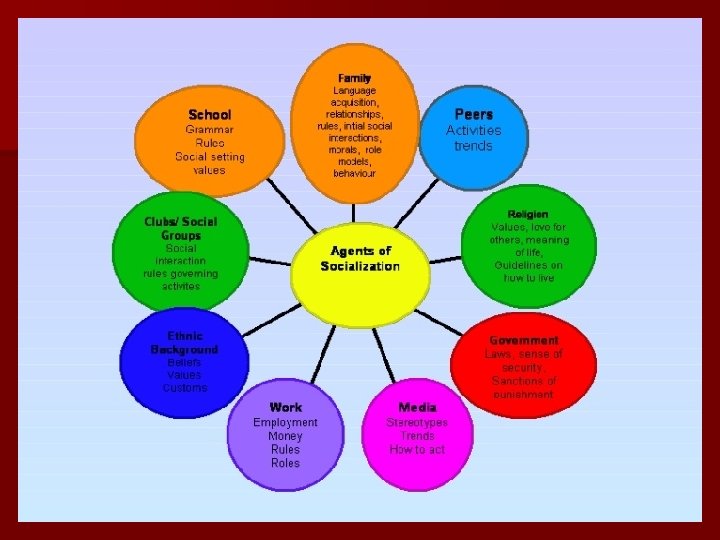
Political Socialization n What is political socialization? n The process by which children learn about values, beliefs and attitudes of political culture. What forces shape our political socialization?
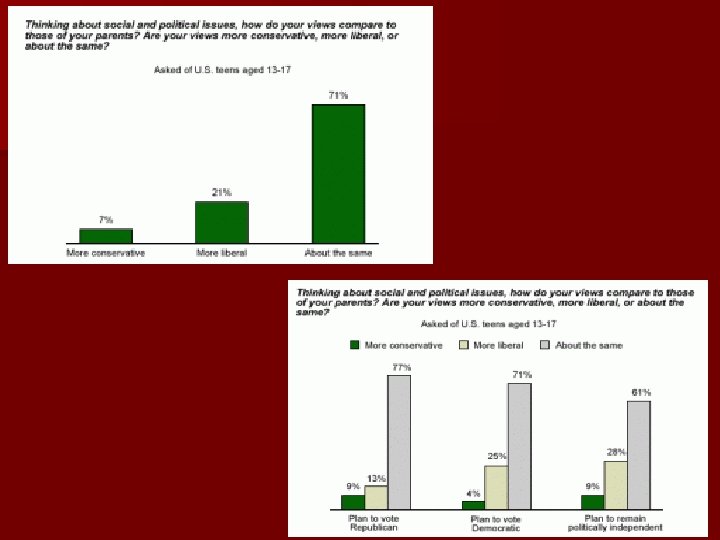
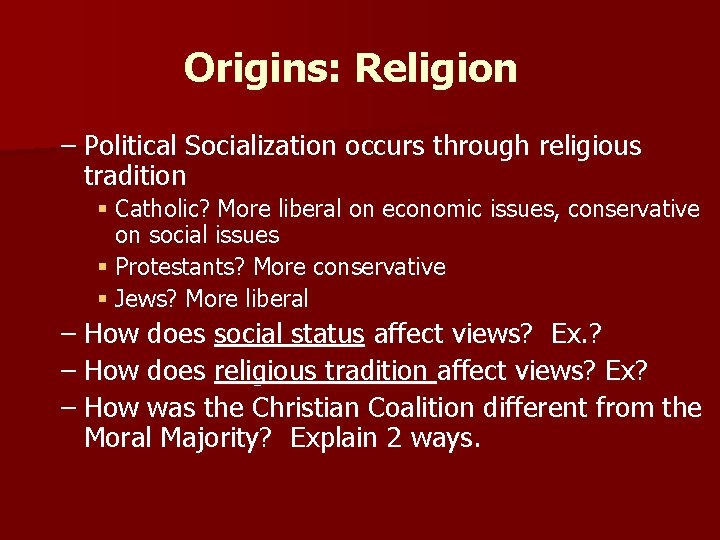
Origins: Role of Family – First & most important force. – Links us to other socialization forces. – Party identification absorbed, but child becomes more independent with age. – The ability to pass on party ID declining – More consider themselves independent – Very rare to choose the opposite party – Children less influenced in regard to policy; Clear ideologies rarely passed on. http: //www. youtube. com/watch? v=OHSYSIX 4 s 7 I
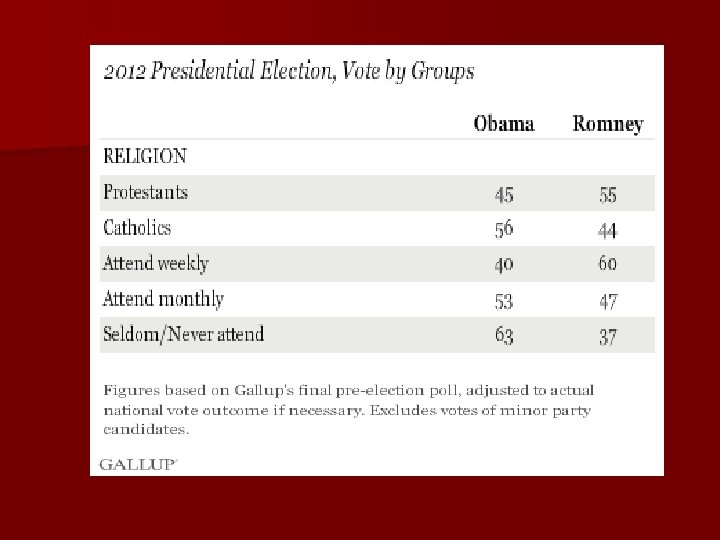
Origins: Religion – Political Socialization occurs through religious tradition § Catholic? More liberal on economic issues, conservative on social issues § Protestants? More conservative § Jews? More liberal – How does social status affect views? Ex. ? – How does religious tradition affect views? Ex? – How was the Christian Coalition different from the Moral Majority? Explain 2 ways.
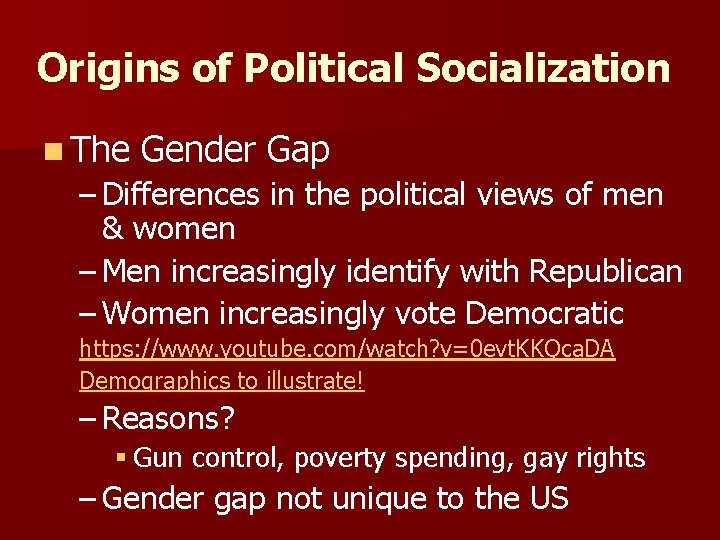
Origins of Political Socialization n The Gender Gap – Differences in the political views of men & women – Men increasingly identify with Republican – Women increasingly vote Democratic https: //www. youtube. com/watch? v=0 evt. KKQca. DA Demographics to illustrate! – Reasons? § Gun control, poverty spending, gay rights – Gender gap not unique to the US
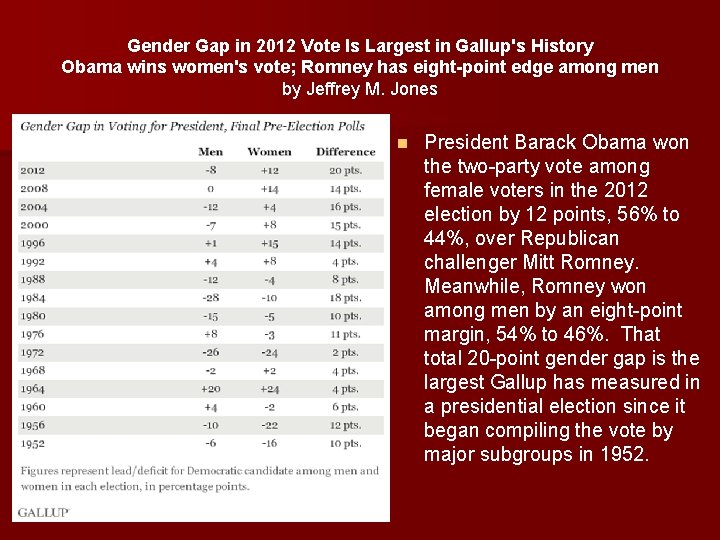
Gender Gap in 2012 Vote Is Largest in Gallup's History Obama wins women's vote; Romney has eight-point edge among men by Jeffrey M. Jones n President Barack Obama won the two-party vote among female voters in the 2012 election by 12 points, 56% to 44%, over Republican challenger Mitt Romney. Meanwhile, Romney won among men by an eight-point margin, 54% to 46%. That total 20 -point gender gap is the largest Gallup has measured in a presidential election since it began compiling the vote by major subgroups in 1952.
Assignment n Finish Chapter 7 reading: pp. 170 -178. Take notes on cleavages and ideologies. Complete “How do we vote? ” sheet. n Go to Symbaloo board and take the class ideology quiz (brown tile). Bring print out of grid placement to class on Tuesday. If you do not have a printer, draw the grid with all of the placements in it. n We will also use data from this week’s blog “tests” to compare.
- Slides: 14