
PUBLIC OPINION Abbreviated Lecture Outline Effects of Polarization

PUBLIC OPINION Abbreviated Lecture
Outline Effects of Polarization • Political Knowledge 2020 Demographic Voting Patterns • Gender, Race, Marital Status, Religion, Ideology, Party ID
POLARIZATION How Polarization Affects Public Opinion
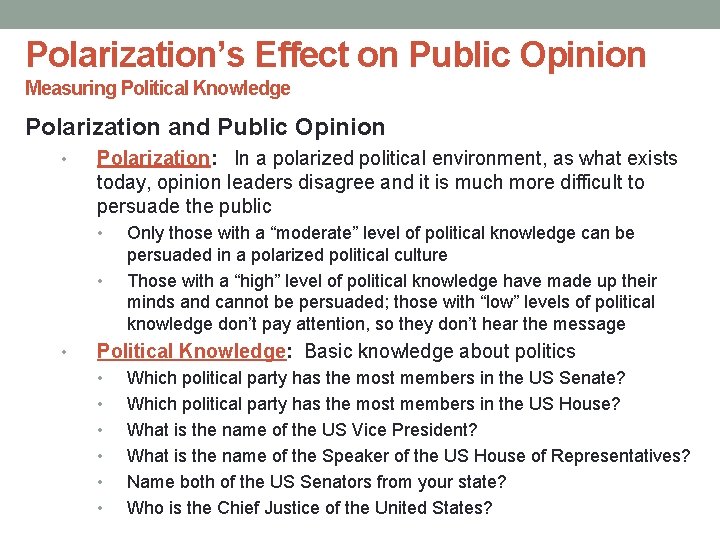
Polarization’s Effect on Public Opinion Measuring Political Knowledge Polarization and Public Opinion • Polarization: In a polarized political environment, as what exists today, opinion leaders disagree and it is much more difficult to persuade the public • • • Only those with a “moderate” level of political knowledge can be persuaded in a polarized political culture Those with a “high” level of political knowledge have made up their minds and cannot be persuaded; those with “low” levels of political knowledge don’t pay attention, so they don’t hear the message Political Knowledge: Basic knowledge about politics • • • Which political party has the most members in the US Senate? Which political party has the most members in the US House? What is the name of the US Vice President? What is the name of the Speaker of the US House of Representatives? Name both of the US Senators from your state? Who is the Chief Justice of the United States?
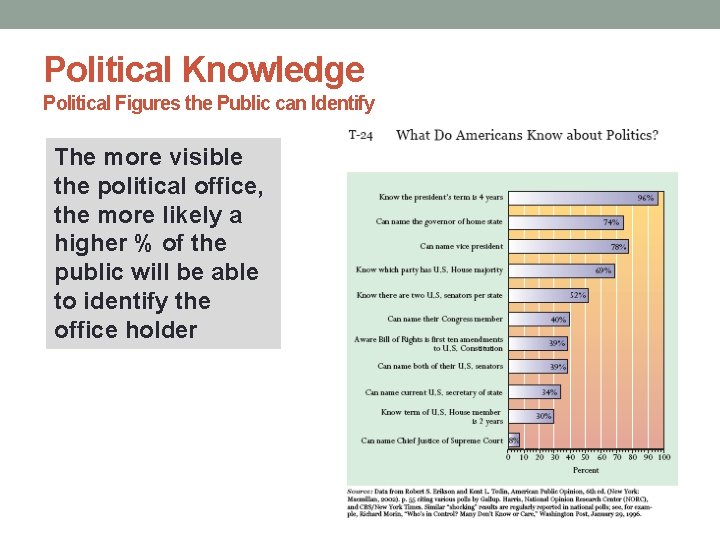
Political Knowledge Political Figures the Public can Identify The more visible the political office, the more likely a higher % of the public will be able to identify the office holder
DEMOGRAPHICS The 2020 Presidential Election
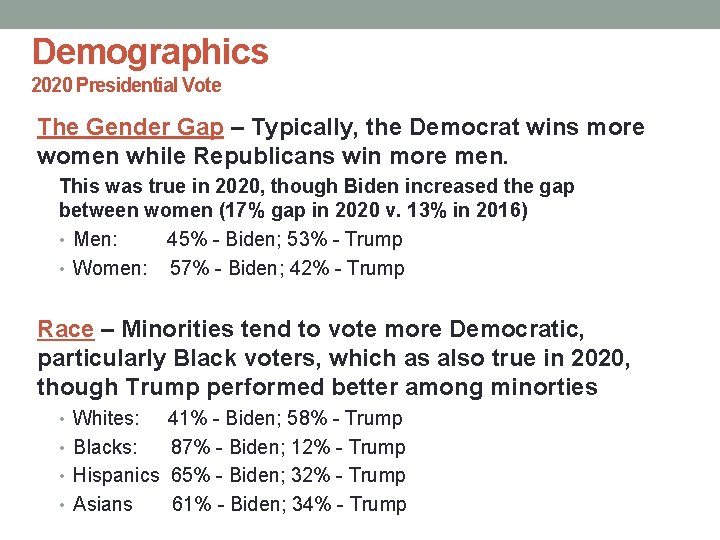
Demographics 2020 Presidential Vote The Gender Gap – Typically, the Democrat wins more women while Republicans win more men. This was true in 2020, though Biden increased the gap between women (17% gap in 2020 v. 13% in 2016) • Men: 45% - Biden; 53% - Trump • Women: 57% - Biden; 42% - Trump Race – Minorities tend to vote more Democratic, particularly Black voters, which as also true in 2020, though Trump performed better among minorties • Whites: 41% - Biden; 58% - Trump • Blacks: 87% - Biden; 12% - Trump • Hispanics 65% - Biden; 32% - Trump • Asians 61% - Biden; 34% - Trump
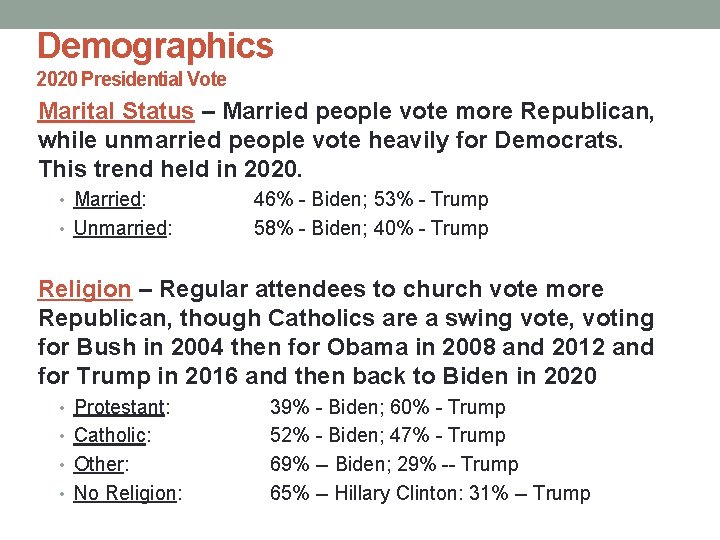
Demographics 2020 Presidential Vote Marital Status – Married people vote more Republican, while unmarried people vote heavily for Democrats. This trend held in 2020. • Married: • Unmarried: 46% - Biden; 53% - Trump 58% - Biden; 40% - Trump Religion – Regular attendees to church vote more Republican, though Catholics are a swing vote, voting for Bush in 2004 then for Obama in 2008 and 2012 and for Trump in 2016 and then back to Biden in 2020 • Protestant: • Catholic: • Other: • No Religion: 39% - Biden; 60% - Trump 52% - Biden; 47% - Trump 69% -- Biden; 29% -- Trump 65% -- Hillary Clinton: 31% -- Trump
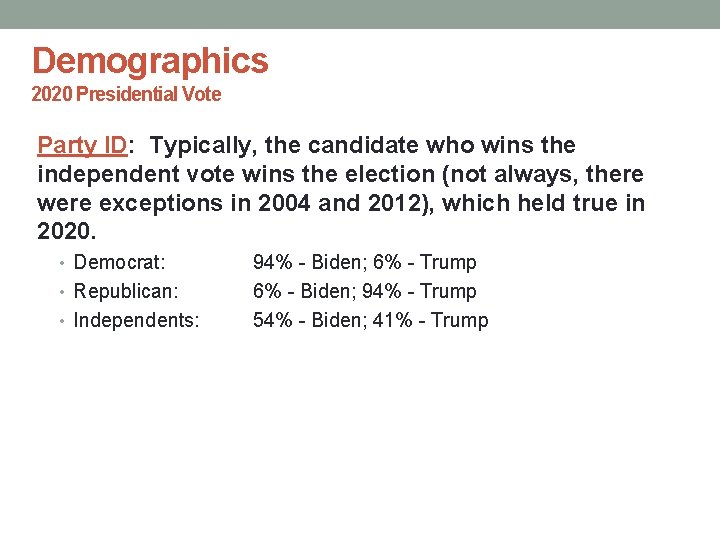
Demographics 2020 Presidential Vote Party ID: Typically, the candidate who wins the independent vote wins the election (not always, there were exceptions in 2004 and 2012), which held true in 2020. • Democrat: • Republican: • Independents: 94% - Biden; 6% - Trump 6% - Biden; 94% - Trump 54% - Biden; 41% - Trump
- Slides: 9