
Public Key Infrastructure Digital Certificates n Public key
Public Key Infrastructure

Digital Certificates n Public key encryption: encrypt using receiver’s public key q n Digital signature: verify a signature q n sender has to be sure that the public key used for encryption is indeed the receiver’s public key Verifier has to be sure that the public key used for signature verification is indeed the signer’s public key How can the encryptor / verifier be sure that the public key is authentic? cryptanalysis M encryption C Eve M private key decryption Alice’s public key Alice’s Personal Homepage • How about posting the public key at a personal homepage? • How about sending the public key to the encryptor / verifier using email? M Alice private key
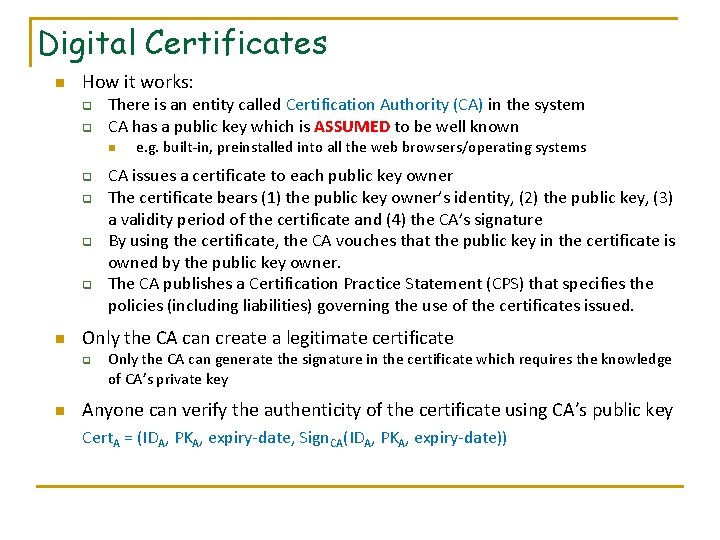
Digital Certificates n How it works: q q There is an entity called Certification Authority (CA) in the system CA has a public key which is ASSUMED to be well known n q q n CA issues a certificate to each public key owner The certificate bears (1) the public key owner’s identity, (2) the public key, (3) a validity period of the certificate and (4) the CA’s signature By using the certificate, the CA vouches that the public key in the certificate is owned by the public key owner. The CA publishes a Certification Practice Statement (CPS) that specifies the policies (including liabilities) governing the use of the certificates issued. Only the CA can create a legitimate certificate q n e. g. built-in, preinstalled into all the web browsers/operating systems Only the CA can generate the signature in the certificate which requires the knowledge of CA’s private key Anyone can verify the authenticity of the certificate using CA’s public key Cert. A = (IDA, PKA, expiry-date, Sign. CA(IDA, PKA, expiry-date))
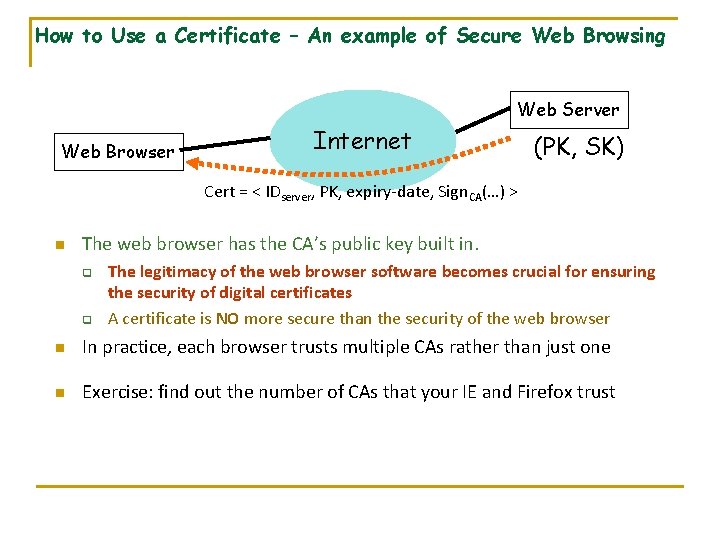
How to Use a Certificate – An example of Secure Web Browsing Web Server Web Browser Internet (PK, SK) Cert = < IDserver, PK, expiry-date, Sign. CA(…) > n The web browser has the CA’s public key built in. q q The legitimacy of the web browser software becomes crucial for ensuring the security of digital certificates A certificate is NO more secure than the security of the web browser n In practice, each browser trusts multiple CAs rather than just one n Exercise: find out the number of CAs that your IE and Firefox trust
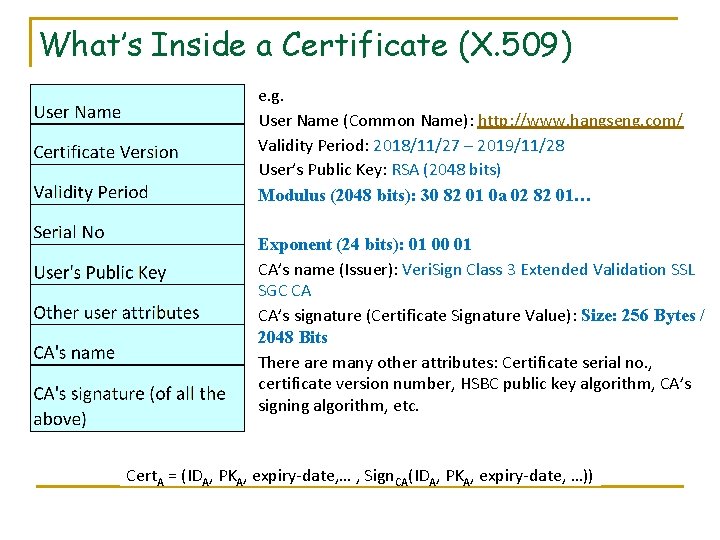
What’s Inside a Certificate (X. 509) e. g. User Name (Common Name): http: //www. hangseng. com/ Validity Period: 2018/11/27 – 2019/11/28 User’s Public Key: RSA (2048 bits) Modulus (2048 bits): 30 82 01 0 a 02 82 01… Exponent (24 bits): 01 00 01 CA’s name (Issuer): Veri. Sign Class 3 Extended Validation SSL SGC CA CA’s signature (Certificate Signature Value): Size: 256 Bytes / 2048 Bits There are many other attributes: Certificate serial no. , certificate version number, HSBC public key algorithm, CA’s signing algorithm, etc. Cert. A = (IDA, PKA, expiry-date, … , Sign. CA(IDA, PKA, expiry-date, …))
Some Remarks on Digital Certificates n Certificate authority (CA) is considered as a Trusted Third Party (TTP) that issues and signs certificates q q Verifying CA’s signature in a certificate only verifies the binding validity between the public key and the identity in the certificate vouched by the CA Verifying CA’s signature does not verify the identity of the source that the certificate comes from! n E. g. Alice may receive Carol’s certificate from Bob Certificates are public! Common format for certificates is ITU-T X. 509.
Certificate Revocation n n There are cases when a certificate has to be made invalid before its expiry date q For example, when an employee leaves an organization, or when a participant's private key has been compromised. Certificate Revocation List (CRL) q The CA should periodically, or on demand basis, distribute CRL (which is signed by the CA) listing the serial numbers of the certificates that have been revoked. q A participant using a certificate should check the latest CRL from the CA, to determine if the certificate is still valid.
PKI n Public Key Infrastructure (PKI) consists of all pieces needed to securely use public key cryptography q q q n n Key generation and management Certification authorities, digital certificates Certificate revocation lists (CRLs) No general standard for PKI We consider a few models of PKI
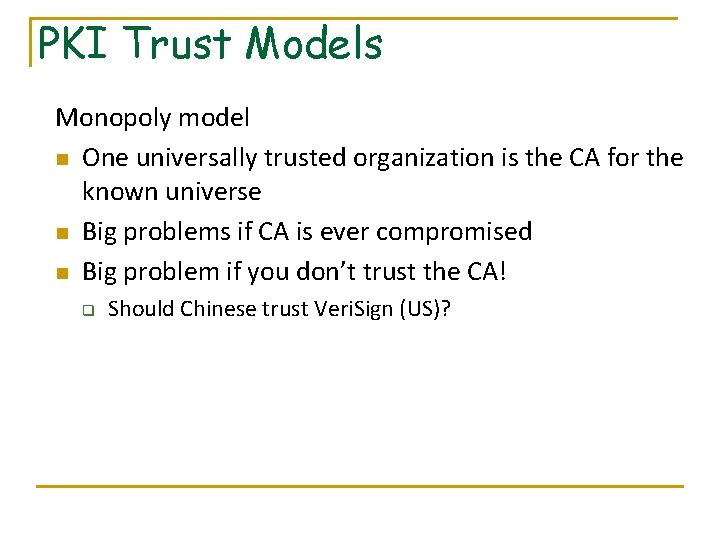
PKI Trust Models Monopoly model n One universally trusted organization is the CA for the known universe n Big problems if CA is ever compromised n Big problem if you don’t trust the CA! q Should Chinese trust Veri. Sign (US)?
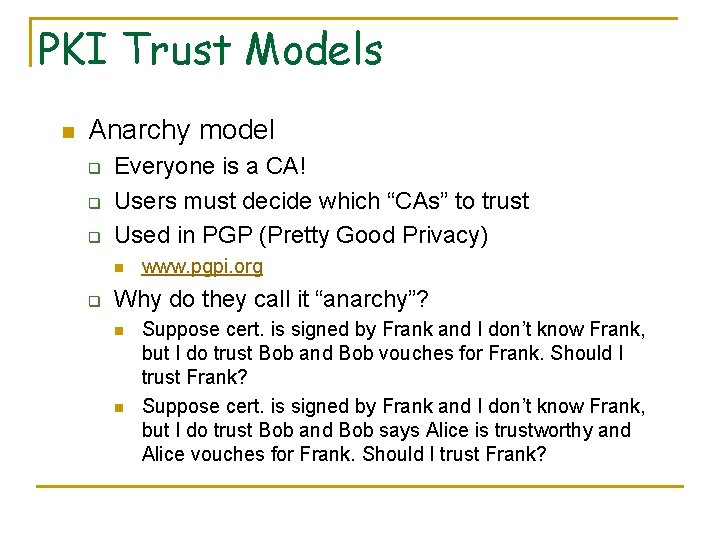
PKI Trust Models n Anarchy model q q q Everyone is a CA! Users must decide which “CAs” to trust Used in PGP (Pretty Good Privacy) n q www. pgpi. org Why do they call it “anarchy”? n n Suppose cert. is signed by Frank and I don’t know Frank, but I do trust Bob and Bob vouches for Frank. Should I trust Frank? Suppose cert. is signed by Frank and I don’t know Frank, but I do trust Bob and Bob says Alice is trustworthy and Alice vouches for Frank. Should I trust Frank?
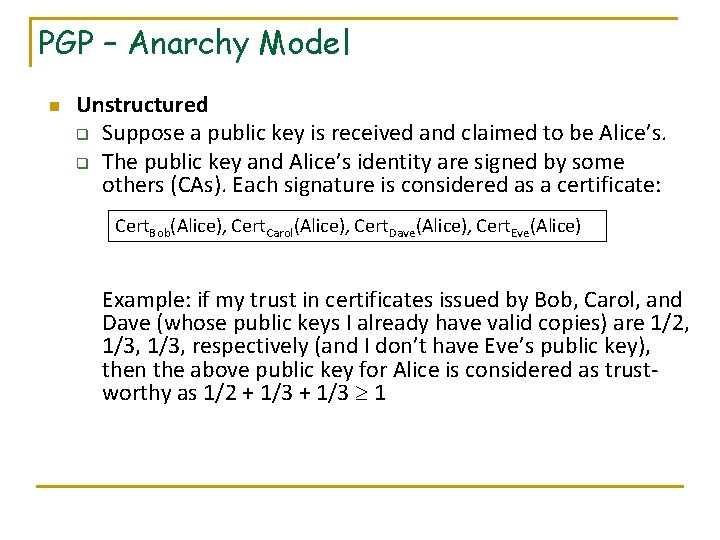
PGP – Anarchy Model n Unstructured q Suppose a public key is received and claimed to be Alice’s. q The public key and Alice’s identity are signed by some others (CAs). Each signature is considered as a certificate: Cert. Bob(Alice), Cert. Carol(Alice), Cert. Dave(Alice), Cert. Eve(Alice) Example: if my trust in certificates issued by Bob, Carol, and Dave (whose public keys I already have valid copies) are 1/2, 1/3, respectively (and I don’t have Eve’s public key), then the above public key for Alice is considered as trustworthy as 1/2 + 1/3 1
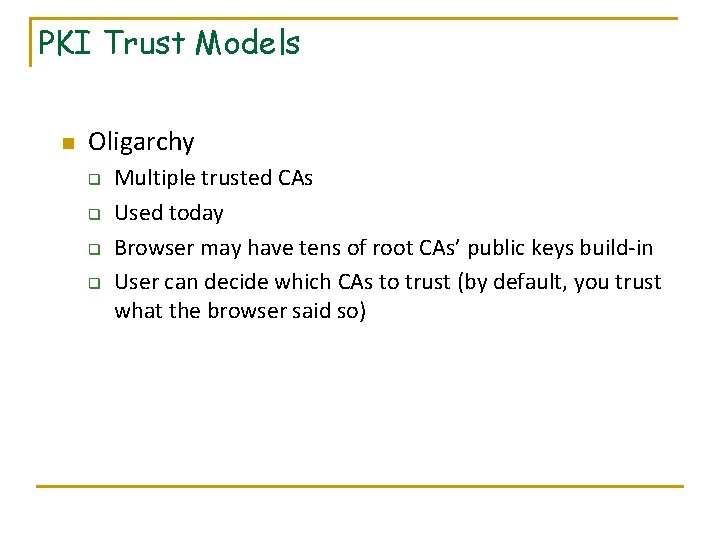
PKI Trust Models n Oligarchy q q Multiple trusted CAs Used today Browser may have tens of root CAs’ public keys build-in User can decide which CAs to trust (by default, you trust what the browser said so)
Hybrid Encryption
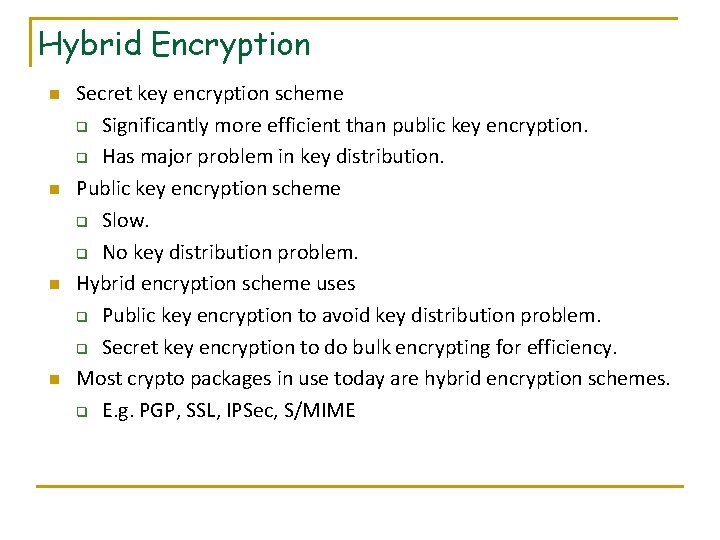
Hybrid Encryption n n Secret key encryption scheme q Significantly more efficient than public key encryption. q Has major problem in key distribution. Public key encryption scheme q Slow. q No key distribution problem. Hybrid encryption scheme uses q Public key encryption to avoid key distribution problem. q Secret key encryption to do bulk encrypting for efficiency. Most crypto packages in use today are hybrid encryption schemes. q E. g. PGP, SSL, IPSec, S/MIME
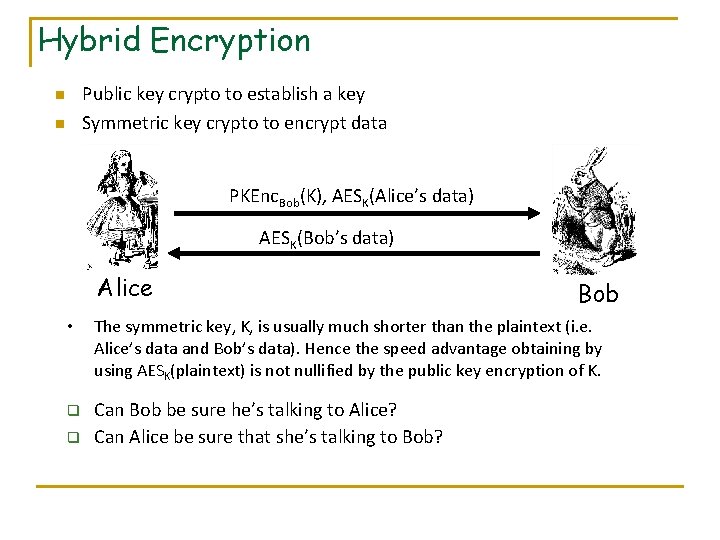
Hybrid Encryption Public key crypto to establish a key Symmetric key crypto to encrypt data n n PKEnc. Bob(K), AESK(Alice’s data) AESK(Bob’s data) Alice Bob • The symmetric key, K, is usually much shorter than the plaintext (i. e. Alice’s data and Bob’s data). Hence the speed advantage obtaining by using AESK(plaintext) is not nullified by the public key encryption of K. q Can Bob be sure he’s talking to Alice? Can Alice be sure that she’s talking to Bob? q
Summary n n n Digital Certificate PKI Hybird Encryption 17
- Slides: 17