
Public Key Cryptosystems RSA p p q q
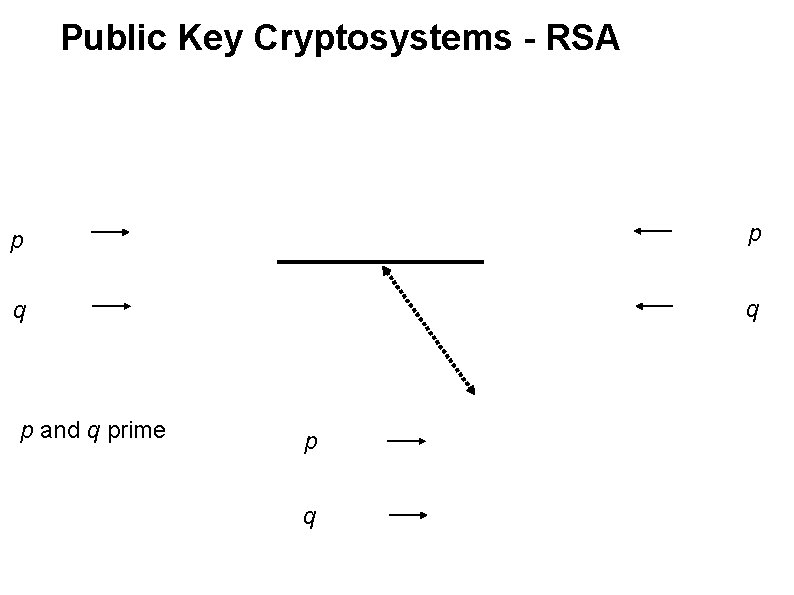
Public Key Cryptosystems - RSA p p q q p and q prime p q
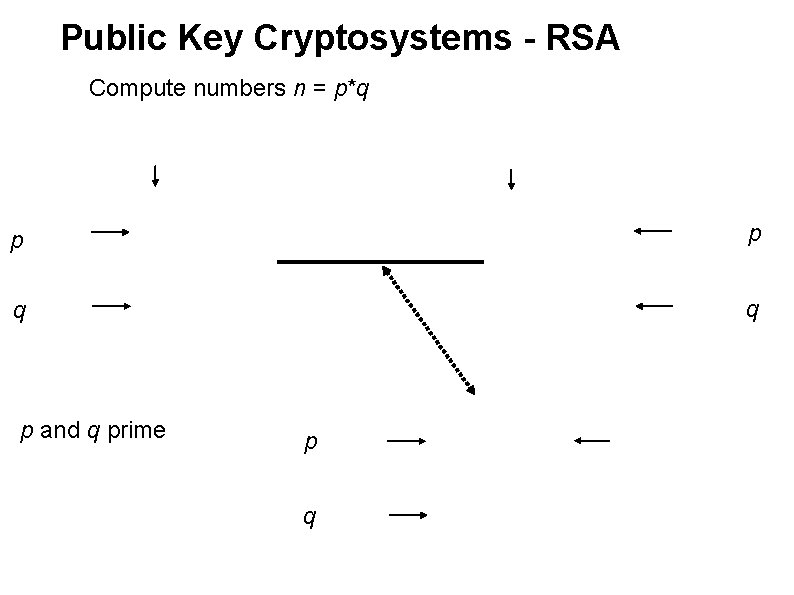
Public Key Cryptosystems - RSA Compute numbers n = p*q p p q q p and q prime p q

Public Key Cryptosystems - RSA Choose e prime relative to (p-1)(q-1) p p q q p and q prime p q
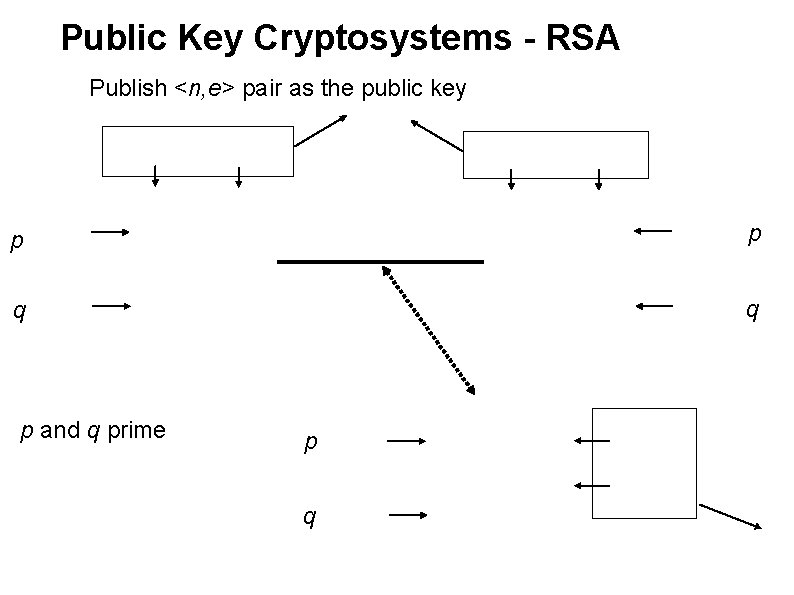
Public Key Cryptosystems - RSA Publish <n, e> pair as the public key p p q q p and q prime p q
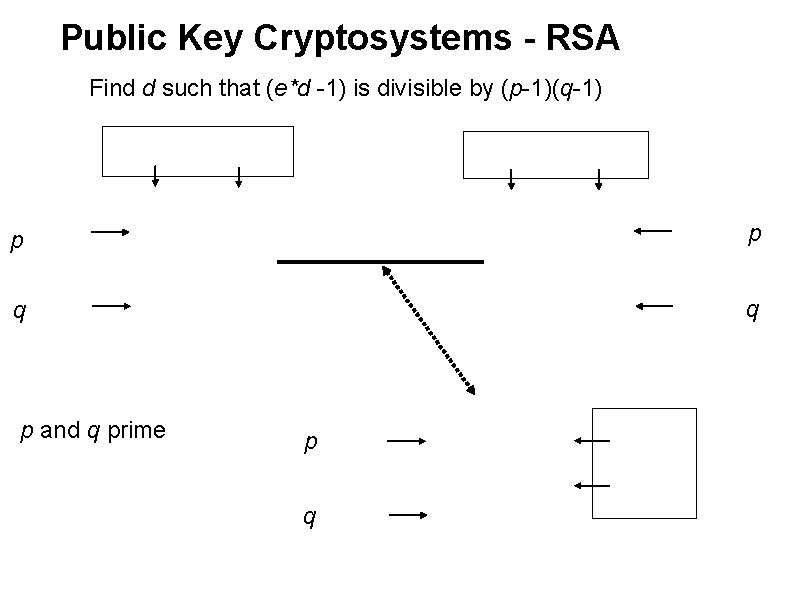
Public Key Cryptosystems - RSA Find d such that (e*d -1) is divisible by (p-1)(q-1) p p q q p and q prime p q
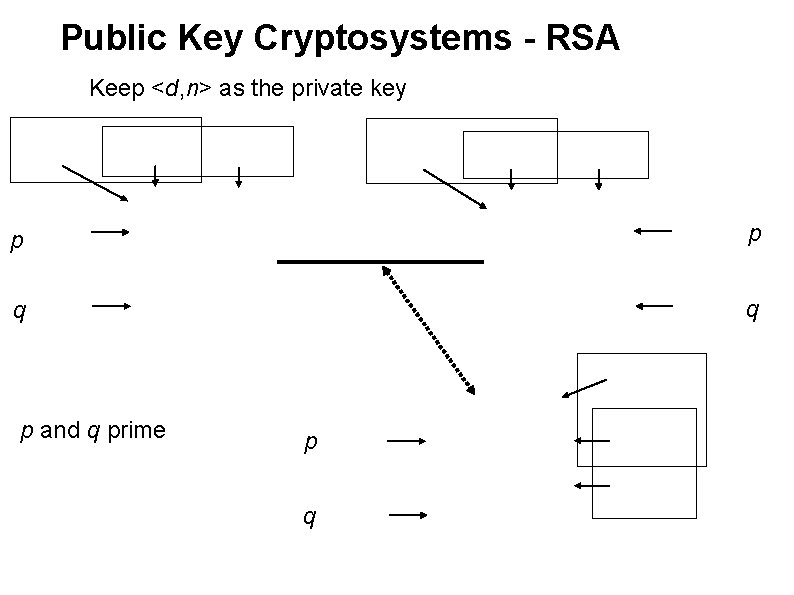
Public Key Cryptosystems - RSA Keep <d, n> as the private key p p q q p and q prime p q
Public Key Cryptosystems - RSA Toss p and q
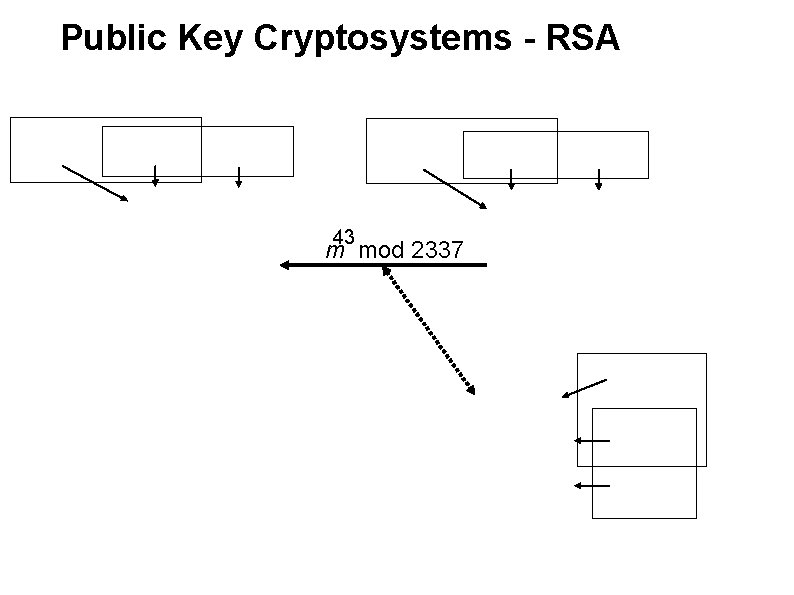
Public Key Cryptosystems - RSA 43 m mod 2337
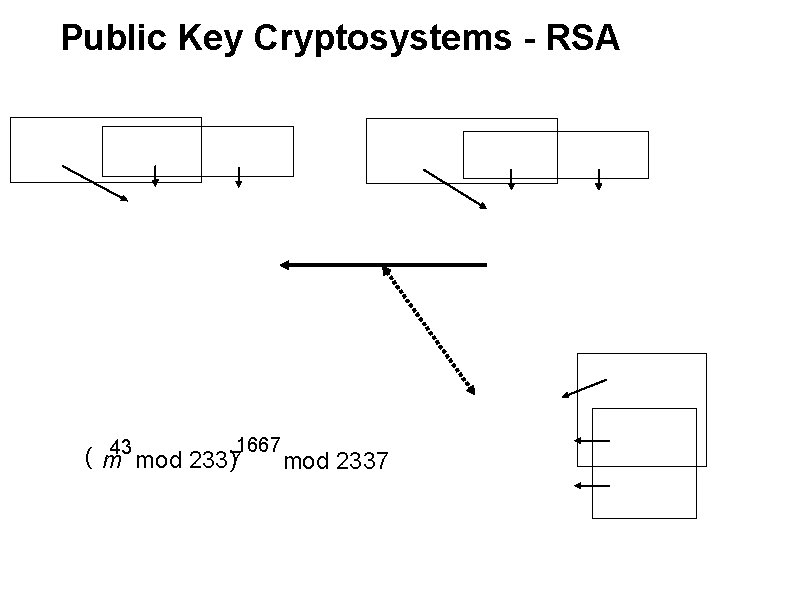
Public Key Cryptosystems - RSA 43 1667 ( m mod 2337 ) mod 2337
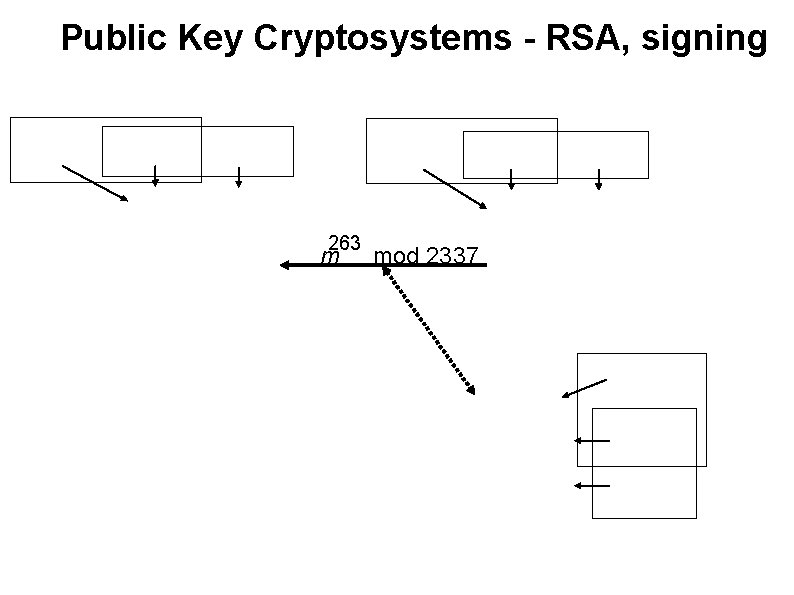
Public Key Cryptosystems - RSA, signing 263 m mod 2337
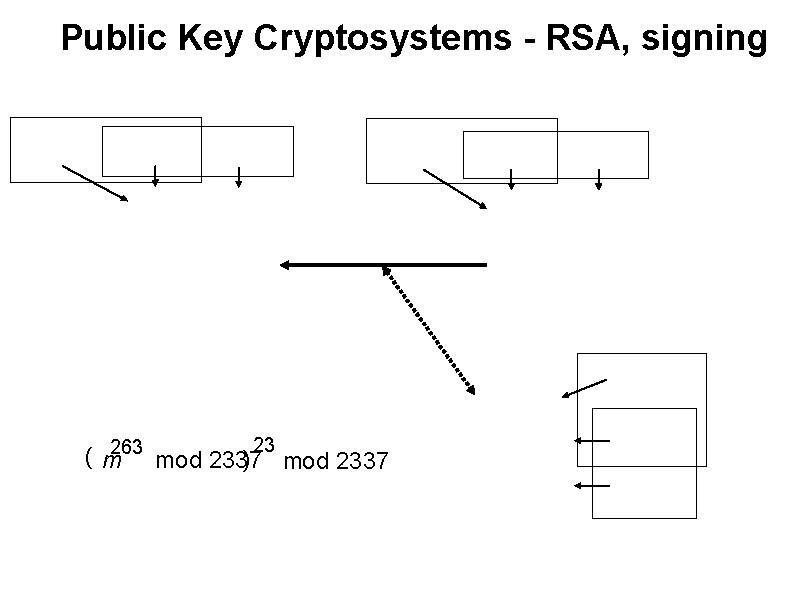
Public Key Cryptosystems - RSA, signing 263 (m 23 ) mod 2337
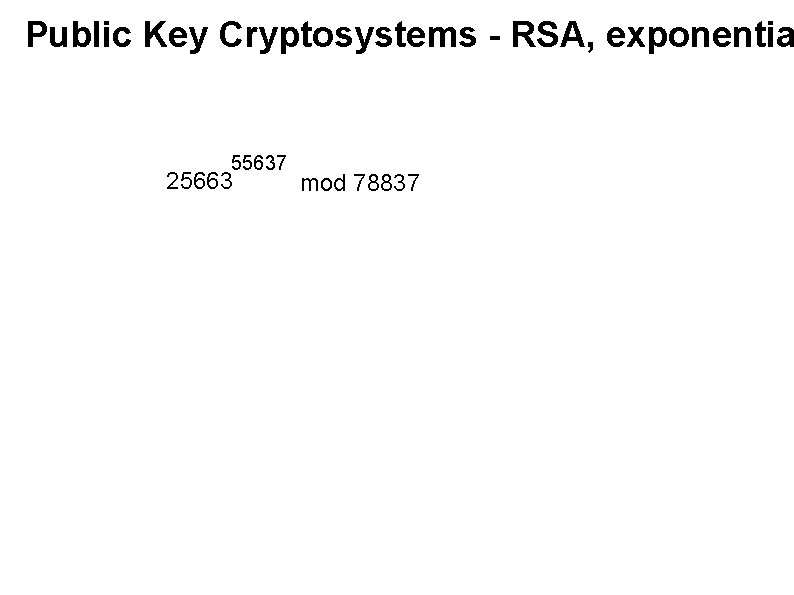
Public Key Cryptosystems - RSA, exponentia 55637 25663 mod 78837
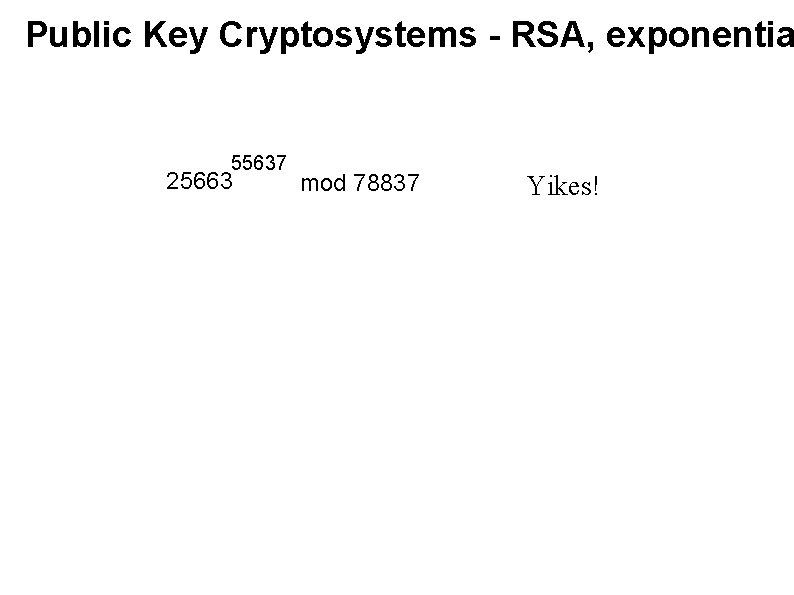
Public Key Cryptosystems - RSA, exponentia 55637 25663 mod 78837 Yikes!
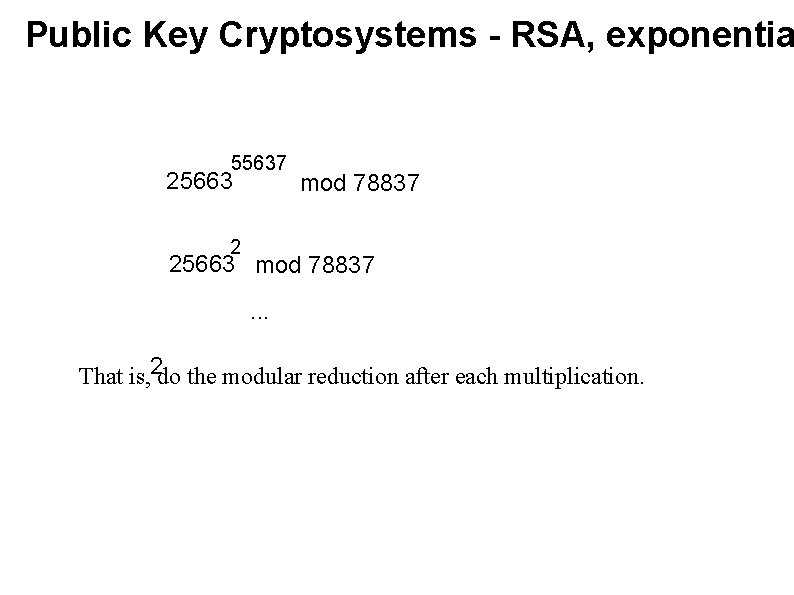
Public Key Cryptosystems - RSA, exponentia 55637 25663 mod 78837 2 25663 mod 78837. . . That is, 2 do the modular reduction after each multiplication.
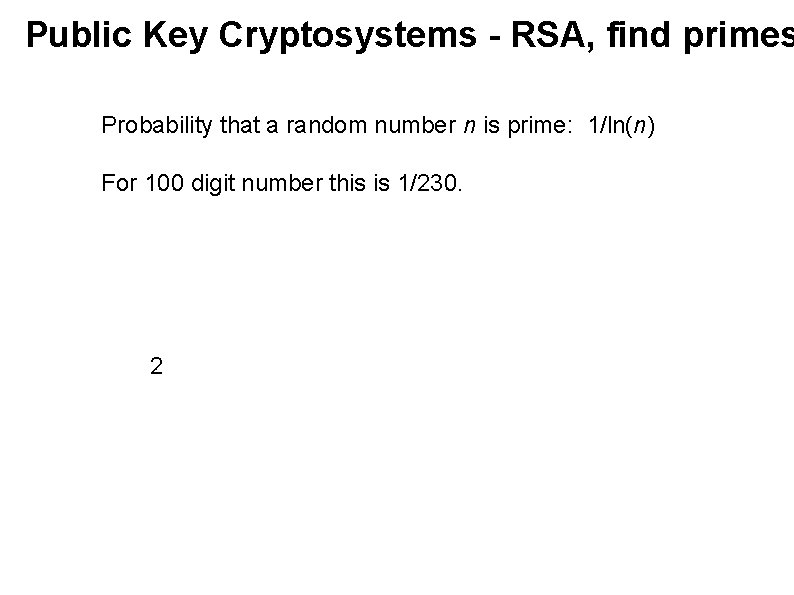
Public Key Cryptosystems - RSA, find primes Probability that a random number n is prime: 1/ln(n) For 100 digit number this is 1/230. 2
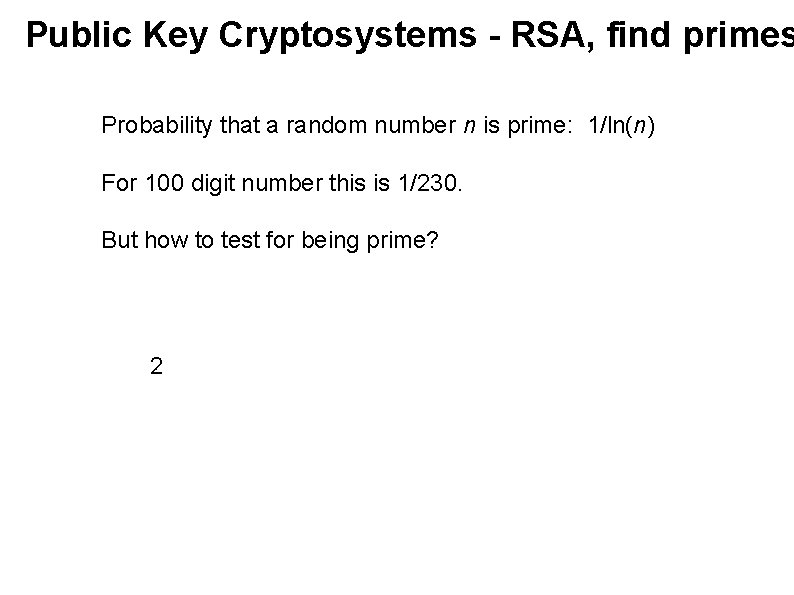
Public Key Cryptosystems - RSA, find primes Probability that a random number n is prime: 1/ln(n) For 100 digit number this is 1/230. But how to test for being prime? 2
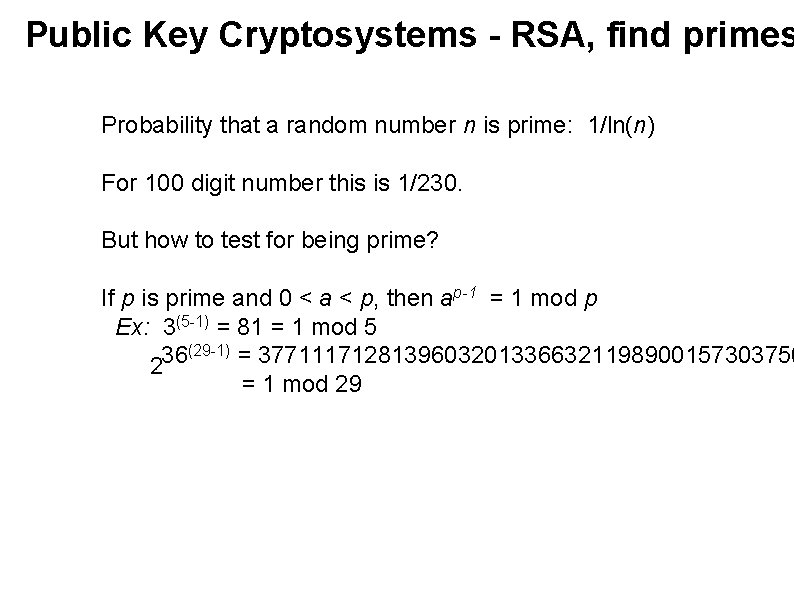
Public Key Cryptosystems - RSA, find primes Probability that a random number n is prime: 1/ln(n) For 100 digit number this is 1/230. But how to test for being prime? If p is prime and 0 < a < p, then ap-1 = 1 mod p Ex: 3(5 -1) = 81 = 1 mod 5 (29 -1) = 37711171281396032013366321198900157303750 36 2 = 1 mod 29
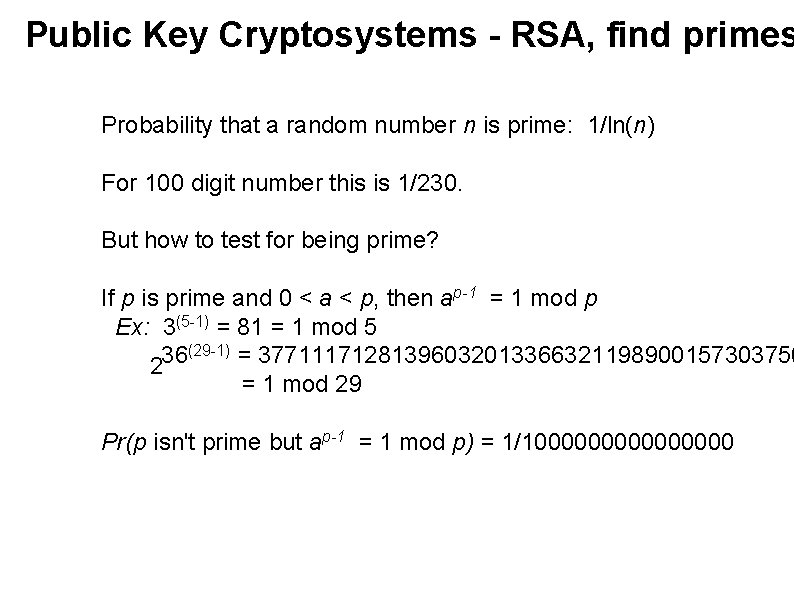
Public Key Cryptosystems - RSA, find primes Probability that a random number n is prime: 1/ln(n) For 100 digit number this is 1/230. But how to test for being prime? If p is prime and 0 < a < p, then ap-1 = 1 mod p Ex: 3(5 -1) = 81 = 1 mod 5 (29 -1) = 37711171281396032013366321198900157303750 36 2 = 1 mod 29 Pr(p isn't prime but ap-1 = 1 mod p) = 1/100000000
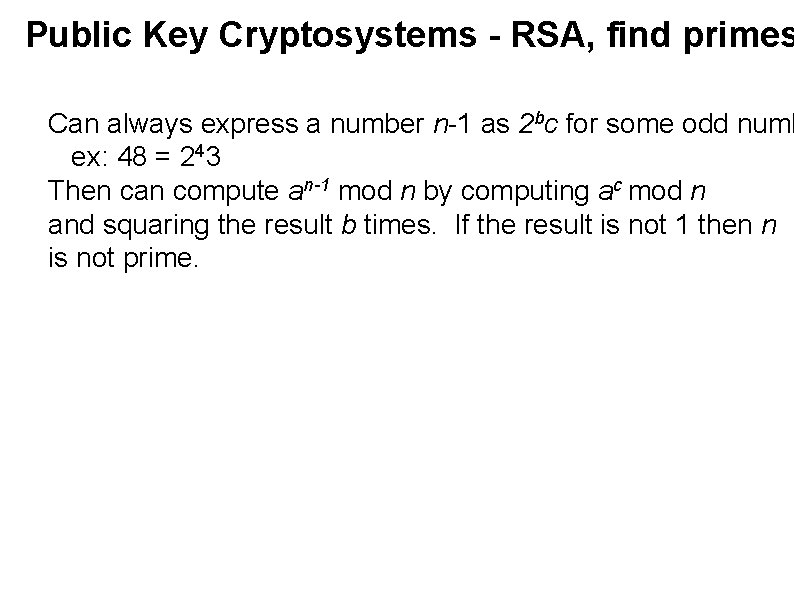
Public Key Cryptosystems - RSA, find primes Can always express a number n-1 as 2 bc for some odd numb ex: 48 = 243 Then can compute an-1 mod n by computing ac mod n and squaring the result b times. If the result is not 1 then n is not prime.
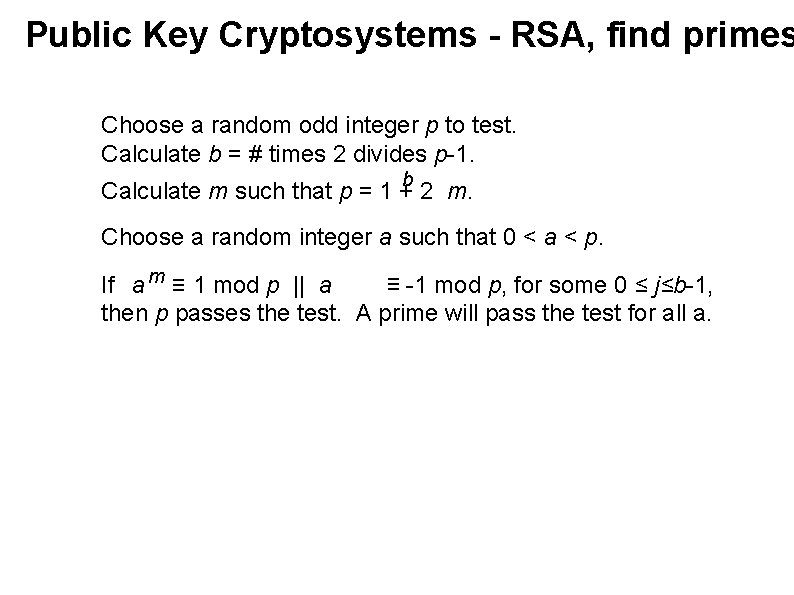
Public Key Cryptosystems - RSA, find primes Choose a random odd integer p to test. Calculate b = # times 2 divides p-1. b Calculate m such that p = 1 + 2 m. Choose a random integer a such that 0 < a < p. If a m ≡ 1 mod p || a ≡ -1 mod p, for some 0 ≤ j≤b-1, then p passes the test. A prime will pass the test for all a.
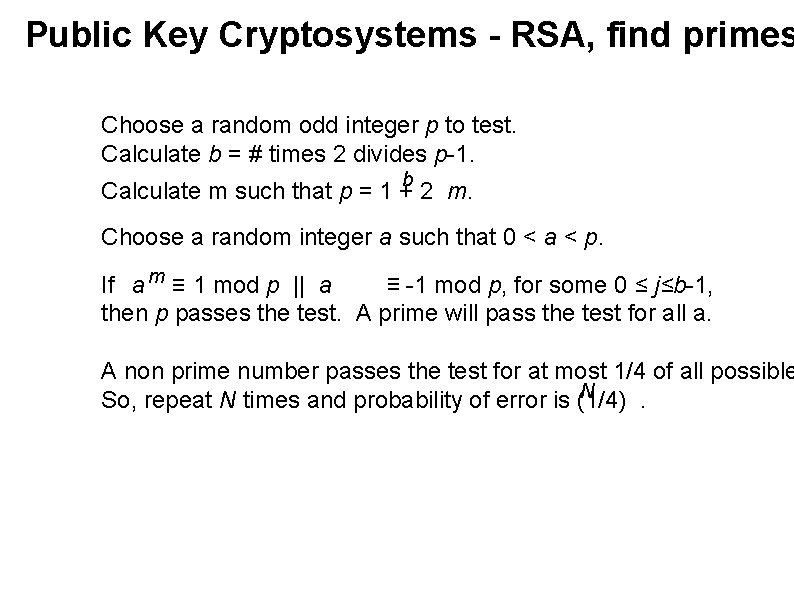
Public Key Cryptosystems - RSA, find primes Choose a random odd integer p to test. Calculate b = # times 2 divides p-1. b Calculate m such that p = 1 + 2 m. Choose a random integer a such that 0 < a < p. If a m ≡ 1 mod p || a ≡ -1 mod p, for some 0 ≤ j≤b-1, then p passes the test. A prime will pass the test for all a. A non prime number passes the test for at most 1/4 of all possible N So, repeat N times and probability of error is (1/4).

Public Key Cryptosystems - RSA, picking d a Choose e first, then find p and q so (p-1) and (q-1) are relatively prime RSA is no less secure if e is always the same and small Popular values for e are 3 and 65537 For e = 3, though, must pad message or else ciphertext = plaintext Choose p ≡ 2 mod 3 so p-1 = 1 mod 3 So, choose random odd number, multiply by 3 and add 2, then test for prim Or, start with any random number, multiply by 6 and add 5
- Slides: 22