
Public Health Surveillance using routine individuallevel data Meaning
Public Health Surveillance using routine individual-level data Meaning, Implementation & Results Jim Todd Annual Health M&E Best Practices Conference Dar-es-Salaam: 14 th December 2017
Objectives • Public Health Surveillance – Review • Routine data – What can it tell us? • WHO and national priorities – What is new? • Conducting a SWOT – Why is it important? • Example project – pilot of HTS-CTC linkage • Benefits and limitations of using routine data in Public Health Surveillance • Way forward.
Public Health Surveillance • WHO definition: “The continuous, systematic collection, analysis and interpretation of health-related data needed for the planning, implementation, and evaluation of public health practice. ” “The ongoing systematic collection, analysis, and interpretation of outcome-specific data for use in planning, implementing, and evaluating public health practice…”
Key features of surveillance data • Ongoing collection of data • Practicality • Uniformity • Rapidity • Usefulness • Timely information for action
Areas where surveillance is used • Vital data - Demographic surveillance of births and deaths (DSS) • Disease monitoring and screening for disease - underlying prevalence (or incidence) of disease (DHS) • Monitoring risk behaviours (identifying those at risk). • Drug sensitivity – to inform changes in drugs • Early notification of outbreaks of infectious diseases – for Public health action (outbreak investigation) • Program evaluation (eg. vaccination)
Questions: - Can we use data collected at routine health care settings? - What are the advantages & disadvantages? - This is used in many developed countries –So why not here?
Routinely collected data • Data collected for routine purposes, such as patient management. • PMR used for clinical management of health conditions • Routine monthly & quarterly aggregate reports • Medical and educational programme reporting (tests, questions, etc) • Limitations (biases due to selection or recording of data): • • Completeness, missing data present a bias. Accuracy, we have no control over the collection Coverage, not all cases included Comparability, different clinics have different protocols • Difficulty identifying outcomes experienced by individuals
Person centred guidelines • First priority is to provide a service to an individual • • Focus on needs Assist in achieving interests, goals, and dreams Employs person first language, and activities Recognise functional strengths and limitations • Second priority to use the data for the system • Programme implementation • Surveillance of known risks, weaknesses, and difficulties • Action to resolve identified problems
WHO guidelines for HIV surveillance • Aggregate data inadequate to address patient care and treatment • Focus on the patient, and their needs • A cascade of linked services for care • Reporting on access to each level • Concentrate on each case and what they need. • First priority to provide the services • Second priority – case based surveillance, by recording key events in clinical care.
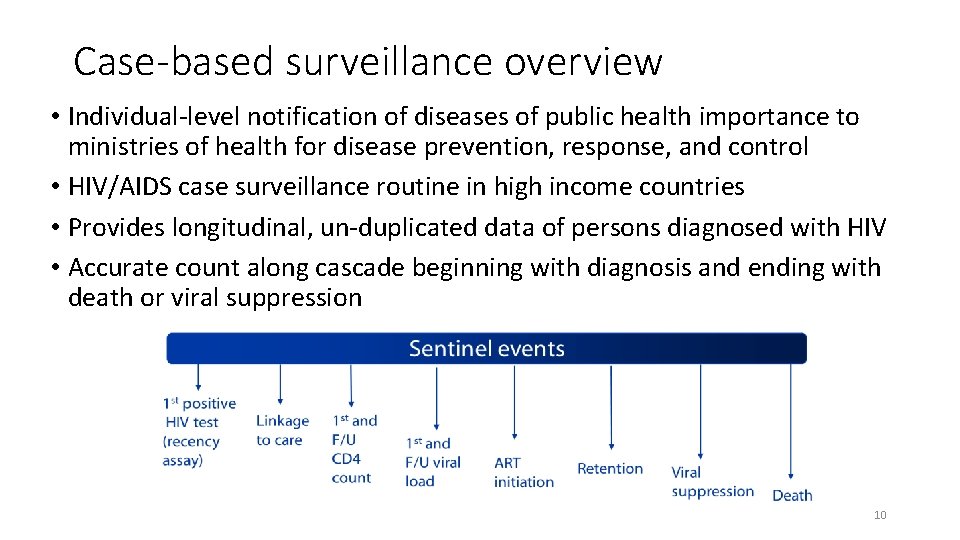
Case-based surveillance overview • Individual-level notification of diseases of public health importance to ministries of health for disease prevention, response, and control • HIV/AIDS case surveillance routine in high income countries • Provides longitudinal, un-duplicated data of persons diagnosed with HIV • Accurate count along cascade beginning with diagnosis and ending with death or viral suppression 10
National guidelines for health information systems (HIS) • New draft guidelines in 2017, building on HSSP III • Produce overarching policy guidelines on HIS • Strengthen disease and demographic surveillance • Improve routine health management information • Reduce burden on health care workers • Enhance communication to policy makers, and feedback to service providers • Rationalise, harmonise and coordinate information systems, so they serve the clinical care, and improve decision making.
Questions: • How do we start to implement patient centred surveillance? • What is needed for case-based surveillance of HIV? • Can Tanzania make the change from the current aggregate data reporting?
Identifying the reporting system: Strengths, weaknesses, opportunities & threats • Importance of finding out what is happening BEFORE changing the system • Example SWOT for case-based surveillance. • Conducted in Tanzania September 2015
Strengths, weaknesses, opportunities & threats (SWOT) • Objectives: Determine resources, services, data, & systems for changing to Case-Based Surveillance (CBS) • Gauge feasibility of implementation of CBS using routine data from HIV testing, ART initiation, Viral load suppression, and deaths in HIV cases • Identify the demands of data collection and data management on HR • Methods: Standardised protocol, review of documents, SOP, tool for data collection, visit to health facilities
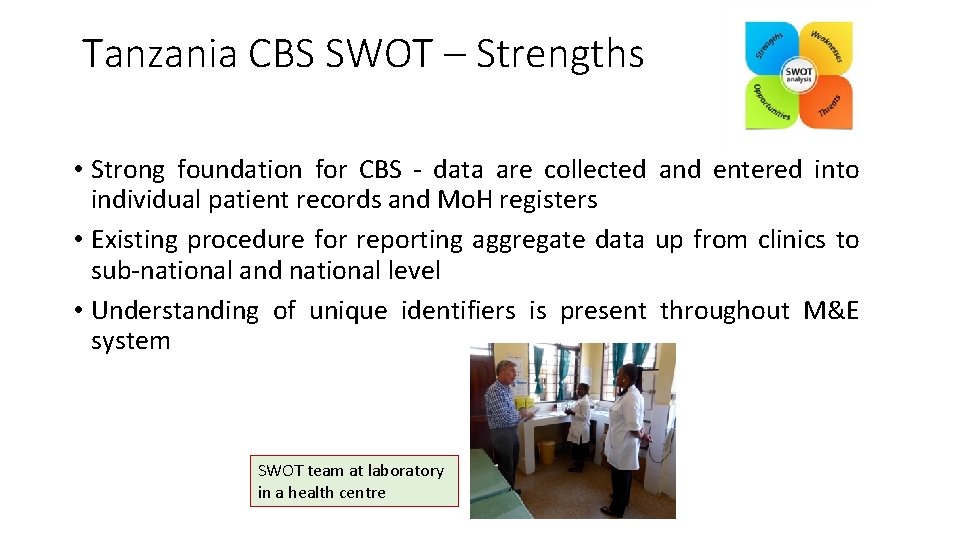
Tanzania CBS SWOT – Strengths • Strong foundation for CBS - data are collected and entered into individual patient records and Mo. H registers • Existing procedure for reporting aggregate data up from clinics to sub-national and national level • Understanding of unique identifiers is present throughout M&E system SWOT team at laboratory in a health centre
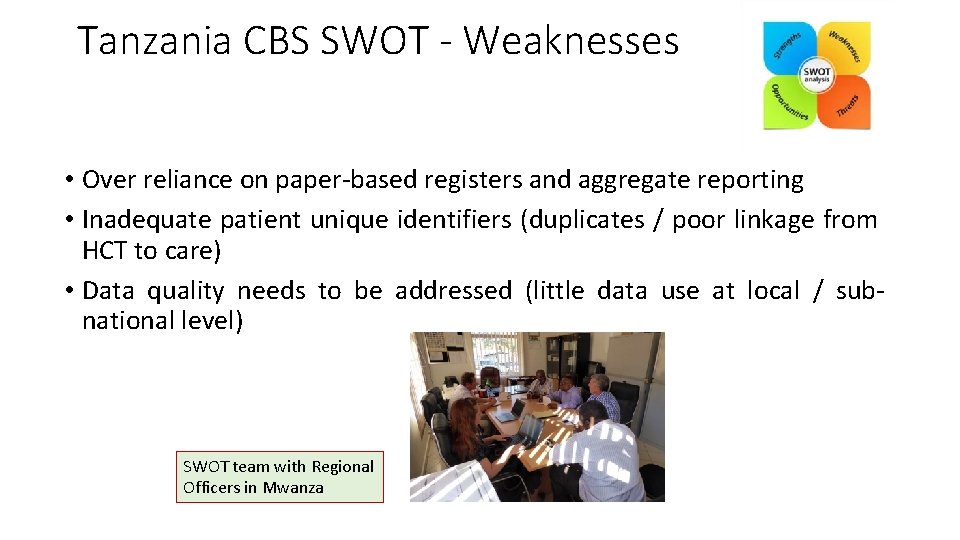
Tanzania CBS SWOT - Weaknesses • Over reliance on paper-based registers and aggregate reporting • Inadequate patient unique identifiers (duplicates / poor linkage from HCT to care) • Data quality needs to be addressed (little data use at local / subnational level) SWOT team with Regional Officers in Mwanza
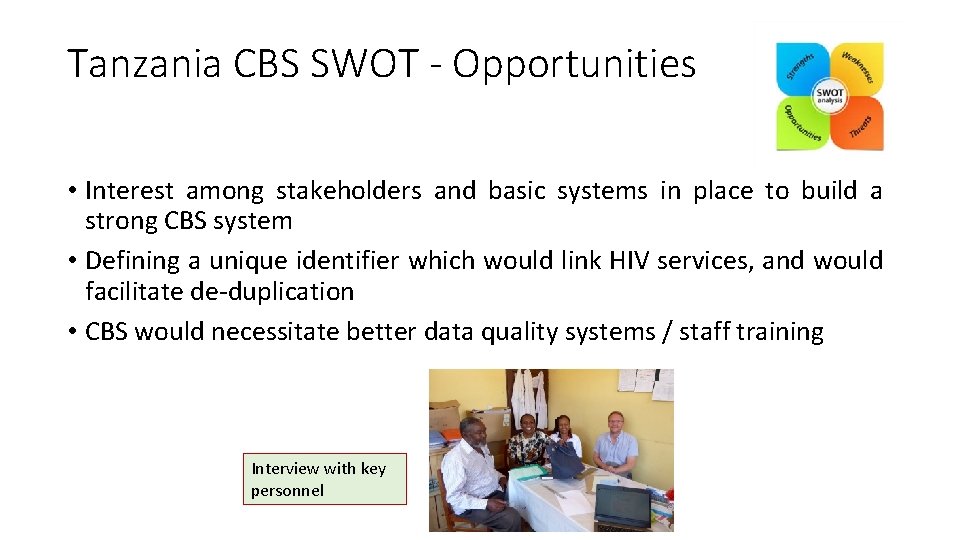
Tanzania CBS SWOT - Opportunities • Interest among stakeholders and basic systems in place to build a strong CBS system • Defining a unique identifier which would link HIV services, and would facilitate de-duplication • CBS would necessitate better data quality systems / staff training Interview with key personnel
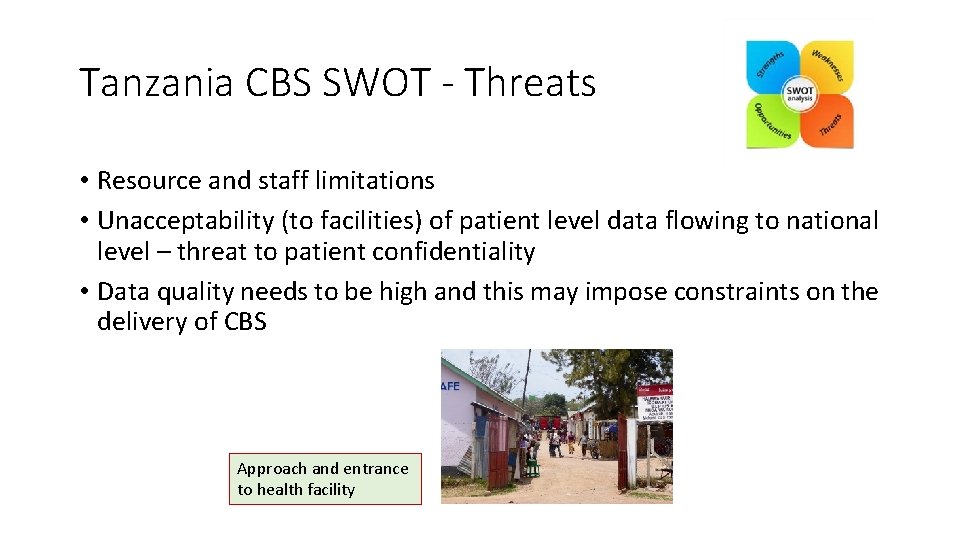
Tanzania CBS SWOT - Threats • Resource and staff limitations • Unacceptability (to facilities) of patient level data flowing to national level – threat to patient confidentiality • Data quality needs to be high and this may impose constraints on the delivery of CBS Approach and entrance to health facility
SWOT conclusions • Develop policies to support CBS • Systems are in place, specific resources need strengthening • Integrate and link the different data sources (HTS, CTC, laboratory) • Develop both infrastructure and data skills in HW and IT personnel • DQA and data cleaning procedures be improved • Require unique identifiers for clinics and patients • Master Facility List in 2016 • Master Patient List – being developed •
Implementing new systems – An example • Linkage of HTS with CTC data • Example from pilot in Magu, Mwanza
Background • Tanzania SWOT for HIV case based surveillance • Identified the linkage between HTS and CTC as a weakness • Need for unique identifiers for HIV notification of new HIV positives • Feasibility of collecting names and confidential information at HTC • Ministry of Health (Mo. HCDGEC) new HIS guidelines (Oct 2017) • Stress integration of data systems within health facilities • Reduce burden on health care providers • Integration of HTS and CTC is a priority in NACP • Pilot study of new CTC database, integrates HTS services into the data • Uses fingerprints to track individuals within the system • Not yet approved for trial
Background in Mwanza • Within Magu HDSS (by TAZAMA, NIMR Mwanza) • Since 2008, used an expanded referral form for HTS to CTC • In Kisesa HC clinics (VCT, ANC and PITC) & community sero-survey • Community sero-survey (2015/16) • Minimum 43% of new HIV diagnosis report to Kisesa CTC within 6 months • HIV patients may report to other CTC • Distance between testing site and CTC is an issue for patients • Real time record linkage between HTS and HDSS population • Facility HTS higher linkage to care than community HTS (HR=5. 57, 95%CI 3. 7 -8. 3) • Median time to CTC =1 day in Facility HTS; =49 days from community HTS
Objectives • To establish a surveillance process for linkage of newly diagnosed HIV cases to the care and treatment clinics (CTC) • Sustainable, low cost surveillance for use in districts, or nationally • To develop and pilot the surveillance using routinely collected data • Assess duplication, and the proportion who repeat HIV positive tests • Assess factors associated with successful linkage to care • Qualitative study to determine patient expectations and reasons for linkage, and non linkage to care • Estimate the second 90 in the 90: 90 indicators
Methods (pilot implementation) • Time period of 12 months (1 st Jan 2017 to 31 st Dec 2017) • Capture HIV positive diagnoses in 16 clinics in Western Magu district • Use modified referral form from HIV testing services (HTS) for referral to CTC • Capture all new attendance at CTC in the same 16 clinics • Collect the referral forms from CTC, or capture the same data from the patients on enrolment in CTC • Field worker to collect data from all clinics monthly • Additional data from the previous 6 months (2016) HTS register, and from CTC database • Qualitative interviews • Patients enrolled in CTC and not enrolled (all adults) • Health care workers referring patients
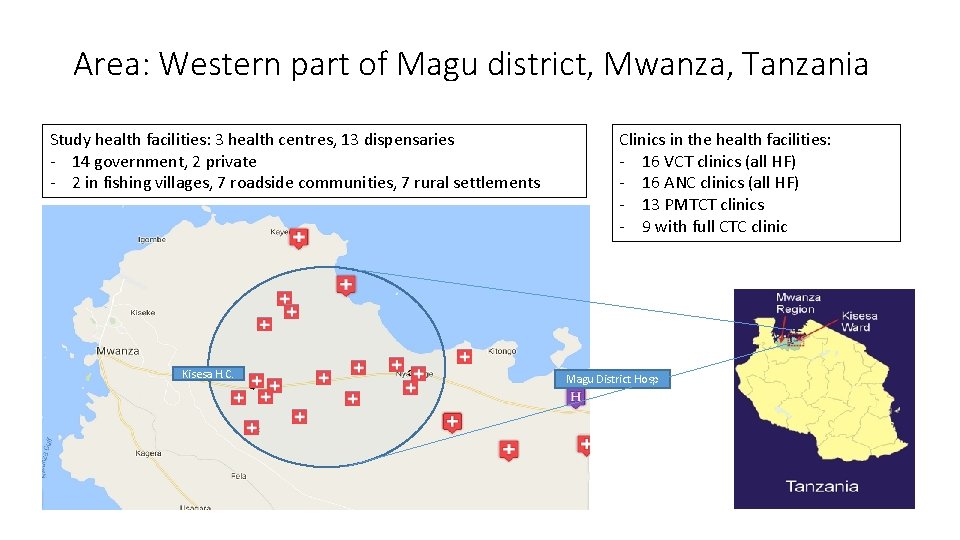
Area: Western part of Magu district, Mwanza, Tanzania Study health facilities: 3 health centres, 13 dispensaries - 14 government, 2 private - 2 in fishing villages, 7 roadside communities, 7 rural settlements Kisesa H. C. Clinics in the health facilities: - 16 VCT clinics (all HF) - 16 ANC clinics (all HF) - 13 PMTCT clinics - 9 with full CTC clinic Magu District Hosp
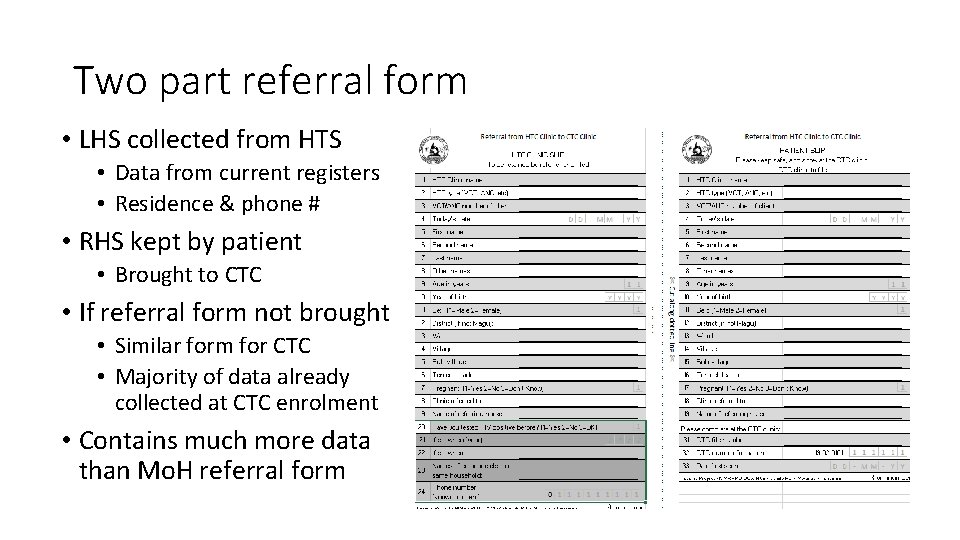
Two part referral form • LHS collected from HTS • Data from current registers • Residence & phone # • RHS kept by patient • Brought to CTC • If referral form not brought • Similar form for CTC • Majority of data already collected at CTC enrolment • Contains much more data than Mo. H referral form
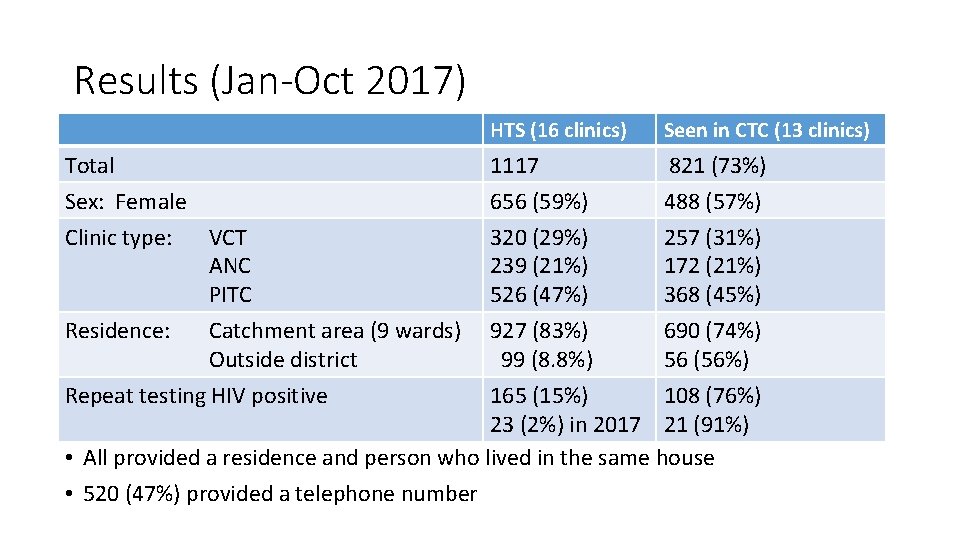
Results (Jan-Oct 2017) Total Sex: Female Clinic type: VCT ANC PITC Residence: Catchment area (9 wards) Outside district Repeat testing HIV positive HTS (16 clinics) Seen in CTC (13 clinics) 1117 656 (59%) 320 (29%) 239 (21%) 526 (47%) 927 (83%) 99 (8. 8%) 821 (73%) 488 (57%) 257 (31%) 172 (21%) 368 (45%) 690 (74%) 56 (56%) 165 (15%) 108 (76%) 23 (2%) in 2017 21 (91%) • All provided a residence and person who lived in the same house • 520 (47%) provided a telephone number
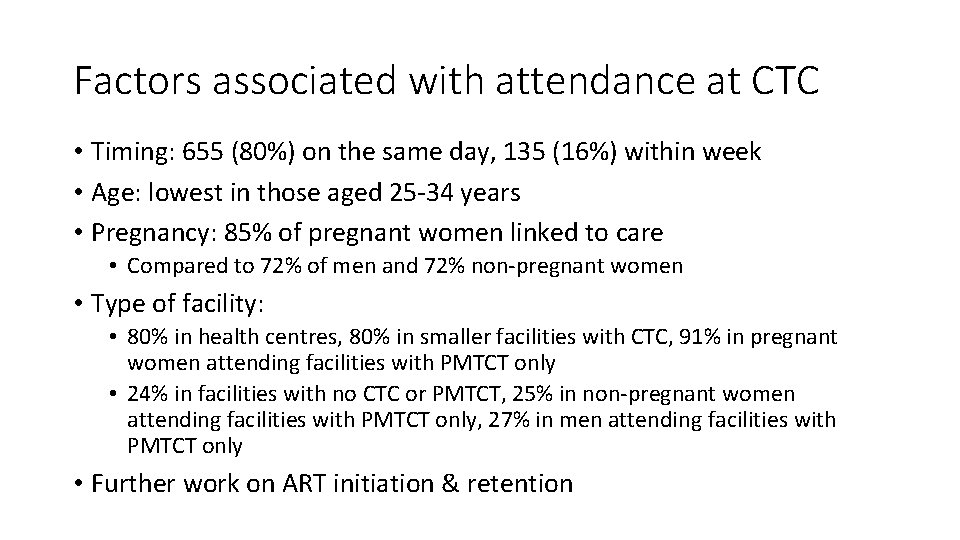
Factors associated with attendance at CTC • Timing: 655 (80%) on the same day, 135 (16%) within week • Age: lowest in those aged 25 -34 years • Pregnancy: 85% of pregnant women linked to care • Compared to 72% of men and 72% non-pregnant women • Type of facility: • 80% in health centres, 80% in smaller facilities with CTC, 91% in pregnant women attending facilities with PMTCT only • 24% in facilities with no CTC or PMTCT, 25% in non-pregnant women attending facilities with PMTCT only, 27% in men attending facilities with PMTCT only • Further work on ART initiation & retention
Qualitative findings: Health facility factors • Services: “people would like to go to health facilities, where they find … services” • Distance and cost: Minimum or zero cost preferred • Trust in providers: “there at X health facility, they care [for] clients” • Delays: “here at Y, there is poor service, you come at 7 AM, you find no health provider” • Identification: “[if] there is a new/another procedure, I find it difficult” • HCW: “Referral forms useful and easy to use. ”
Qualitative findings: Health journeys – personal factors • Ignorance: “I didn’t have any Idea; my wife was pregnant, when we came for test” • Misconceptions: “I had a normal fever” “I just know this is Malaria” • Denial: “the second test result, I will see the kind of result” “I do not feel like have something, or rather suffers from diseases” • Realisation: “this will be your lifetime problem” • Social stigma: “is my great concern, at the open space, … where I can go and take the drugs” • Coping: “I came to realize that they are both using the drugs with his first wife” • Acceptance: “I am not alone” “I am not the first”
Discussion • Referral form important clinically, and useful for surveillance. • Virtually all clients used it when enrolling in CTC • HCW found it convenient, useful, quick, and easy to use • Feasible, affordable, and easy to use for CBS surveillance • For 2 nd of the 90’s: Estimate 73% of HIV positive linked to care. • >80% if CTC is in same facility as HTS (most enrol on the same day) • Access factors: Convenience of services, trust in the service providers, and the quality of the service • Need to implement at district level. • Build in local analysis of the data by district staff
Conclusions to pilot HTS-CTC linkage project • Referral forms provide a low-cost, sustainable way to link HTS clients to enrolment in care. • Useful for improved clinical outcomes & for surveillance • Can be done by existing facility staff • Patients willing to provide extra information needed for surveillance • Devolvement of CTC to every health facility in Tanzania would improve linkage, and help achieve the WHO 90: 90 target. • Implementation needs to be integrating into district services • Local surveillance of HIV testing services and linkage to care • De-duplication of repeat testers
Benefits and Limitations • Clinical care is the prime importance of health care systems • Surveillance using routinely collected data supports better clinical care: • • Concentrates on key clinical outcomes Improves data quality, through use and analysis Builds skills among health workers and IT professionals Integrated with reality on the ground (practical & sustainable) • Requires investment in infrastructure and personnel
Next steps • Identify the key events to monitor for HIV surveillance • HTS, CTC enrolment, ART initiation, VL suppression, retention • Develop innovative ways to collect these data from clinical services • Integrate the data systems across services • Pilot and test ways to improve integration • Develop de-duplication application for CBS of HIV • Analyse and use the existing data • Provide results for policy and implementers • Feedback to local health care workers • Develop local capacity for management and analysis
Acknowledgements • NACP, Mo. HCDGEC, implementors HIV services in Tanzania • Donors, funders and partners to HIV programmes • Districts, Health Facility staff, and those delivering HIV care & treatment • Researchers in NIMR, TAZAMA project, and others involved with surveillance using routinely collected data • LSHTM, Me. SH & funding from B&MGF for this research
- Slides: 35