
Public Health Model For Substance Abuse Prevention HQ
Public Health Model For Substance Abuse Prevention HQ IMCOM "IMCOM will synchronize, integrate, and deliver installation services and sustain facilities in support of Senior Commanders in order to enable a ready and resilient Army" Scott Maylender/Prev Svcs/466 -0397/scott. maylender. civ@mail. mil 1 Version 2 03 Mar 14/1300/ASAP
Terminal Learning Objectives • TLO: To lean the elements of the Public Health Model (PHM) and the execution of ASAP as a PHM Scott Maylender/Prev Svcs/466 -0397/scott. maylender. civ@mail. mil 2 Version 2 03 Mar 14/1300/ASAP
Enabling Objectives I. III. IV. V. VIII. IX. X. What is a Public Health Model? The Three Components of the PHM Institute of Medicine Public Health Model Examples of Public Health Models Elements of Public Health Model Army Public Health Model IMCOM use of the Public Health Model Facts and Research PHM for Substance Abuse Prevention References Scott Maylender/Prev Svcs/466 -0397/scott. maylender. civ@mail. mil 3 Version 2 03 Mar 14/1300/ASAP
What is the Public Health Model? • • “The public health model holds that addiction is a disease in a genetically predisposed host (the actual user) who lives in a contributory environment (the actual location and the social network of the host) in which an agent (the drug or drugs) introduces the disease (Inaba, D. , Pharm, D. & Cohen, E. (2000). Uppers, Downers, and All Arounders (p. 312). ” Prevention is designed to affect the relationship of these three factors to control addiction Scott Maylender/Prev Svcs/466 -0397/scott. maylender. civ@mail. mil 4 Version 2 03 Mar 14/1300/ASAP
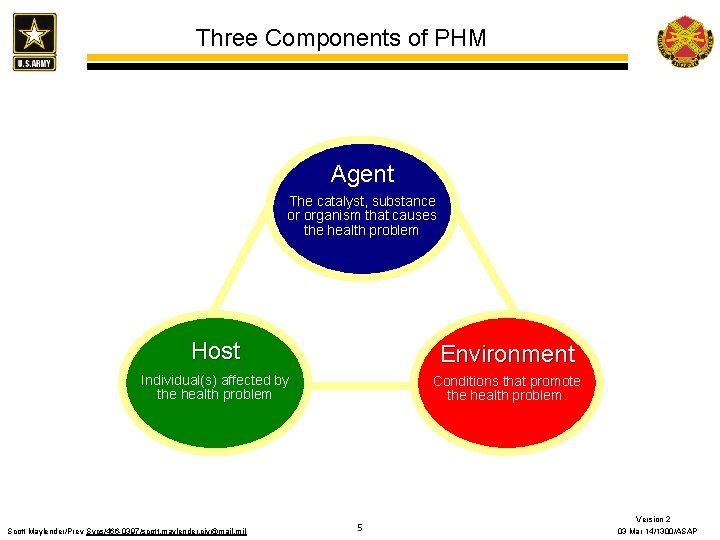
Three Components of PHM Agent The catalyst, substance or organism that causes the health problem Host Environment Individual(s) affected by the health problem Conditions that promote the health problem. Scott Maylender/Prev Svcs/466 -0397/scott. maylender. civ@mail. mil 5 Version 2 03 Mar 14/1300/ASAP
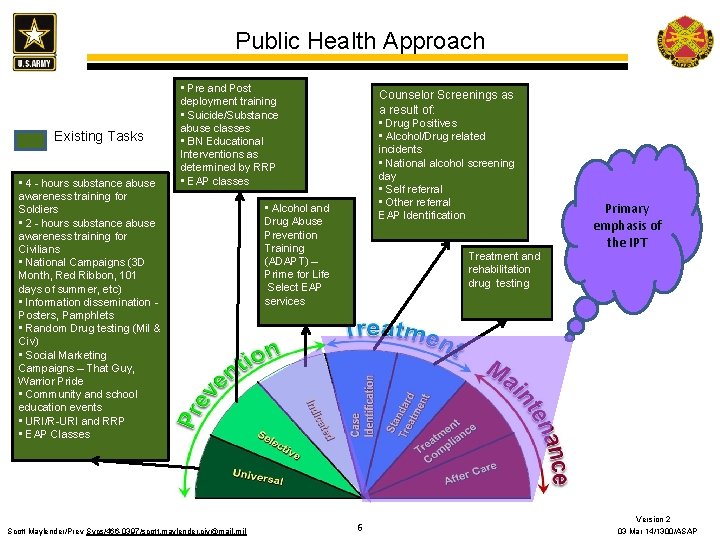
Public Health Approach Existing Tasks • 4 - hours substance abuse awareness training for Soldiers • 2 - hours substance abuse awareness training for Civilians • National Campaigns (3 D Month, Red Ribbon, 101 days of summer, etc) • Information dissemination Posters, Pamphlets • Random Drug testing (Mil & Civ) • Social Marketing Campaigns – That Guy, Warrior Pride • Community and school education events • URI/R-URI and RRP • EAP Classes • Pre and Post deployment training • Suicide/Substance abuse classes • BN Educational Interventions as determined by RRP • EAP classes Scott Maylender/Prev Svcs/466 -0397/scott. maylender. civ@mail. mil Counselor Screenings as a result of: • Drug Positives • Alcohol/Drug related incidents • National alcohol screening day • Self referral • Other referral EAP Identification • Alcohol and Drug Abuse Prevention Training (ADAPT) – Prime for Life Select EAP services Primary emphasis of the IPT Treatment and rehabilitation drug testing 6 Version 2 03 Mar 14/1300/ASAP
Examples of PHM • Centers for Disease Control and Prevention (CDC) • National Weather Service (NWS) • Surgeon General Scott Maylender/Prev Svcs/466 -0397/scott. maylender. civ@mail. mil 7 Version 2 03 Mar 14/1300/ASAP
Elements of a good PHM • • Agency is credible Identify the three parts to the PHM Prevention and treatment identified Saturation (media, posters, word of mouth) Scott Maylender/Prev Svcs/466 -0397/scott. maylender. civ@mail. mil 8 Version 2 03 Mar 14/1300/ASAP
What about Alcohol in the Army? • Host • Agent • Environment Scott Maylender/Prev Svcs/466 -0397/scott. maylender. civ@mail. mil 9 Version 2 03 Mar 14/1300/ASAP
Army PHM • What has been the focus of prevention according to the PHM? – Universal, selective, or indicated? • What has been the focus of treatment according to the PHM? – Universal, selective, or indicated? – How do we receive the majority of our clients? Scott Maylender/Prev Svcs/466 -0397/scott. maylender. civ@mail. mil 10 Version 2 03 Mar 14/1300/ASAP
How do we conduct a true PHM for Prevention? • Prevention is the goal • Which can we truly affect? – Host – Agent – Environment Scott Maylender/Prev Svcs/466 -0397/scott. maylender. civ@mail. mil 11 Version 2 03 Mar 14/1300/ASAP
Facts • Host- Soldiers Family Members and Civilians – High risk 17 -24 year olds (40% of the Army). – Negative consequences range from relatively minor issues such as poor performance on tests, absences, hangovers, and vomiting to more serious and sometimes fatal consequences such as physical assaults, unprotected sex, sexual assaults, and alcohol related motor vehicle injuries and fatalities. – The gross rate of binge drinking is higher in the active duty population (49%) than in the civilian population. Scott Maylender/Prev Svcs/466 -0397/scott. maylender. civ@mail. mil 12 Version 2 03 Mar 14/1300/ASAP
Research • Research suggests the following: – Target the reduction in alcohol consumption in the age group of 18 -24 years of age – Teach socially acceptable behaviors and skills – Get the person to age 25 Scott Maylender/Prev Svcs/466 -0397/scott. maylender. civ@mail. mil 13 Version 2 03 Mar 14/1300/ASAP
PHM for Substance Abuse Prevention • Make the Army Substance Abuse Program credible • Saturate the message through media, PAO, STRATCOM, posters, etc. • Prevention training: Focus training on selective age groups • Treatment: Focus on prevention to reduce the cost of treatment. Scott Maylender/Prev Svcs/466 -0397/scott. maylender. civ@mail. mil 14 Version 2 03 Mar 14/1300/ASAP
References • • 1. Babor, T. , Stenius, K. , & Romelsjo, A. (2008). Alcohol and drug treatment systems in public health perspective: mediators and moderators of population effects. International Journal of Methods in Psychiatric Research, 17, 50 -59. Retrieved January 13, 2010 from the Academic Search Premier database. 2. Buettner, C. , Andrews, D. , & Glassman, M. (2009). Development of a student engagement approach to alcohol prevention: Pragmatics project. Journal of American College Health, 58(1), 33 -38. Retrieved January 22, 2010 from the Academic Search Premier database. 3. Center for Substance Abuse Treatment (2007). The Epidemiology of Co-Occurring Substance Use and Mental Disorders. COCE Overview Paper 8. Retrieved from http: //coce. samhsa. gov/cod_resources/PDF/OP 8 Epidemiology 10 -03 -07. pdf 4. Hutchinson, J. , Greene, J. , & Hansen, S. (2008). Evaluating Active Duty Risk-Taking: Military Home, Education, Activity, Drugs, Sex, Suicide, and Safety Method. Military Medicine, 173(12), 11641167. 5. IOM (Institute of Medicine) (1994). Reducing risks for mental disorders: Frontiers for preventive intervention research. Institute of Medicine, Washington D. C: National Academy Press. 6. Reinke, W. , Splett, J. , & Offutt, C. (2009). Combining school and family intervention of disruptive behavior problems in children: A public health perspective. Psychology in the Schools, 46(1), 3343. Retrieved January 22, 2010 from the Academic Search Premier database. 7. Tip sheet: A violence prevention glossary. (n. d. ). Ohio Domestic Violence Network. Retrieved 2010 from www. odvn. org. Scott Maylender/Prev Svcs/466 -0397/scott. maylender. civ@mail. mil 15 Version 2 03 Mar 14/1300/ASAP
- Slides: 15