
Public Health Health a state of complete physical

Public Health
Health: a state of complete physical, mental, and social well - being and not merely the absence of disease or infirmity. ” Public health: the science and art of preventing disease, prolonging life, and promoting health and efficiency through organized community effort, to ensure everyone a standard of living adequate for the maintenance of health. Epidemiology: is the study of the distribution and determinants of health-related states or events in human populations and the application of this study to the control of health problems. The core of epidemiology is the use of quantitative methods to study disease and risk factors in human populations.
Goals of public health: 1 - Sanitation of the environment. 2 -Education of the individual in the principles of personal hygiene. 3 - Control of community infections 4 - Organization of medical and nursing service for the early detection and prevention of diseases. 5 - Development of the social machinery which will ensure to every individual in the community a standard of living adequate for the maintenance of health.
Epidemiology Definition: Originally, the term ‘epidemiology’ meant ‘the study of epidemics’, but the techniques that were originally used in the study and control of epidemics have also been usefully applied in the study of other types of diseases including noncommunicable diseases and accidents. So the definition was changed to be “ The distribution and determinants of disease frequency or health events in man”. • Distribution refers to the time; place and person characteristics of disease while the determinants (what determines disease) are generally characterized as agent, host and environmental factors.
• Since freedom from disease allows an individual to remain healthy, it is also important to find out how and why individuals do not suffer from disease and remain healthy. Such analyses will help in finding solutions to disease and maintaining good health. The modern definition of epidemiology includes three important elements: ■ All diseases: The term is no longer restricted to the study of infections but it includes cancer, malnutrition, road accidents, mental illness and other non-communicable diseases. ■ Populations: epidemiology deals with the distribution of disease in populations, communities or groups. ■ Ecological approach: The frequency and distribution of disease are examined against the background of various circumstances in man’s total environment (physical, biological
• Uses of epidemiology: 1 - To search for determinants of disease. To find out how and why disease is caused, is a major use of epidemiology. 2 - To assess the health status of communities. 3 - To assess the magnitude or burden of disease in a community. It, therefore, helps in studying the occurrence of disease in a population. 4 - To estimate an individual’s risks and chances of suffering from a disease and to establish the prognosis in an individual suffering from disease. 5 - To plan comprehensive health services, including specific strategies, ways and means of implementation.
6 - To evaluate strategies and interventions for disease control. Such evaluation helps in identifying weaknesses and to suggest remedial measures for the future. Evaluation of costs and benefits or effectiveness of specific interventions is also an integral use. 7 - To complete the natural history of disease. 8 - To forecast future disease trends. *Three major questions are usually asked in epidemiology: ■ Who? What is the distribution of the disease in terms of persons? ■ Where? What is the distribution of the disease in terms of place? ■ When? What is the distribution of the disease in terms of time?
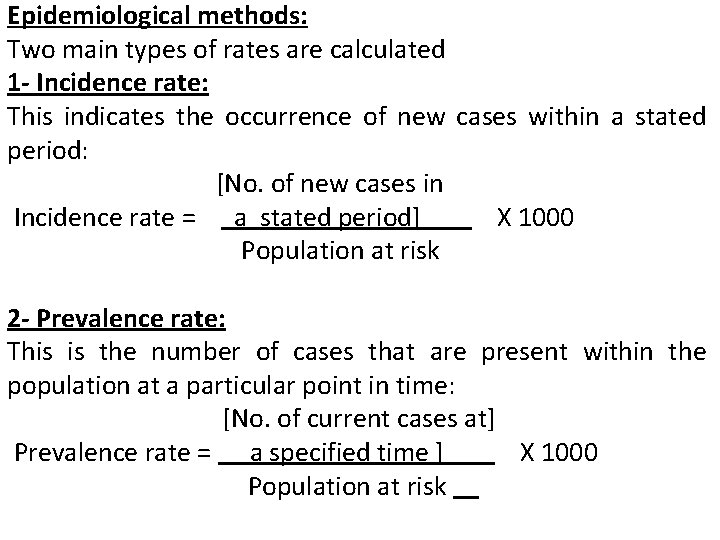
Epidemiological methods: Two main types of rates are calculated 1 - Incidence rate: This indicates the occurrence of new cases within a stated period: [No. of new cases in Incidence rate = a stated period] X 1000 Population at risk 2 - Prevalence rate: This is the number of cases that are present within the population at a particular point in time: [No. of current cases at] Prevalence rate = a specified time ] X 1000 Population at risk
Relationship between Prevalence and Incidence rates: Prevalence of a disease is the product of incidence and the duration of disease ( P= I x. D). Therefore, prevalence of a disease depends not only on the actual number of people who develop a disease but also on the duration of a disease. For short duration diseases like common cold, the prevalence and incidence are almost identical while for chronic or longstanding diseases like tuberculosis, leprosy or blindness the prevalence is always much higher than the incidence.
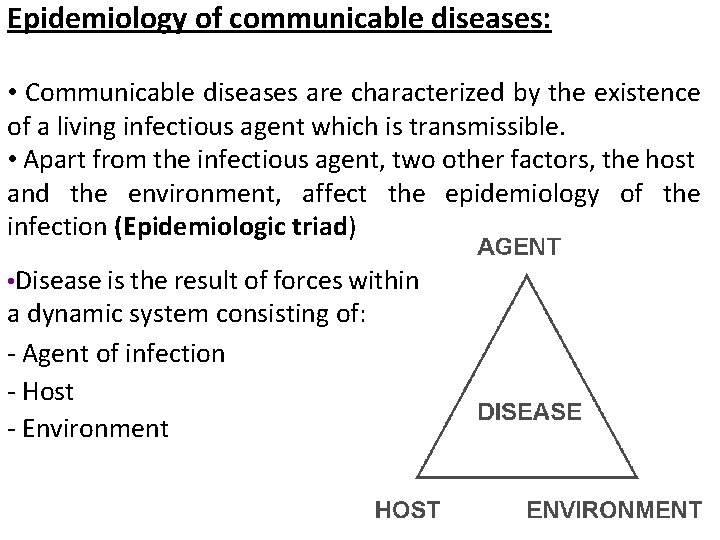
Epidemiology of communicable diseases: • Communicable diseases are characterized by the existence of a living infectious agent which is transmissible. • Apart from the infectious agent, two other factors, the host and the environment, affect the epidemiology of the infection (Epidemiologic triad) • Disease is the result of forces within a dynamic system consisting of: - Agent of infection - Host - Environment
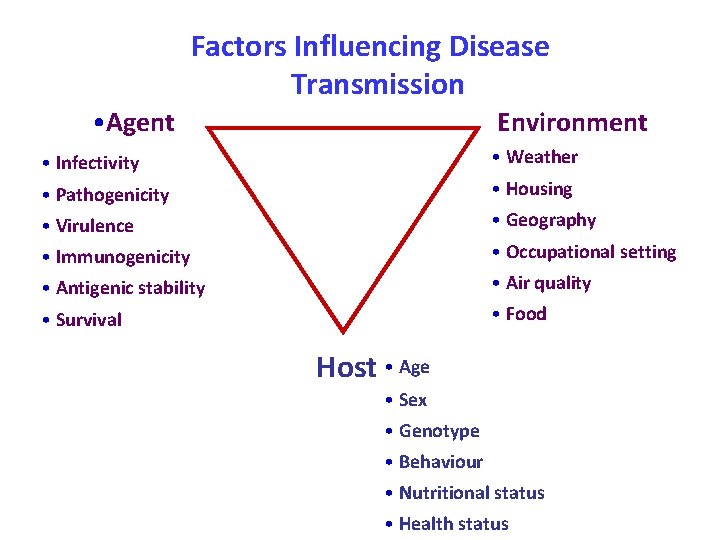
Factors Influencing Disease Transmission • Agent Environment • Infectivity • Weather • Pathogenicity • Housing • Virulence • Geography • Immunogenicity • Occupational setting • Antigenic stability • Air quality • Survival • Food Host • Age • Sex • Genotype • Behaviour • Nutritional status • Health status
Infectious agents: • These may be viruses, rickettsiae, bacteria, protozoa, fungi or helminths. • The biological properties of the agent may play a major role in its epidemiology. • In order to survive an infectious agent must be able to do the following: ■ multiply; ■ emerge from the host; ■ reach a new host; ■ infect the new host.
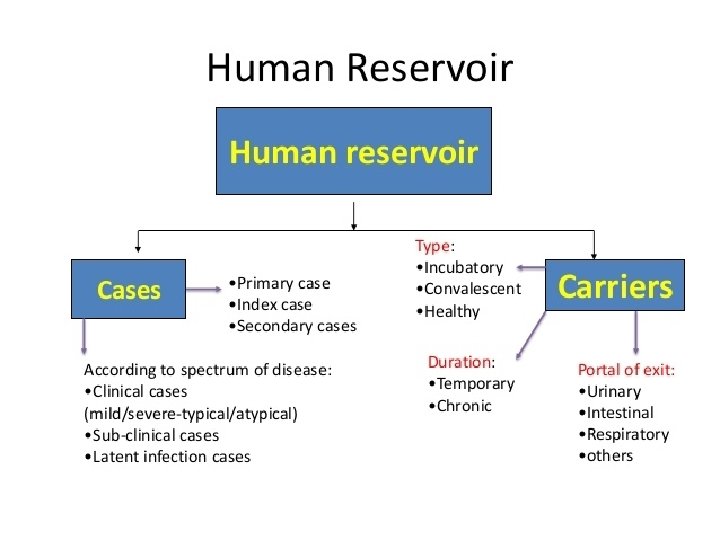
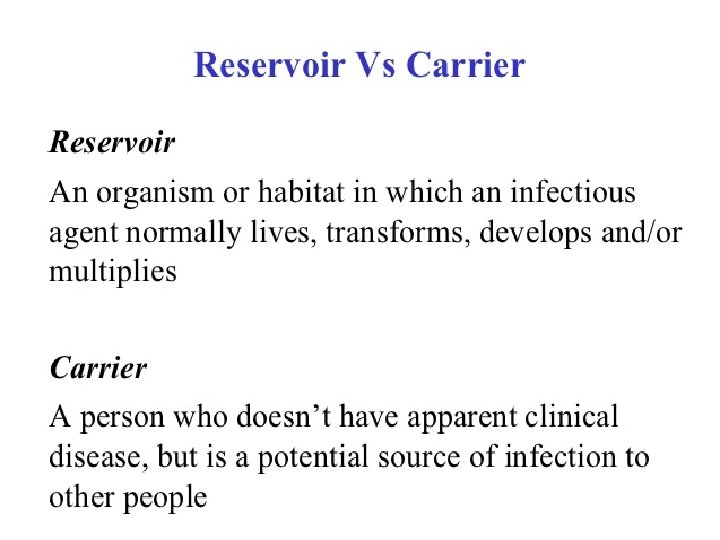
Carriers • A carrier is a person who harbors the infective agent without showing signs of disease but is capable of transmitting the agent to other persons. • The carrier may excrete the agent for only a short period; or may become a chronic carrier, excreting the organism continuously or intermittently over a period of years. • Different types of carriers are described depending on when they excrete the organism in relation to the illness: 1 - Healthy carrier: remains well throughout the infection. 2 - Incubatory carrier: excretes the pathogens during the incubation period, before the onset of symptoms (e. g. HIV/AIDS) or before the characteristic features of the disease (e. g. the measles rash or glandular swelling in mumps are manifested).
3 - Convalescent carrier: continues to harbor the infective agent after recovering from the illness. Why carriers are important in the epidemiology of some infections: ■ Carriers play an important role in the epidemiology of certain infections (poliomyelitis, meningococcal meningitis, AIDs, etc): ■ There may be large numbers of carriers far outnumbering the sick patients. Chronic carriers may serve as a source of infection over a very long period and as a means of repeatedly reintroducing the disease into an area which is otherwise free of infection
■ Since neither the healthy carriers nor their contacts are aware of the infection, they may not take precautions to avoid transmission of the infection, e. g. using condoms to avoid sexually transmitted infection. Thus, while the sick patient’s contacts may be restricted to close family members, friends and visitors, the carrier can continue with normal daily routine, moving freely from place to place, and making contacts with uninfected persons over a wide area. Reservoir: Any person, animal, plant, soil or substance in which an infectious agent normally lives and multiplies. The reservoir harbors the infectious agent without injury to itself and serves as a source of infection. The infectious agent primarily depends on the reservoir for its survival. It is from the reservoir that the infectious substance is transmitted to a human or another susceptible host.
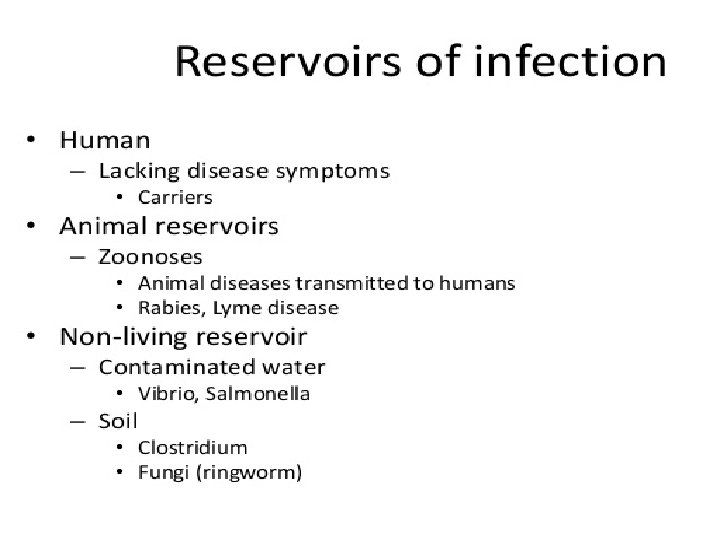
Human reservoir This includes a number of important pathogens that are specifically adapted to man – the infective agents of measles, AIDS, typhoid, meningococcal meningitis, gonorrhoea and syphilis. The human reservoir includes both ill persons and healthy carriers. In some cases (e. g. salmonellosis) humans share the reservoir with other animals. Animal reservoir: Some infective agents that affect humans have their reservoir in animals. The term zoonoses is applied to those infectious diseases of vertebrate animals which are transmissible to man under natural conditions: ■ where humans use the animal for food, e. g: taeniasis; ■ where there is a vector transmitting the infection from animals to humans, e. g. plague (flea), viral encephalitis (mosquito);
■ Where the animal bites human beings, e. g. rabies; ■ Where the animal contaminates human environment including food, e. g. salmonellosis. Health workers should collaborate closely with veterinary authorities in identifying and dealing with these zoonosis. Non-living reservoir: Many of these agents are saprophytes living in soil and are fully adapted to living free in nature. The vegetative forms are usually equipped to withstand marked changes in environmental temperature and humidity. In addition, some develop resistant forms such as spores which can withstand adverse environmental conditions, for example clostridial organisms – the infective agents of tetanus (Clostridium tetani), gas gangrene (C. welchii) and botulism (C. botulinum).
Routes of infection transmission: This refers to the mechanism by which an infectious agent is transferred from one person to another or from the reservoir to a new host. Transmission may occur by: 1 - Contact: either directly, person to person or animal to person (kissing, touching, biting or sexual intercourse), or indirectly through contaminated objects or fomites (Tinea, common cold, flu, pneumonia). It is more likely to occur where there is overcrowding, since this increases the likelihood of contact with infected persons. Blood borne diseases can be transmitted by contact with contaminated blood and body fluids rather directly or indirectly.
2 - Penetration of skin: directly by the organism itself (e. g. hookworm larvae, schistosomiasis), by the bite of a vector (e. g. malaria, plague) or through wounds (e. g. tetanus). Blood borne diseases can be transmitted through this way, the skin is pierced by contaminated syringes, sharp objects or surgical equipments. 3 - Ingestion (food, water & milk borne infections), from contaminated hands, food, milk or water. 4 - Inhalation (air borne infections): Poor ventilation, overcrowding are important factors in the epidemiology of airborne infections. 5 - Transplacental infection: Some infective agents cross the placenta to infect the fetus, producing congenital infections (e. g. HIV, syphilis, toxoplasmosis) and may lead to fetal deformities.
• For some infective agents, infection occurs through more than one route of transmission. For example, plague is transmitted by flea bite (bubonic plague) but in some cases, direct person to person transmission occurs through the respiratory route (pneumonic plague).
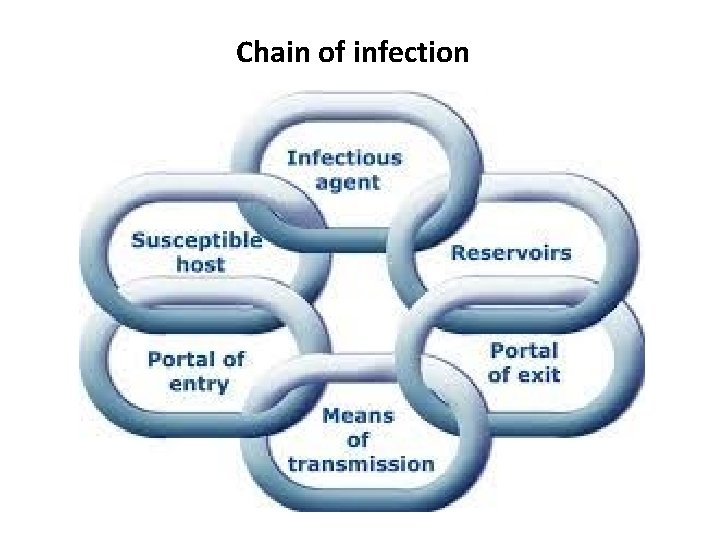
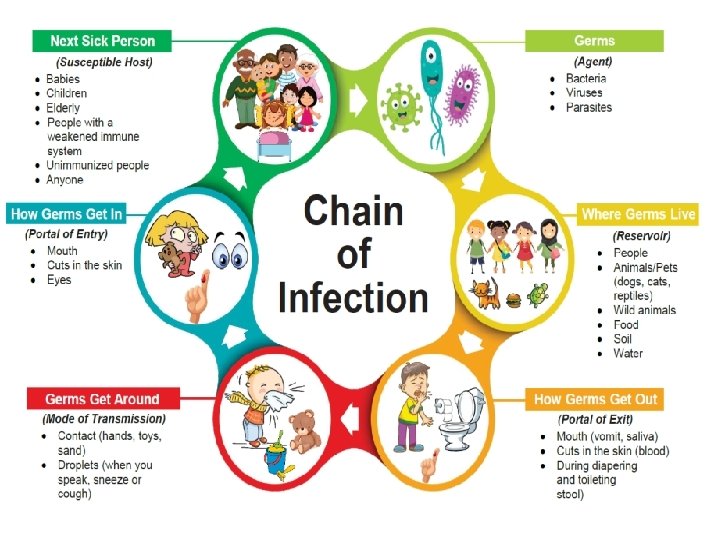
Chain of infection
Patterns of disease incidence: Endemic disease The constant, continuous or usual presence of a disease in a defined geographic area is called an endemic disease. Endemic disease: a disease that exists permanently in a particular region or population. Ex: Malaria is a constant worry in parts of Africa. Epidemic disease The occurrence of a disease clearly in excess of normal expectations in a short period is called an epidemic. Epidemic disease: An outbreak of disease that attacks many peoples at about the same time and may spread through one or several communities. Pandemic disease: When an epidemic spreads across many continents throughout the world.
Sporadic disease: Disease that is seen only occasionally, and usually without geographic concentration. Examples: tetanus, rabies, and plague. CLINICAL COURSE, DURATION , APPEARANCE- FORMS OF COMMUNICABLE DISEASES: 1 - HYPERACUTE (FULMINANT): -Complications may appear before classical symptoms -Ex: Fulminant hepatitis is a rare syndrome of massive necrosis of liver parenchyma and a decrease in liver size that usually occurs after infection with certain hepatitis viruses, exposure to toxic agents, or druginduced injury.
2 - ACUTE -marked onset - marked end -duration no more 6 week -Ex: chicken-pox, rubella 3 - SEMI-ACUTE: -Marked onset - long-lasting duration, with more than 6 weeks -Ex: typhoid fever, tularaemia. 4 - CHRONIC: -Duration: years with exacerbations, -Ex: hepatitis B, C, AIDS, TB, syphilis.
OUTCOMES of COMMUNICABLE DISEASES: 1 - RECOVERY 2 - RECOVERY WITH COMPLICATIONS -Serious, but reparable alterations Ex: mumps : orchitis 3 - RECOVERY WITH DEFECT - permanent organic alterations Ex: poliomyelitis: paralysis. 4 - RECOVEREY WITH POST-DISEASE (SEQUELAE) - after the recovery and passed an asymptomatic period appearance of a characteristic non-communicable disease. Ex: after 2 weeks of the scarlet fever infection, glomerulonephritis, carditis may occur. 5 - DEATH
- Slides: 29