
Public Health 101 Series Introduction to Prevention Effectiveness
Public Health 101 Series Introduction to Prevention Effectiveness Instructor name Title Organization Note: This slide set is in the public domain and may be customized as needed by the user for informational or educational purposes. Permission from the Centers for Disease Control and Prevention is not required, but citation of the source is appreciated.

Course Topics Introduction to Prevention Effectiveness 1. 2. 3. 4. 5. A Public Health Approach What Is Prevention Effectiveness? Prevention Effectiveness Study Design Economic Costs Types of Economic Evaluations 2
Learning Objectives After completing this course, you will be able to • define prevention effectiveness • describe the key components of prevention effectiveness studies • identify basic economic evaluation methods used in prevention effectiveness studies • identify data used in the most common types of economic evaluation methods 3

Topic 1 A Public Health Approach 4

A Public Health Approach Surveillance Risk Factor Identification Intervention Evaluation Implementation 5
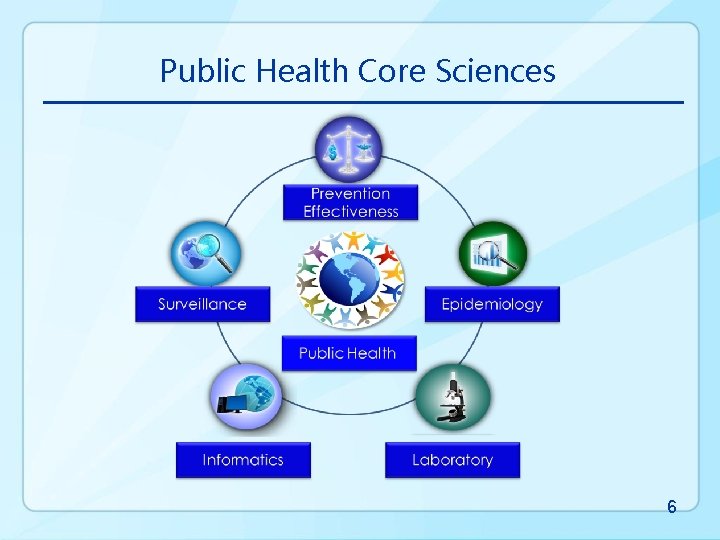
Public Health Core Sciences 6
Topic 2 What Is Prevention Effectiveness? 7

Prevention Effectiveness Defined Prevention effectiveness is the systematic assessment of the impact of public health policies, programs, and practices on health outcomes by determining their effectiveness, safety, and costs. Haddix AC, Teutsch SM, Corso PS. Prevention effectiveness: a guide to decision analysis and economic evaluation, 2 nd ed. New York, NY: Oxford University Press; 2002. 8
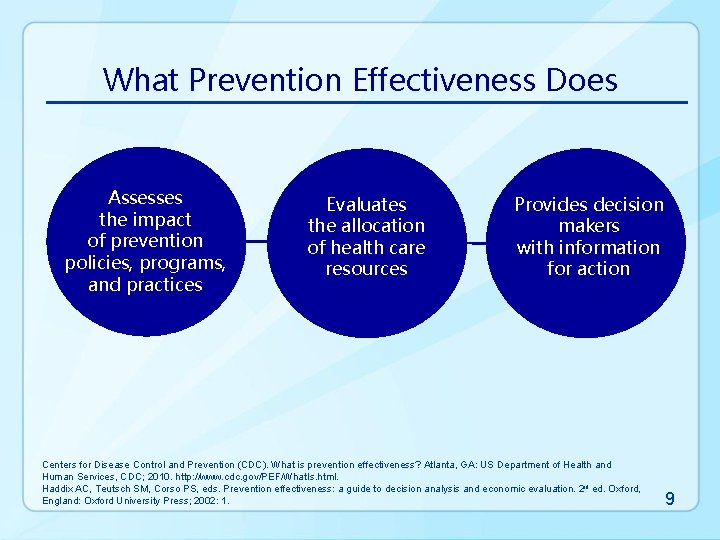
What Prevention Effectiveness Does Assesses the impact of prevention policies, programs, and practices Evaluates the allocation of health care resources Provides decision makers with information for action Centers for Disease Control and Prevention (CDC). What is prevention effectiveness? Atlanta, GA: US Department of Health and Human Services, CDC; 2010. http: //www. cdc. gov/PEF/What. Is. html. Haddix AC, Teutsch SM, Corso PS, eds. Prevention effectiveness: a guide to decision analysis and economic evaluation. 2 nd ed. Oxford, England: Oxford University Press; 2002: 1. 9

Prevention Effectiveness in Developing and Implementing Prevention Strategies Basic Research Applied Research Community Demonstrations Implementation Is prevention plausible? Can prevention work (efficacy)? Does prevention work (effectiveness)? Is it continuing to work? Prevention Effectiveness Adapted from: Haddix AC, Teutsch SM, Corso PS, eds. Prevention effectiveness: a guide to decision analysis and economic evaluation. 2 nd ed. Oxford, England: Oxford University Press; 2002: 2. 10
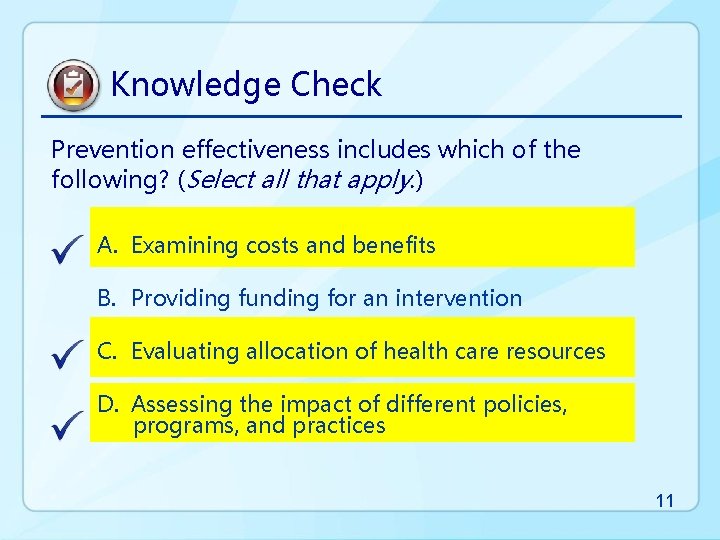
Knowledge Check Prevention effectiveness includes which of the following? (Select all that apply. ) A. Examining costs and benefits B. Providing funding for an intervention C. Evaluating allocation of health care resources D. Assessing the impact of different policies, programs, and practices 11
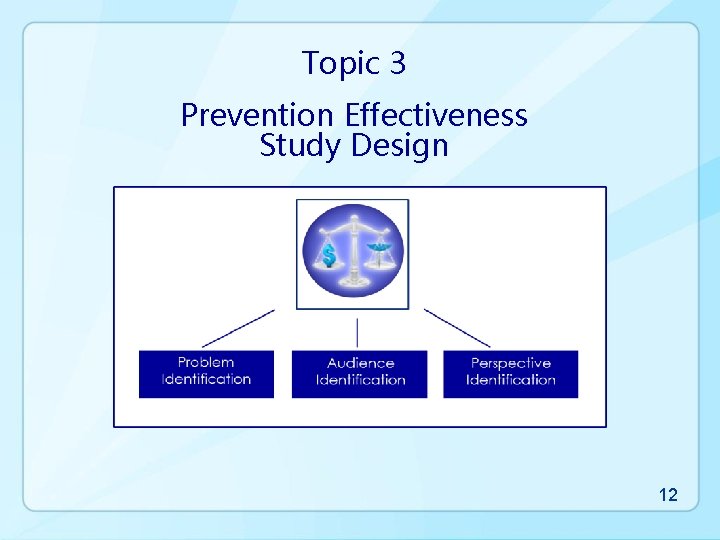
Topic 3 Prevention Effectiveness Study Design 12
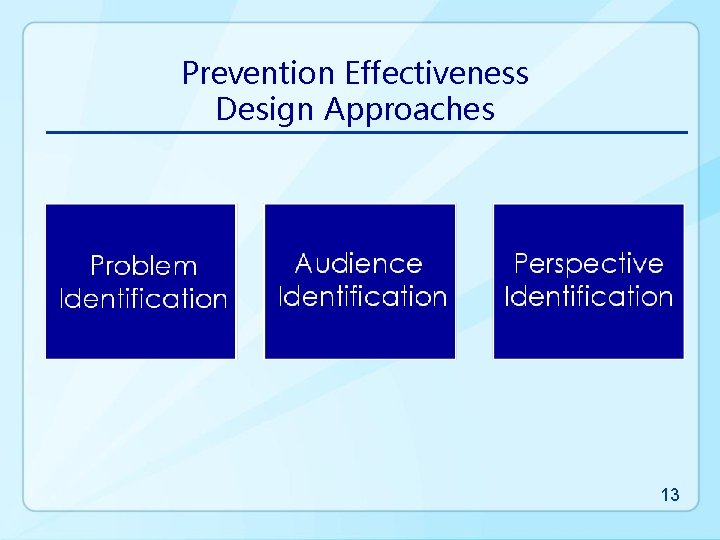
Prevention Effectiveness Design Approaches 13
Problem Identification Any health-related situation in which a policy solution or management decision can be applied Haddix AC, Teutsch SM, Corso PS, eds. Prevention effectiveness: a guide to decision analysis and economic evaluation. 2 nd ed. Oxford, England: Oxford University Press; 2002. Centers for Disease Control and Prevention (CDC). Framing an economic evaluation [self-study course]. Atlanta, GA: US Department of Health and Human Services, CDC; [undated]. http: //www. cdc. gov/owcd/eet/framing 3/1. html. 14
Audience Identification • • • Policy and program decision makers Health care organizations Researchers Clinical workers The general public The media Haddix AC, Teutsch SM, Corso PS, eds. Prevention effectiveness: a guide to decision analysis and economic evaluation. 2 nd ed. Oxford, England: Oxford University Press; 2002. Centers for Disease Control. A framework for assessing the effectiveness of disease and injury prevention. MMWR Recommend Report 1992; 41(No. RR-3). 15
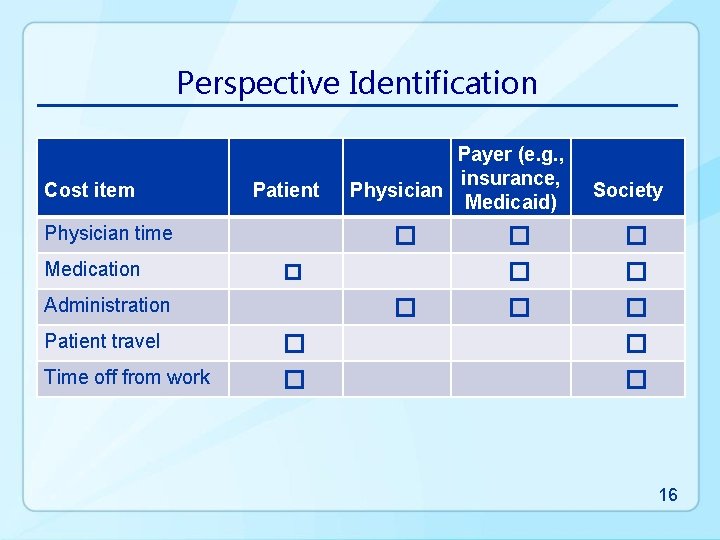
Perspective Identification Cost item Patient Physician time Medication � � Administration Patient travel Time off from work Payer (e. g. , insurance, Physician Medicaid) � � � Society � � � 16
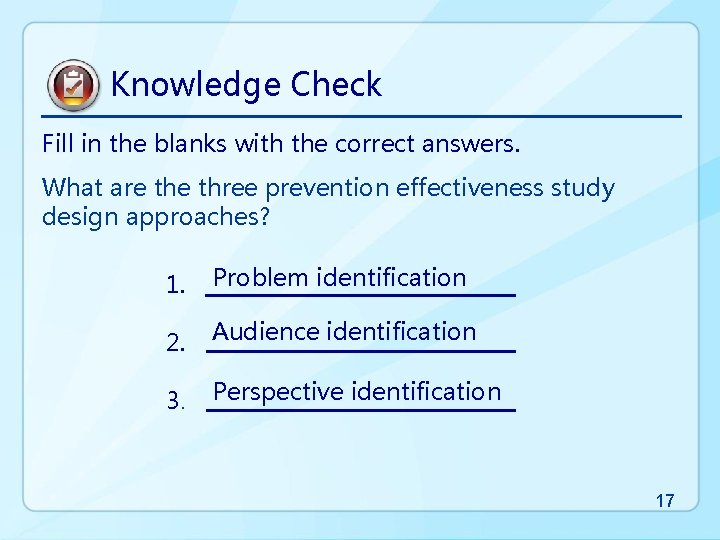
Knowledge Check Fill in the blanks with the correct answers. What are three prevention effectiveness study design approaches? 1. Problem identification 2. Audience identification 3. Perspective identification 17
Topic 4 Economic Costs 18
Prevention Effectiveness Costs • Direct • Indirect • Intangible • Opportunity 19
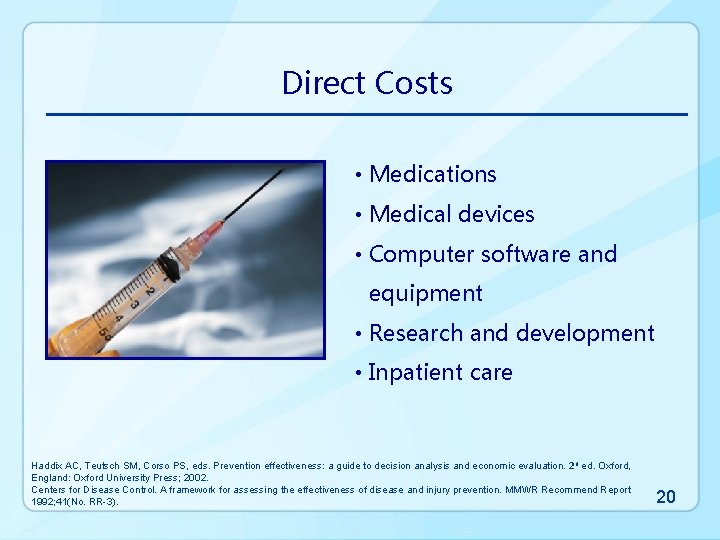
Direct Costs • Medications • Medical devices • Computer software and equipment • Research and development • Inpatient care Haddix AC, Teutsch SM, Corso PS, eds. Prevention effectiveness: a guide to decision analysis and economic evaluation. 2 nd ed. Oxford, England: Oxford University Press; 2002. Centers for Disease Control. A framework for assessing the effectiveness of disease and injury prevention. MMWR Recommend Report 1992; 41(No. RR-3). 20
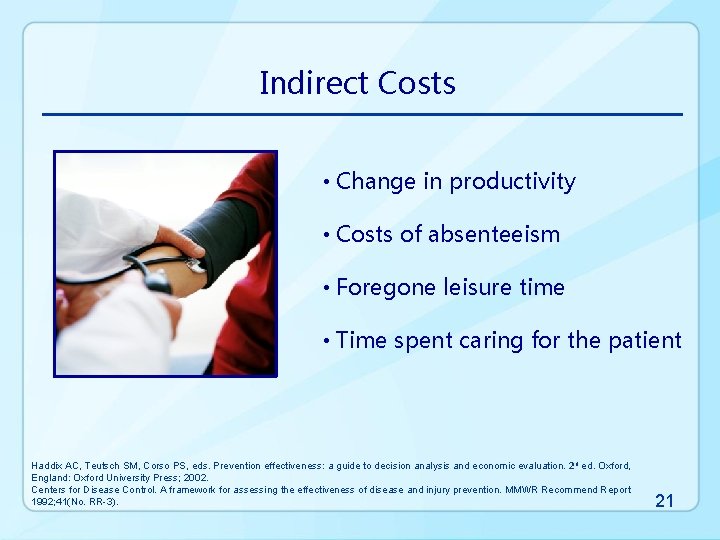
Indirect Costs • Change in productivity • Costs of absenteeism • Foregone leisure time • Time spent caring for the patient Haddix AC, Teutsch SM, Corso PS, eds. Prevention effectiveness: a guide to decision analysis and economic evaluation. 2 nd ed. Oxford, England: Oxford University Press; 2002. Centers for Disease Control. A framework for assessing the effectiveness of disease and injury prevention. MMWR Recommend Report 1992; 41(No. RR-3). 21
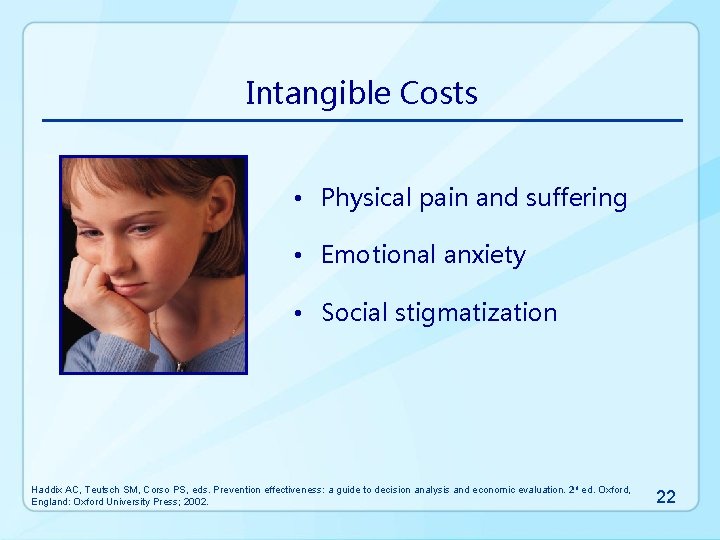
Intangible Costs • Physical pain and suffering • Emotional anxiety • Social stigmatization Haddix AC, Teutsch SM, Corso PS, eds. Prevention effectiveness: a guide to decision analysis and economic evaluation. 2 nd ed. Oxford, England: Oxford University Press; 2002. 22
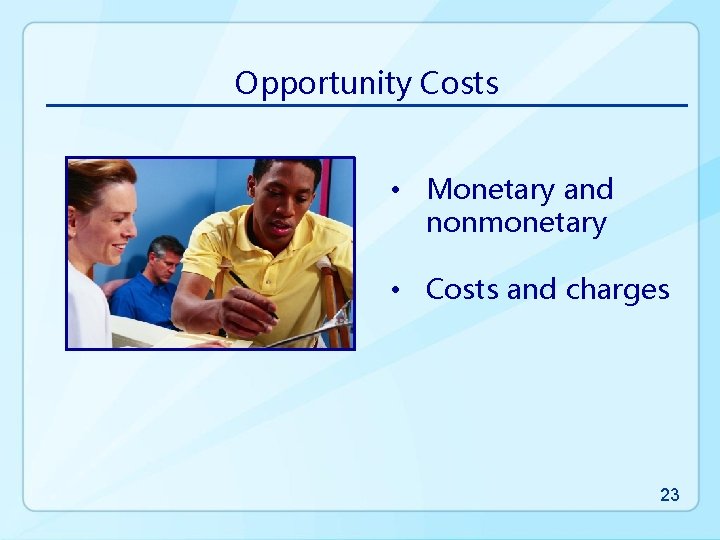
Opportunity Costs • Monetary and nonmonetary • Costs and charges 23
Knowledge Check Choose the best answer from the choices below. Prevention effectiveness costs are important to a study because they are often the main quantitative variable for use in A. prevention B. analysis C. identification D. effectiveness 24

Topic 5 Types of Economic Evaluations 25
Types of Economic Evaluations The choice of economic evaluations used is dependent on • audience • study question • data 26
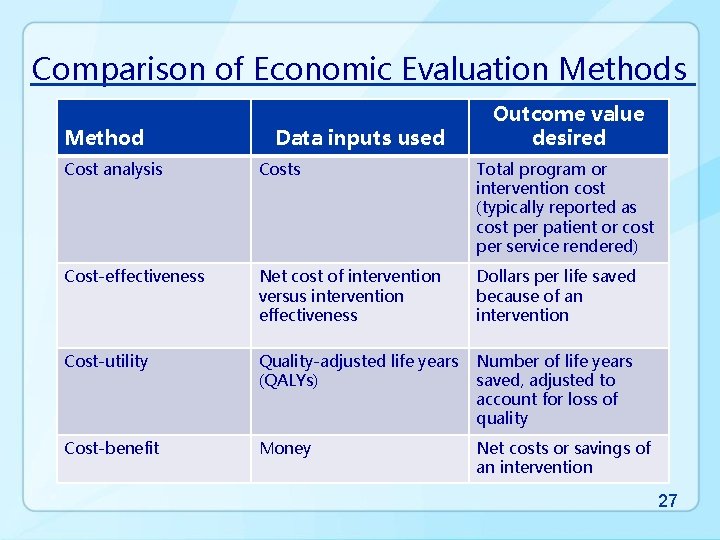
Comparison of Economic Evaluation Methods Method Data inputs used Outcome value desired Cost analysis Costs Total program or intervention cost (typically reported as cost per patient or cost per service rendered) Cost-effectiveness Net cost of intervention versus intervention effectiveness Dollars per life saved because of an intervention Cost-utility Quality‐adjusted life years (QALYs) Number of life years saved, adjusted to account for loss of quality Cost-benefit Money Net costs or savings of an intervention 27
Cost Analysis • Considers program or intervention costs and cost of illness • Achieves cost minimization for the program under consideration 28
Cost-Effectiveness Analysis Compares interventions for the same disease or condition among a common population Grosse SD. Presentation to the Canadian Pediatric Endocrine Group 2011 Scientific Meeting, Toronto, Ontario, February 12, 2011. 29
Cost-Utility Analysis • Considers quality-adjusted life years • Compares interventions for same disease or injury 30
Cost-Benefit Analysis • Evaluates multiple options • Compares different options among sectors Centers for Disease Control and Prevention (CDC). Cost-benefit analysis [self-study course]. Atlanta, GA: US Department of Health and Human Services, CDC; [undated]. ttp: //www. cdc. gov/owcd/EET/CBA/Fixed/1. html. 31
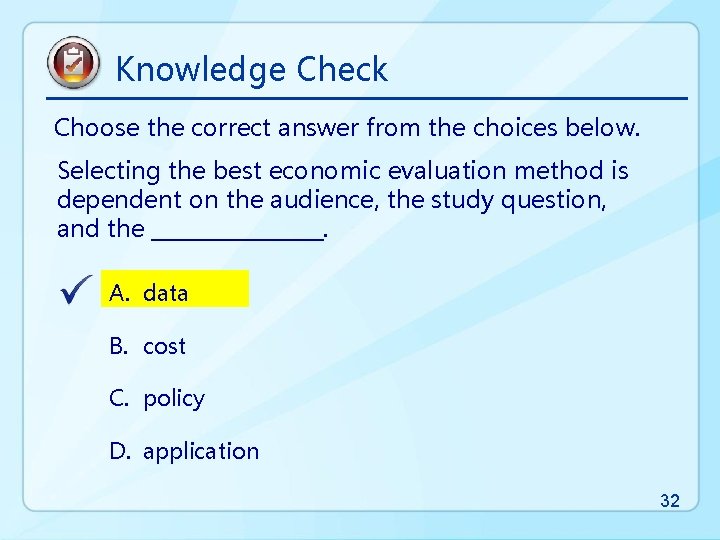
Knowledge Check Choose the correct answer from the choices below. Selecting the best economic evaluation method is dependent on the audience, the study question, and the ________. A. data B. cost C. policy D. application 32
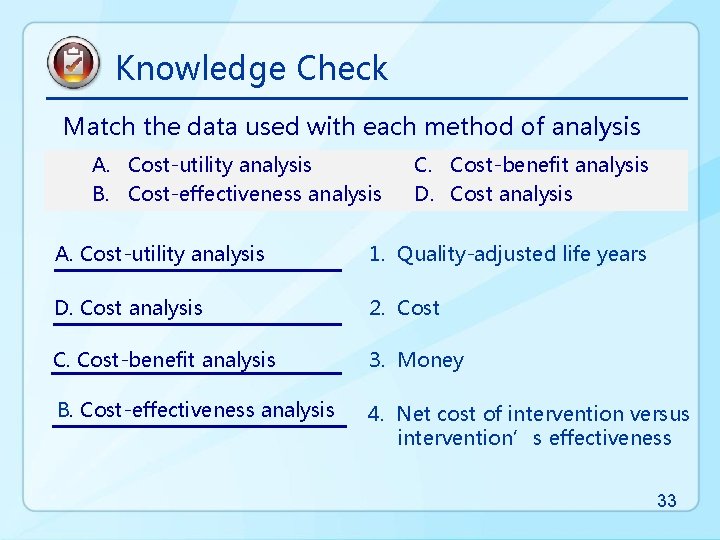
Knowledge Check Match the data used with each method of analysis A. Cost-utility analysis B. Cost-effectiveness analysis C. Cost-benefit analysis D. Cost analysis A. Cost-utility analysis 1. Quality-adjusted life years D. Cost analysis 2. Cost C. Cost-benefit analysis 3. Money B. Cost-effectiveness analysis 4. Net cost of intervention versus intervention’s effectiveness 33
Course Summary During this course, you learned to • define prevention effectiveness • describe the key components of prevention effectiveness studies • identify basic economic evaluation methods used in prevention effectiveness studies • identify data used in the most common types of economic evaluation methods 34

QUESTIONS? 35
Acknowledgments • • • Ricardo Basurto-Davila, Ph. D, MSc, Los Angeles County Department of Public Health, California Paul Farnham, Ph. D, National Center for HIV/AIDS, Viral Hepatitis, STD, and TB Prevention, Centers for Disease Control and Prevention, Atlanta, Georgia Martin Meltzer, Ph. D, MS, National Center for Emerging and Zoonotic Infectious Diseases 36
Resources and Additional Reading • • • Haddix AC, Teutsch SM, Corso PS, eds. Prevention effectiveness: a guide to decision analysis and economic evaluation. 2 nd ed. Oxford, England: Oxford University Press; 2002. Prosser LA, Bridges CB, Uyeki TM, et al. Health benefits, risks, and cost-effectiveness of influenza vaccination of children. Emerg Infect Dis 2006; 12: 1548– 58. Centers for Disease Control. A framework for assessing the effectiveness of disease and injury prevention. MMWR Recommend Report 1992; 41(No. RR-3). Centers for Disease Control and Prevention (CDC). What is prevention effectiveness? Atlanta, GA: US Department of Health and Human Services, CDC; 2010. http: //www. cdc. gov/PEF/What. Is. html. Centers for Disease Control and Prevention (CDC). Framing an economic evaluation [self-study course]. Atlanta, GA: US Department of Health and Human Services, CDC; [undated]. http: //www. cdc. gov/owcd/eet/framing 3/1. html. Meltzer MI, Cox NJ, Fukuda K. The economic impact of pandemic influenza in the United States: priorities for intervention. Emerg Infect Dis 1999; 5: 659– 71. Grosse SD. Presentation to the Canadian Pediatric Endocrine Group 2011 Scientific Meeting, Toronto, Ontario, February 12, 2011. Centers for Disease Control and Prevention (CDC). Cost-benefit analysis [self-study course]. Atlanta, GA: US Department of Health and Human Services, CDC; [undated]. ttp: //www. cdc. gov/owcd/EET/CBA/Fixed/1. html. Wagner TH, Engelstad LP, Mc. Phee SJ, Pasick RJ. The costs of an outreach intervention for lowincome women with abnormal Pap smears. Prev Chronic Dis. 2007; 4: A 11. Epub Dec 15, 2006. Centers for Disease Control and Prevention (CDC). Cervical cancer statistics. Atlanta, GA: US Department of Health and Human Services, CDC; 2012. http: //www. cdc. gov/cancer/cervical/statistics/. 37
Resources and Additional Reading • • • Drummond MF, Sculpher MJ, Torrance GW, O’Brien B, Stoddart GL. Methods for the economic evaluation of health care programmes. 3 rd ed. Oxford, England: Oxford University Press; 2005. Gold MR, Siegal JE, Russell LB, Weinstein MC, eds. Cost-effectiveness in health and medicine. Oxford, England: Oxford University Press; 1996. Patrick DL, Erickson P. Health status and health policy: quality of life in health care evaluation and resource allocation. Oxford, England: Oxford University Press; 1993. Meltzer MI, Teutsch SM. Setting priorities for health needs, managing resources. In: Stroup DF, Teutsch SM, eds. Statistics in public health: quantitative approaches to public health problems. Oxford, England: Oxford University Press; 1998. Lichtenstein AH. New York City trans fat ban: improving the default option when purchasing foods prepared outside of the home. Ann Intern Med 2012; 157: 144– 5. Messonnier M. Economics and public health at CDC. MMWR Suppl 2006; 55(Suppl 2): 17– 9. O’Brien BJ, Helyland D, Richardson WS, Levine M, Drummond MF. Users’ guides to the medical literature. XIII. How to use an article on economic analysis of clinical practice. B. What are the results and will they help me in caring for my patients? JAMA 1997; 277: 1802 – 6. Stewart KJ. The challenge of cost-effective decision making. Fam Pract Manage 1996; July/August: 16– 7. Meltzer MI, Cox NJ, Fukuda K. The economic impact of pandemic influenza in the United States: priorities for intervention. Emerg Infect Dis 1999; 5: 659– 71. 38
Disclaimers Links provided in this course to nonfederal organizations are provided solely as a service to our users. These links do not constitute an endorsement of these organizations nor their programs by the Centers for Disease Control and Prevention (CDC) or the federal government, and none should be inferred. CDC is not responsible for the content contained at these sites. Use of trade names and commercial sources is for identification only and does not imply endorsement by the Division of Scientific Education and Professional Development, Center for Surveillance, Epidemiology, and Laboratory Services, Centers for Disease Control and Prevention, the Public Health Service, or the U. S. Department of Health and Human Services. The findings and conclusions in this course are those of the authors and do not necessarily represent the official position of the Centers for Disease Control and Prevention. 39
For more information, please contact Centers for Disease Control and Prevention 1600 Clifton Road NE, Atlanta, GA 30333 Telephone: 1 -800 -CDC-INFO (232 -4636)/TTY: 1 -888 -232 -6348 Visit: http: //www. cdc. gov | Contact CDC at: 1 -800 -CDC-INFO or http: //www. cdc. gov/info The findings and conclusions in this course are those of the authors and do not necessarily represent the official position of the Centers for Disease Control and Prevention. Center for Surveillance, Epidemiology, and Laboratory Services Division of Scientific Education and Professional Development
- Slides: 40