
Public Goods and Impure Altruism Presentation by Peter
Public Goods and Impure Altruism Presentation by Peter Mc. Henry September 23, 2004
Why Public Goods Experiments? • Test our theory (Nash equilibrium, etc. ) • Describe interactions of people in groups – Do people behave cooperatively? – Does this behavior vary across environments? • Inform policy – Do taxes crowd out charitable donations? – Will people provide public goods on their own?
Major Experiments in Public Goods • Drawing from John Ledyard chapter in The Handbook of Experimental Economics • Several disciplines: – Sociology (Marwell at Wisconsin) – Psychology (Dawes at Oregon) – Political Science (Orbell at Oregon and Carnegie. Mellon) – Economics (Isaac and Walker at Arizona and Indiana)
What a Public Goods Experiment Looks Like • 4 subjects around a table • Each has 2 envelopes: private and public • Each is given $5 and asked to distribute it between envelopes, secretly • Subjects keep there private envelope; the public funds are collected, doubled, and distributed evenly among subjects • Highlighted outcomes: – Dominant strategy to contribute $0 to public good (freeride) – Pareto-optimum play is to contribute $5 to public good
Major Experimental Findings • In one-shot games mixture of Pareto and free-riding (Nash) • Contributions decline with repetition • Face-to-face communication increases contribution
Bohm (1972) • Perhaps the first public goods experiment • Requested the willingness to pay to see two Swedish comedians on TV • Only see the show if your group’s stated willingness to pay covers the production costs • Result: plenty of willingness to pay (little free riding). Little difference between those forced to pay and others.
Dawes, Mc. Tavish, and Shaklee (1977) • Members of groups choosing O (cooperate) or X (deviate) based on payoff tables. Varying types of communication. • Communication increases cooperation (about 72 percent cooperation with unrestricted communication)
Marwell and Ames (1979, 1980) • Teenagers on the phone, given tokens, investing in public or private goods • About 50 percent of resources to public goods theoretical free-riding is weak • Prompted economists to get involved (defending theory predicting more free-riding)
Kim and Walker (1984); Isaac, Mc. Cue, and Plott (1985) • Public and private contributions as before • Add repetition – Contribution declines with repetition – Roughly 50% in round 1 to 10% by round 5 • But why the reduction in contributions? (not controlled) – Learning about strategies – Learning about the payoff tables – Punishing
Isaac, Walker, and Thomas (1984) • More systematic study • Undergraduates at computer terminals • Vary four characteristics – Repetition: less contribution from repetition – Group size: not much of an effect – Marginal payoff: big effect – Experience: more experience yields less contribution
“Giving with Impure Altruism: Applications to Charity and Ricardian Equivalence” James Andreoni, 1989, JPE
Motivation • Free riding is not pervasive – In experiments, players tend to cooperate – Charity is pervasive (2. 3 percent of GDP in the U. S. in 2002, American Association of Fundraising Counsel) • Crowding out is not complete – Taxes tend to increase public good allocation – Contrary to theoretical neutrality results
Andreoni’s Gimmick • Add public good contribution as an argument in the utility function • This implies a “warm glow” from giving, beyond its indirect effect of increasing public goods • This will help explain: – Cooperation in public goods allocation – Incomplete crowding out
A Little Vocabulary • Pure altruism – Just like previous models – Utility depends on private consumption and total public goods available • Impure altruism – Andreoni’s focus here – Utility depends on private consumption, total public goods, and own public contribution (warm glow) • Pure egoism – For comparisons – Utility depends on private consumption and own public contribution
The Model (of Impure Altruism) • n agents • Agent i, endowed with wi, chooses private goods (xi) and public good contribution (gi), and pays tax ( i) • Total public goods: Y = G + T • i’s total giving to public goods: yi = gi + i • Y-i = others’ (voluntary and involuntary) public goods contributions • Utility depends on xi, Y, and gi
Optimization • Agent i solves:
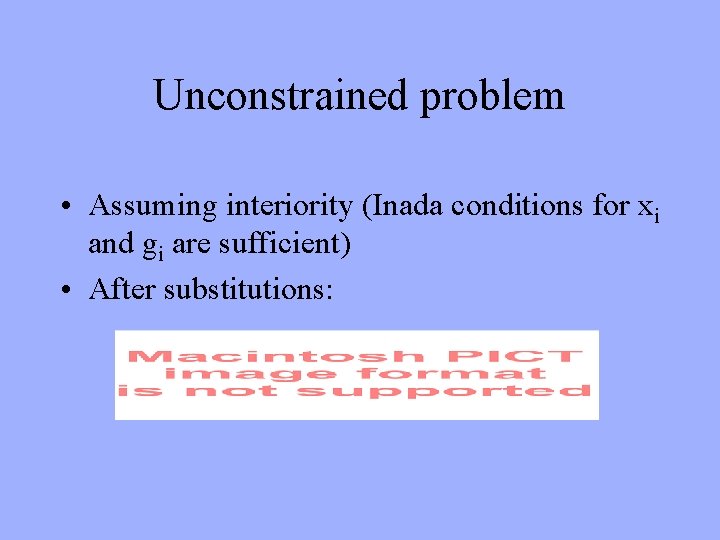
Unconstrained problem • Assuming interiority (Inada conditions for xi and gi are sufficient) • After substitutions:
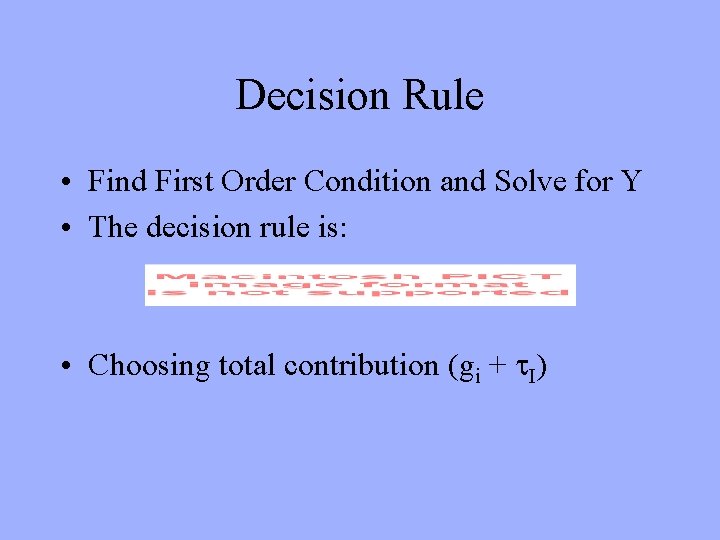
Decision Rule • Find First Order Condition and Solve for Y • The decision rule is: • Choosing total contribution (gi + I)
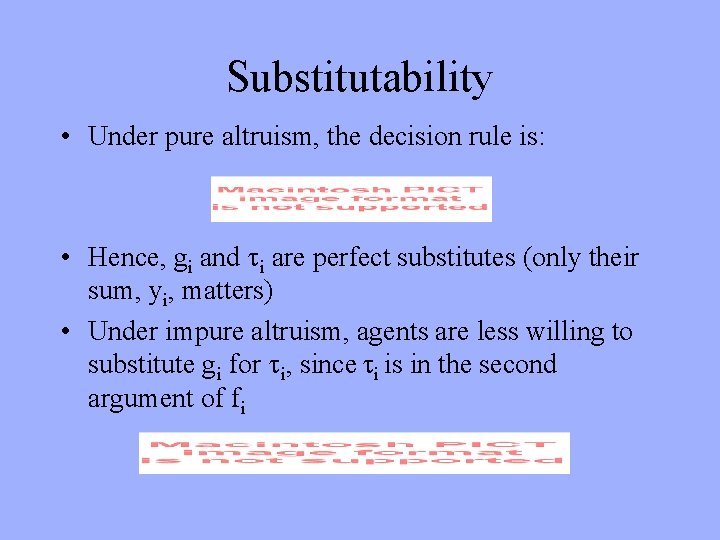
Substitutability • Under pure altruism, the decision rule is: • Hence, gi and i are perfect substitutes (only their sum, yi, matters) • Under impure altruism, agents are less willing to substitute gi for i, since i is in the second argument of fi
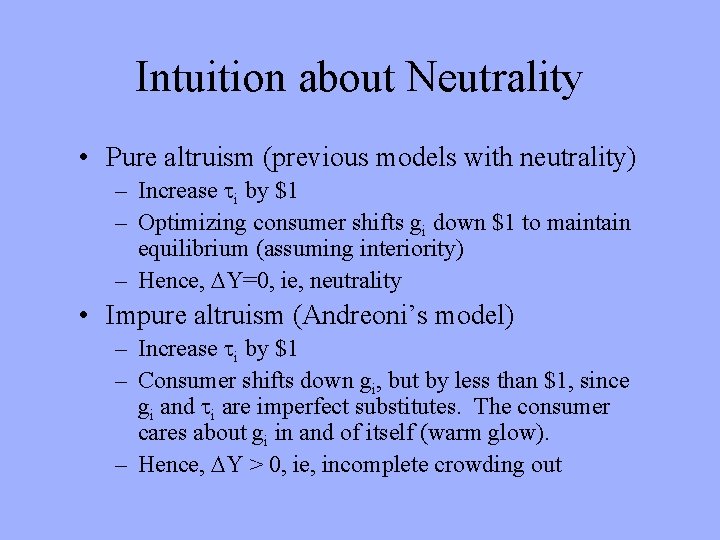
Intuition about Neutrality • Pure altruism (previous models with neutrality) – Increase i by $1 – Optimizing consumer shifts gi down $1 to maintain equilibrium (assuming interiority) – Hence, Y=0, ie, neutrality • Impure altruism (Andreoni’s model) – Increase i by $1 – Consumer shifts down gi, but by less than $1, since gi and i are imperfect substitutes. The consumer cares about gi in and of itself (warm glow). – Hence, Y > 0, ie, incomplete crowding out
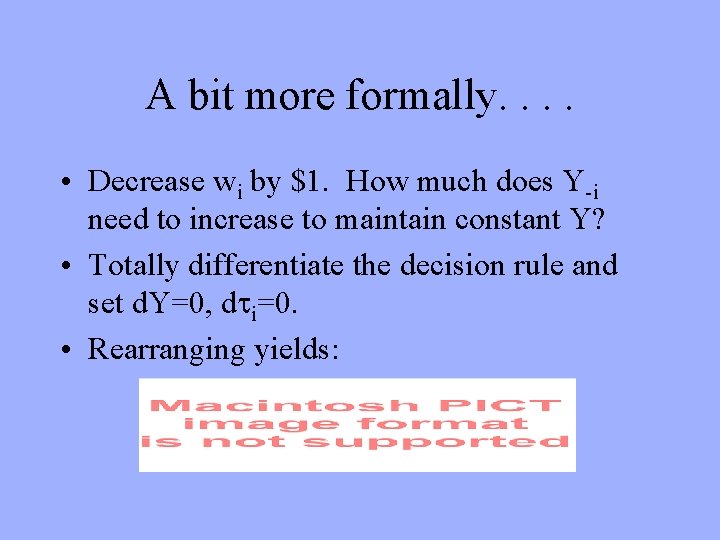
A bit more formally. . • Decrease wi by $1. How much does Y-i need to increase to maintain constant Y? • Totally differentiate the decision rule and set d. Y=0, d i=0. • Rearranging yields:
Altruism Index • i is an index of altruism • Relatively high values of i correspond with a high willingness to substitute gi and Y-i • j > i implies j is more altruistic than i
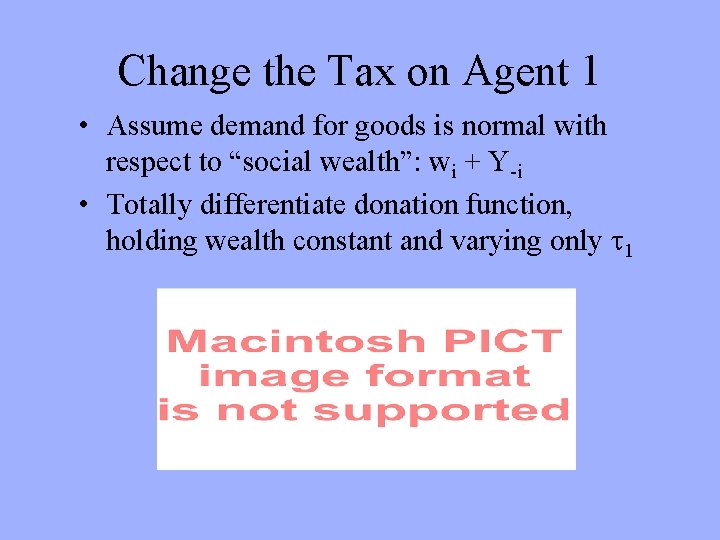
Change the Tax on Agent 1 • Assume demand for goods is normal with respect to “social wealth”: wi + Y-i • Totally differentiate donation function, holding wealth constant and varying only 1
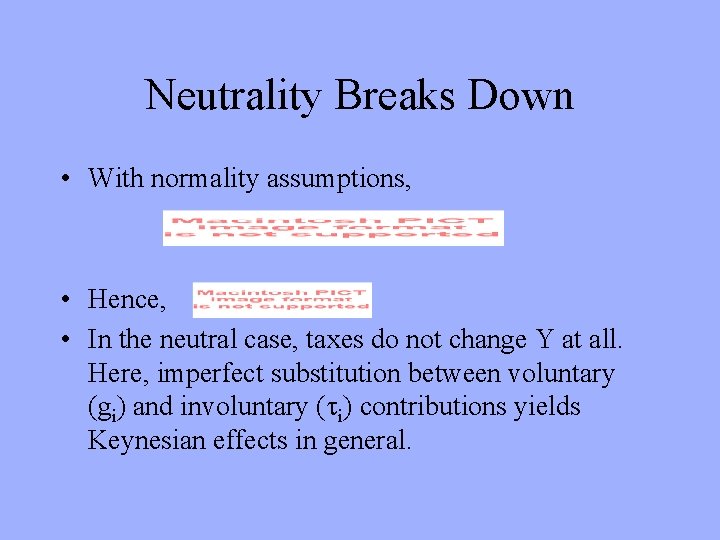
Neutrality Breaks Down • With normality assumptions, • Hence, • In the neutral case, taxes do not change Y at all. Here, imperfect substitution between voluntary (gi) and involuntary ( i) contributions yields Keynesian effects in general.
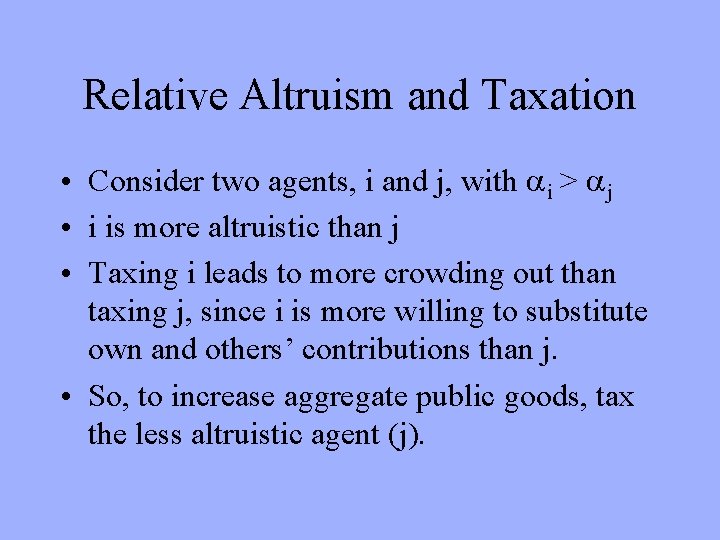
Relative Altruism and Taxation • Consider two agents, i and j, with i > j • i is more altruistic than j • Taxing i leads to more crowding out than taxing j, since i is more willing to substitute own and others’ contributions than j. • So, to increase aggregate public goods, tax the less altruistic agent (j).
The Big Ideas • Warm glow (own contribution in the utility function) may explain cooperation in experiments, and donations to charity. • Empirically, taxation does not appear to be neutral, as some theory predicts. Theory with warm glow captures this non-neutrality (incomplete crowding out).
A Criticism • Treatment of corner solutions seems sloppy • Interiority assumed • This is relaxed eventually, but – Still working with the same first order condition, which needed the interiority assumption to be derived – Would seem better to follow Bergstrom, Blume, and Varian (1986) in treating corner solutions
Experimental Support for the Warm Glow • James Andreoni “Warm-glow versus Cold-prickle: The Effects of Positive and Negative Framing on Cooperation in Experiments” QJE 1995. • An experiment with endowments contributed either to private or public goods • Two treatments: positive and negative frame. Both groups share identical incentives.
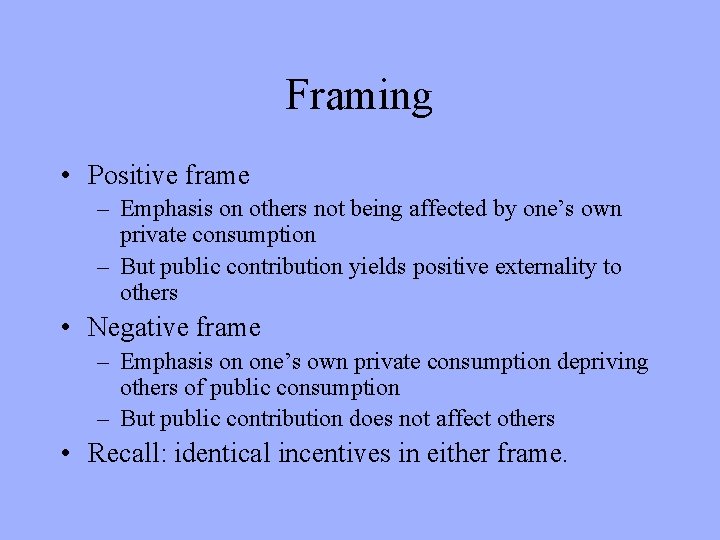
Framing • Positive frame – Emphasis on others not being affected by one’s own private consumption – But public contribution yields positive externality to others • Negative frame – Emphasis on one’s own private consumption depriving others of public consumption – But public contribution does not affect others • Recall: identical incentives in either frame.
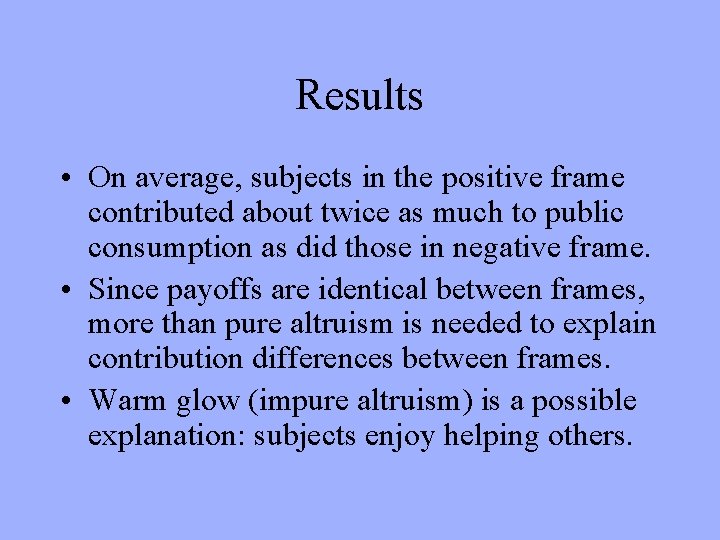
Results • On average, subjects in the positive frame contributed about twice as much to public consumption as did those in negative frame. • Since payoffs are identical between frames, more than pure altruism is needed to explain contribution differences between frames. • Warm glow (impure altruism) is a possible explanation: subjects enjoy helping others.

- Slides: 31