
Public Goods and Common Resources Chapter 11 IN
Public Goods and Common Resources Chapter 11
IN THIS CHAPTER YOU WILL. . . 1. Learn the defining characteristics of public goods and common resources 2. Examine why private markets f a i l to provide public goods 3. Consider some of the important public goods in our economy
IN THIS CHAPTER YOU WILL. . . 4. See why the cost benefit analysis of public goods is both necessary and difficult 5. Examine why people tend to use common resources too much 6. Consider some of the important common resources in our economy

“The best things in life are free. . . ” Free goods provide a special challenge for economic analysis Most goods in our economy are allocated in markets… …for these goods, prices are the signals that guide the decisions of buyers and sellers.
“The best things in life are free. . . ” When goods are available free of charge, the market forces that normally allocate resources in our economy are absent.
“The best things in life are free. . . ” When a good does not have a price attached to it, private markets cannot ensure that the good is produced and consumed in the proper amounts.
“The best things in life are free. . . ” In such cases, government policy can potentially remedy the market failure that results, and raise economic well-being.
The Different Kinds of Goods When thinking about the various goods in the economy, it is useful to group them according to two characteristics: u Is the good excludable? u Is the good rival?
The Different Kinds of Goods u. Excludability People can be prevented from enjoying the good. u Laws recognize and enforce private property rights. u
The Different Kinds of Goods u Rivalness u One person’s use of the good diminishes another person’s enjoyment of it.
Four Types of Goods u. Private Goods u. Public Goods u. Common Resources u. Natural Monopolies
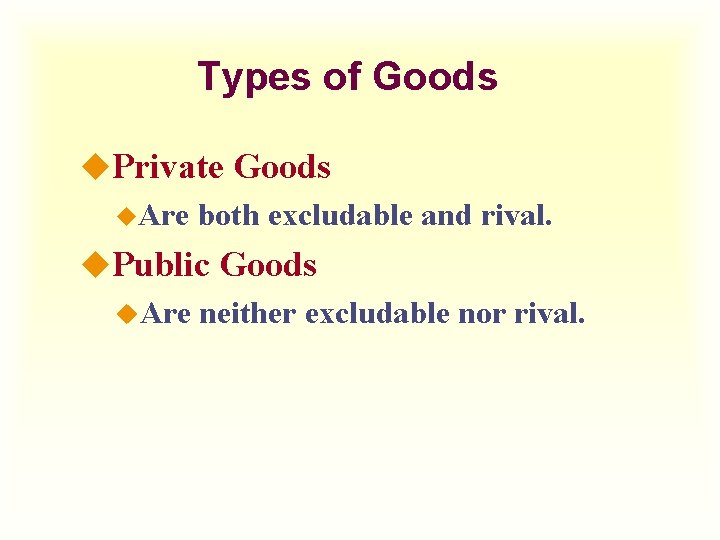
Types of Goods u. Private Goods u. Are both excludable and rival. u. Public Goods u. Are neither excludable nor rival.
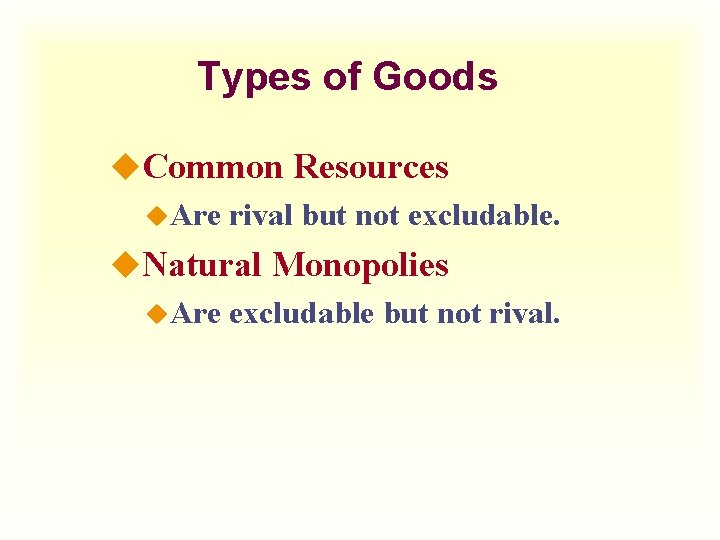
Types of Goods u. Common Resources u. Are rival but not excludable. u. Natural Monopolies u. Are excludable but not rival.
Private Goods Are both excludable and rival Consider an ice-cream cone, for example. An ice-cream cone is excludable because it is possible to prevent someone from eating an icecream cone—you just don’t give it to him. An ice-cream cone is rival because if one person eats an ice-cream cone, another person cannot eat the same cone. Most goods in the economy are private goods like ice-cream cones. When we analyzed supply and demand in Chapters 4, 5, and 6 and the efficiency of markets in Chapters 7, 8, and 9, we implicitly assumed that goods were both excludable and rival.
Public Goods Are neither excludable nor rival. That is, people cannot be prevented from using a public good, and one person’s enjoyment of a public good does not reduce another person’s enjoyment of it. For example, national defense is a public good. Once the country is defended from foreign aggressors, it is impossible to prevent any single person from enjoying the benefit of this defense. Moreover, when one person enjoys the benefit of national defense, he does not reduce the benefit to anyone else.
Common Resources Are rival but not excludable. For example, fish in the ocean are a rival good: When one person catches fish, there are fewer fish for the next person to catch. Yet these fish are not an excludable good because it is difficult to charge fishermen for the fish that they catch.
Natural Monopolies Are excludable but not rival. For instance, consider fire protection in a small town. It is easy to exclude people from enjoying this good: The fire department can just let their house burn down. Yet fire protection is not rival. Firefighters spend much of their time waiting for a fire, so protecting an extra house is unlikely to reduce the protection available to others. In other words, once a town has paid for the fire department, the additional cost of protecting one more house is small. In Chapter 15 we give a more complete definition of natural monopolies and study them in some detail.

Types of Goods Rival? Yes Private Goods Yes Excludable? No · Ice- cream cones · Clothing · Congested toll roads No Natural Monopolies · Fire protection · Cable TV · Uncongested toll roads Common Resources Public Goods · Fish in the ocean · The environment · Congested nontoll roads Chapter 11, figure 1, page 181 · National defense · Knowledge · Uncongested nontoll roads
The Free-Rider Problem A free-rider is a person who receives the benefit of a good but avoids paying for it.
The Free-Rider Problem u Since people cannot be excluded from enjoying the benefits of a public good, individuals may withhold paying for the good hoping that others will pay for it. u The free-rider problem prevents private markets from supplying public goods.
Solving the Free-Rider Problem u The government can decide to provide the public good if the total benefits exceed the costs. u The government can make everyone better off by providing the public good and paying for it with tax revenue.
Some Important Public Goods u. National Defense u. Basic Research u. Programs to Fight Poverty
The defense of the country from foreign aggressors is a classic example of a public good. It is also one of the most expensive. In 1999 the U. S. federal government spent a total of $277 billion on national defense, or about$1, 018 person. People disagree about whether this amount is too small or too large, but almost no one doubts that some government spending for national defense is necessary. Even economists who advocate small government agree that the national defense is a public good the government should provide.
Are Lighthouses Public Goods?
Lighthouses are used to mark specific locations so that passing ships can avoid treacherous waters. The benefit that the lighthouse provides to the ship captain is neither excludable nor rival, so each captain has an incentive to free ride by using the lighthouse to navigate without paying for the service. Because of this free-rider problem, private markets usually fail to provide the lighthouses that ship captains need. As a result, most lighthouses today are operated by the government.
In some cases, however, lighthouses may be closer to private goods. On the coast of England in the nineteenth century, some lighthouses were privately owned and operated. The owner of the local lighthouse did not try to charge ship captains for the service but did charge the owner of the nearby port. If the port owner did not pay, the lighthouse owner turned off the light, and ships avoided that port.
In deciding whether something is a public good, one must determine the number of beneficiaries and whether these beneficiaries can be excluded from enjoying the good. A free-rider problem arises when the number of beneficiaries is large and exclusion of any one of them is impossible. If a lighthouse benefits many ship captains, it is a public good. Yet if it primarily benefits a single port owner, it is more like a private good.
Cost-Benefit Analysis u In order to decide whether to provide a public good or not, the total benefits of all those who use the good must be compared to the costs of providing and maintaining the public good. u Cost benefit analysis estimates the total costs and benefits of a good to society as a whole.
Cost-Benefit Analysis u. A cost-benefit analysis would be used to estimate the total costs and benefits of the project to society as a whole. u It is difficult to do because of the absence of prices needed to estimate social benefits and resource costs. u The value of life, the consumer’s time, and aesthetics are difficult to assess.
Common Resources Common resources, like public goods, are not excludable. They are available free of charge to anyone who wishes to use them.
Common Resources Common resources are rival goods because one person’s use of the common resource reduces other people’s use.
Tragedy of the Commons The Tragedy of the Commons is a story with a general lesson: When one person uses a common resource, he or she diminishes another person’s enjoyment of it. u. Common resources tend to be used excessively when individuals are not charged for their usage. u. This creates a negative externality.
Examples of Common Resources u. Clean air and water u. Oil pools u. Congested roads u. Fish, whales, and other wildlife
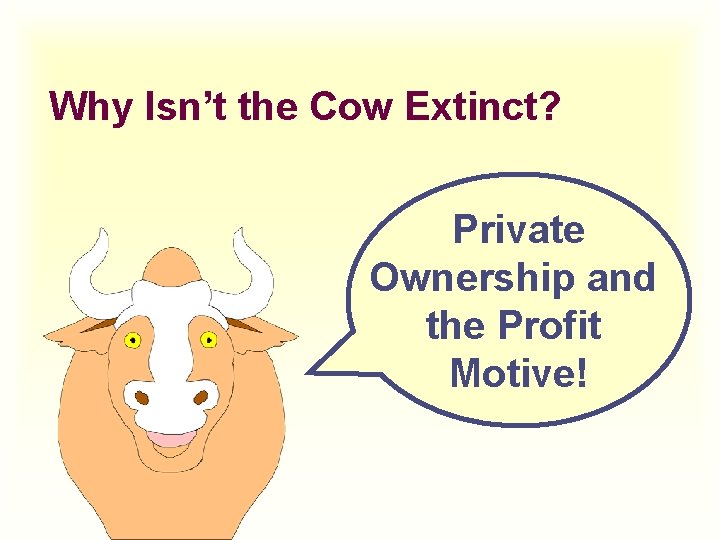
Why Isn’t the Cow Extinct? Private Ownership and the Profit Motive!
Importance of Property Rights The market fails to allocate resources efficiently when property rights are not well-established (i. e. some item of value does not have an owner with the legal authority to control it).
Importance of Property Rights When the absence of property rights causes a market failure, the government can potentially solve the problem.
Summary u Goods differ in whether they are excludable and whether they are rival. u A good is excludable if it is possible to prevent someone from using it. u A good is rival if one person’s enjoyment of the good prevents other people from enjoying the same unit of the good.
Summary u Public goods are neither rival nor excludable. u Because people are not charged for their use of public goods, they have an incentive to free ride when the good is provided privately. u Governments provide public goods, making quantity decisions based upon cost-benefit analysis.
Summary u Common resources are rival but not excludable. u Because people are not charged for their use of common resources, they tend to use them excessively. u Governments tend to try to limit the use of common resources.
- Slides: 39