
Public Goods and Common Resources 1 The Different
Public Goods and Common Resources 1
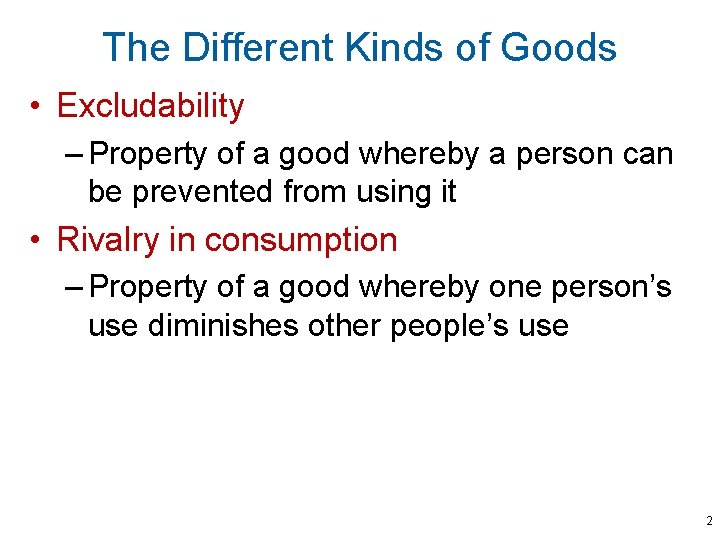
The Different Kinds of Goods • Excludability – Property of a good whereby a person can be prevented from using it • Rivalry in consumption – Property of a good whereby one person’s use diminishes other people’s use 2
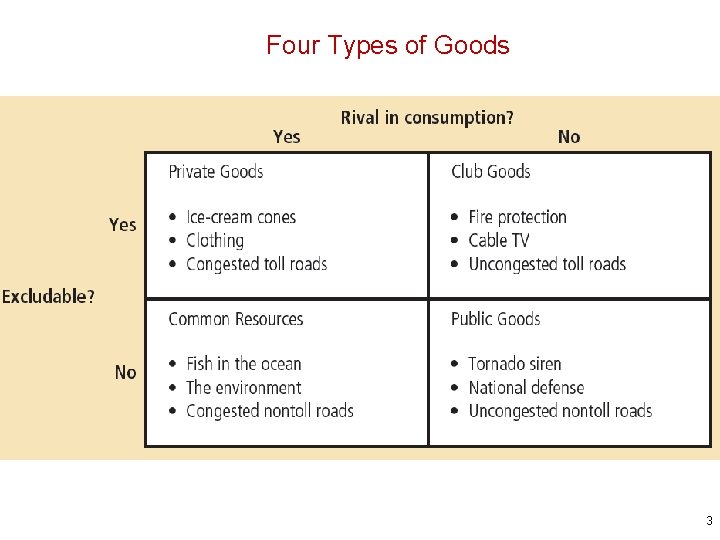
Four Types of Goods 3
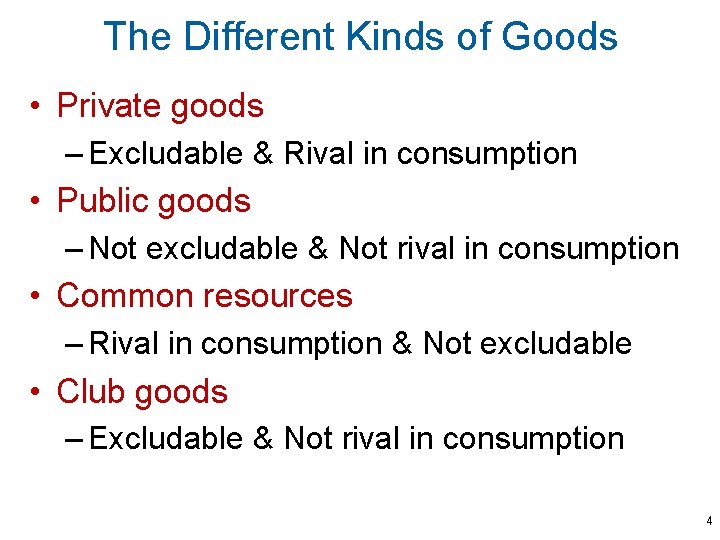
The Different Kinds of Goods • Private goods – Excludable & Rival in consumption • Public goods – Not excludable & Not rival in consumption • Common resources – Rival in consumption & Not excludable • Club goods – Excludable & Not rival in consumption 4
The Different Kinds of Goods • Public goods & Common resources – Not excludable • People cannot be prevented from using them – No price attached to it – External effects • Positive externalities • Negative externalities 5
The Different Kinds of Goods • Public goods & Common resources – Private decisions about consumption and production • Can lead to an inefficient allocation of resources – Government intervention • Can potentially raise economic well-being 6
Public Goods • Free rider – Person who receives the benefit of a good but avoids paying for it • The free-rider problem – Public goods – not excludable – Prevents the private market from supplying the goods 7
Public Goods • Government can remedy the free-rider problem – If total benefits of a public good exceeds its costs – Provide the public good – Pay for it with tax revenue – Make everyone better off 8
Public Goods • Some important public goods – National defense • Very expensive public good – Basic research • General knowledge – Fighting poverty • Welfare system • Food stamps • Government housing programs 9
Public Goods • The difficult job of cost–benefit analysis – Government • Decide what public goods to provide • In what quantities – Cost–benefit analysis • Compare the costs and benefits to society of providing a public good • Doesn’t have any price signals to observe • Government findings – Rough approximations at best 10

How much is a life worth? • Cost: $10, 000 – new traffic light • Benefit: increased safety – Risk of a fatal traffic accident • Drops from 1. 6% to 1. 1 % • Obstacle – Measure costs and benefits in the same units • Put a dollar value on a human life? – Priceless = infinite dollar value 11
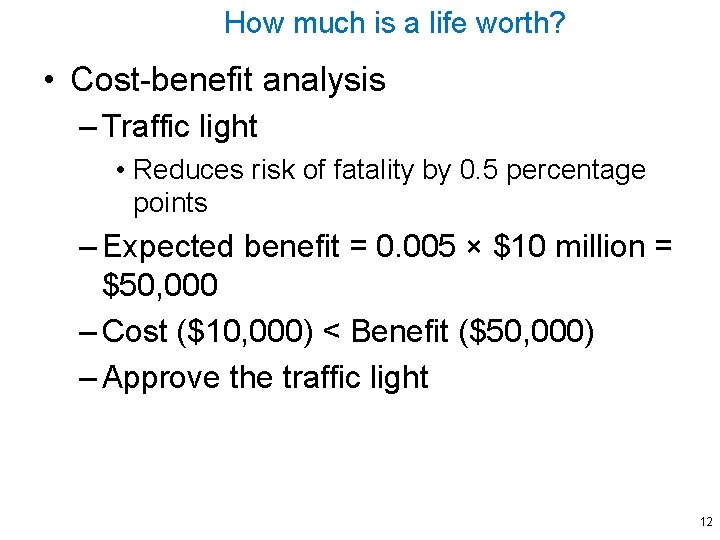
How much is a life worth? • Cost-benefit analysis – Traffic light • Reduces risk of fatality by 0. 5 percentage points – Expected benefit = 0. 005 × $10 million = $50, 000 – Cost ($10, 000) < Benefit ($50, 000) – Approve the traffic light 12
Common Resources • Common resources – Not excludable – Rival in consumption • The tragedy of the commons – Parable - why common resources are used more than desirable • From society’s standpoint – Social and private incentives differ – Arises because of a negative externality 13
Common Resources • The tragedy of the commons – Negative externality • One person uses a common resource – Diminishes other people’s enjoyment of it • Common resources tend to be used excessively – Government - can solve the problem • Regulation or taxes to reduce consumption of the common resource • Turn the common resource into a private good 14
Common Resources • Some important common resources – Clean air and water • Negative externality – pollution • Regulations or corrective taxes – Congested roads • Negative externality – congestion • Corrective tax: charge drivers a tool • Tax on gasoline 15
Common Resources • Some important common resources – Fish, whales, and other wildlife • Oceans – least regulated common resource – Needs international cooperation – Difficult to enforce an agreement • Fishing and hunting licenses • Limits on fishing and hunting seasons • Limits on size of fish • Limits on quantity of animals killed 16
Importance of Property Rights • Market fails to allocate resources efficiently – Because property rights are not well established – Some item of value does not have an owner with the legal authority to control it 17
- Slides: 17