
Public Financial Management Concept and Importance Financial Management
Public Financial Management: Concept and Importance
Financial Management • Management of resources for achieving optimum outputs • Flow of financial resources – Input, process, output • Internal Control – Regulations, procedures, Approval/Scanctions • External Scrutiny – Audit, Public Hearing • Financial Responsibility and
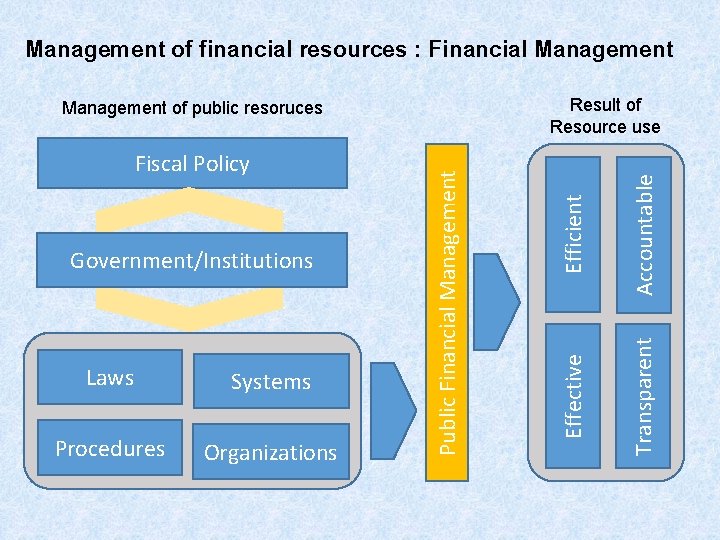
Management of financial resources : Financial Management Procedures Organizations Accountable Systems Transparent Laws Efficient Government/Institutions Public Financial Management Fiscal Policy Effective Result of Resource use Management of public resoruces
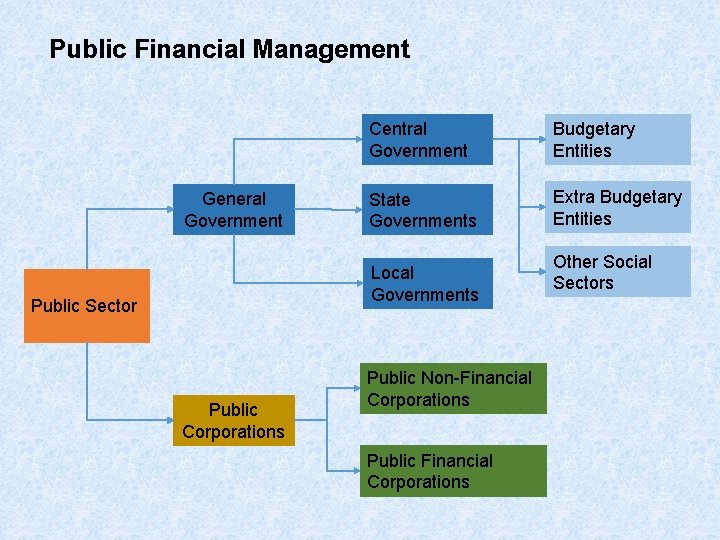
Public Financial Management General Government Central Government Budgetary Entities State Governments Extra Budgetary Entities Local Governments Public Sector Public Corporations Public Non-Financial Corporations Public Financial Corporations Other Social Sectors
PFM Concept • PFM deals with government finance, • Government administers and controls resources of the country on behalf of the citizens through PFM • PFM is concerned with handling of public purse/Money • Management of revenue and expenditure in a broader sense. • Needs to be guided by laws, systems, procedures and organizations. • Should guarantee the effective, efficient, transparent and sustainable use of resources. • Should have mitigate the risk associated with finance. • Should serve the interest of the people at large. • Enables Government to fulfil its fiduciary role on behalf of the owners of the nations resources
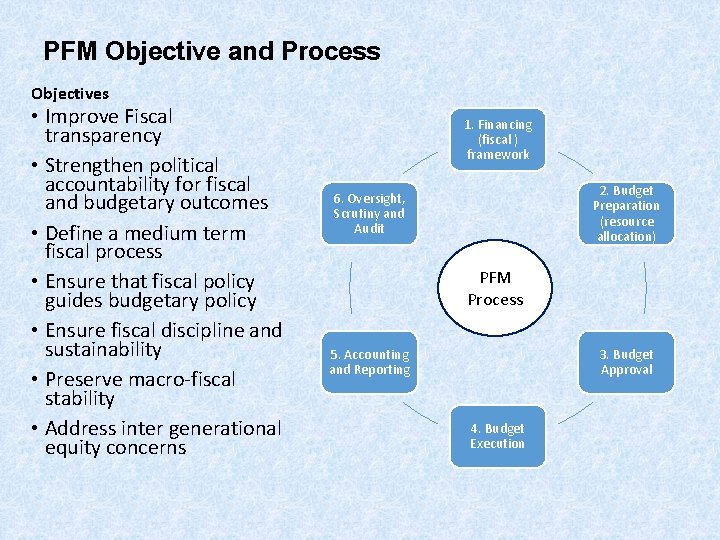
PFM Objective and Process Objectives • Improve Fiscal transparency • Strengthen political accountability for fiscal and budgetary outcomes • Define a medium term fiscal process • Ensure that fiscal policy guides budgetary policy • Ensure fiscal discipline and sustainability • Preserve macro-fiscal stability • Address inter generational equity concerns 1. Financing (fiscal ) framework 2. Budget Preparation (resource allocation) 6. Oversight, Scrutiny and Audit PFM Process 5. Accounting and Reporting 3. Budget Approval 4. Budget Execution
Scope of PFM deals with the efficient allocation of public resources, distribution of income and macroeconomic stabilization of the country; • Taxation and revenue management, • Borrowing and debt management, • Budgeting and expenditure management, • PMF procedure and organizations, • Responsibility and accountability, • Oversight, scrutiny and Audit
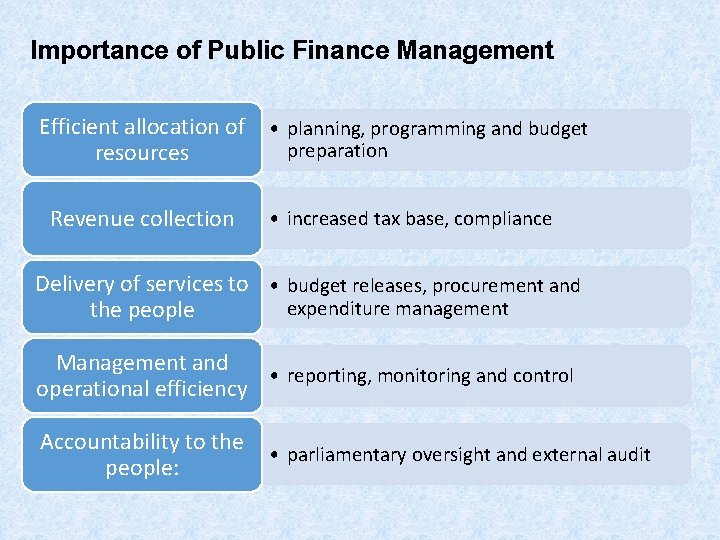
Importance of Public Finance Management Efficient allocation of • planning, programming and budget preparation resources Revenue collection • increased tax base, compliance Delivery of services to • budget releases, procurement and expenditure management the people Management and • reporting, monitoring and control operational efficiency Accountability to the people: • parliamentary oversight and external audit
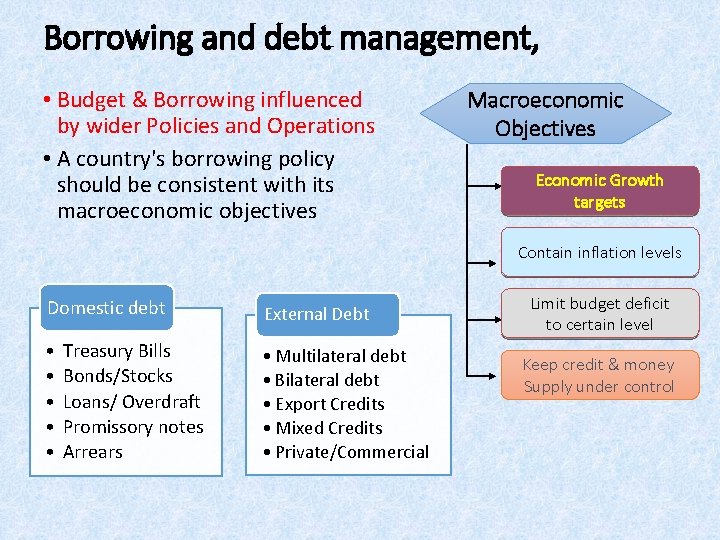
Borrowing and debt management, • Budget & Borrowing influenced by wider Policies and Operations • A country's borrowing policy should be consistent with its macroeconomic objectives Macroeconomic Objectives Economic Growth targets Contain inflation levels Domestic debt External Debt • • • Multilateral debt • Bilateral debt • Export Credits • Mixed Credits • Private/Commercial Treasury Bills Bonds/Stocks Loans/ Overdraft Promissory notes Arrears Limit budget deficit to certain level Keep credit & money Supply under control
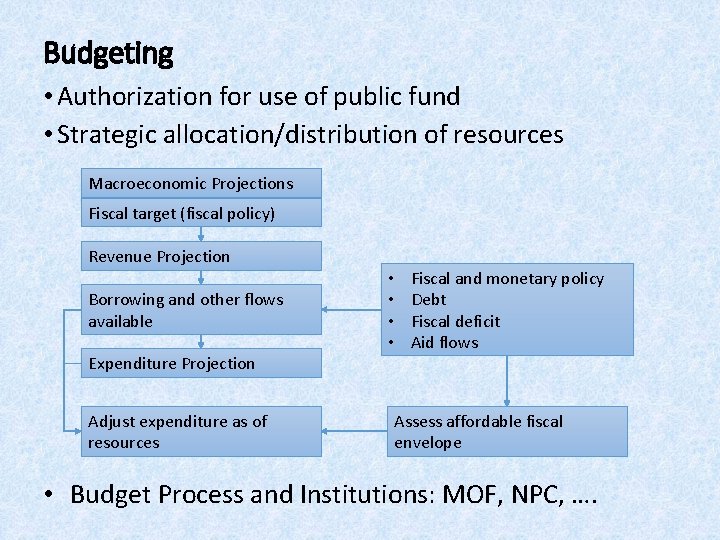
Budgeting • Authorization for use of public fund • Strategic allocation/distribution of resources Macroeconomic Projections Fiscal target (fiscal policy) Revenue Projection Borrowing and other flows available Expenditure Projection Adjust expenditure as of resources • • Fiscal and monetary policy Debt Fiscal deficit Aid flows Assess affordable fiscal envelope • Budget Process and Institutions: MOF, NPC, ….
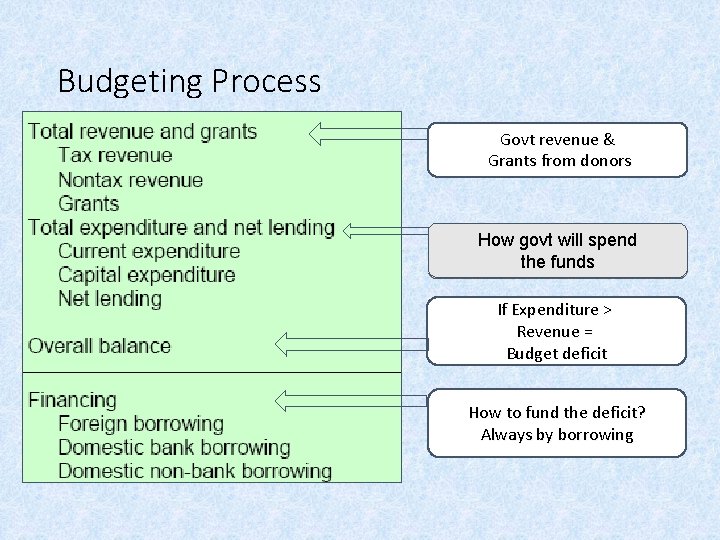
Budgeting Process Govt revenue & Grants from donors How govt will spend the funds If Expenditure > Revenue = Budget deficit How to fund the deficit? Always by borrowing
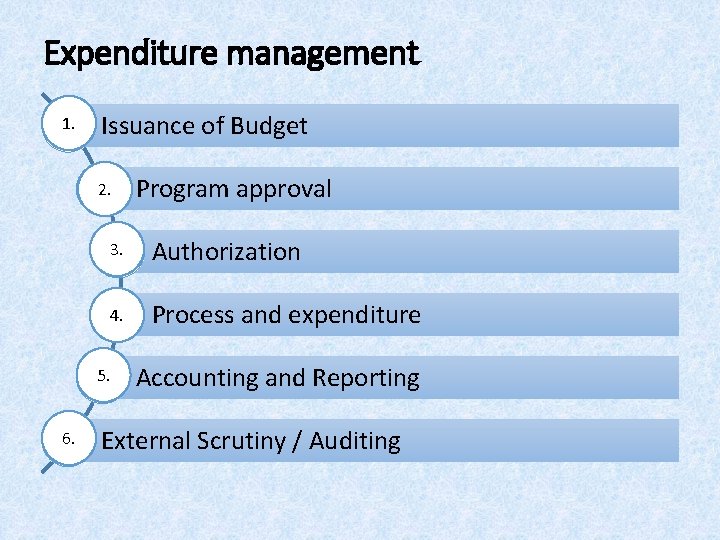
Expenditure management 1. Issuance of Budget 2. 3. Authorization 4. Process and expenditure 5. 6. Program approval Accounting and Reporting External Scrutiny / Auditing
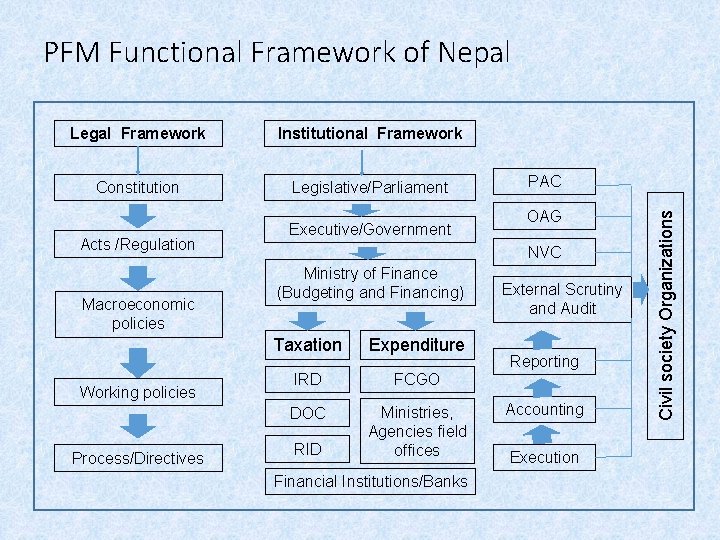
PFM Functional Framework of Nepal Institutional Framework Constitution Legislative/Parliament Acts /Regulation Macroeconomic policies Working policies Process/Directives Executive/Government PAC OAG NVC Ministry of Finance (Budgeting and Financing) Taxation Expenditure IRD FCGO DOC Ministries, Agencies field offices RID Financial Institutions/Banks External Scrutiny and Audit Reporting Accounting Execution Civil society Organizations Legal Framework
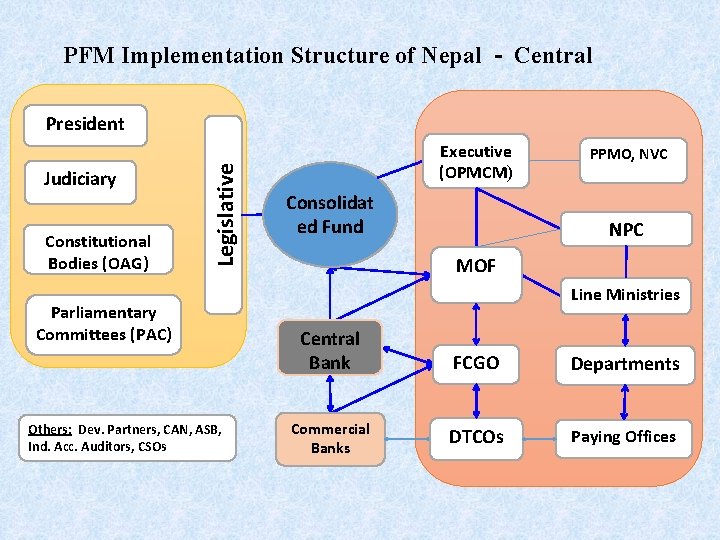
PFM Implementation Structure of Nepal - Central Judiciary Constitutional Bodies (OAG) Legislative President Parliamentary Committees (PAC) Others: Dev. Partners, CAN, ASB, Ind. Acc. Auditors, CSOs Executive (OPMCM) Consolidat ed Fund PPMO, NVC NPC MOF Line Ministries Central Bank Commercial Banks FCGO Departments DTCOs Paying Offices
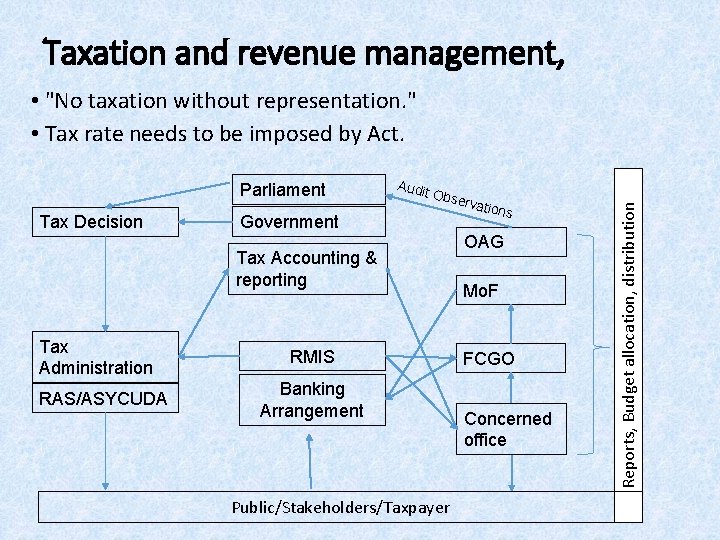
Taxation and revenue management, Parliament Tax Decision Audit Obse rv Government Tax Accounting & reporting Tax Administration RAS/ASYCUDA RMIS Banking Arrangement Public/Stakeholders/Taxpayer ation s OAG Mo. F FCGO Concerned office Reports, Budget allocation, distribution • "No taxation without representation. " • Tax rate needs to be imposed by Act.
PFM Reform • PFM is taken as an essential part of development process. • PFM changes the manner of governance by mobilizing the public resources in the area of strategic importance. • PFM Reform enables desirable fiscal and budgetary outcomes; • Aggregate fiscal discipline : budgetary & fiscal risk control; • Strategic allocation of resources; priority and policy based • Efficient service delivery: using resources for best PSD • PFM reform needs to be implemented as part of an overall strategy - reforms should be part of an overall strategic movement towards change (holistic public sector reform initiative) in order to enhance operations and outcomes in the public sector. 16
PFM Reform. . … Principally PFM reform is focused in the following guiding areas; • country leadership - in setting/managing the PFM reform strategy and action plan. • PFM diagnostic - in an integrated and coordinated manner with appropriate tools in regular timing and scope as of country needs. • Capacity building - adding value to government decision-making cycles. • Framed within a multi-year horizon, sequenced around agreed priorities, and built upon a coordinated approach. • Linked to a robust monitoring and evaluation framework. 17

Discussions
- Slides: 18