
Public Financial Management and Accountability Governance Induction Hitchin
Public Financial Management and Accountability Governance Induction Hitchin 9 th March 2004
What do we want to get out of it? n n n A clearer understanding of the public financial management and accountability framework Some understanding of diagnostic instruments and the harmonisation agenda Taking the work forward Know when to ask for expert help and support Calling for more!!
What do we want to get out of it? n n n What is our vision…What are we aiming for? Where are we now…Diagnostics and drivers for change Moving on…Addressing the basics and strategic incrementalism Know when to ask for expert help and support Calling for more!!
What is PFMA? Process by which decisions are made, implemented and accounted for n n amount of resources to be spent balance between revenue and expenditure allocation of funds between entities /activities how resources will be managed and accounted for (emphasis on substantive outcomes) (covers the whole of the budget cycle) (covers broad institutional and managerial arrangements)
Vision. . What are we aiming for? n n n Effective, transparent and accountable public financial management systems that will translate clearly defined development priorities into the effective delivery of public goods and services Country ownership consistent with evolving international standards, regular progress measurement supported by coherent donor support Overall fiscal discipline, allocative efficiency and value for money
Why is PFMA important? n n n n Sound management of all public finances are intrinsically important to development Transparency about how public resources are raised and then used is basic to democratic accountability Improvements can lead to big changes which benefit the poor (viz Uganda education) Off budget expenditure financed by donors undermines accountability Active scrutiny by legislature and public is essential Risk to service delivery of poor PFM systems (see WDR 2004) Improvements in PFM reduce opportunities for corruption (see WDR 2004)
Where are we now? n Evidence shows that these systems are in very poor shape in many of our partner countries n Assessment of accounting in countries receiving direct budget support from DFID u n No country met the proposed minimum standard IMF/WB review of HIPC countries 2002(2001) u Little upgrading = 0 (2) u Significant upgrade = 8 (7) u Substantial upgrade = 14 (16)
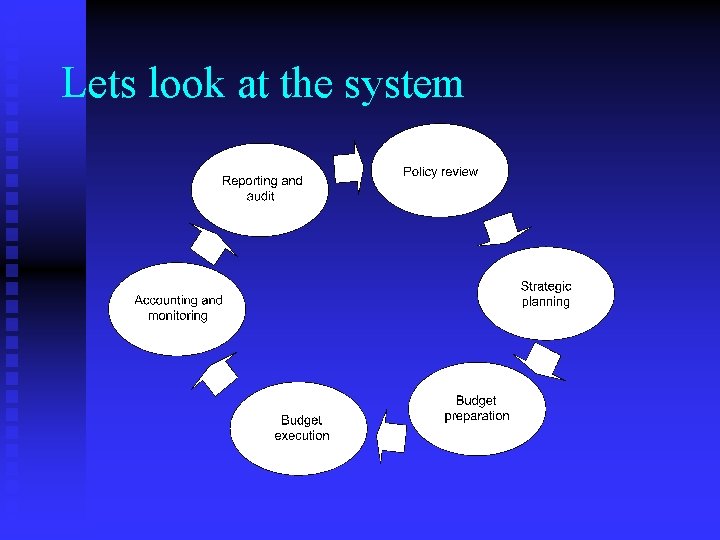
Lets look at the system
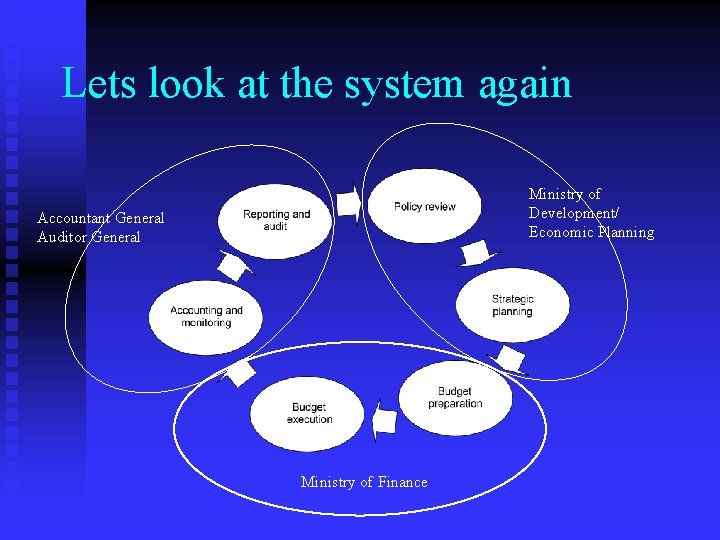
Lets look at the system again Ministry of Development/ Economic Planning Accountant General Auditor General Ministry of Finance
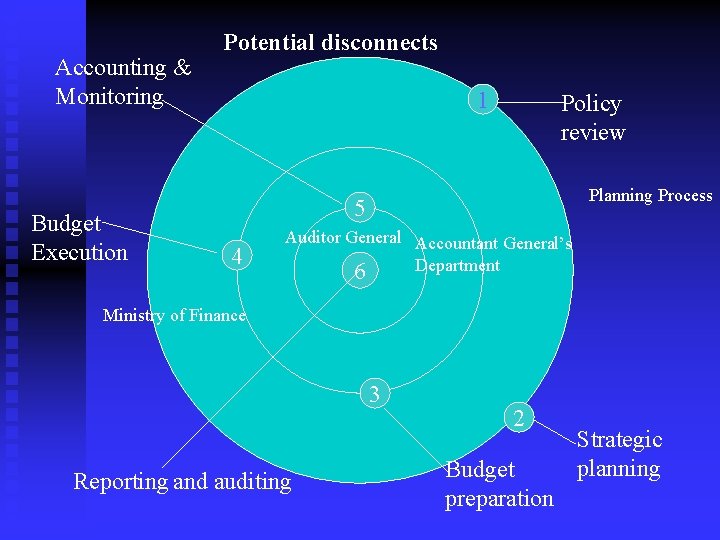
Accounting & Monitoring Budget Execution Potential disconnects 1 Policy review Planning Process 5 4 Auditor General Accountant General’s Department 6 Ministry of Finance 3 Reporting and auditing 2 Budget preparation Strategic planning
The Budget Cycle and Risk Where can risk occur?
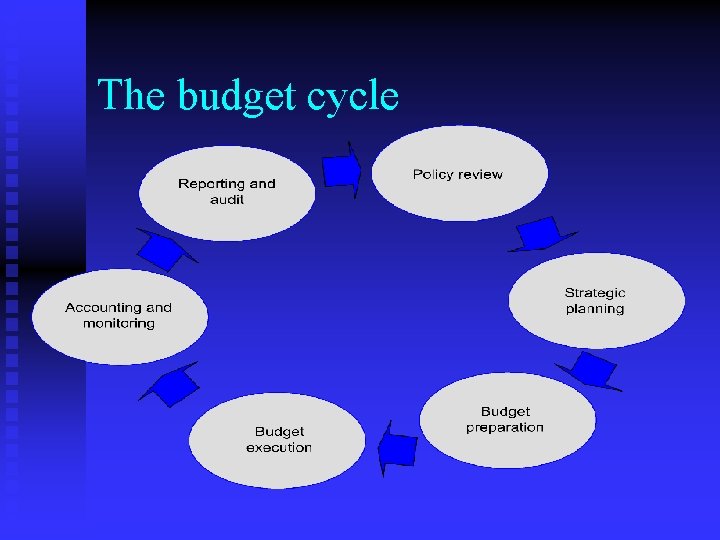
The budget cycle
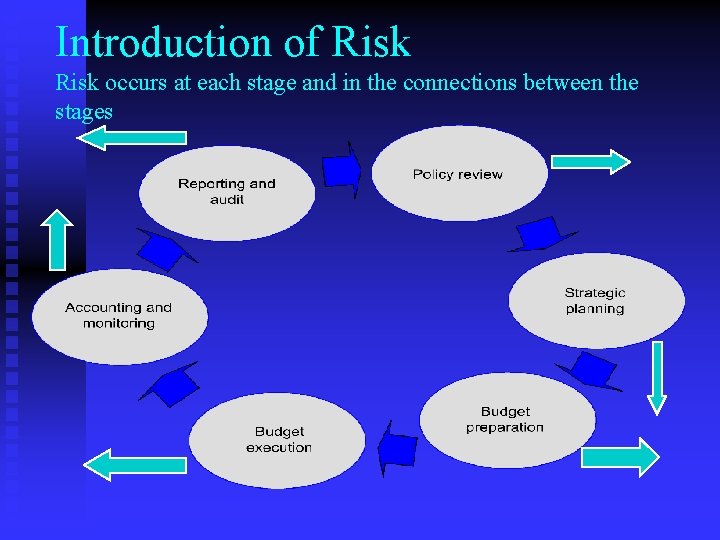
Introduction of Risk occurs at each stage and in the connections between the stages
Is the Budget Cycle flawed? n n n Does Policy review feed into Strategic Planning? Does Strategic Planning inform Budget preparation? Is the Budget executed? Is expenditure accounted and monitored? (who does it and who for? ) Is resource use audited? Does audit information feed into policy review?
Risk identification The broader governance framework n Does the budget translate strategies into resource allocation? n Budget composition n Budget execution n Different perspectives by the players n
The broader Governance framework n n n n Level of political engagement in medium term expenditure plans/poverty strategies Institutional links between planning and finance Executive involvement in setting resource allocation priorities Adherence to the “rules of the game” A budget law specifying fiscal management responsibilities Independent scrutiny of government expenditures Overall Government capacity to design and implement a reform programme
The Budget as an instrument of translation n n Consistency of resource allocation decisions with overall plans and strategies What use is made of a medium term framework? Relationship of the discretionary budget to overall government expenditure? Is expenditure linked with objectives and priorities Are there adequate estimates of the costs of delivering on policies?
The composition of the budget Are all Government activities included in the budget? n Are all sources of revenue captured? n What is the role of extra budgetary funds? n Are there separate earmarked funds? n Consistency between the recurrent and capital budgets n
Budget execution n n Are funds disbursed in a timely and consistent way? What is the relationship between the budget and the expenditure outturn? Can they be compared? Is there a history of cash constraints and expenditure cut backs? Do ceilings change during the budget preparation process?
Summary of the Risks Little accountability for the use of public resources (Diversion and corruption) n Strategies are not translated into resource allocations n Funded ministries do not deliver Public services n Poor value for money n
Having said all of that n n How can we build up a shared understanding of the problem? What experiences do we have of constructive dialogue? A twin track…delivering “quick wins” based on a jointly owned and developed longer term strategic plan. Engagement of both politicians and bureaucrats. Different perceptions of risk
Implications for Diagnosis(1) n n n Moving away from accounting for transactions to a focus on systems improvement The country is the focus for support Diagnostic tools must capture the breadth of the agenda (technical, institutional and wider governance considerations) Too many products and not enough attention to the process Diagnosis must lead to a reform programme which can be monitored
Implications for Diagnosis(2) Review the diagnostic part of the DFID PEM guidelines n Working collaboratively with others CFAA, PER, CPAR, ROSC, etc n Adding value in terms of breadth n Awareness of the integration agenda n Considerable work going on by PEFA (see Handout) n
Diagnosis Using the benchmarks within DFID’s Fiduciary Risk Framework
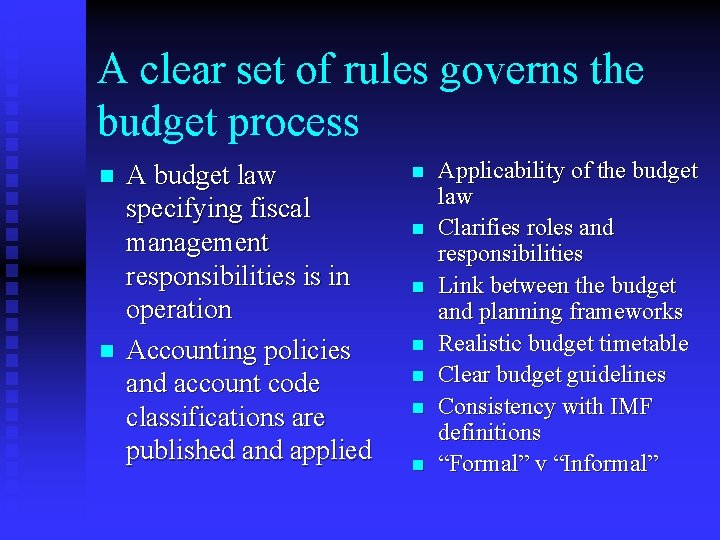
A clear set of rules governs the budget process n n A budget law specifying fiscal management responsibilities is in operation Accounting policies and account code classifications are published and applied n n n n Applicability of the budget law Clarifies roles and responsibilities Link between the budget and planning frameworks Realistic budget timetable Clear budget guidelines Consistency with IMF definitions “Formal” v “Informal”
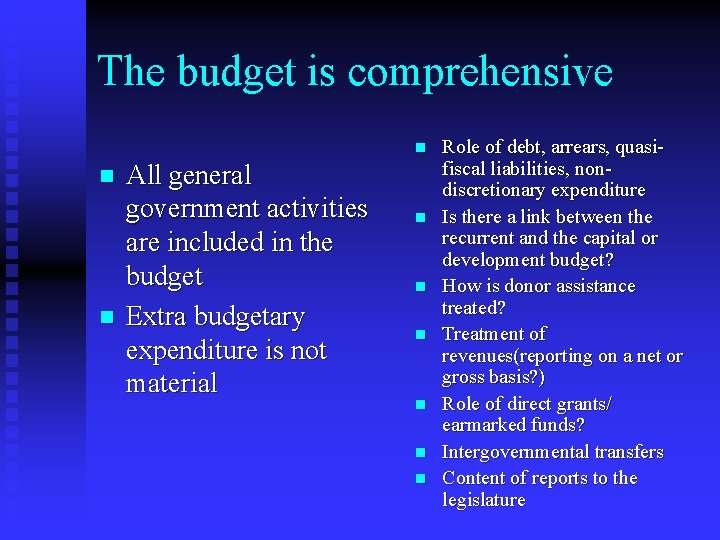
The budget is comprehensive n n n All general government activities are included in the budget Extra budgetary expenditure is not material n n n Role of debt, arrears, quasifiscal liabilities, nondiscretionary expenditure Is there a link between the recurrent and the capital or development budget? How is donor assistance treated? Treatment of revenues(reporting on a net or gross basis? ) Role of direct grants/ earmarked funds? Intergovernmental transfers Content of reports to the legislature
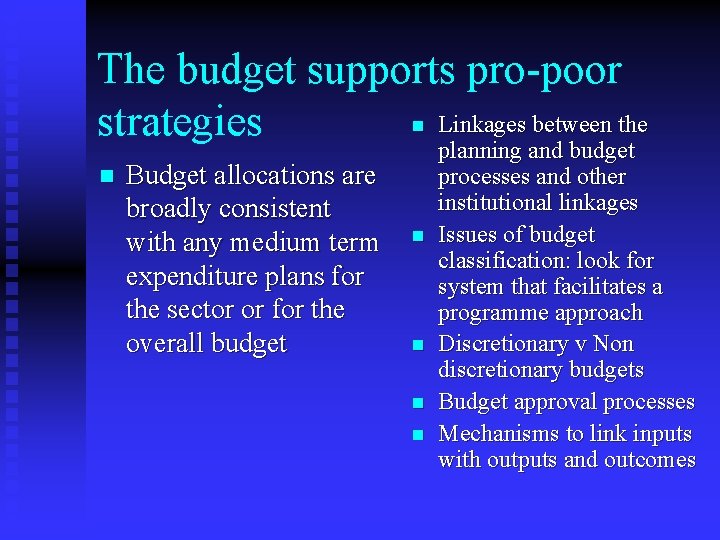
The budget supports pro-poor n Linkages between the strategies n Budget allocations are broadly consistent with any medium term expenditure plans for the sector or for the overall budget n n planning and budget processes and other institutional linkages Issues of budget classification: look for system that facilitates a programme approach Discretionary v Non discretionary budgets Budget approval processes Mechanisms to link inputs with outputs and outcomes
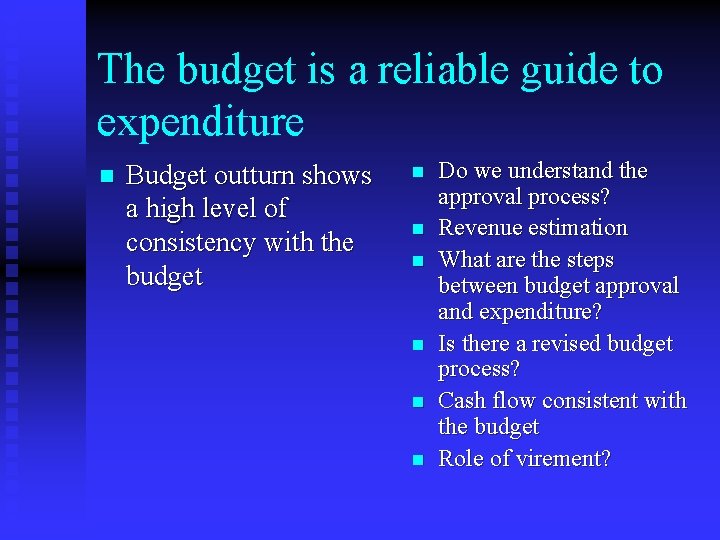
The budget is a reliable guide to expenditure n Budget outturn shows a high level of consistency with the budget n n n Do we understand the approval process? Revenue estimation What are the steps between budget approval and expenditure? Is there a revised budget process? Cash flow consistent with the budget Role of virement?
Expenditure within year is controlled n n In-year reporting of actual expenditure Systems operating to control virement, commitments and arrears n n n Where are the controls? Role of Internal audit How can commitments be entered into? Who sees the reports? What is their timeliness? Handling of cash balances
Government carries out procurement in line with principles of value for money and transparency n n n Appropriate use of competitive tendering rules. Decision making is recorded and auditable Effective action to identify and eliminate corruption n n Informal v Formal Appropriateness of limits. Delegation of powers Regularity of tender board operation Transparency of operation Value for money programme
Reporting of expenditure is timely and accurate n n Reconciliation of fiscal and bank records is carried out on a regular basis Audited annual accounts are submitted to parliament within the statutory period n n n Role of Government banker Regularity. What actually happens? Who does the reconciliation? Who uses the information? What does it tell you?
There is effective independent scrutiny of government expenditure n n n Government accounts are independently audited Government agencies are held to account for mismanagement Criticism made by the auditors are followed up n n n Capacity of the Auditor’s office Time lag Expertise/ understanding of watchdog Evidence of follow up Accessibility of information
Some broader issues Need for clear understanding by all players u Legislature/Executive u Government/Donors u Mo. F / other central ministries u Mo. F / sectoral ministries n Incentives to maintain reform n
Applying the diagnosis Choose a country you are familiar n Apply the six characteristics of PFM (see below) n Look at the principles of Good Practice n What about the broader political, governance and institutional factors? n
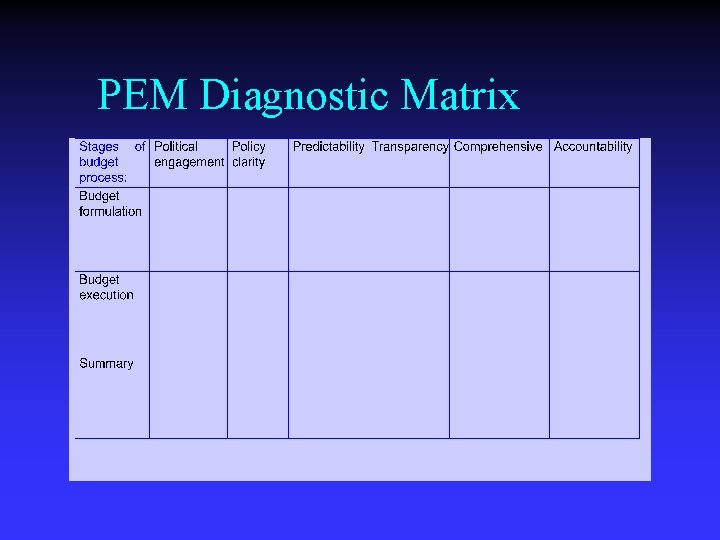
PEM Diagnostic Matrix
Diagnostic Work What are our experiences of n Developing ownership n Working collaboratively with donors n Adding value to the process n Linking with our own fiduciary framework n Linking diagnosis with reform
Supporting country owned reform n n n n Is there a shared vision? What do the diagnostics tell us? Where is the greatest risk/ potential for most gain? Political support Donor cohesion Technical v Institutional/Governance Issues of sequencing
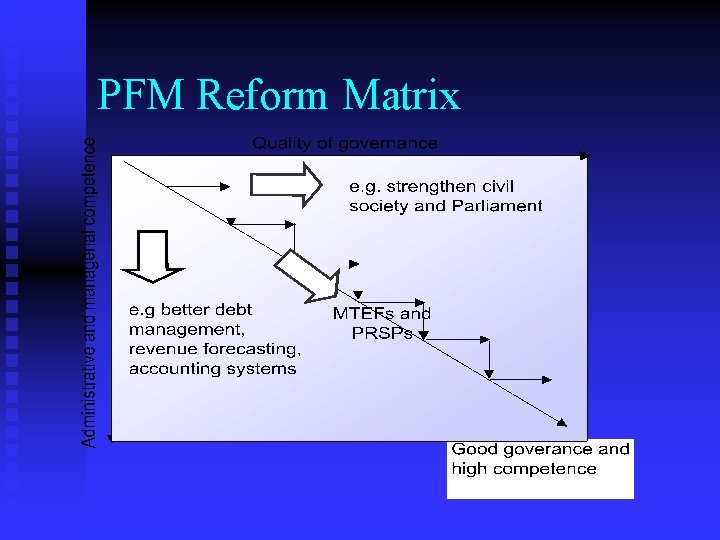
PFM Reform Matrix
PEFA work on reviewing safeguards n Wide variety of safeguards have been used by donors. Broad conclusions Fragmented and partial nature of measures “Measure based” Little consistency between and within donors Implementation can weaken Government ownership
PEFA review (contd) n n n Upfront measures should complement longer term reform Develop a “platform” for reform Initial platform should focus on the basic dialogue with Government Key characteristics of the “platform” would be measures that 1) establish basic data integrity and 2) require political support and mandate
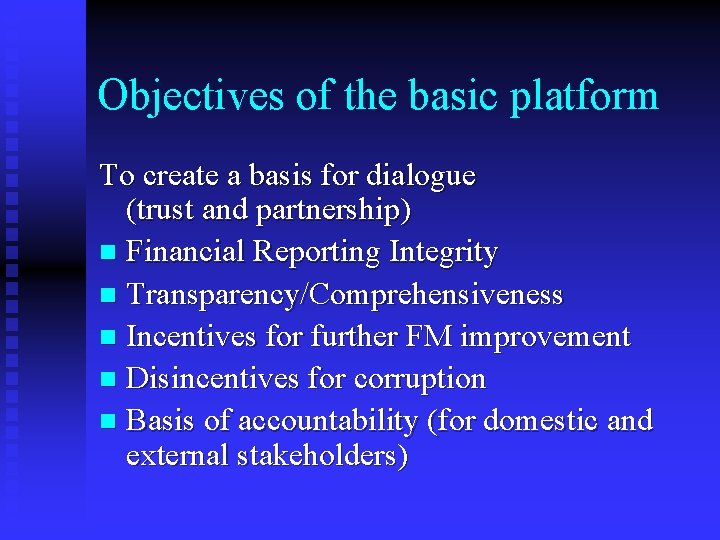
Objectives of the basic platform To create a basis for dialogue (trust and partnership) n Financial Reporting Integrity n Transparency/Comprehensiveness n Incentives for further FM improvement n Disincentives for corruption n Basis of accountability (for domestic and external stakeholders)
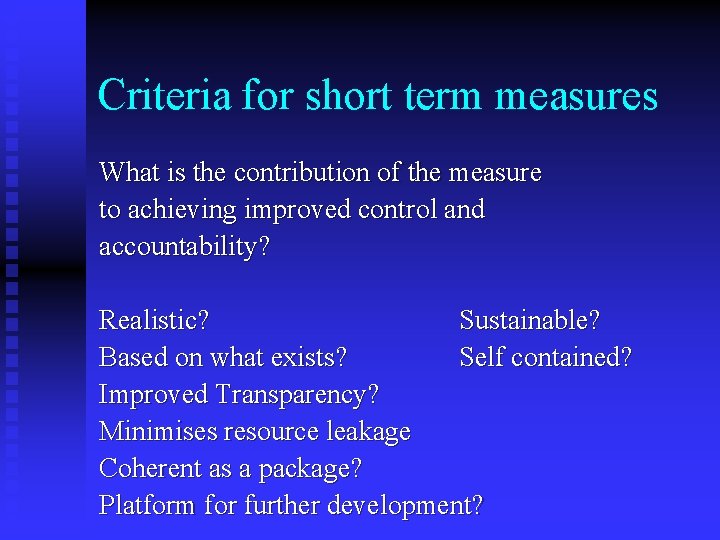
Criteria for short term measures What is the contribution of the measure to achieving improved control and accountability? Realistic? Sustainable? Based on what exists? Self contained? Improved Transparency? Minimises resource leakage Coherent as a package? Platform for further development?
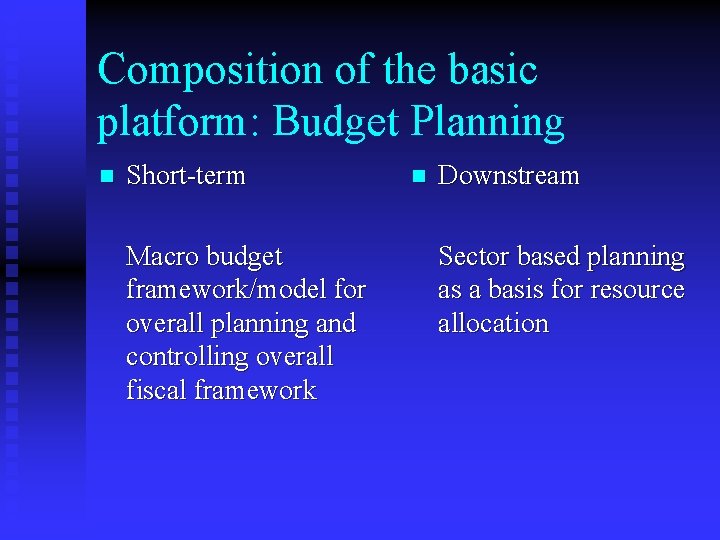
Composition of the basic platform: Budget Planning n Short-term Macro budget framework/model for overall planning and controlling overall fiscal framework n Downstream Sector based planning as a basis for resource allocation
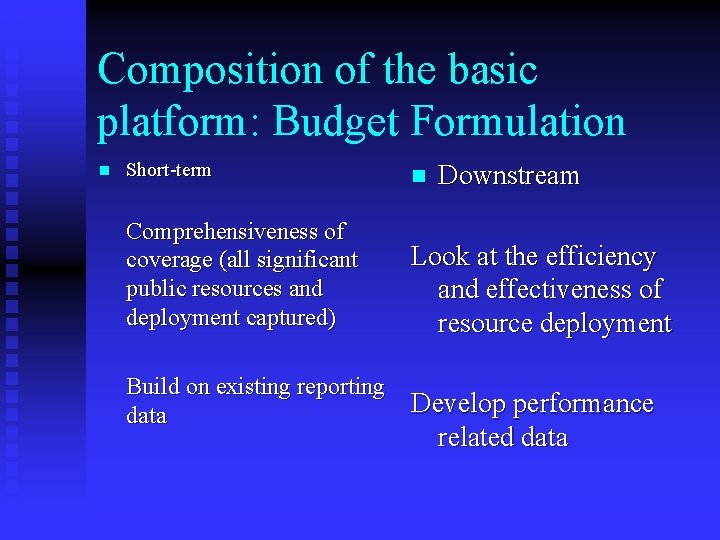
Composition of the basic platform: Budget Formulation n Short-term n Comprehensiveness of coverage (all significant public resources and deployment captured) Look at the efficiency and effectiveness of resource deployment Build on existing reporting data Downstream Develop performance related data
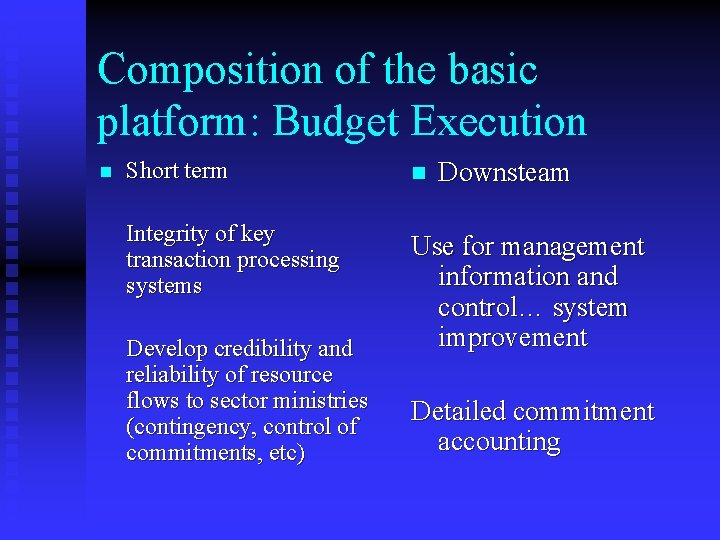
Composition of the basic platform: Budget Execution n Downsteam Short term n Integrity of key transaction processing systems Use for management information and control… system improvement Develop credibility and reliability of resource flows to sector ministries (contingency, control of commitments, etc) Detailed commitment accounting
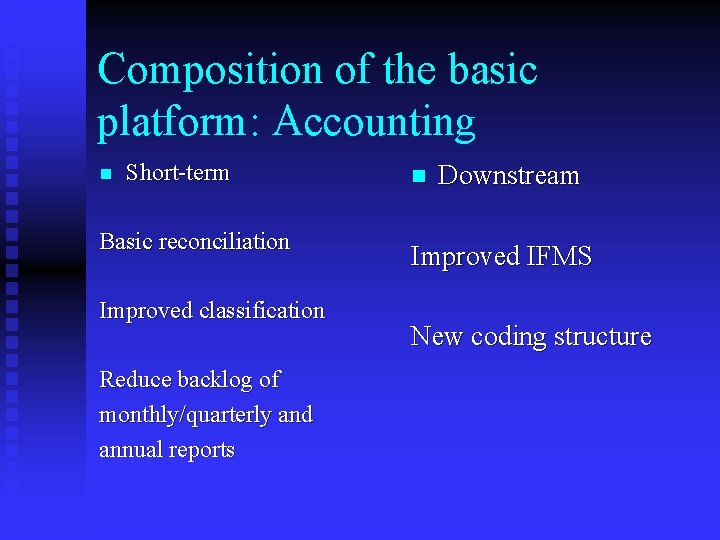
Composition of the basic platform: Accounting n Short-term Basic reconciliation Improved classification Reduce backlog of monthly/quarterly and annual reports n Downstream Improved IFMS New coding structure
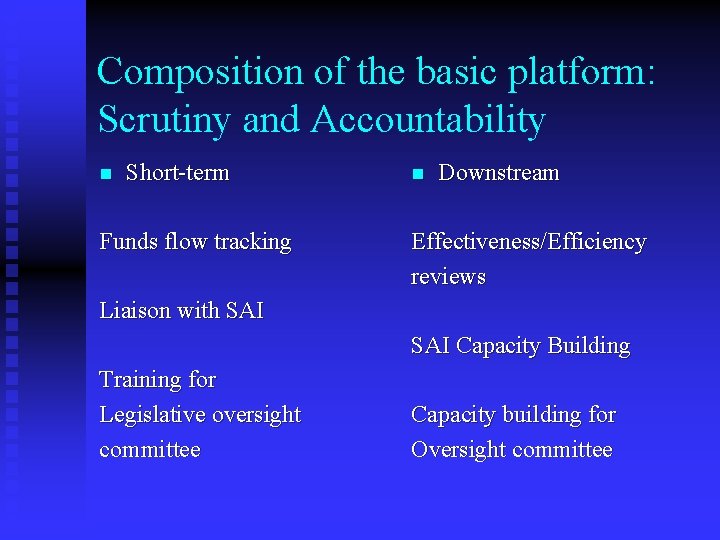
Composition of the basic platform: Scrutiny and Accountability n Short-term Funds flow tracking n Downstream Effectiveness/Efficiency reviews Liaison with SAI Capacity Building Training for Legislative oversight committee Capacity building for Oversight committee
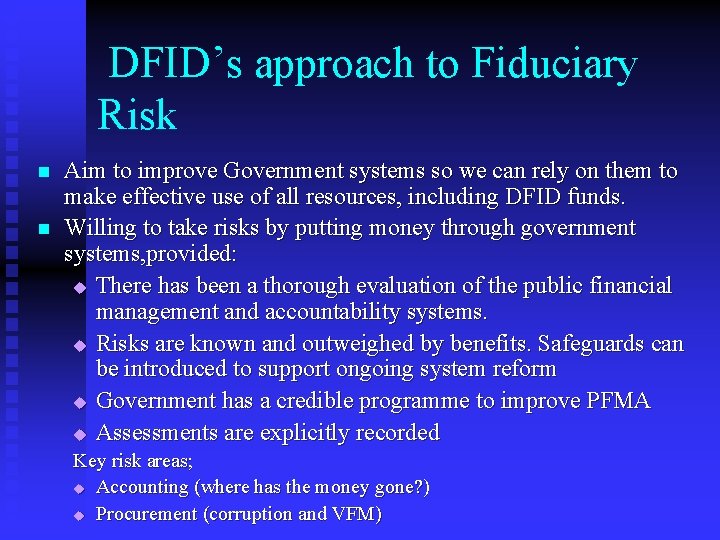
DFID’s approach to Fiduciary Risk n n Aim to improve Government systems so we can rely on them to make effective use of all resources, including DFID funds. Willing to take risks by putting money through government systems, provided: u There has been a thorough evaluation of the public financial management and accountability systems. u Risks are known and outweighed by benefits. Safeguards can be introduced to support ongoing system reform u Government has a credible programme to improve PFMA u Assessments are explicitly recorded Key risk areas; u Accounting (where has the money gone? ) u Procurement (corruption and VFM)
Other issues Experiences of n n n n Engagement at the political level Translation of priorities into resource allocation MTEF Fiscal decentralisation Participatory budgeting IFMS Role of the Auditor General’s Department Revenue
PFMA team in Policy Division n n n Simon Gill, Kathy Ford, Helen Leadbetter, Caroline Bash…. David Biggs (from August) Plus Julie Lynn (NAO secondee) Revenue secondee Nicola Smithers (seconded to the PEFA Programme in Washington) Luke Mukubvu (Based in Harare, with some time) Check out the PFMA page on Insight
What is the PFMA team doing? Operational guidelines on Fiduciary Risk n Harmonisation agenda via PEFA and the OECD-DAC n Guidelines for working at the sectoral level n Broader issues of accountability n Training support n Audit guidelines…. n
Almost by Royal appointment!! n A Lesotho Case Study
Critical appraisal of a reform programme
Papers to review 1. Executive Summary from IMF review 2. Draft Government Action Plan 3. Draft Project Memorandum prepared by a Consultant
To discuss n How should the DFID programme team take forward PFM reform?
Some thoughts n n Need to improve legislative oversight. Create some demand for reform Need to improve the credibility of the Ministry of Finance Identify some quick wins Address the need for a comprehensive reform agenda Link with other donors and the broader Public Sector Reform agenda Look at sequencing and priority Concentrate reform in the area of budget execution
Develop a dialogue with Government (1) n n n Importance of PFM to translate Government strategies into practice Develop linkages between financial inputs and sectoral outcomes Need to develop broader accountability for the delivery of services Use of donor resources to strengthen Government’s own accountability Develop a common view with the wider donor community
Develop a dialogue with Government (2) n Maintain a focus on the basics Basic financial reporting integrity Increasing transparency and oversight Incentives for reform Disincentives for corruption
- Slides: 58