
Public Finance Seminar Professor Yinger Public Production Functions

Public Finance Seminar Professor Yinger Public Production Functions Professor John Yinger, The Maxwell School, Syracuse University, 2018
Production Functions Class Outline �The Algebra of Production Functions �Alternative Approaches to Education Production Functions �Examples
Production Functions Why Production Functions? �Scholars and policy makers often want to understand the technology of public production. �The basic idea of a production function is simple, but it turns out that production functions raise an astonishingly large number of methodological issues. �Different scholars make different decisions about what is important. �I hope to give you a sense of some key trade-offs today, with a focus on education production functions.
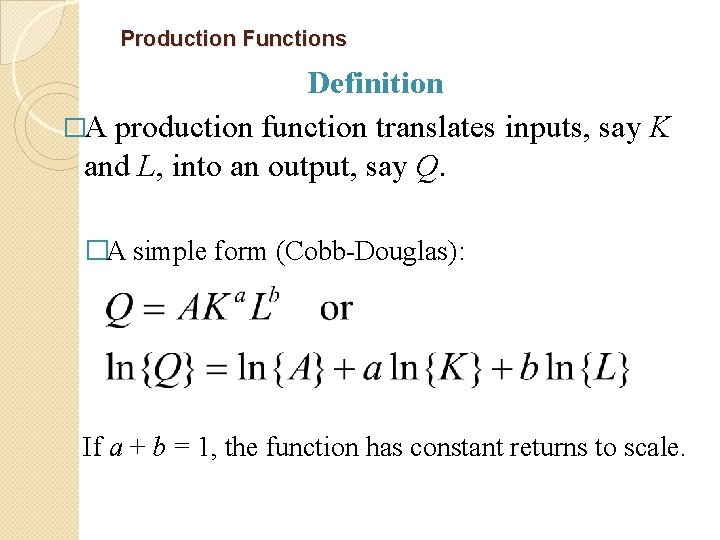
Production Functions Definition �A production function translates inputs, say K and L, into an output, say Q. �A simple form (Cobb-Douglas): If a + b = 1, the function has constant returns to scale.
Production Functions Duncombe and Yinger �Bill and I took a look at production functions for fire services in NY (J. Public Economics, 1993). �We measure output by fire losses as a share of property value �We identify 2 key measures of scale �Service quality (i. e. level of output) �The number of people served �We find �Increasing returns to quality scale (cost per unit of quality goes down as quality goes up) �Constant returns to population scale (cost per capita is constant as population changes)
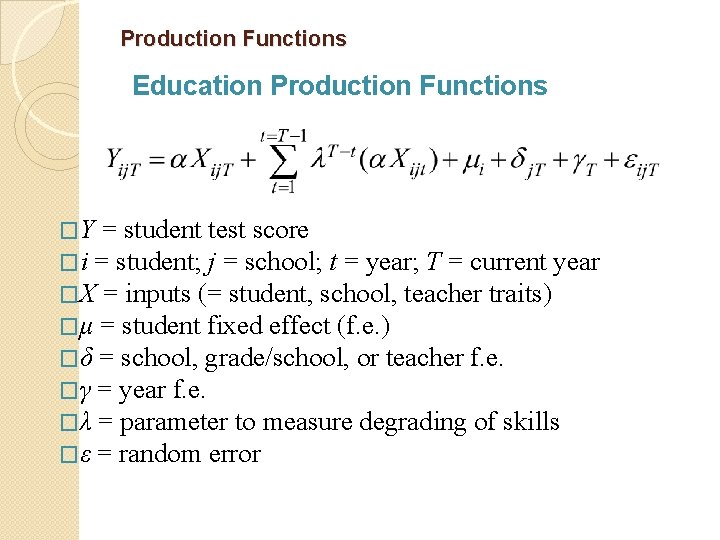
Production Functions Education Production Functions �Y = student test score �i = student; j = school; t = year; T = current year �X = inputs (= student, school, teacher traits) �μ = student fixed effect (f. e. ) �δ = school, grade/school, or teacher f. e. �γ = year f. e. �λ = parameter to measure degrading of skills �ε = random error
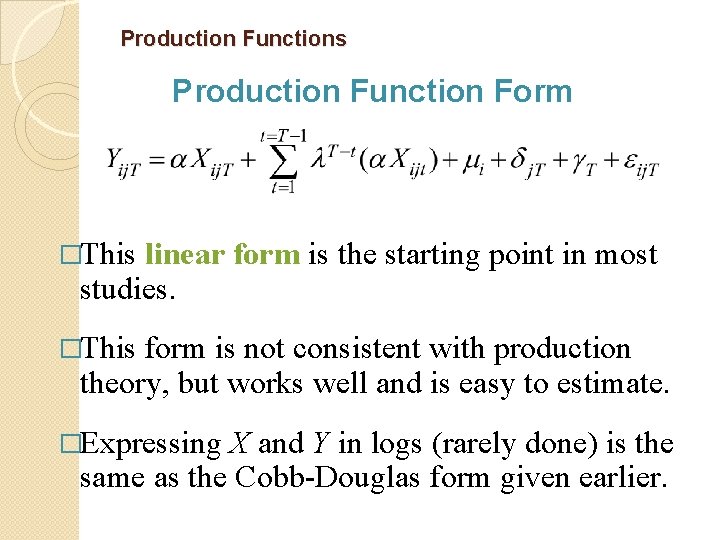
Production Functions Production Function Form �This linear form is the starting point in most studies. �This form is not consistent with production theory, but works well and is easy to estimate. �Expressing X and Y in logs (rarely done) is the same as the Cobb-Douglas form given earlier.
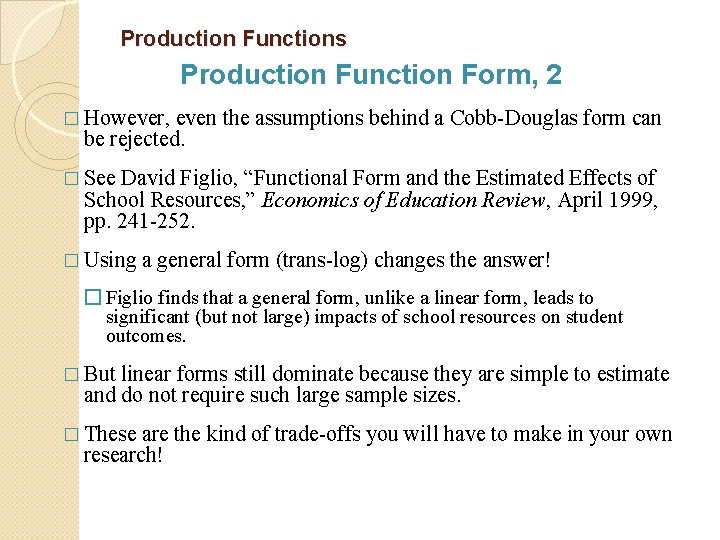
Production Functions Production Function Form, 2 � However, even the assumptions behind a Cobb-Douglas form can be rejected. � See David Figlio, “Functional Form and the Estimated Effects of School Resources, ” Economics of Education Review, April 1999, pp. 241 -252. � Using a general form (trans-log) changes the answer! � Figlio finds that a general form, unlike a linear form, leads to significant (but not large) impacts of school resources on student outcomes. � But linear forms still dominate because they are simple to estimate and do not require such large sample sizes. � These are the kind of trade-offs you will have to make in your own research!
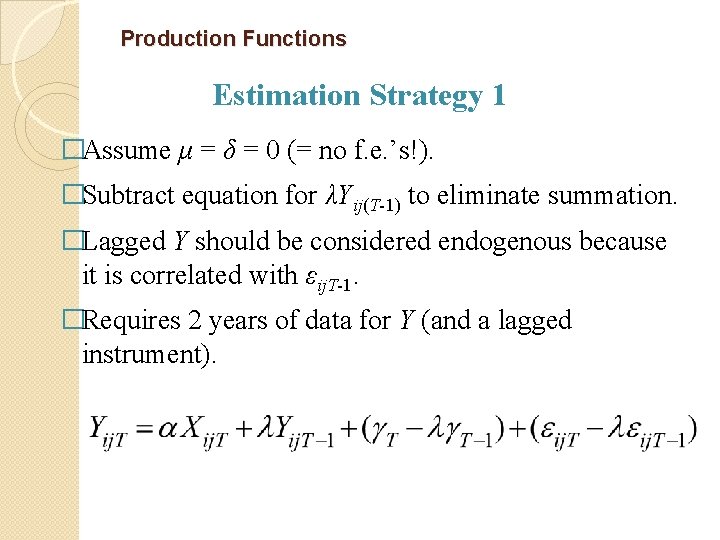
Production Functions Estimation Strategy 1 �Assume μ = δ = 0 (= no f. e. ’s!). �Subtract equation for λYij(T-1) to eliminate summation. �Lagged Y should be considered endogenous because it is correlated with εij. T-1. �Requires 2 years of data for Y (and a lagged instrument).
Production Functions Estimation Strategy 1, Continued �The big problem with this strategy, of course, is that it assumes away student fixed effects. �Traits such as motivation cannot be observed, but they both influence performance are correlated with included explanatory variables. �This strategy is more credible if a study has a large number of control variables for student traits.
Production Functions Estimation Strategy 1 A �Add school, school/grade, or teacher f. e. ’s to Strategy 1. �One must be able to link students to schools or school and grade or (rarely possible) teachers. �This gets away from the assumption that δ = 0, �But still does not estimate student fixed effects. �With a longer panel, one could use school-by-year fixed effects (or school/grade by year).
Production Functions Estimation Strategy 1 B? �The literature assumes that λ is the same for all students. �But this does not appear to be the case: �higher-income students go to math and music camp! �This issue could be introduced with interactions between λ and various student traits. �There may be a study that does this, but I have not come across it.
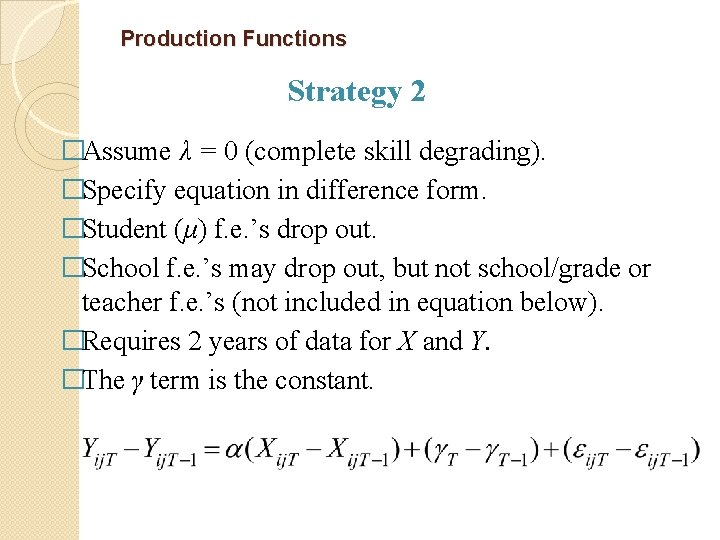
Production Functions Strategy 2 �Assume λ = 0 (complete skill degrading). �Specify equation in difference form. �Student (μ) f. e. ’s drop out. �School f. e. ’s may drop out, but not school/grade or teacher f. e. ’s (not included in equation below). �Requires 2 years of data for X and Y. �The γ term is the constant.
Production Functions Strategy 2, Continued �Note that the student f. e. ’s account for all student unobservables and X’s before year T-1. �The problem comes in year T-1. �The form of the X variables for period T-1 in the estimating equation is based on the assumption that λ = 0. �So these explanatory variables are mis-specified if there is not complete skill degrading.
Production Functions Strategy 2 A �Add school, school/grade, or teacher fixed effects. �Requires better data. �Still assumes no degrading of skills.
Production Functions An Aside on “Value Added” �The change in a student’s test score from one year to the next is called the “value added. ” �But the term is not used consistently. �Some people (e. g. one study discussed below) say they are estimating a “value added” model when they introduce a lagged test score (Strategy 1). �Other say a “value added” model is equivalent to differencing test scores (Strategy 2). �Whatever terminology your prefer, make sure your assumptions about degrading are clear!
Production Functions Differencing and Fixed Effects �With a two-year panel, differencing and student fixed effects are equivalent. �With a longer panel, they are not equivalent, and fixed effects are generally more appropriate. �A fixed-effects model estimates parameters based on deviations from mean values. �A first-difference model estimates parameters based on the changes from the previous year. �So when I say “difference, ” I really mean “fixed effects” when the panel is more than 2 years.
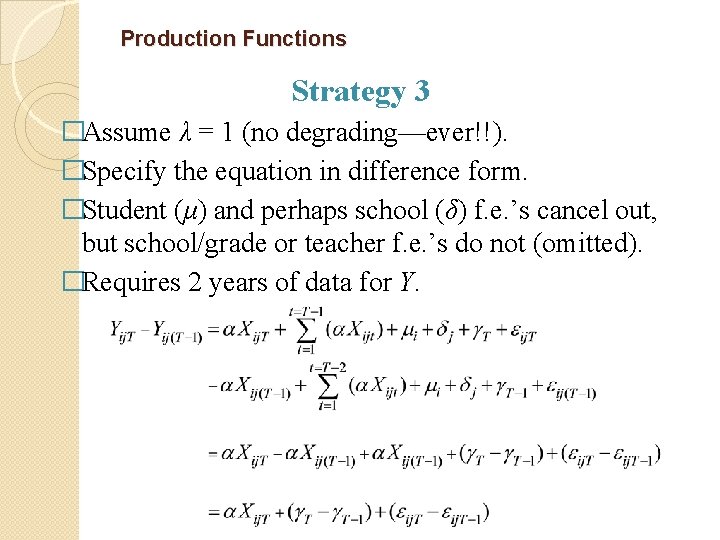
Production Functions Strategy 3 �Assume λ = 1 (no degrading—ever!!). �Specify the equation in difference form. �Student (μ) and perhaps school (δ) f. e. ’s cancel out, but school/grade or teacher f. e. ’s do not (omitted). �Requires 2 years of data for Y.
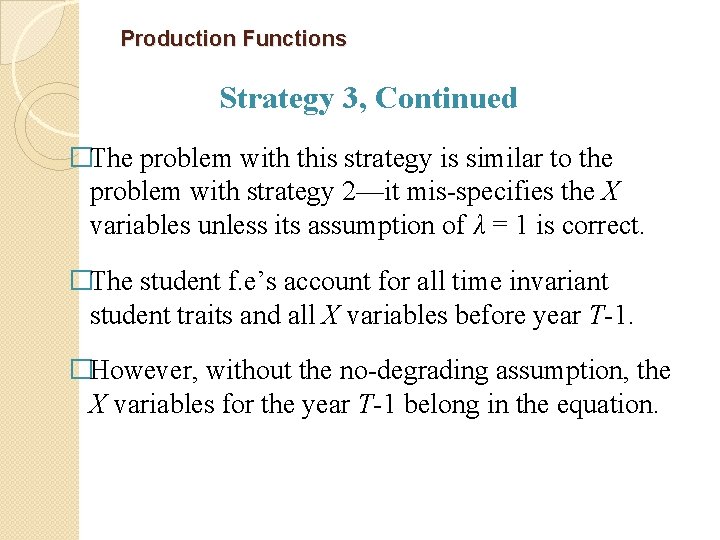
Production Functions Strategy 3, Continued �The problem with this strategy is similar to the problem with strategy 2—it mis-specifies the X variables unless its assumption of λ = 1 is correct. �The student f. e’s account for all time invariant student traits and all X variables before year T-1. �However, without the no-degrading assumption, the X variables for the year T-1 belong in the equation.
Production Functions Strategy 3 A �Some people interpret this set-up as regressing value added on current student and school traits. �Hence unobserved student, school, and teacher traits are interpreted as part of current factors. �Under this interpretation student f. e. ’s do not cancel, and panel data are needed. �Teacher f. e. ’s obviously still are relevant. �This does not eliminate the issue of skill degrading.
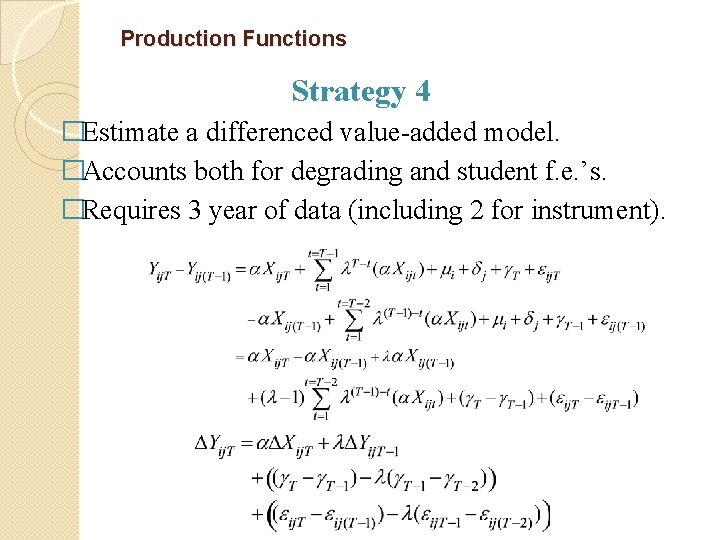
Production Functions Strategy 4 �Estimate a differenced value-added model. �Accounts both for degrading and student f. e. ’s. �Requires 3 year of data (including 2 for instrument).
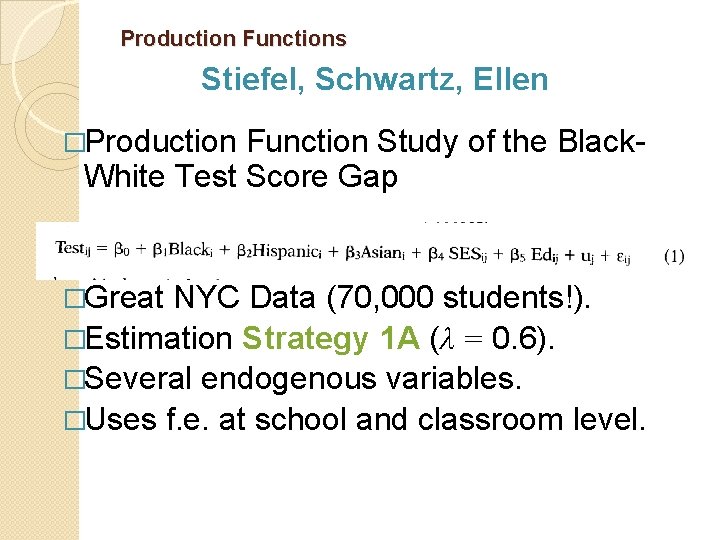
Production Functions Stiefel, Schwartz, Ellen �Production Function Study of the Black. White Test Score Gap �Great NYC Data (70, 000 students!). �Estimation Strategy 1 A (λ = 0. 6). �Several endogenous variables. �Uses f. e. at school and classroom level.
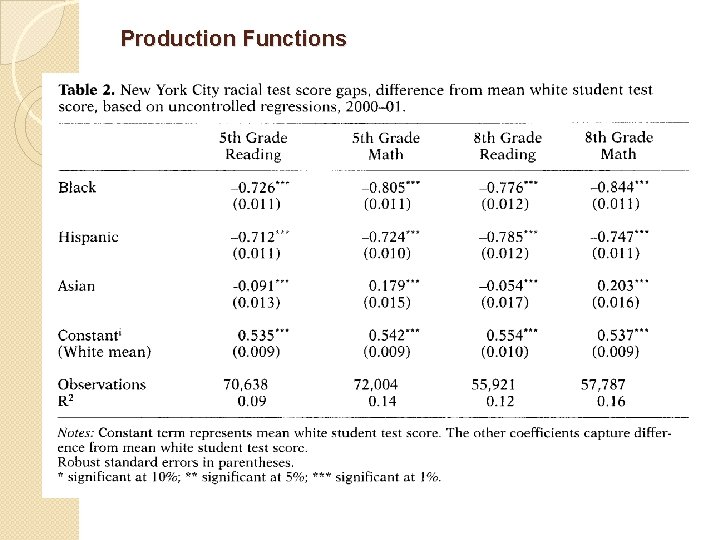
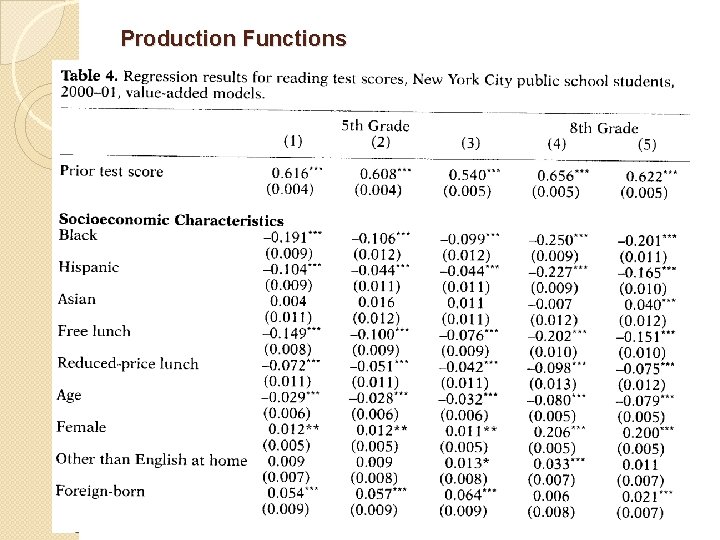
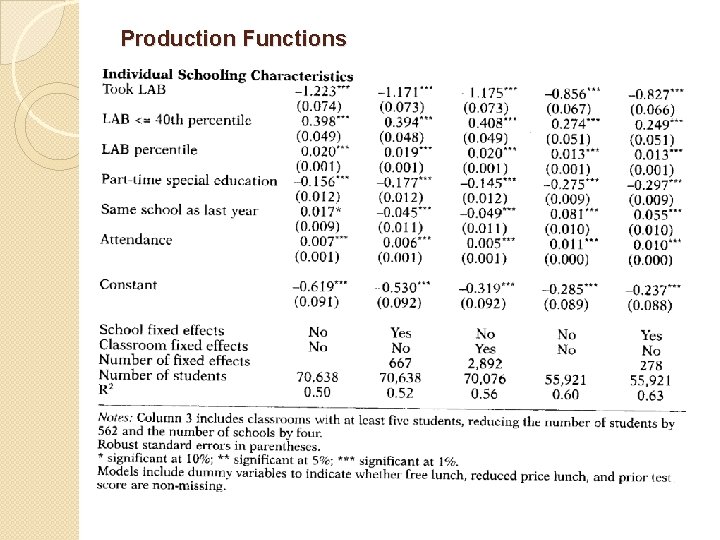
Production Functions Stiefel, Schwartz, Ellen, Results �A large share of the black-white and Hispanic-white gaps in test scores is explained by the control variables. �But a significant gap remains. �Their Table 2 is just raw differences. �Their Table 4 uses Strategy 1 (columns 1 and 4) or Strategy 1 A (columns 2, 3, and 5). �Columns 2 and 5 use school f. e. ; column 3 uses classroom f. e.
Production Functions
Production Functions
Production Functions
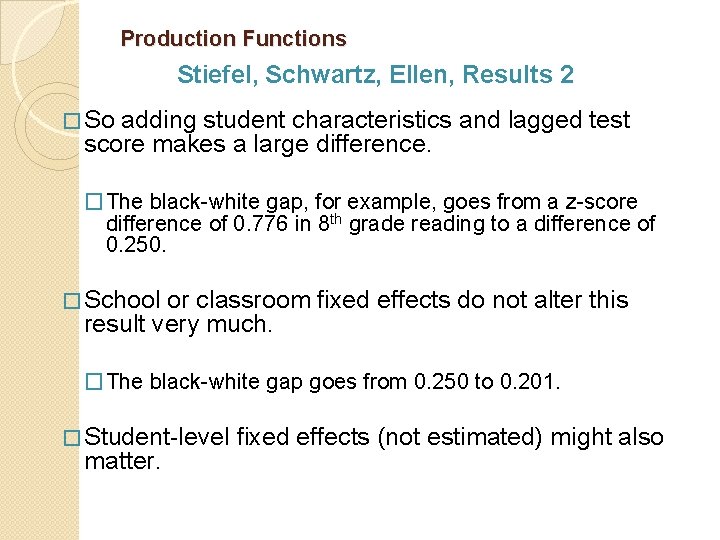
Production Functions Stiefel, Schwartz, Ellen, Results 2 � So adding student characteristics and lagged test score makes a large difference. �The black-white gap, for example, goes from a z-score difference of 0. 776 in 8 th grade reading to a difference of 0. 250. � School or classroom fixed effects do not alter this result very much. �The black-white gap goes from 0. 250 to 0. 201. � Student-level matter. fixed effects (not estimated) might also
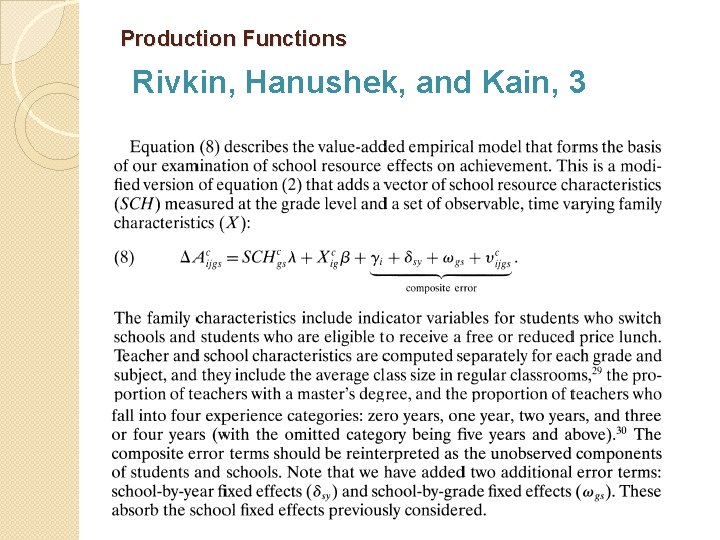
Production Functions Rivkin, Hanushek, and Kain �Influential production function study. ◦ S. G. Rivkin, E. A. Hanushek, and J. F. Kain. “Teachers, Schools, and Academic Achievement. ” Econometrica, March 2005, pp. 417 -458. �Great data for Texas; �> 1 million observations. �Students linked to grades and schools �Strategy 3 A. �School by year and school by class f. e. �Assumes no degrading.
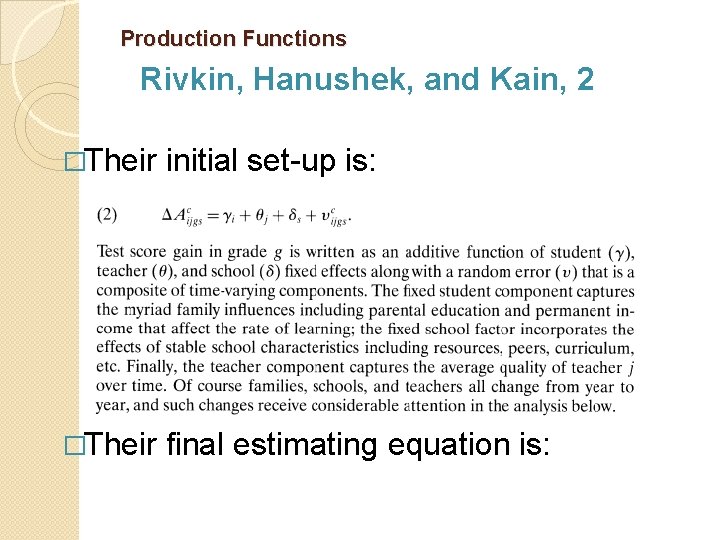
Production Functions Rivkin, Hanushek, and Kain, 2 �Their initial set-up is: �Their final estimating equation is:
Production Functions Rivkin, Hanushek, and Kain, 3
Production Functions Rivkin, Hanushek, and Kain, 4 �This paper finds significant, but small impacts of class size and teacher traits on value added. �It is famous because it uses fixed effects to isolate the impact of unobserved withinschool variation (= teacher quality) on student performance—and shows that it has a large impact. �Other studies have matched students to teachers and replicate this result with teacher f. e. �J. E. Rockoff, “The Impact of Individual Teachers
- Slides: 31