
Public Finance 10 th Edition David N Hyman

Public Finance, 10 th Edition David N. Hyman C h a p t e r 10 INTRODUCTION TO GOVERNMENT FINANCE © 2011 Cengage Learning. All Rights Reserved. May not be scanned, copied or duplicated, or posted to a publicly accessible website, in whole or in part.
Government Finance Method of finance proposed for a community or actually used can affect many variables, including: 1. The political equilibrium 2. Overall market equilibrium and efficiency with which resources are employed in private uses 3. The distribution of income © 2011 Cengage Learning. All Rights Reserved. May not be scanned, copied or duplicated, or posted to a publicly accessible website, in whole or in part.
Principles of Taxation • Taxes – compulsory payments associated with certain activities • Revenues from taxation used to purchase inputs necessary to produce government-supplied goods and services or to redistribute purchasing power among citizens • Reallocates resources from private to government use in two steps: 1. Ability of individuals to command resources is reduced (reduces income for spending) 2. Revenues collected used to bid for resources necessary to provide government goods and services, plus income support to recipients of government transfers (i. e. , Social Security) © 2011 Cengage Learning. All Rights Reserved. May not be scanned, copied or duplicated, or posted to a publicly accessible website, in whole or in part.
Tax Base • Tax base – item or economic activity on which the tax is levied - Economic bases (most commonly used): income, consumption, wealth • General tax – taxes all components of the economic bases; no exclusions, exemptions, or deductions from the tax base • Selective tax – one that taxes only certain portions of the tax base, or allows exemptions and deductions from general tax base • Excise tax – tax on manufacture or sale of particular good or service © 2011 Cengage Learning. All Rights Reserved. May not be scanned, copied or duplicated, or posted to a publicly accessible website, in whole or in part.
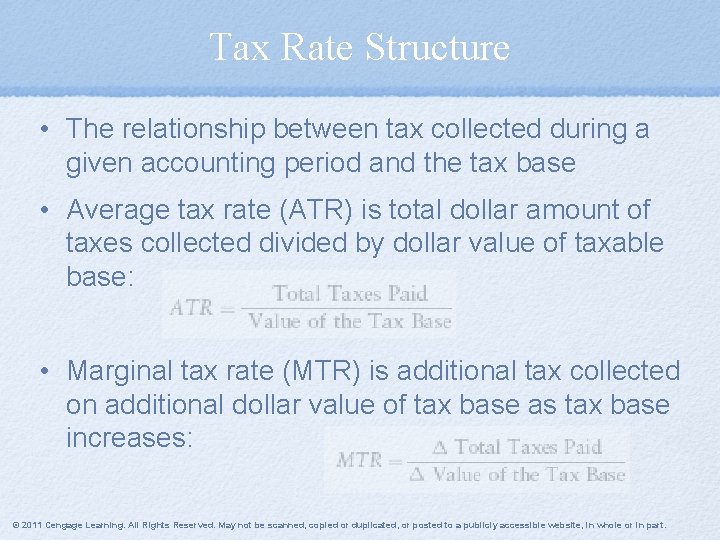
Tax Rate Structure • The relationship between tax collected during a given accounting period and the tax base • Average tax rate (ATR) is total dollar amount of taxes collected divided by dollar value of taxable base: • Marginal tax rate (MTR) is additional tax collected on additional dollar value of tax base as tax base increases: © 2011 Cengage Learning. All Rights Reserved. May not be scanned, copied or duplicated, or posted to a publicly accessible website, in whole or in part.
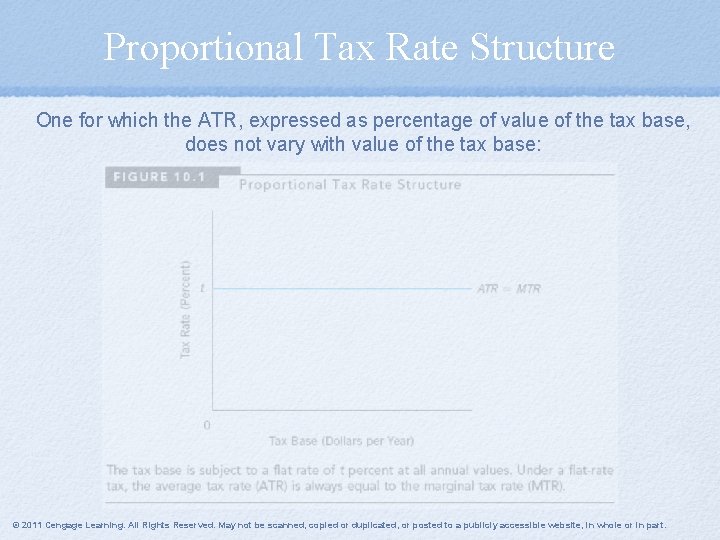
Proportional Tax Rate Structure One for which the ATR, expressed as percentage of value of the tax base, does not vary with value of the tax base: © 2011 Cengage Learning. All Rights Reserved. May not be scanned, copied or duplicated, or posted to a publicly accessible website, in whole or in part.
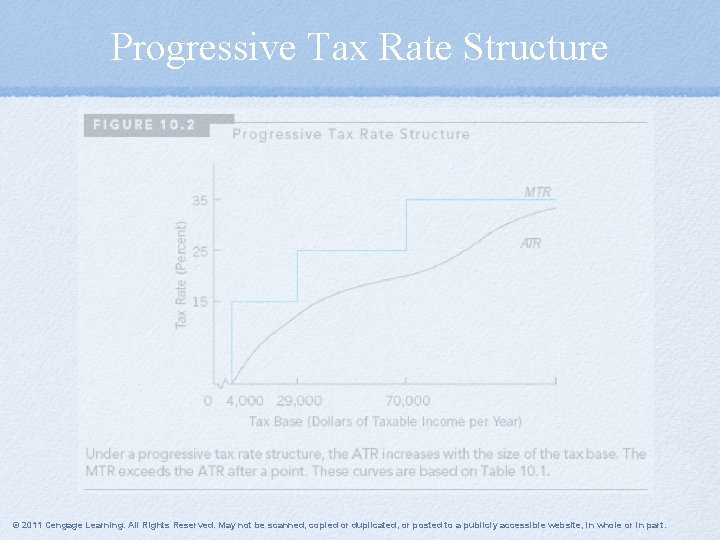
Progressive Tax Rate Structure © 2011 Cengage Learning. All Rights Reserved. May not be scanned, copied or duplicated, or posted to a publicly accessible website, in whole or in part.
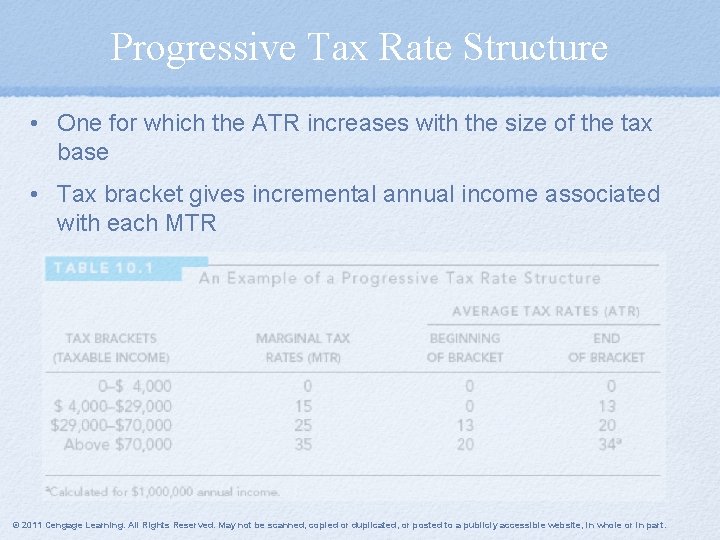
Progressive Tax Rate Structure • One for which the ATR increases with the size of the tax base • Tax bracket gives incremental annual income associated with each MTR © 2011 Cengage Learning. All Rights Reserved. May not be scanned, copied or duplicated, or posted to a publicly accessible website, in whole or in part.
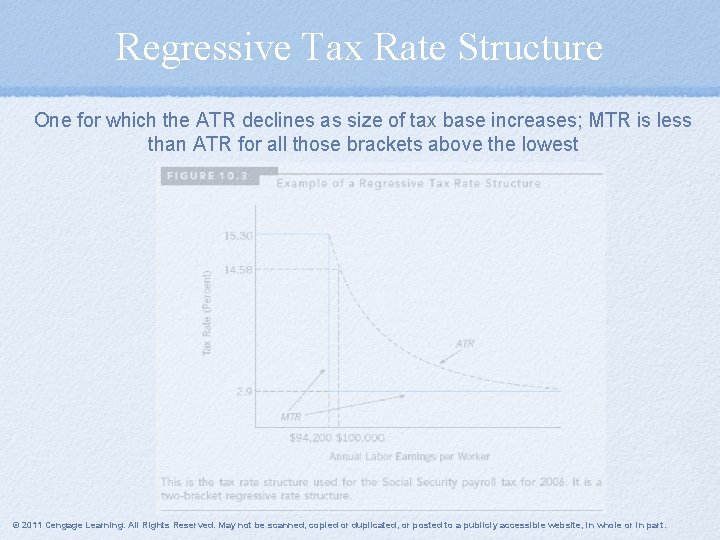
Regressive Tax Rate Structure One for which the ATR declines as size of tax base increases; MTR is less than ATR for all those brackets above the lowest © 2011 Cengage Learning. All Rights Reserved. May not be scanned, copied or duplicated, or posted to a publicly accessible website, in whole or in part.
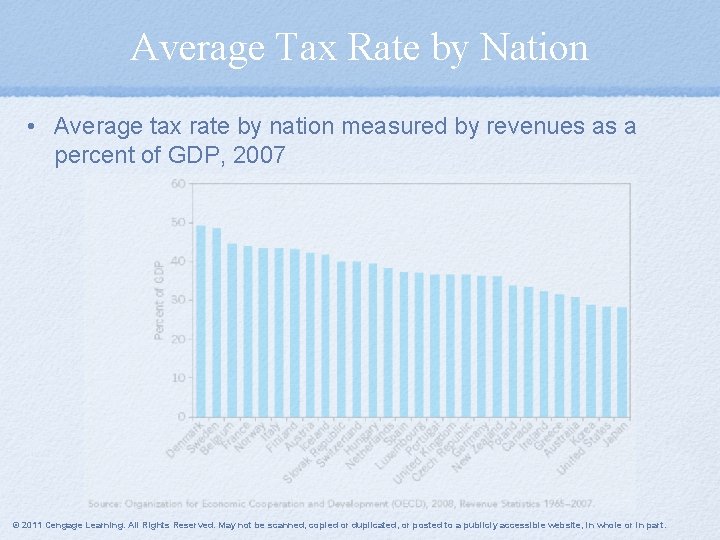
Average Tax Rate by Nation • Average tax rate by nation measured by revenues as a percent of GDP, 2007 © 2011 Cengage Learning. All Rights Reserved. May not be scanned, copied or duplicated, or posted to a publicly accessible website, in whole or in part.
Benefit Principle • Argues that the means of financing government-supplied goods and services should be linked to benefits citizens receive from government - Fees and charges ideal forms of government finance • If successfully implemented, links cost per unit of government-provided services with marginal benefits of those services - Taxing all according to their marginal benefits results in Lindahl equilibrium (if no free riders) • However, collectively consumed benefits difficult to assign to individuals • Sometimes benefits can be correlated with particular economic activity, taxed so that amount paid varies according to benefits received © 2011 Cengage Learning. All Rights Reserved. May not be scanned, copied or duplicated, or posted to a publicly accessible website, in whole or in part.
Ability-to-Pay Principle • Maintains that taxes should be distributed according to capacity of taxpayers to pay them - Citizens with greater ability to earn income taxed more heavily than those with less capacity to earn • Horizontal equity achieved when those of same economic capacity pay same amount of taxes per year • Vertical equity achieved when those of differing economic ability pay annual tax bills that differ according to some collectively chosen notion of fairness • Both concepts of equity subjective, difficult to administer © 2011 Cengage Learning. All Rights Reserved. May not be scanned, copied or duplicated, or posted to a publicly accessible website, in whole or in part.
Evaluating Methods of Government Finance System of government finance makes trade-offs among such criteria as: 1. Equity: should coincide with commonly held notions of fairness and ability to pay 2. Efficiency: should raise revenues with minimal loss in efficiency in private sector 3. Administrative ease: should be relatively easy to administer in consistent manner without excessive costs to collect, enforce, comply with taxes and tax laws © 2011 Cengage Learning. All Rights Reserved. May not be scanned, copied or duplicated, or posted to a publicly accessible website, in whole or in part.
Equity Versus Efficiency • Because main function of government finance is to reallocate resources from private to government use, government must reduce private consumption and investment to accomplish this • Most efficient means of government finance raise level of revenue while minimizing loss in well-being from market production, exchange • Goals of efficiency and equity in distribution of taxes likely to conflict • Trade-off between equitable and efficient system resolved through political interaction • Democratic tax systems often full of exemptions and deductions for particular groups © 2011 Cengage Learning. All Rights Reserved. May not be scanned, copied or duplicated, or posted to a publicly accessible website, in whole or in part.
Tax Compliance and Evasion • Tax evasion – noncompliance with tax laws by failing to pay taxes that are due - The greater the noncompliance, the higher the tax rates necessary to raise revenues - Is illegal • Tax avoidance – a change in behavior to reduce tax liability - High taxes on labor income may induce workers to refuse overtime - Taking advantage of loopholes in tax code can reduce tax liability - Not illegal, but socially wasteful © 2011 Cengage Learning. All Rights Reserved. May not be scanned, copied or duplicated, or posted to a publicly accessible website, in whole or in part.
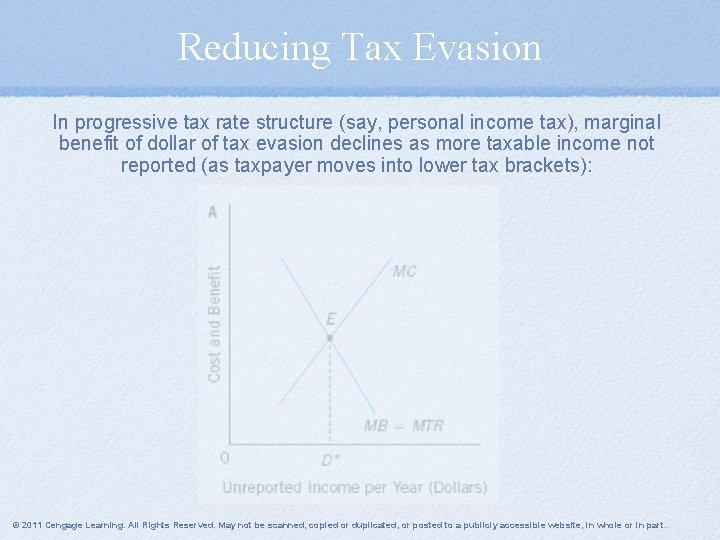
Reducing Tax Evasion In progressive tax rate structure (say, personal income tax), marginal benefit of dollar of tax evasion declines as more taxable income not reported (as taxpayer moves into lower tax brackets): © 2011 Cengage Learning. All Rights Reserved. May not be scanned, copied or duplicated, or posted to a publicly accessible website, in whole or in part.
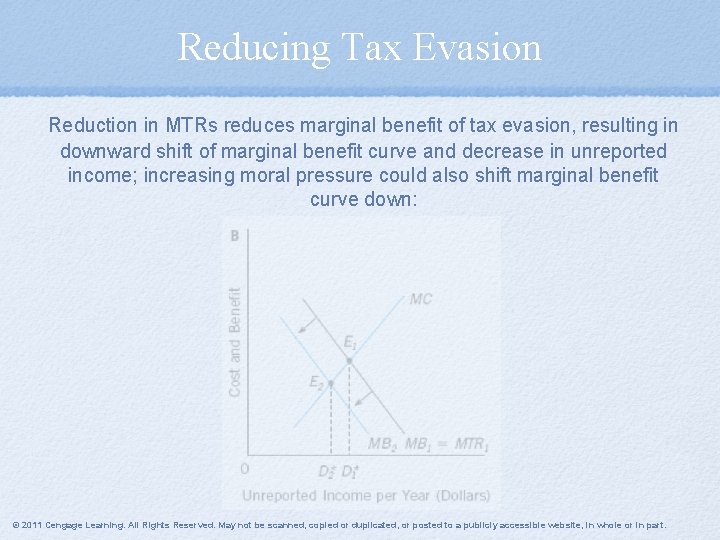
Reducing Tax Evasion Reduction in MTRs reduces marginal benefit of tax evasion, resulting in downward shift of marginal benefit curve and decrease in unreported income; increasing moral pressure could also shift marginal benefit curve down: © 2011 Cengage Learning. All Rights Reserved. May not be scanned, copied or duplicated, or posted to a publicly accessible website, in whole or in part.
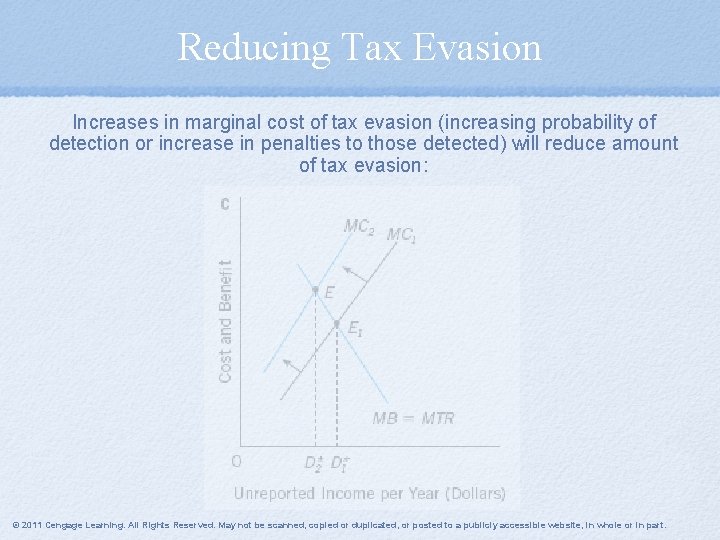
Reducing Tax Evasion Increases in marginal cost of tax evasion (increasing probability of detection or increase in penalties to those detected) will reduce amount of tax evasion: © 2011 Cengage Learning. All Rights Reserved. May not be scanned, copied or duplicated, or posted to a publicly accessible website, in whole or in part.
Debt Finance • Use of borrowed funds to finance government expenditures • Lender receives bond, or some other note, that embodies promise of government to repay loan with interest at some future date - As debt is paid off, some form of alternate finance is necessary • Often used to finance capital expenditures made by government authorities - Allows financing of projects with benefits that will accrue in the future without excessive reduction in current purchasing power © 2011 Cengage Learning. All Rights Reserved. May not be scanned, copied or duplicated, or posted to a publicly accessible website, in whole or in part.
Government-Induced Inflation • Sustained annual increase in prices caused by expansion of the money supply to pay for government-supplied goods and services • Effect of such continual increases in money supply is sustained increases in general level of prices, or inflation • Reduces purchasing power of money held by the public • Can be used only for short periods of time © 2011 Cengage Learning. All Rights Reserved. May not be scanned, copied or duplicated, or posted to a publicly accessible website, in whole or in part.
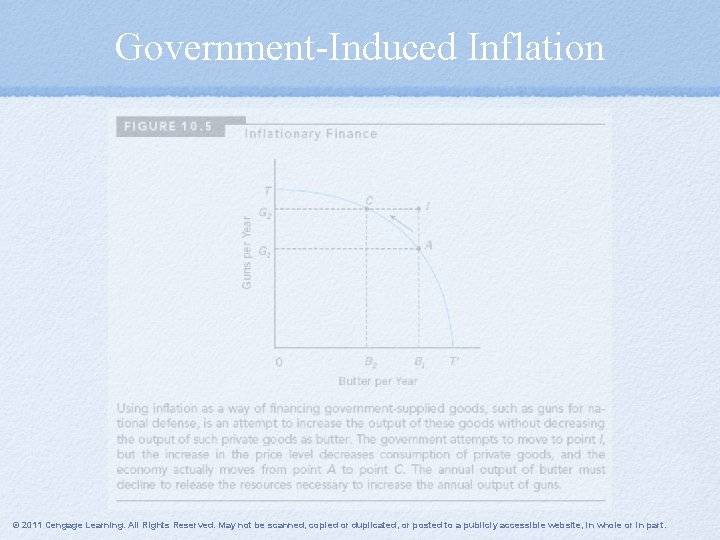
Government-Induced Inflation © 2011 Cengage Learning. All Rights Reserved. May not be scanned, copied or duplicated, or posted to a publicly accessible website, in whole or in part.
Donations • Voluntary contributions to governments from individuals or organizations • Occasionally used to finance particular programs - Aid to victims of natural disasters - Contribution of materials and/or time to a war effort • In communities (where individuals have common tastes or goals), voluntary contributions may be good means of finance; effectiveness diminishes as diversity of preference or population increases © 2011 Cengage Learning. All Rights Reserved. May not be scanned, copied or duplicated, or posted to a publicly accessible website, in whole or in part.
User Charges • Prices determined through political rather than market interaction - Direct prices associated with consumption of particular goods and services - Fees for using certain government facilities or services - Special assessments on private property - Licenses or franchises - Fares or tolls • Earmarked taxes – special taxes designed to finance specific government-supplied services; similar to user charges - Gasoline tax © 2011 Cengage Learning. All Rights Reserved. May not be scanned, copied or duplicated, or posted to a publicly accessible website, in whole or in part.
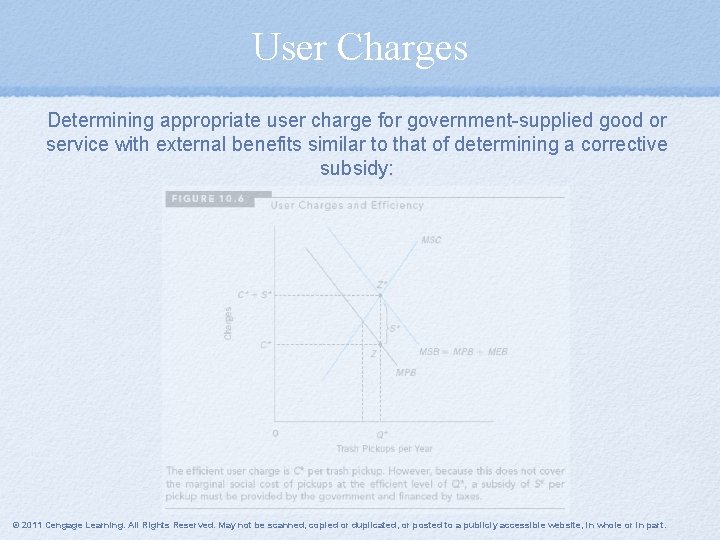
User Charges Determining appropriate user charge for government-supplied good or service with external benefits similar to that of determining a corrective subsidy: © 2011 Cengage Learning. All Rights Reserved. May not be scanned, copied or duplicated, or posted to a publicly accessible website, in whole or in part.
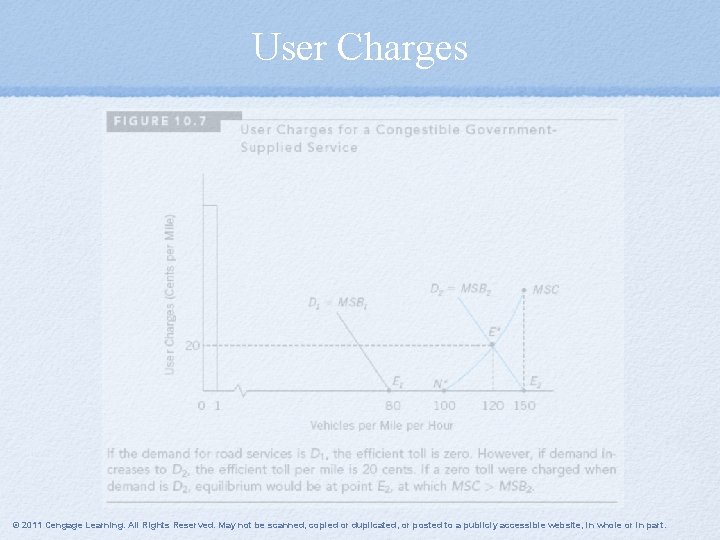
User Charges © 2011 Cengage Learning. All Rights Reserved. May not be scanned, copied or duplicated, or posted to a publicly accessible website, in whole or in part.
Government Enterprise • Governments often sell private goods and services to raise revenues to reduce reliance on taxes: - Gambling services such as state lotteries, betting games - Retail services such as state liquor stores • Normative approach argues that output of public enterprise must be priced at its marginal cost to achieve efficiency © 2011 Cengage Learning. All Rights Reserved. May not be scanned, copied or duplicated, or posted to a publicly accessible website, in whole or in part.
- Slides: 26