
Public English Jan Blommaert Tilburg University of Jyvskyl

Pub(l)ic English Jan Blommaert Tilburg University of Jyväskylä
The question n Linguistic landscapes: a synchronic image n How to add a historical dimension to linguistic landscapes? n Necessary for theoretical understanding of similarities and differences in globalization processes
Points of departure n Globalization: worldwide ‘flows’ – We cannot afford an ‘immobile’ and ‘timeless’ sociolinguistics n Ideological and linguistic aspects of flows – Ideological: English as ‘indexical viagra’ – Linguistic: issues of resources, competence n The public space as a nexus – ‘publication’ of competence – Normative space
Histories of resources n n n English: the language that defines globalization Globalization as uniformization (Mc. Donaldization): synchronic illusion Underlying: very different processes of encounter/learning/acquisition And of distribution: top-down versus bottom-up, elite versus democratic ‘Standard’ English versus ‘nonstandard’ English reflect such differences

n Standard English in Tanzania

n Access to ‘high’ forms of language is restricted, conditioned, controlled n Access to ‘substandard’ forms: informal encounter/learning/acquisition, democratic field Fuck, shit
acquired resources reflect local ecologies of language n Informally – Patterns of distribution of language materials – ‘accents’, influences from other languages – Local functions, ideologies § Ideas about globalization: Hip. Hop, Reggae § Business success, upward social mobility
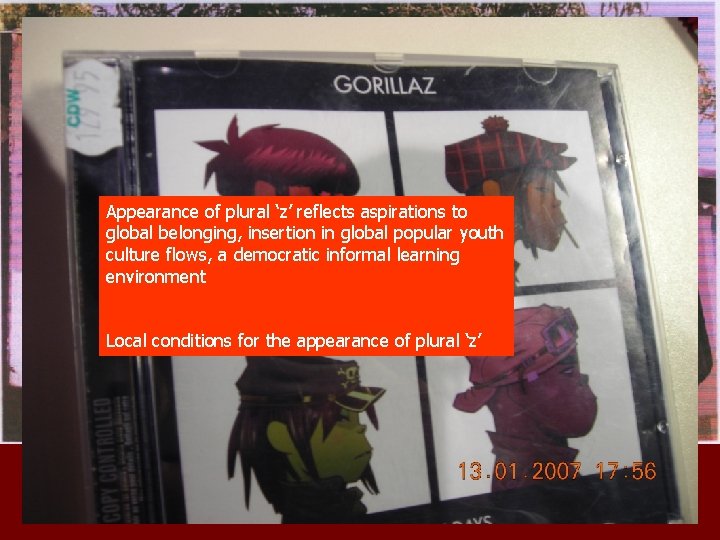
Appearance of plural ‘z’ reflects aspirations to global belonging, insertion in global popular youth culture flows, a democratic informal learning environment Local conditions for the appearance of plural ‘z’
Pub(l)ic English n Acquisition versus encounter n A lot of English in the world is encountered, not acquired n Used as empty linguistic sign system n But as powerful indexical signs n It is not language but an emblem of ideological forces
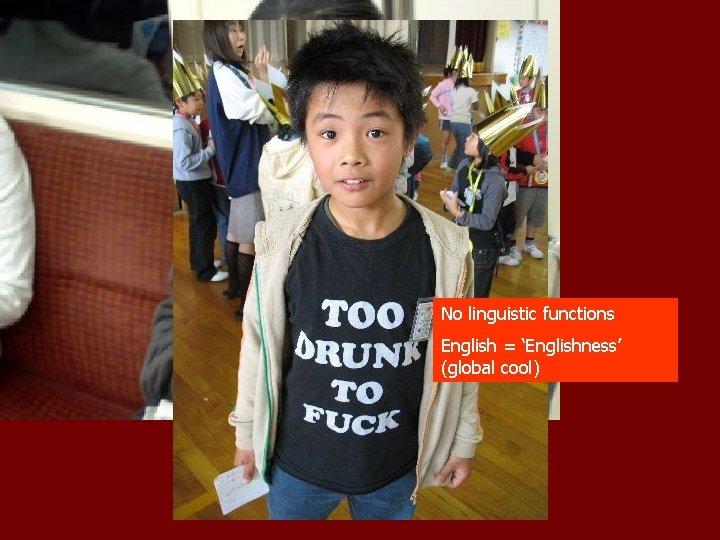
No linguistic functions English = ‘Englishness’ (global cool)
n Encounter acquisition n I. e. can be stretched into partial acquisition based on local possibilities and restrictions n Reflecting not ‘new varieties of English’ n But specific new processes of acquiring English in globalization n Due to availability of English resources

n Globalized English resources (availability) create conditions for new roads to acquisition (accessability) n Drive behind acquisition is ideological: indexical value of English language display n Clashes with problems of linguistic competence: access to ‘good’ English is restricted, ‘errors’ are not perceived as such n Even in hyper-professional contexts

So… n n New forms of occurrence of English reflect local social conditions of accessability These are historical, reflect the local patterns of distribution of language resources across the social system And account for differences and similarities in the globalized world of English The question is not one of new varieties, but one of dynamics between availability and accessability

This raises new questions n. A lot of language is not language but emblematic display n Only becomes language when it shifts place, enters in different local ecology of language
n Globalized public space offers such possibilities for mobility n Increasing issue of normativity: when is English ‘good’ enough to become pub(l)ic? n Possibilities for a new sociolinguistics of globalization
- Slides: 17