
PUBLIC CHOICE AND GOVERNMENT FAILURES 20 10 2015
PUBLIC CHOICE AND GOVERNMENT FAILURES 20. 10. 2015 Miloš Fišar BPV_APEC PUBLIC ECONOMICS
WHAT ARE WE GOING TO TALK ABOUT? § How does decision making in private and public sectors differ? § How to make a good decision in public sector? § Are there any influences? § Or paradoxes? 20. 10. 2015 BPV_APEC PUBLIC ECONOMICS
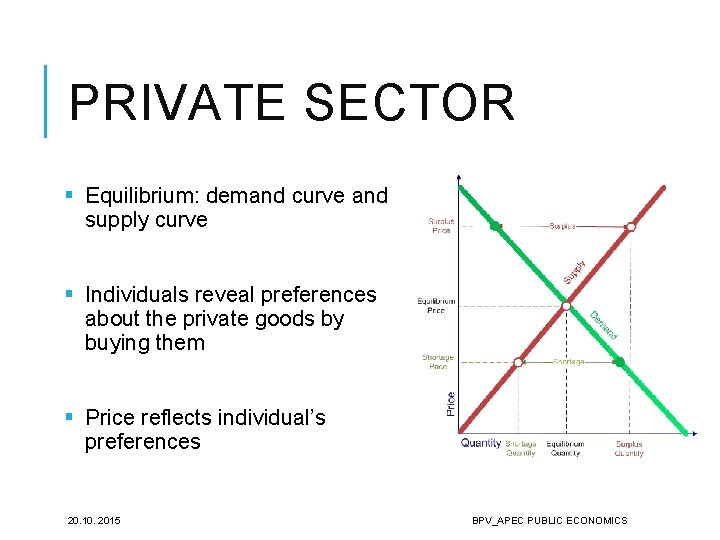
PRIVATE SECTOR § Equilibrium: demand curve and supply curve § Individuals reveal preferences about the private goods by buying them § Price reflects individual’s preferences 20. 10. 2015 BPV_APEC PUBLIC ECONOMICS
PUBLIC SECTOR § No demand x supply equilibrium § Price is not obvious § Decisions made by public agencies, not „customers“ § Individuals vote to elect representatives who vote for public budget § Budget is spent by public agencies § No comparability to private sector 20. 10. 2015 BPV_APEC PUBLIC ECONOMICS
WHAT IS THE PUBLIC CHOICE? § “Public choice can be defined as the economic study of nonmarket decision making“, “Application of economics to political science” (Mueller, 2009) § Covers: § § § theory of the state voting rules voters behavior bureaucracy legislatures etc. 20. 10. 2015 BPV_APEC PUBLIC ECONOMICS
VOTING IN PUBLIC SECTOR § UNANIMITY § Time consuming § Leads to Pareto-preferred situation § Encounters strategic behavior § MAJORITY § § Most used Lower costs Less time to make decision Some individuals will be worse off 20. 10. 2015 BPV_APEC PUBLIC ECONOMICS
MAJORITY RULES: § Simple majority rule (>50%) § Runoff election (1 st round >50% if not best 2 to 2 nd round) § Plurality rule (most “popular” wins) § Approval voting (choose more options; most “popular” wins) § Borda count (n choices, give to each option points {1, 2, …, n}, most popular n, least popular 1; most points wins) § Hare system (select best; in each round the least popular options leaves until there is only one) § Coombs system (select worse; in each round the least popular options leaves until there is only one) 20. 10. 2015 BPV_APEC PUBLIC ECONOMICS
WHAT CAN INFLUENCE THE VOTING? § Personal constrains attitudes § Physical, social, economic, moral, psychological, etc. § External influences § Politics, lobbying, corruption, international relations, legislation, economics, labor unions, etc. § Would you make voting compulsory? 20. 10. 2015 BPV_APEC PUBLIC ECONOMICS
TACTICAL VOTING § Compromising (what happens if the country has firstpast-the-post election systems? ) § Burying - very useful if some party has open primaries § Push-over – Imagine you are a French voter, who likes Sarkozy. Polls for first round say: § Sarkozy 24%, Hollande 18%, Le Pen 17%, lot of other candidates, the Left has a majority. 20. 10. 2015 BPV_APEC PUBLIC ECONOMICS

CONDORCET CRITERION Used to measure efficiency of choices Pair-wise comparison of possible outcomes 20. 10. 2015 BPV_APEC PUBLIC ECONOMICS
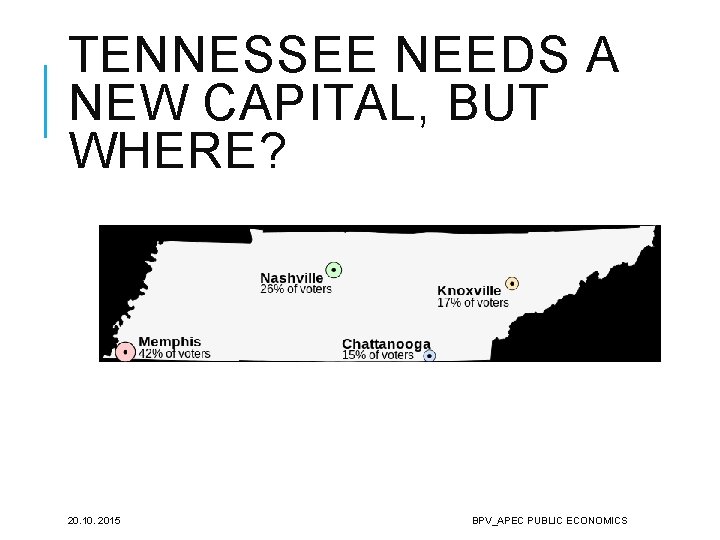
TENNESSEE NEEDS A NEW CAPITAL, BUT WHERE? 20. 10. 2015 BPV_APEC PUBLIC ECONOMICS
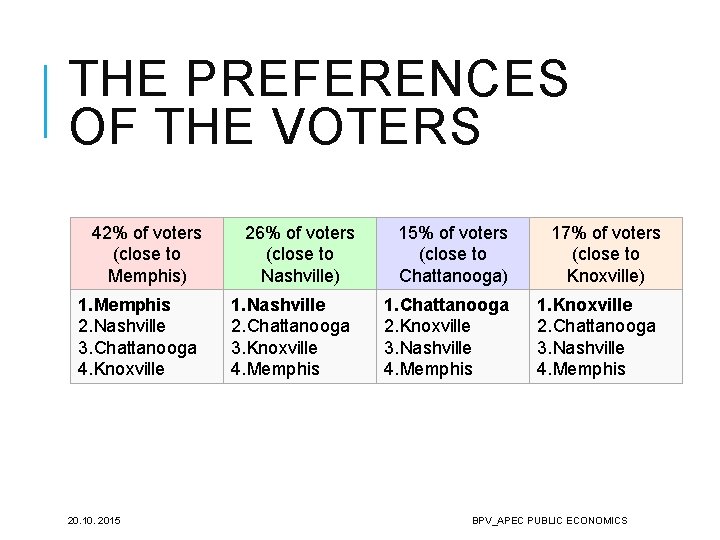
THE PREFERENCES OF THE VOTERS 42% of voters (close to Memphis) 1. Memphis 2. Nashville 3. Chattanooga 4. Knoxville 20. 10. 2015 26% of voters (close to Nashville) 1. Nashville 2. Chattanooga 3. Knoxville 4. Memphis 15% of voters (close to Chattanooga) 1. Chattanooga 2. Knoxville 3. Nashville 4. Memphis 17% of voters (close to Knoxville) 1. Knoxville 2. Chattanooga 3. Nashville 4. Memphis BPV_APEC PUBLIC ECONOMICS
![MATRIX A Memphis [A] 58% [B] 42% Memphis Chattanooga Knoxville [A] 58% [B] 42%](http://slidetodoc.com/presentation_image_h/1cc226450b5f397d555c8363480a4e74/image-13.jpg "MATRIX A Memphis [A] 58% [B] 42% Memphis Chattanooga Knoxville [A] 58% [B] 42%")
MATRIX A Memphis [A] 58% [B] 42% Memphis Chattanooga Knoxville [A] 58% [B] 42% [A] 32% [B] 68% Nashville [A] 42% [B] 58% Chattanooga [A] 42% [B] 58% [A] 68% [B] 32% Knoxville [A] 42% [B] 58% [A] 68% [B] 32% [A] 83% [B] 17% 4 th 1 st 2 nd B Ranking: 20. 10. 2015 Nashville [A] 17% [B] 83% 3 rd BPV_APEC PUBLIC ECONOMICS
ARROW'S IMPOSSIBILITY THEOREM § Voting rule should fulfill: § Universality (all choices are allowed) § Non-dictatorship § Pareto efficiency § Independence of irrelevant alternatives. § But none of the rules does! § In other words: No voting rule is fair. 20. 10. 2015 BPV_APEC PUBLIC ECONOMICS
THE PARADOX OF VOTING § Also called Downs paradox § Individual preferences in a group may lead to ineffective outcome therefore voting becomes § Decision of people to cast a vote is led not only by a human rationality. 20. 10. 2015 BPV_APEC PUBLIC ECONOMICS
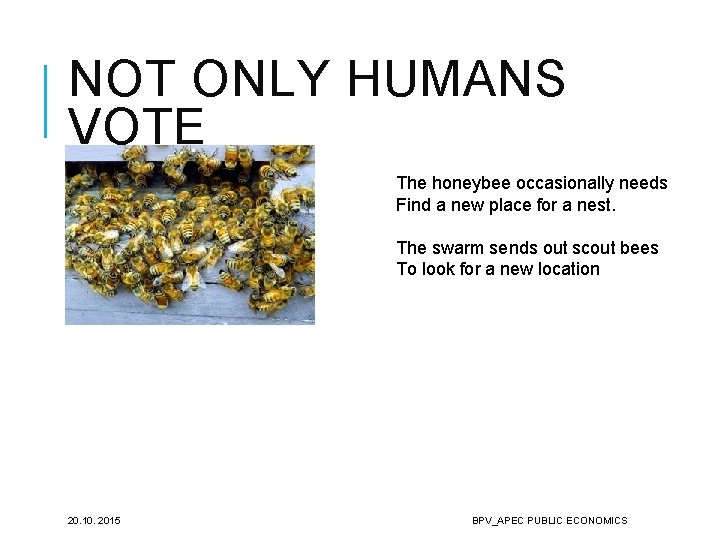
NOT ONLY HUMANS VOTE The honeybee occasionally needs Find a new place for a nest. The swarm sends out scout bees To look for a new location 20. 10. 2015 BPV_APEC PUBLIC ECONOMICS
WHAT METHOD THE BEES USE? § First the researchers thought bees prefered unanimity. § Then they observed that only a quorum is sufficient – 30 bees out of 75 bees at a potential nest site. 20. 10. 2015 BPV_APEC PUBLIC ECONOMICS
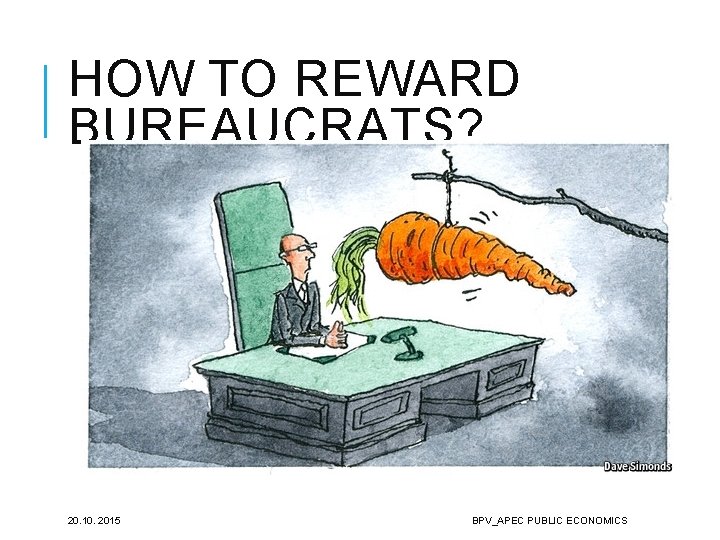
HOW TO REWARD BUREAUCRATS? 20. 10. 2015 BPV_APEC PUBLIC ECONOMICS
§ There are huge differences between countries: § Top pay for elite work § Strict seniority § Project management 20. 10. 2015 BPV_APEC PUBLIC ECONOMICS
CAN WE OR GOVERNEMENT PUNISH BUREACRATS IF SOMETHING GOES §WRONG? Most projects end behind schedule. § Also more expensive and less useful then expected initially. § What exactly would we punish? 20. 10. 2015 BPV_APEC PUBLIC ECONOMICS
WHAT TO DO WHEN A BUEROCRAT FAILS? Jay, Antony, and Jonathan Lynn. "A Question of Loyalty. " Yes, Minister. Prod. Peter Whitmore. BBC. S 02 E 07, 6 Apr. 1981. Television. https: //www. youtube. com/watch? v=JU 68 w. BR 4 pj. Q 20. 10. 2015 BPV_APEC PUBLIC ECONOMICS
- Slides: 21