
Public Administration N 4 Module 1 Introduction to
Public Administration N 4
Module 1 – Introduction to public administration BACKGROUND NOTE: THE SPIRIT OF THE SUBJECT Public administration with all its structures, institutions, rules and processes, are based upon the collective, agreed upon, values of the people in a country. Public administration and other administration systems and structures play a very important role in facilitating processes to develop a country and its people and keep it healthy. www. futuremanagers. com
Module 1 – Introduction to public administration (continued) SHORT HISTORICAL OVERVIEW Politically, South Africa has undergone many changes. From roots going further than 1652, when Jan van Riebeeck entered the country, there is evidence that the San and Khoikhoi were the first inhabitants in South Africa. We have seen many changes over the years leading to the formation of the Constitution in 1996. www. futuremanagers. com
Module 1 – Introduction to public administration (continued) DESCRIPTIONS AND DEFINITIONS • State: an internationally recognised demarcated territory with a self governing permanent population. • Government: a body of people and institutions that make and enforce laws for a particular society. • Administration: the orderly and logical doing of a task. • Public administration: rules and regulations combined to manage a society. www. futuremanagers. com
Module 1 – Introduction to public administration (continued) ROLE PLAYERS • The population; • Interest and pressure groups; • Legislative institutions; and • Cabinet secretariat. www. futuremanagers. com
Module 2 – The development of the family, community and state INTRODUCTION People are the roots of our country and state and families are the roots of our people. Therefore, family and relationships in the communities and the state are very important. www. futuremanagers. com
Module 2 – The development of the family, community and state (continued) THE FAMILY AS STARTING POINT OF PUBLIC ADMINISTRATION The family can be defined as the smallest unit in a community. It is a person’s primary socialising institution for interaction and communication with others. www. futuremanagers. com
Module 2 – The development of the family, community and state (continued) THE COMMUNITY The need to be governed by government institutions arose from communal needs and was not restricted to only a few people or groups. Over time it was informally recognised to choose a person or persons who were natural leaders and give them the task of applying the rules and regulations. This has developed into formal systems, such as governmental institutions. www. futuremanagers. com
Module 2 – The development of the family, community and state (continued) THE STATE As communities developed into a population with a common interest and territory, the need to constitute the community as an independent and sovereign entity arose. We can define the state as: “an organised society occupying a definite territory and possessing an authoritative government independent of external control. ” www. futuremanagers. com
Module 3 – Principles and guidelines for a democratic society INTRODUCTION It is of the utmost importance that government, the administrative officials, the legislatures, judiciary and the citizens of the country, understand the underlying principles of democracy so that the vision of our country can be reached within our own life time. www. futuremanagers. com
Module 3 – Principles and guidelines for a democratic society (continued) THE MEANING OF DEMOCRACY Democracy means that all adult people have a say in how the country is governed. • The government is formed through the vote of the people. • We can choose the person or party that we think is best to govern. • We have the freedom of free thinking. • Freedom of speech and association in guaranteed. www. futuremanagers. com
Module 3 – Principles and guidelines for a democratic society (continued) DEMOCRATIC PRINCIPLES: GUARANTEEING OF BASIC RIGHTS AND FREEDOM The Constitution describes the basic rights and freedoms that people have in South Africa. This includes, but is not limited to: • The right to life; • The right to privacy • The freedom of expression; • The right to make free political choices. www. futuremanagers. com
Module 3 – Principles and guidelines for a democratic society (continued) DEMOCRATIC PRINCIPLE: RULE OF LAW Rule of law means that the law is the uppermost and highest authority. This is based on three factors: • The executive functions of government must not be allowed to use their powers of discretion widely and without restriction; • All citizens are considered to be equal and should be treated equally; and • The courts must operate independently/separately from the legislature and the executive. www. futuremanagers. com
Module 3 – Principles and guidelines for a democratic society (continued) DEMOCRATIC PRINCIPLE: DISTRIBUTION OF GOVERNMENT POWER Power is distributed in government according to the “tri-partite” principle. In the South Africa this is done by separating the legislative, the executive and the judicial authorities. www. futuremanagers. com
Module 3 – Principles and guidelines for a democratic society (continued) DEMOCRATIC PRINCIPLE: GOVERNMENT BY THE PEOPLE FOR THE PEOPLE This principle refers to free and fair general elections in which all persons can take part without being forced to choose for any specific party. www. futuremanagers. com
Module 3 – Principles and guidelines for a democratic society (continued) DEMOCRATIC PRINCIPLE: ORDER AND WELFARE FUNCTIONS In order to provide welfare for the people, the state must abide by: • The protective responsibility; • The responsibility to enhance and enrich; and • The responsibility of assistance. www. futuremanagers. com
Module 4 – Citizenship and the right to vote INTRODUCTION There are general principles that apply to citizenship and the right to vote. www. futuremanagers. com
Module 4 – Citizenship and the right to vote (continued) CITIZENSHIP A citizen is a person who qualifies according to the South African Citizenship Act of 1995. Citizens have privileges and benefits and are subject to duties and responsibilities. People who are born in a country are citizens of the country. www. futuremanagers. com
Module 4 – Citizenship and the right to vote (continued) ELECTIONS According to the Constitution, Parliamentary elections must be held once every five years. These are important as they give the citizens the opportunity to vote for the leaders of the country. www. futuremanagers. com
Module 5 – The hierarchy of authorities INTRODUCTION The current constitutional dispensation of South Africa is the product of an inclusive conflict resolution process, based upon joint negotiations between all the interested parties who supports reconciliation and peaceful transition. The interim constitution makes provision for the establishment of a Government of National Unity for South Africa, during the formal transformation process. www. futuremanagers. com
Module 5 – The hierarchy of authorities (continued) WHAT IS AN INTERIM GOVERNMENT? The interim government was required owing to the need for a new order in South Africa based on equality and fundamental rights and freedoms. The continuing governance process while the final constitution is being drafted by an elected Constitutional Assembly, is known as the interim government. www. futuremanagers. com
Module 5 – The hierarchy of authorities (continued) CONSTITUTION OF SOUTH AFRICA (ACT 108 OF 1996) A constitution will describe the major institutions of state and lay down their respective powers and mutual relationships in order to ensure the protection of human rights by a process of inclusive democratic decision-making. www. futuremanagers. com
Module 5 – The hierarchy of authorities (continued) HIERARCHY OF AUTHORITIES ON THE DIFFERENT LEVELS OF GOVERNMENT At each level of government, there is a hierarchal standard. These levels of government are the: • Central government; • Traditional authorities; • Provincial government; • Volkstaat council; and • Local government; • Permanent forum www. futuremanagers. com
Module 6 – Legislative authority INTRODUCTION Parliament is the highest legislative authority in the land, but it is still subject to the Supreme Constitution. Within Parliament, it is necessary to distribute power so that power cannot be abused. Government has three types of power: • Legislative power; • Executive power; and • Judiciary power. www. futuremanagers. com
Module 6 – Legislative authority (continued) MEANING OF LEGISLATIVE POWER The legislative authority has the main responsibility to make laws for ordering the community life in such a manner that all citizens can live peacefully and under physical and social well-being www. futuremanagers. com
Module 6 – Legislative authority (continued) ROLE OF PARLIAMENT AS LEGISLATIVE AUTHORITY AT CENTRAL LEVEL Parliament plays a very important role in the lives of every citizen of South Africa. It is the place where laws are passed and where important aspects to every South African’s life are discussed and decisions made about. It is the place where all citizens can have their views discussed and where they may even put forward their point of view themselves. www. futuremanagers. com
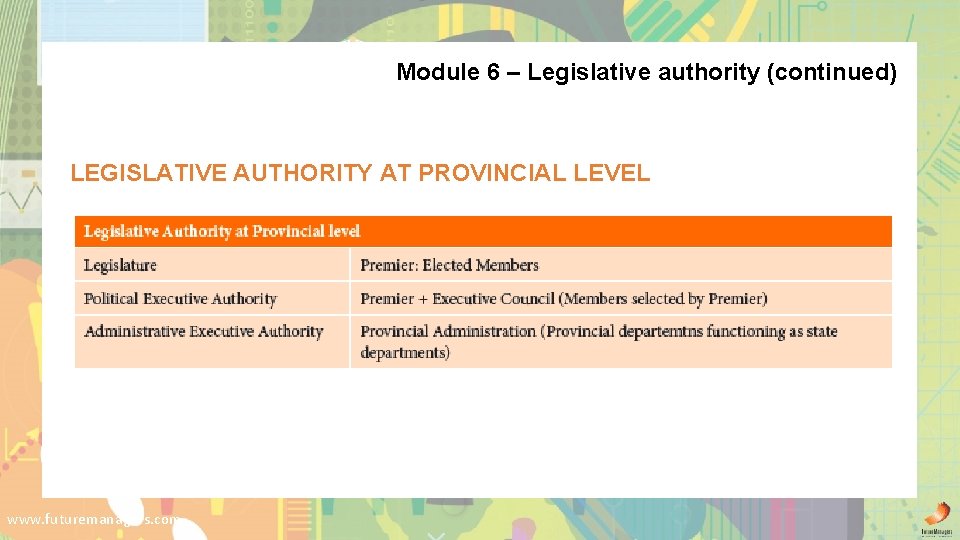
Module 6 – Legislative authority (continued) LEGISLATIVE AUTHORITY AT PROVINCIAL LEVEL www. futuremanagers. com
Module 6 – Legislative authority (continued) LEGISLATIVE AUTHORITY AT LOCAL LEVEL The legislative authority at local government level has the responsibility to ensure that civil society is empowered by law to take part in government decisions, enhance partnerships with other forms of government on central and provincial level and to provide the necessary services to the whole community. www. futuremanagers. com
Module 7 – Executive authority of the three levels of government INTRODUCTION The executive functionaries and institutions can be divided into two groups, namely the political executive institutions and the administrative executive institutions. www. futuremanagers. com
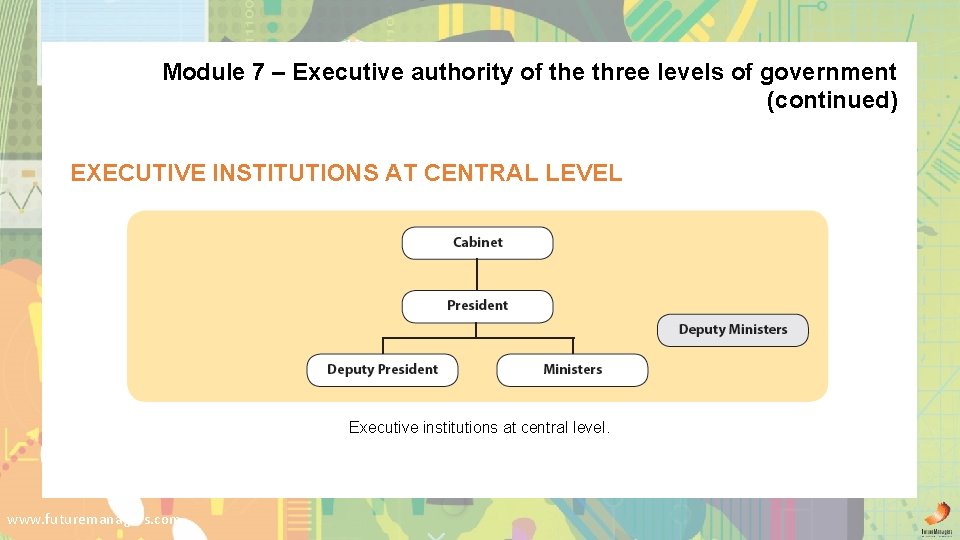
Module 7 – Executive authority of the three levels of government (continued) EXECUTIVE INSTITUTIONS AT CENTRAL LEVEL Executive institutions at central level. www. futuremanagers. com
Module 7 – Executive authority of the three levels of government (continued) EXECUTIVE AUTHORITY AT PROVINCIAL LEVEL The executive power of a province is vested in the Premier and members of the Executive Council. The powers and functions of the executive council include: • Assigning power to a municipality; • Determining policies for management of various provincial departments; • Intervening when a municipal council does not follow regulations; and • Administering and managing provincial departments. www. futuremanagers. com
Module 7 – Executive authority of the three levels of government (continued) EXECUTIVE AUTHORITY AT LOCAL GOVERNMENT LEVEL The Local Government Municipal Structures includes but is not limited to the following functions and powers of the Executive Committee: • Identify the needs of the municipality; • Review and evaluate those needs in order of priority; • Recommend to the municipal council strategies, programmes and services to address priority needs through the integrated development plan. www. futuremanagers. com
Module 8 – Judicial authority INTRODUCTION The Department of Justice aim to provide: • Development of common law in the interest of justice; • A service-orientated system of courts and other systems; • Safety, security and freedom from crime; • Fair and equal justice for all and consideration of people’s needs; • Well-trained and accessible staff; and • Efficient provision of legal and legislative services to Parliament. www. futuremanagers. com
Module 8 – Judicial authority (continued) JUDICIAL AUTHORITY According to the Constitution, the courts exercise the judicial authority of RSA on national level. This means that the courts have the authority to settle disputes by applying the law throughout SA. www. futuremanagers. com
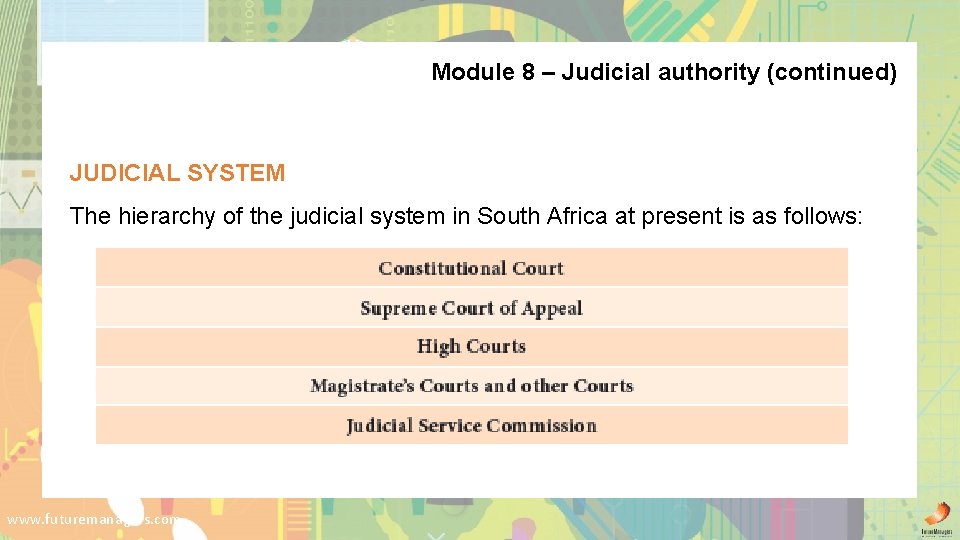
Module 8 – Judicial authority (continued) JUDICIAL SYSTEM The hierarchy of the judicial system in South Africa at present is as follows: www. futuremanagers. com
Module 8 – Judicial authority (continued) CONSTITUTIONAL COURT There are certain issues which only the Constitutional Court may take decisions about. These include, but are not limited to: • Whether a bill before Parliament or a provincial legislature is constitutional; • Whether a law of Parliament or a provincial law is constitutional; • If amendments to the Constitution are constitutional; and • If the working of Parliament is constitutional. www. futuremanagers. com
Module 8 – Judicial authority (continued) SUPREME COURT OF APPEAL The Supreme Court of Appeal is the highest court of appeal in all issues except constitutional issues. www. futuremanagers. com
Module 8 – Judicial authority (continued) HIGH COURT High Courts may decide any constitutional matter except something that the Constitutional Court alone has the right to decide. www. futuremanagers. com
Module 8 – Judicial authority (continued) PROVINCIAL DIVISIONS There are currently 14 provincial divisions found in: Bhisho, Bloemfontein, Cape Town, Durban, Grahamstown, Johannesburg, Kimberley, Pietermaritzburg, Port Elizabeth, Pretoria, Thohoyandou, Mthatha, and Mmabatho. www. futuremanagers. com
Module 8 – Judicial authority (continued) LOCAL DIVISIONS There are three local divisions: • Witwatersrand with its seat in Johannesburg; • Durban and Coast Local Division with its seat in Durban; and • South-Eastern Cape Division with its seat in Port Elizabeth. www. futuremanagers. com
Module 8 – Judicial authority (continued) CIRCUIT COURT Circuit Courts are also part of the High Court. They sit at least twice a year, moving around to serve more rural areas. www. futuremanagers. com
Module 8 – Judicial authority (continued) LAND CLAIMS COURT The Land Claims Court only hears matters for the restitution of land rights that people lost after 1913 as a result of racially discriminatory land laws. www. futuremanagers. com
Module 8 – Judicial authority (continued) LABOUR COURT The Labour Court only decides on matters relating to labour disputes and appeals are made to the Labour Appeal Court. www. futuremanagers. com
Module 8 – Judicial authority (continued) SPECIAL SUPERIOR COURT When the Director of Prosecutions decides to bring a person to trail on a charge relating to the security of the State or maintenance of public order and the Minister of Justice or Public Order feels that justice will only be served in a special court, the President of the country will constitute this court for this specific case. www. futuremanagers. com
Module 8 – Judicial authority (continued) OTHER COURTS • Regional courts; • Family courts project; • Magistrate’s courts; • Sexual offenses courts; and • Municipal courts; • Traditional courts; • Courts for tax offenders; • Small claims courts; www. futuremanagers. com
Module 8 – Judicial authority (continued) JUDICIAL SERVICE COMMISSION The Judicial Service Commission has the following tasks : • Assists the President with decisions on appointing and dismissal of judges; and • Advises the national government on matters about the courts and the administration of justice. www. futuremanagers. com
Module 9 – Executive public institutions INTRODUCTION The Constitution provides for a number of institutions to strengthen the constitutional democracy in South Africa. These institutions are independent and subject only to the Constitution and the law. www. futuremanagers. com
Module 9 – Executive public institutions (continued) STATE DEPARTMENTS State departments are given the responsibility to provide the physical, social and administrative services, also known as public services. The mission is to meet the multi-disciplinary needs of the citizens. www. futuremanagers. com
Module 9 – Executive public institutions (continued) CO-OPERATIVE GOVERNANCE The Constitution recognises that the many state departments and parastatals need to work together. This should happen by an Act of Parliament. The department responsible for developing this legislation is the Department of Provincial and Local Government. www. futuremanagers. com
Module 10 – Generic and management functions CLASSIFICATION OF ACTIVITIES IN PUBLIC INSTITUTIONS The activities of public institutions can be classified into four groups: • Generic administrative and managerial functions; • Auxiliary functions; • Instrumental functions; and • Functional or line functions. www. futuremanagers. com
Module 11 – Budgetary control INTRODUCTION The budget is usually divided into three very important parts: • The acquisition of public funds; • The spending of public funds; and • The control over public funds. www. futuremanagers. com
Module 11 – Budgetary control (continued) FINANCIAL ADMINISTRATION The National Treasury is responsible for the financial administration of the country. Its tasks are: • To carry out the overall economic and financial policy of the government; • Control state finances and financial institutions ; • Draw up income and expenditure budges; • Deal with state tenders; and • Decide on taxation structure. www. futuremanagers. com
Module 11 – Budgetary control (continued) CONTROL Control is taken to ensure that public money is properly accounted for, every person who works /deals with public money is an accounting officer and may be asked to report how the public money was spent in their area. www. futuremanagers. com
Module 11 – Budgetary control (continued) GOVERNMENT RELATIONS AND POWER The main activity of any individual or group with political purpose in a country is to achieve power. The political party in power is accountable to people that voted them into power, and has to look after the welfare of the entire society that it is in power of. www. futuremanagers. com
Module 11 – Budgetary control (continued) GOVERNMENT RELATIONS AND CONFLICT Conflict is necessary for growth and development of new things. Methods of communication must be created for different people to talk to one another so that conflict can be managed and so that positive results will be the result of the talking. The government must and do put channels of communication in place. www. futuremanagers. com
Module 12 – South African symbols INTRODUCTION The symbols used in public administration give our lives more meaning and bind us on this road of democracy. www. futuremanagers. com
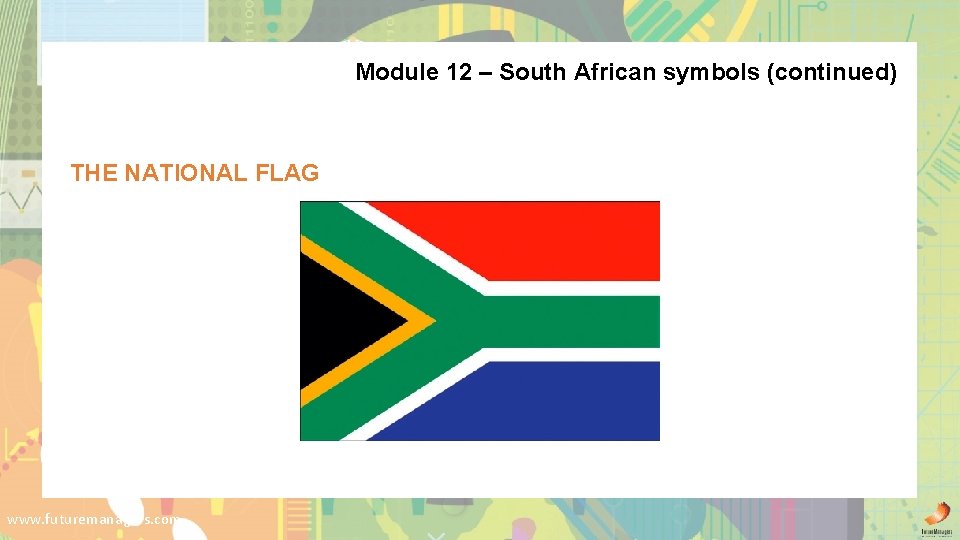
Module 12 – South African symbols (continued) THE NATIONAL FLAG www. futuremanagers. com
Module 12 – South African symbols (continued) THE NATIONAL ANTHEM The official version of the national anthem is a combination of: • Nkosi sikelel’ i. Afrika; • Die Stem; and • The Call of South Africa. www. futuremanagers. com
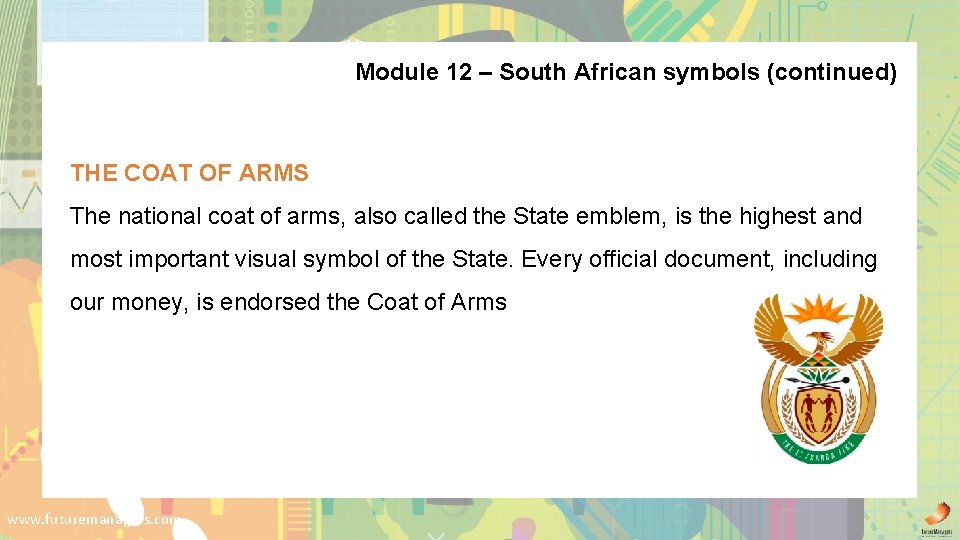
Module 12 – South African symbols (continued) THE COAT OF ARMS The national coat of arms, also called the State emblem, is the highest and most important visual symbol of the State. Every official document, including our money, is endorsed the Coat of Arms www. futuremanagers. com
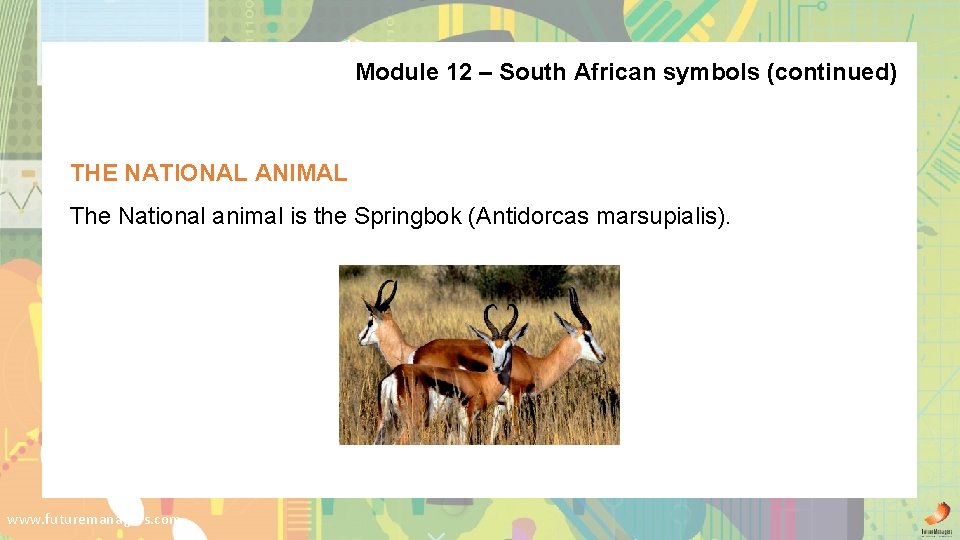
Module 12 – South African symbols (continued) THE NATIONAL ANIMAL The National animal is the Springbok (Antidorcas marsupialis). www. futuremanagers. com
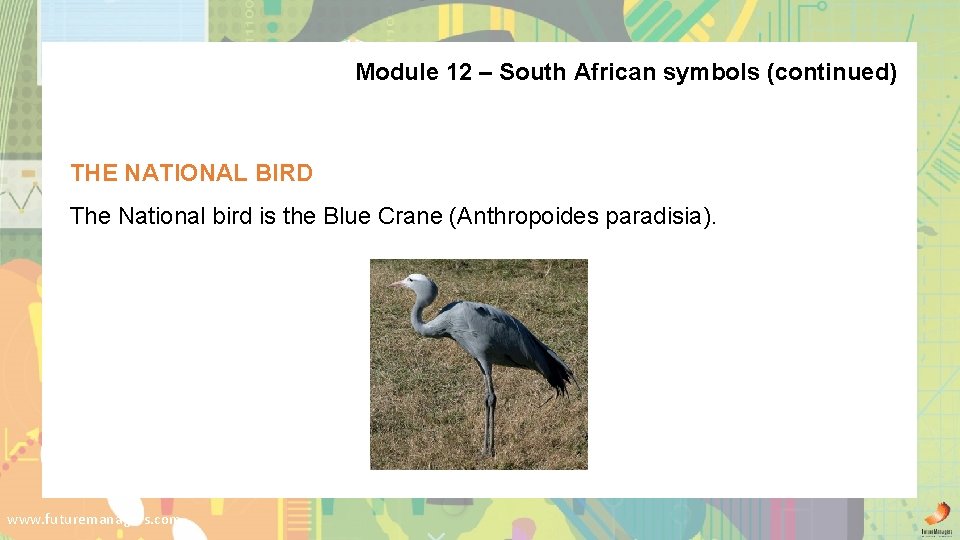
Module 12 – South African symbols (continued) THE NATIONAL BIRD The National bird is the Blue Crane (Anthropoides paradisia). www. futuremanagers. com
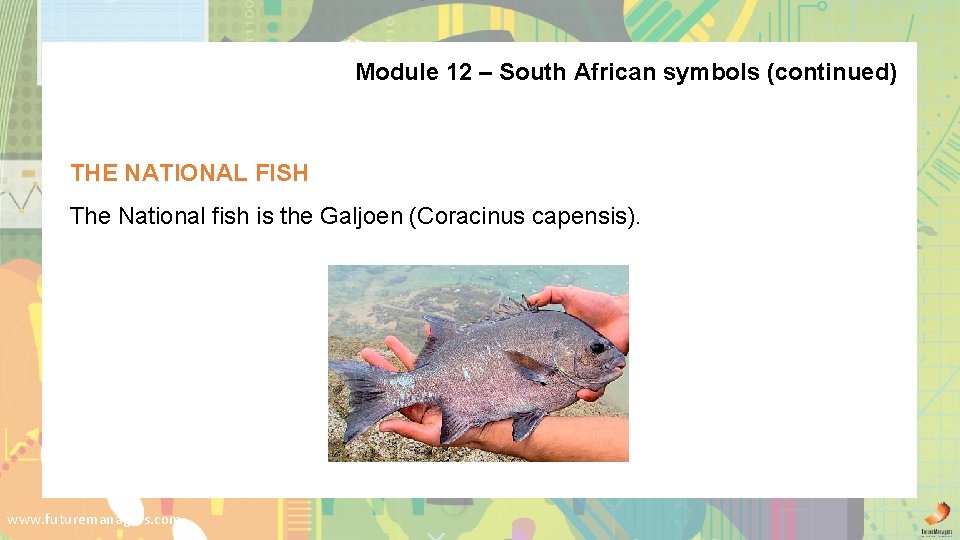
Module 12 – South African symbols (continued) THE NATIONAL FISH The National fish is the Galjoen (Coracinus capensis). www. futuremanagers. com
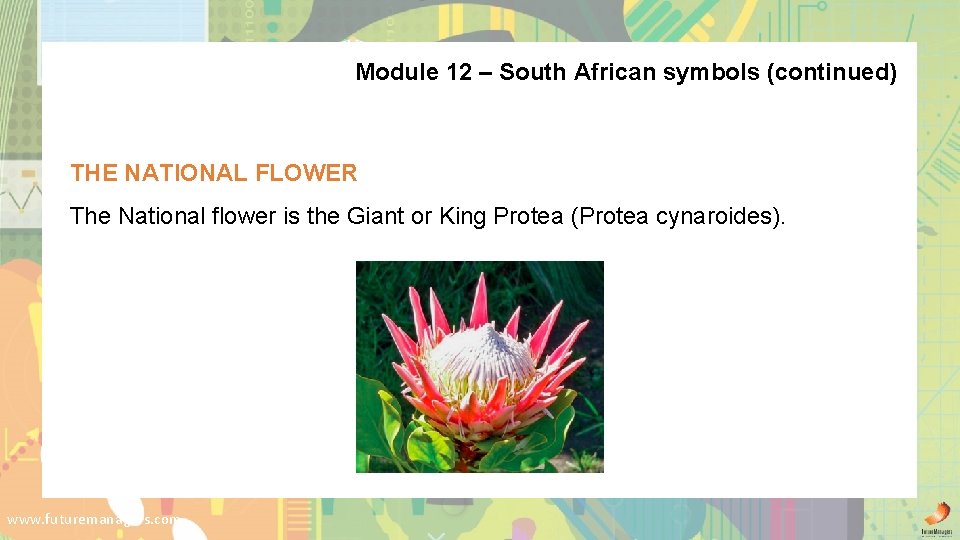
Module 12 – South African symbols (continued) THE NATIONAL FLOWER The National flower is the Giant or King Protea (Protea cynaroides). www. futuremanagers. com
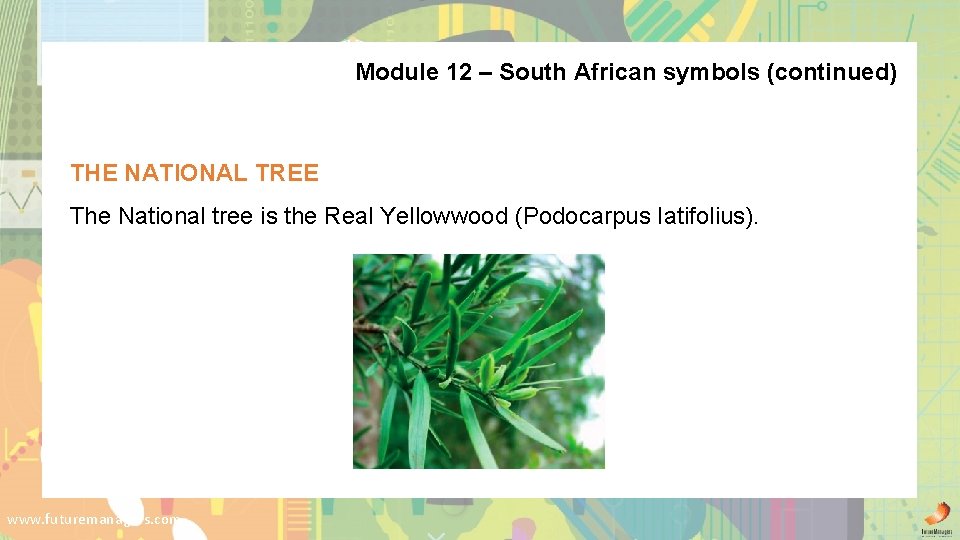
Module 12 – South African symbols (continued) THE NATIONAL TREE The National tree is the Real Yellowwood (Podocarpus Iatifolius). www. futuremanagers. com
Module 12 – South African symbols (continued) SYMBOLS IN PARLIAMENT Our democratic Parliament has inherited a set of ceremonial symbols, namely: • Sergeant-at-arms and usher; • Mace; and • The black rode. www. futuremanagers. com
Module 12 – South African symbols (continued) OFFICIAL LANGUAGES The official languages are: • Xitsonga; • Sepedi; • Afrikaans; • Sesotho; • English; • Setswana; • Isi. Ndebele; • Si. Swati; • Isi. Xhosa; and • Tshivenda; • isi. Zulu. www. futuremanagers. com
- Slides: 66