
Public Access to Priority Investment Approach PIA Data
Public Access to Priority Investment Approach (PIA) Data 2018
How might this be relevant to your grant application for the TTL Fund? How might this be relevant? • provide evidence that the people targeted by your project are at The assessment criteria outlined in the Try Test and Learn Fund grant opportunity guidelines encourages you to provide ‘evidence’ risk of long-term welfare dependence (e. g. evidence may include Priority Investment Approach data, research, government reports, empirical evidence, etc. ); • provide evidence of the need for your project among those it would support (e. g. evidence may include Priority Investment Approach data, research, government reports, empirical evidence, etc. ) Access to Priority Investment Approach (PIA) Data 2
The Australian Priority Investment Approach to Welfare (PIA) policy initiative was established as part of the 2015 -16 Budget What is it? • The Priority Investment Approach, or PIA, uses data analysis to identify groups at risk of long-term welfare dependence and uses insights from the data to find innovative ways to help more Australians live independently, reducing their need for welfare. • The PIA data includes administrative data collected for the purpose of recording eligibility for benefits, service delivery activities and payments. The Australian Priority Investment Approach to Welfare (PIA) policy initiative Access to Priority Investment Approach (PIA) Data 3
The PIA data includes 14 years of information about payment recipients over 56 quarterly snapshots What is in it? • The data is a series of quarterly snapshots taken from the July -September 2001 quarter to the April-June 2015 quarter. • The data contains information about those people who have received one of 21 benefits including Aged Pension, Disability Support Pension, Newstart Allowance and Carer Payment. • The de-identified information includes demographic and geographical information, as well as information relating to accommodation, primary medical conditions, education and income. • Demographic variables of the partner are also available for some of the recipients. The PIA data includes 14 years of information about payment recipients over 56 quarterly snapshots Access to Priority Investment Approach (PIA) Data 4
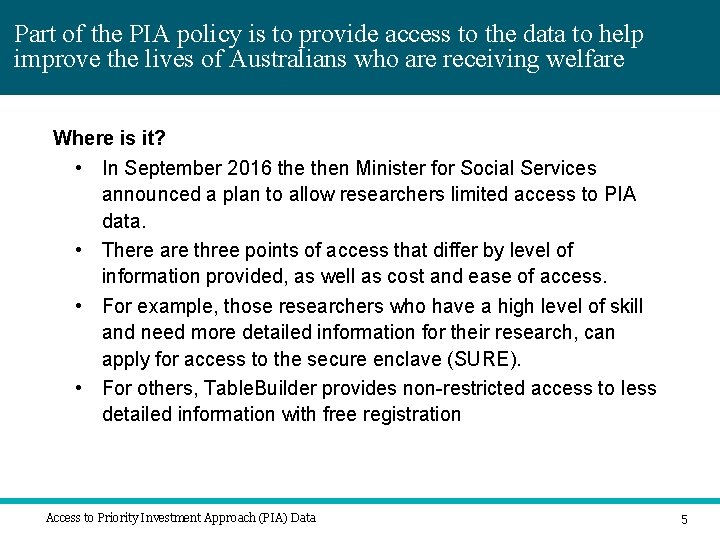
Part of the PIA policy is to provide access to the data to help improve the lives of Australians who are receiving welfare Where is it? • In September 2016 then Minister for Social Services announced a plan to allow researchers limited access to PIA data. • There are three points of access that differ by level of information provided, as well as cost and ease of access. • For example, those researchers who have a high level of skill and need more detailed information for their research, can apply for access to the secure enclave (SURE). • For others, Table. Builder provides non-restricted access to less detailed information with free registration Part of the PIA policy is to provide access to the data Access to Priority Investment Approach (PIA) Data 5
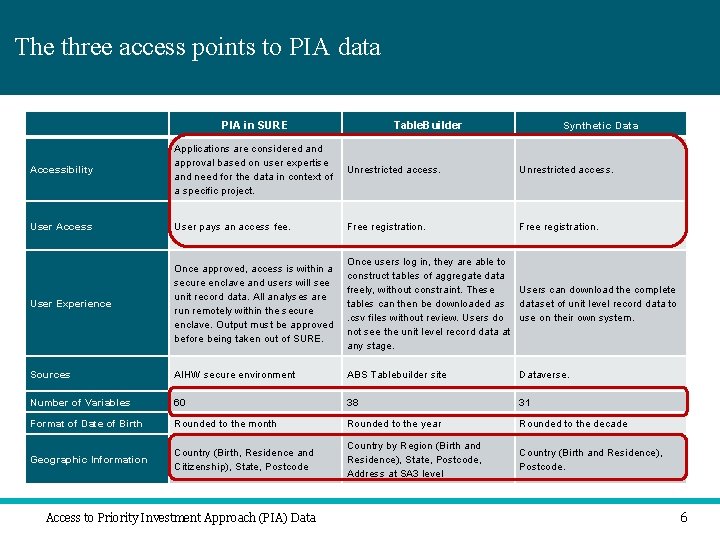
The three access points to PIA data PIA in SURE Table. Builder The three access points to PIA data Synthetic Data Accessibility Applications are considered and approval based on user expertise and need for the data in context of a specific project. Unrestricted access. User Access User pays an access fee. Free registration. User Experience Once approved, access is within a secure enclave and users will see unit record data. All analyses are run remotely within the secure enclave. Output must be approved before being taken out of SURE. Once users log in, they are able to construct tables of aggregate data freely, without constraint. These Users can download the complete tables can then be downloaded as dataset of unit level record data to. csv files without review. Users do use on their own system. not see the unit level record data at any stage. Sources AIHW secure environment ABS Tablebuilder site Dataverse. Number of Variables 60 38 31 Format of Date of Birth Rounded to the month Rounded to the year Rounded to the decade Geographic Information Country (Birth, Residence and Citizenship), State, Postcode Country by Region (Birth and Residence), State, Postcode, Address at SA 3 level Country (Birth and Residence), Postcode. Access to Priority Investment Approach (PIA) Data 6
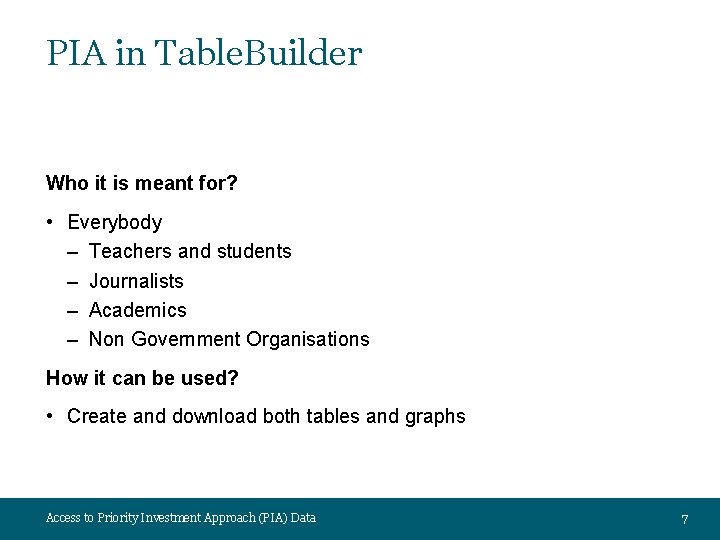
PIA in Table. Builder Who it is meant for? • Everybody – Teachers and students – Journalists – Academics – Non Government Organisations How it can be used? • Create and download both tables and graphs Access to Priority Investment Approach (PIA) Data 7
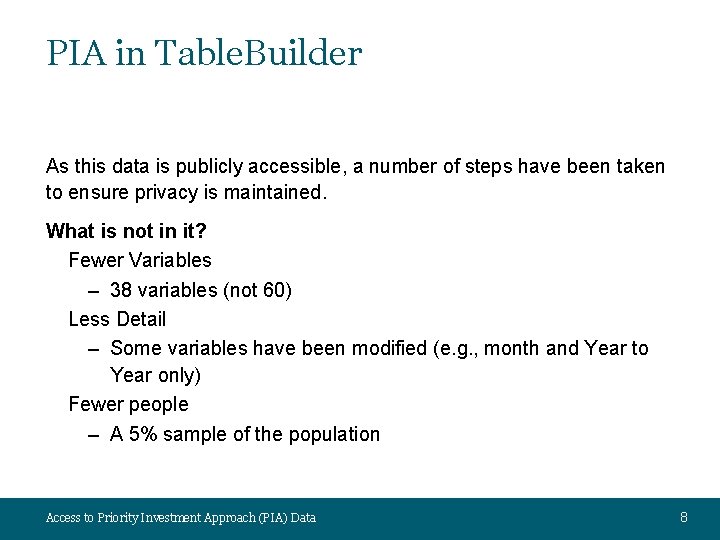
PIA in Table. Builder As this data is publicly accessible, a number of steps have been taken to ensure privacy is maintained. What is not in it? Fewer Variables – 38 variables (not 60) Less Detail – Some variables have been modified (e. g. , month and Year to Year only) Fewer people – A 5% sample of the population Access to Priority Investment Approach (PIA) Data 8
Why you might be interested in using Table. Builder to access the PIA data • Table. Builder is good for a wide range of data analysis expertise; from beginner to advanced • Table. Builder allows for population estimates Access to Priority Investment Approach (PIA) Data 9
What can you do with Table. Builder? • Get population estimates (numbers) • Create graphs to display your comparisons • Save and/or download tables and graphs for later use Access to Priority Investment Approach (PIA) Data 10
Some examples using Table. Builder Access to Priority Investment Approach (PIA) Data 11
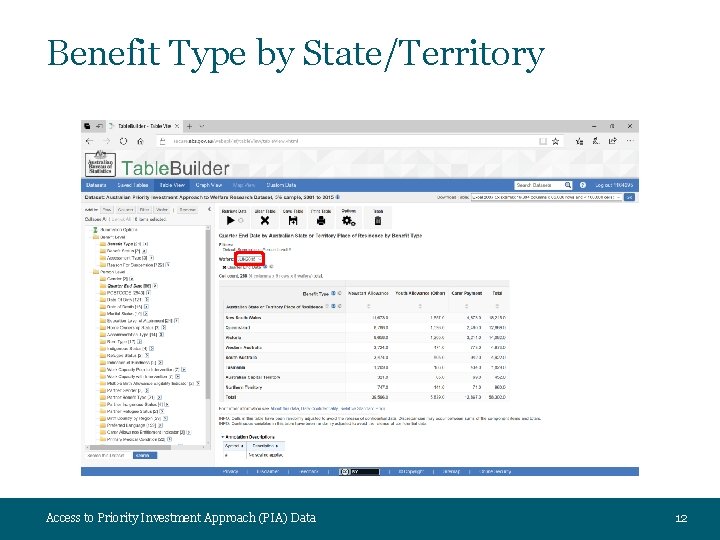
Benefit Type by State/Territory Access to Priority Investment Approach (PIA) Data 12
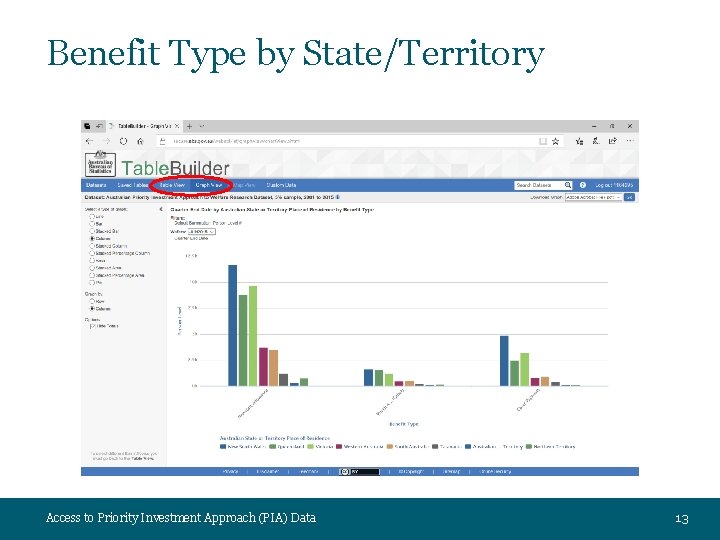
Benefit Type by State/Territory Access to Priority Investment Approach (PIA) Data 13
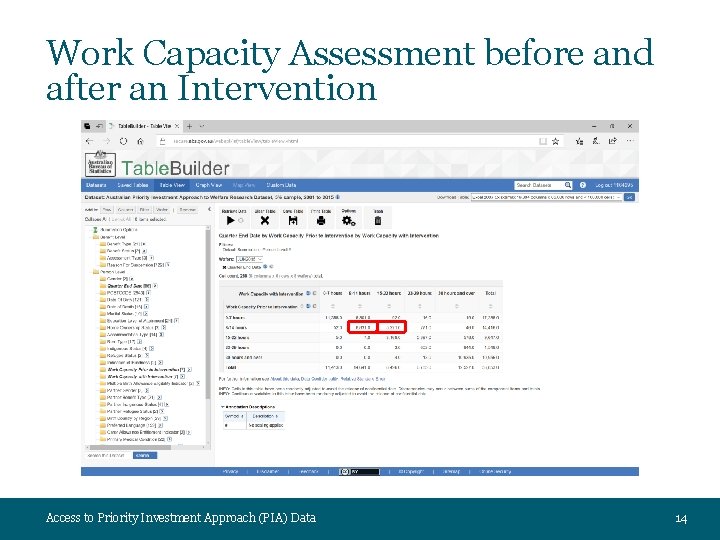
Work Capacity Assessment before and after an Intervention Access to Priority Investment Approach (PIA) Data 14
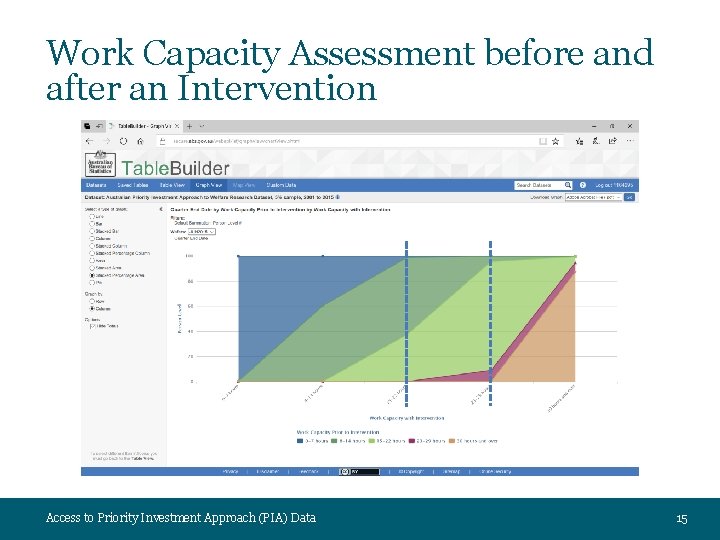
Work Capacity Assessment before and after an Intervention Access to Priority Investment Approach (PIA) Data 15
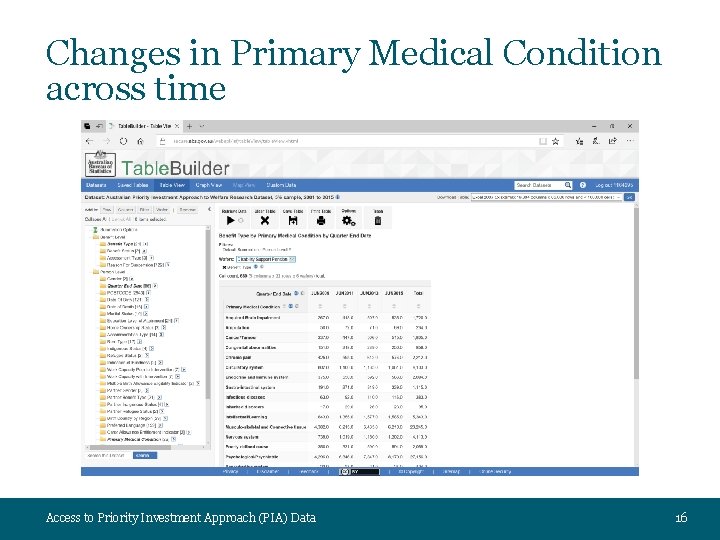
Changes in Primary Medical Condition across time Access to Priority Investment Approach (PIA) Data 16
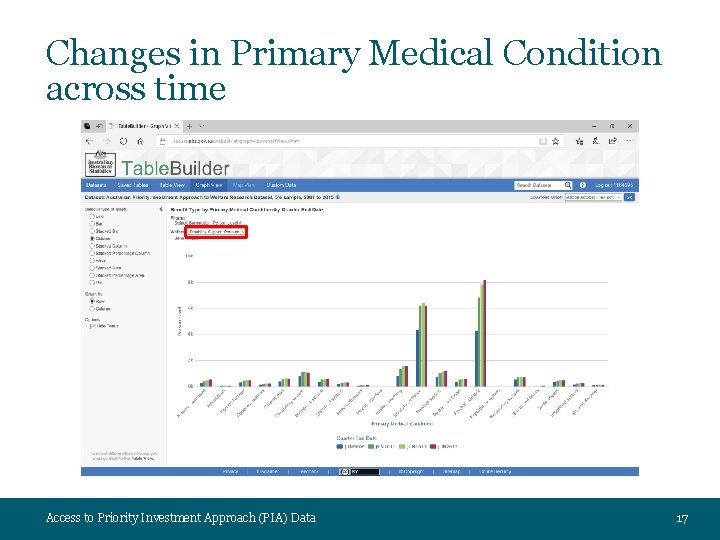
Changes in Primary Medical Condition across time Access to Priority Investment Approach (PIA) Data 17
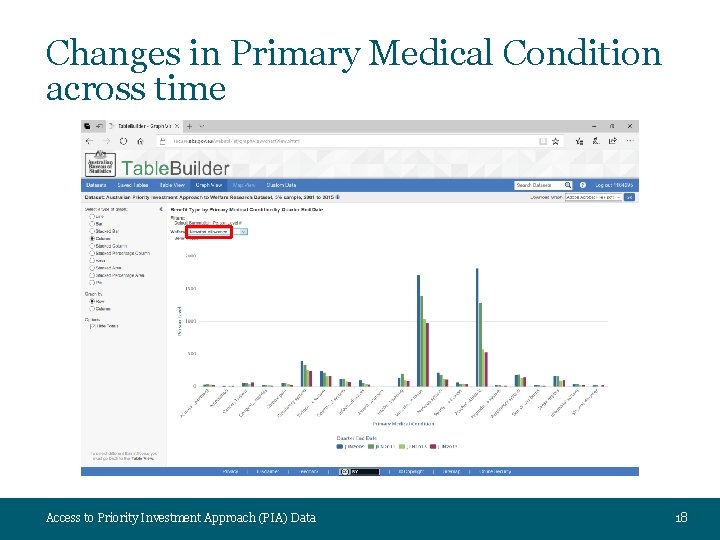
Changes in Primary Medical Condition across time Access to Priority Investment Approach (PIA) Data 18
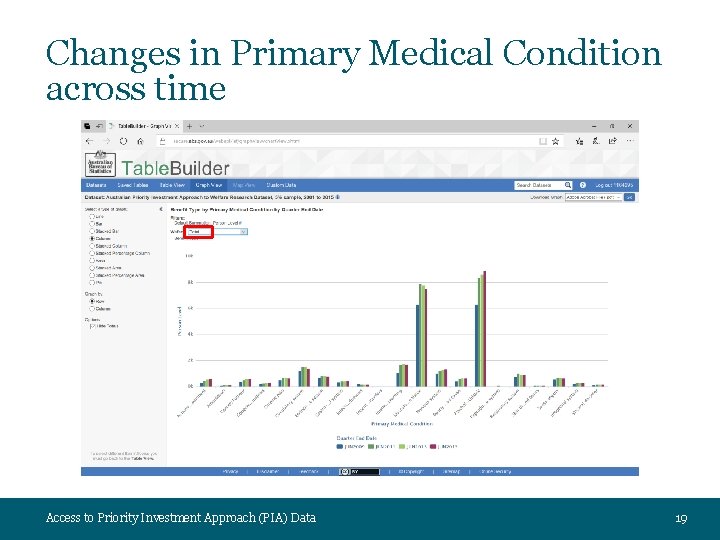
Changes in Primary Medical Condition across time Access to Priority Investment Approach (PIA) Data 19
Any Questions? Thank you. Tara Spokes, Ph. D Policy Research Officer tara. spokes@dss. gov. au Access to Priority Investment Approach (PIA) Data 20
- Slides: 20