
Puberty Tiegerman School CCMC Advocacy Residents Kelsey Mc
Puberty Tiegerman School CCMC Advocacy Residents: Kelsey Mc. Leod, MD Jolanta Norelli, MD, Ph. D Julia Apoznanski, MD Preceptor- Allison Driansky, MD December 3 rd 2019
Key Principles ● Respect for humanity and independence ●Education is key to promotion of healthy and mutually respectful behavior, regardless of ability level ●Sexual health is a necessity, not luxury 2
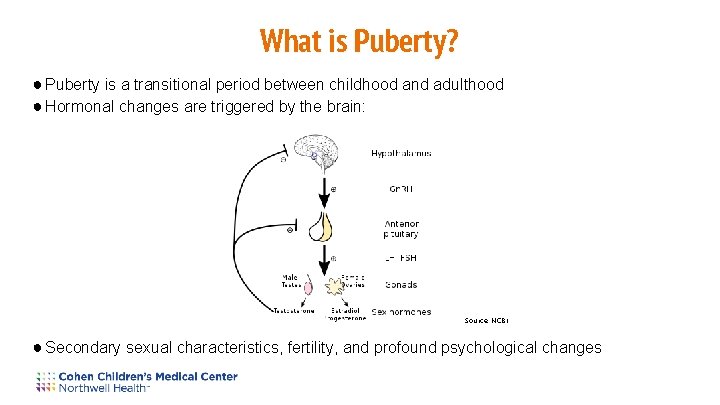
What is Puberty? ● Puberty is a transitional period between childhood and adulthood ● Hormonal changes are triggered by the brain: Source: NCBI ● Secondary sexual characteristics, fertility, and profound psychological changes
Onset of Puberty • Girls - between ages 8 to 14 • Boys - between ages 9 to 15 • Girls generally experience growth spurt (characteristic of the onset of puberty) 2 years before boys • Over the last 150 years, girls' sexual maturation, as measured by the age of menarche, is occurring at younger ages in all developed countries by at least 2 to 3 years: • Improved diets • Effective public health measures 4

What happens to boys during puberty? • Pubic hair • Body hair • Changes in body parts • Body shape • Voice Change 5
What happens to girls during puberty? • Breast development • Pubic Hair • Body shape • Menstruation/period 6
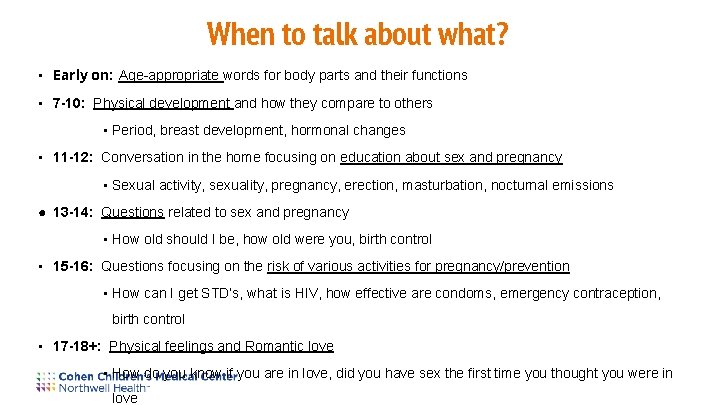
When to talk about what? • Early on: Age-appropriate words for body parts and their functions • 7 -10: Physical development and how they compare to others • Period, breast development, hormonal changes • 11 -12: Conversation in the home focusing on education about sex and pregnancy • Sexual activity, sexuality, pregnancy, erection, masturbation, nocturnal emissions ● 13 -14: Questions related to sex and pregnancy • How old should I be, how old were you, birth control • 15 -16: Questions focusing on the risk of various activities for pregnancy/prevention • How can I get STD’s, what is HIV, how effective are condoms, emergency contraception, birth control • 17 -18+: Physical feelings and Romantic love • How do you know if you are in love, did you have sex the first time you thought you were in love
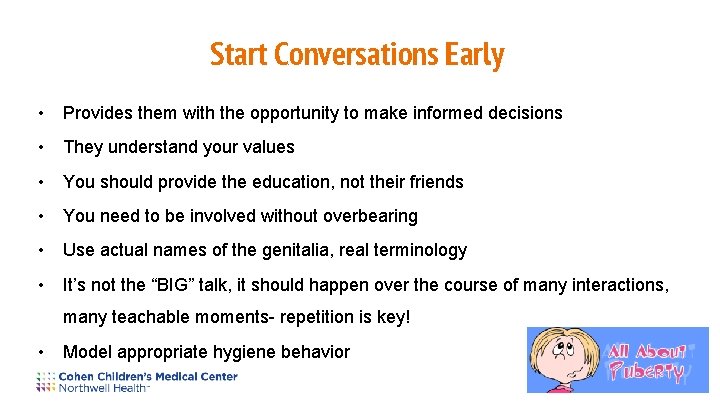
Start Conversations Early • Provides them with the opportunity to make informed decisions • They understand your values • You should provide the education, not their friends • You need to be involved without overbearing • Use actual names of the genitalia, real terminology • It’s not the “BIG” talk, it should happen over the course of many interactions, many teachable moments- repetition is key! • Model appropriate hygiene behavior 8
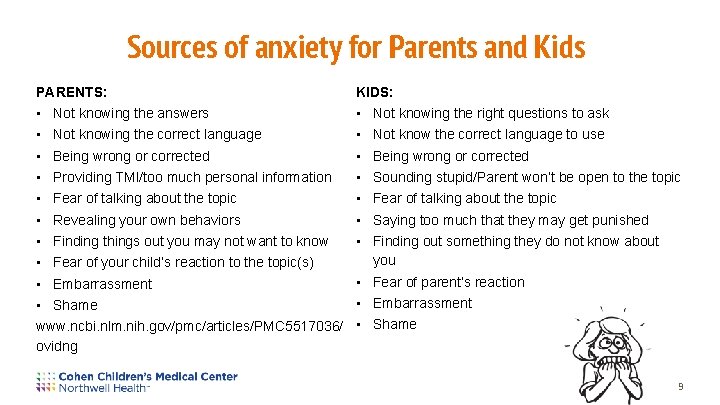
Sources of anxiety for Parents and Kids PARENTS: KIDS: • Not knowing the answers • Not knowing the right questions to ask • Not knowing the correct language • Not know the correct language to use • Being wrong or corrected • Providing TMI/too much personal information • Sounding stupid/Parent won’t be open to the topic • Fear of talking about the topic • Revealing your own behaviors • Saying too much that they may get punished • Finding things out you may not want to know • Fear of your child’s reaction to the topic(s) • Finding out something they do not know about you • Embarrassment • Fear of parent’s reaction • Shame • Embarrassment www. ncbi. nlm. nih. gov/pmc/articles/PMC 5517036/ • Shame ovidng 9
What does that conversation look like 1. It shouldn’t be just a one time conversation 2. Studies show these conversations are positive for teens 3. Only you know exactly what to say, here is some help: • Everyone goes through these changes, many of them are awkward • Timing of these changes can vary greatly • Acne, mood changes, growth spurts, and hormonal changes are all part of these changes 4. What teens want to hear from parents: • Start talking to your kids before they come to you with questions, initiate conversations • Answer the questions honestly and openly • It’s important to be reassuring so they feel secure and not alone • You are available any time to talk
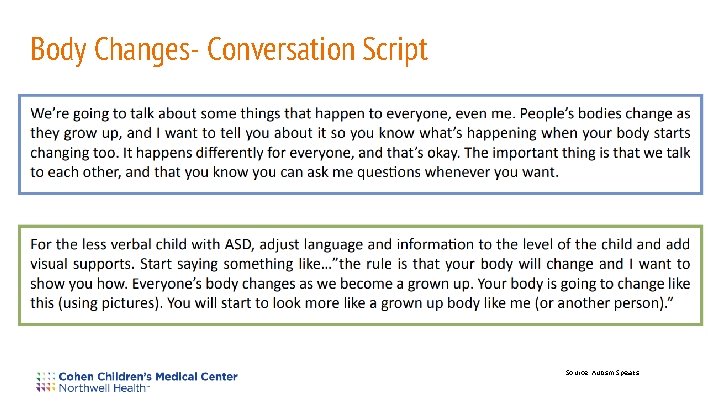
Body Changes- Conversation Script Source: Autism Speaks
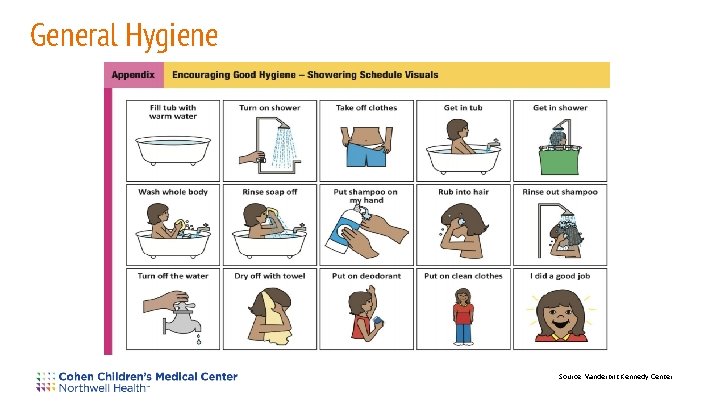
General Hygiene Source: Vanderbilt Kennedy Center
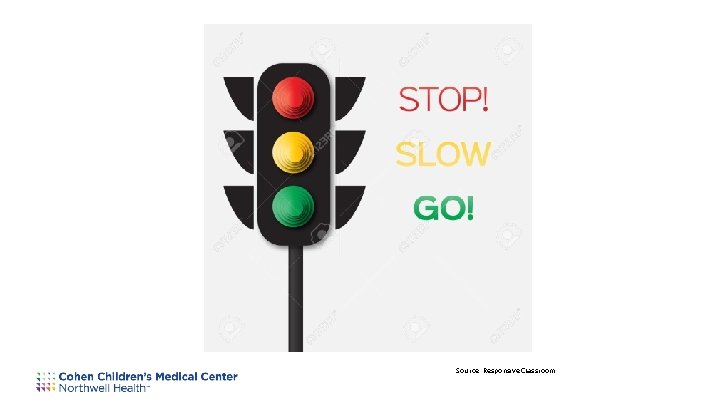
Source: Responsive Classroom
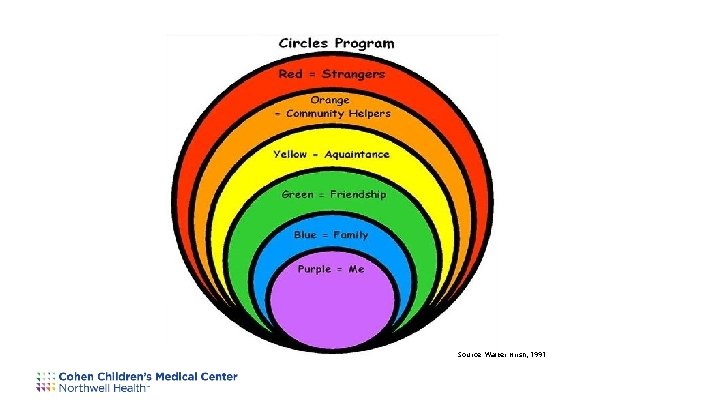
Source: Walker-Hirsh, 1991
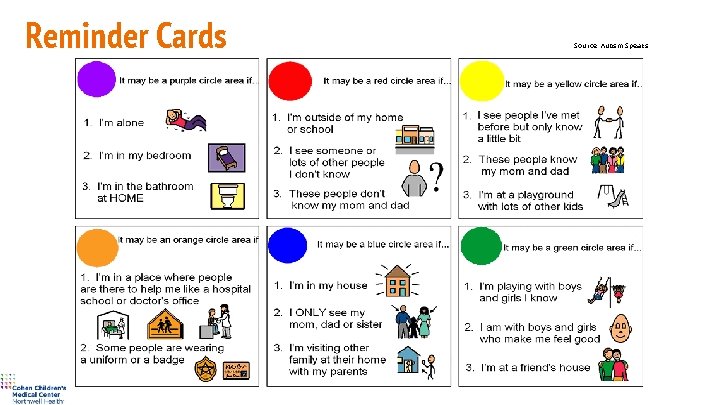
Reminder Cards Source: Autism Speaks
Shaving ● ● Try different razors and shaving creams to find one your child prefers and accepts. Often, an electric razor is a better option for teenagers just starting out (watch for sensitivity to their sounds). Keep in mind that some people with ASD may be sensitive to the sounds of electric razors. If your child is very averse to shaving, you may need to work on increasing his or her comfort level first. ○ Start with single steps (i. e. put on shaving cream and rinse off) ○ Short periods of time (i. e. turn razor on for 5 seconds and then off) ○ Small areas (i. e. put on shaving cream and shave a small area). If shaving is not an option, these same incremental steps could be used with depilatory creams, which may have less of a sensory impact and require less fine motor skills.
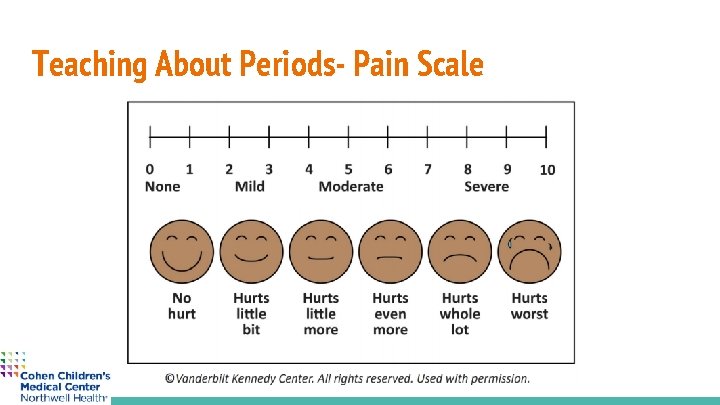
Teaching About Periods- Pain Scale
The difficult conversations you must have! • Girls’ breasts swell and grow, one may be larger than the other • Boys’ penises and testicles grow larger • Girls and boys get public hair, underarm and leg hair that becomes thicker • Acne, sweating, growth spurts • Boys’ voices change and become deeper, facial hair and muscles grow • Boys sometimes have wet dreams, which means they ejaculate in their sleep • When girls begin menstruating, her uterine lining fills with blood in preparation for a fertilized egg. If it doesn’t happen, she will have her period. If fertilized, pregnancy • A girl’s period may last 3 to 7 days, she will use feminine products to absorb the blood 18
Questions to expect 1. Why don’t/do I have pubic hair? 2. When will my period start? Why haven’t I gotten my period yet? Is something wrong? 3. Why is my breast/penis so small/large compared to others? 4. What is the difference between a pad and tampon? 5. My friends say I should use a tampon? 6. Why do I get erections for no reason? 7. Will wet dreams ever stop? 8. One of my testicles/breasts are larger than the other, why? 19
Resources for Parents 1. American Sexual Health Association (ASHASexual. Health. org) 2. The Center for Sex Education (Sex. Ed. Center. org)) 3. The Center for Disease Control and Prevention (CDC. gov) 4. Center for Parent Information and Resources (Parent. Center. Hub. org) 5. Kids Health (Kids. Health. org) 6. The Mediatrician (http: //cmch. tv/parents/askthemediatrician/) 7. Office of Adolescent Health (http: //www. hhs. gov/ash/oah/) 8. Planned Parenthood (Planned. Parenthood. org) 9. Sex, Etc. (Sexetc. org) 10. Urban Dictionary, LLC (Urban. Dictionary. com) 11. Advocates for Youth (www. advocatesforyouth. org) 12. Parent Advocacy Coalition for Educational Rights (www. pacer. org) 13. Your Child Development and Behavioral Resources (www. med. umich. edu/1 libr/yourchild/disabsex. htm) 14. Center for Parent Information and Resources (parentcenterhub. org/sexed/)
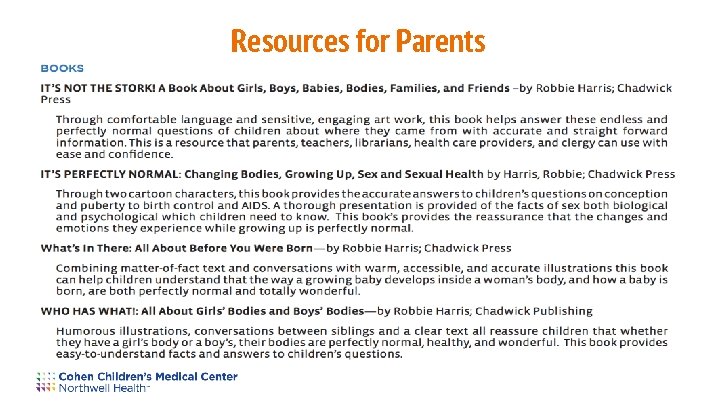
Resources for Parents 22
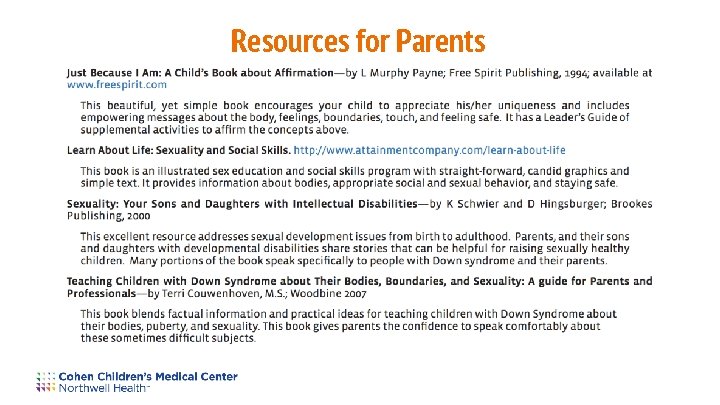
Resources for Parents 23
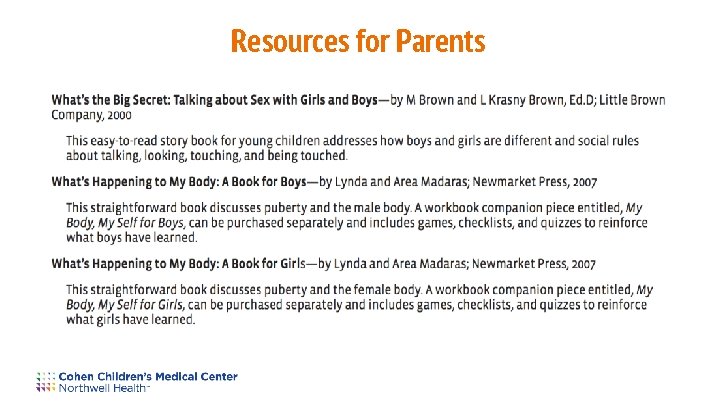
Resources for Parents 24
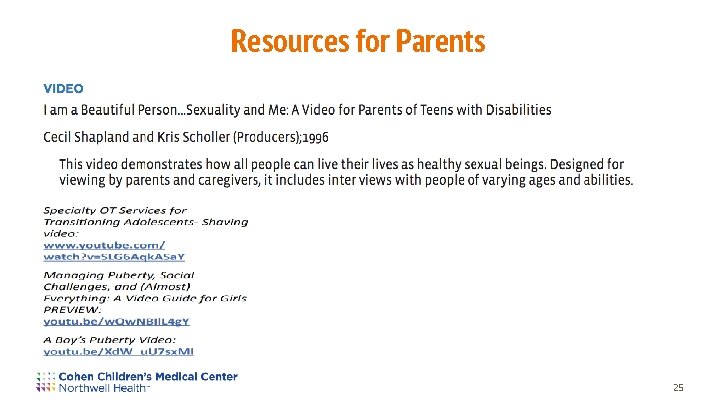
Resources for Parents 25
“Good Parenting does not mean giving them a perfect life. It means teaching them how to lead a good and happy life in our imperfect world. ” Author unknown
References Advocate for Youth: https: //www. advocatesforyouth. org/wp-content/uploads/storage//advfy/documents/Factsheets/sexualhealth-education-for-young-people-with-disabilities-parentsguardians. pdf Autism Society: https: //www. autism-society. org/wp-content/uploads/2014/04/LWA_Puberty. pdf Autism Speaks Puberty Toolkit: https: //cdd. tamu. edu/sites/cdd. tamu. edu/files/puberty_tool_kit%20 Autism%20 Speaks. pdf CCMC lecture series The Circles Concept: Social Competence in Special Education: http: //www. ascd. org/ASCD/pdf/journals/ed_lead/el_199109_walker-hirsch. pdf Vanderbilt Kennedy Center Healthy Bodies Toolkit: https: //vkc. mc. vanderbilt. edu/healthybodies/

Thank You
- Slides: 28