
Pu238 Supply ProjectTechnology Demonstration Pu238 Robert Wham Ph
Pu-238 Supply Project–Technology Demonstration Pu-238 α β– Robert Wham, Ph. D. Presented to (n, fission) (n, γ) Np-238 (2. 1 d) Click to edit Master subtitle style Np-237 (n, fission) Np-238 (n, fission) Future in Space Operations April 20, 2016 ORNL is managed by UT-Battelle for the US Department of Energy

You Tube https: //www. youtube. com/watch? v=9 Ymkx. Gdp-b 0 2
Why Pu-238 as a Heat Source? • Long half-life- 87. 7 years • High power density/specific power ~ 0. 57 watts/gram • Low radiation levels – primarily an alpha emitter – limit radiation exposures of operating personnel during production, fabrication, testing and delivery – low-mass configurations for space applications offer very little self shielding – compatibility with sensitive instrumentation for space exploration • High thermal stability – oxide form with high melting point • Low solubility rate in the human body and environment • Producible in sufficient quantities and schedule to meet mission needs • Other isotopes considered and dismissed over the years – investigated several times in response to concerns over supply 3
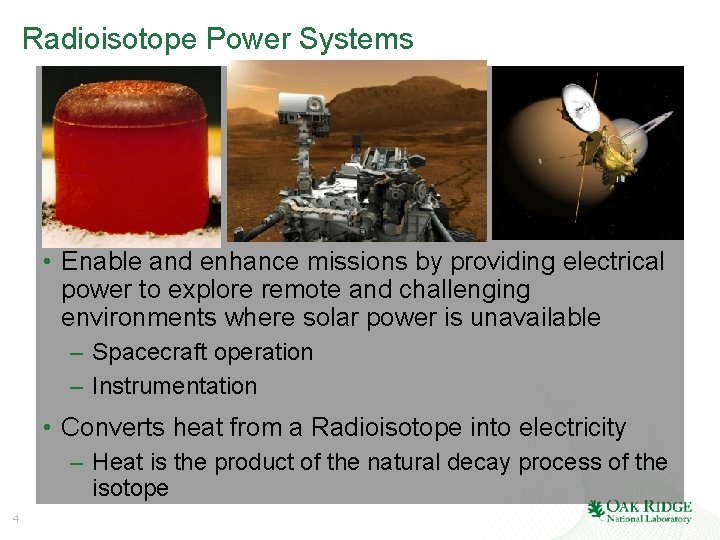
Radioisotope Power Systems • Enable and enhance missions by providing electrical power to explore remote and challenging environments where solar power is unavailable – Spacecraft operation – Instrumentation • Converts heat from a Radioisotope into electricity – Heat is the product of the natural decay process of the isotope 4
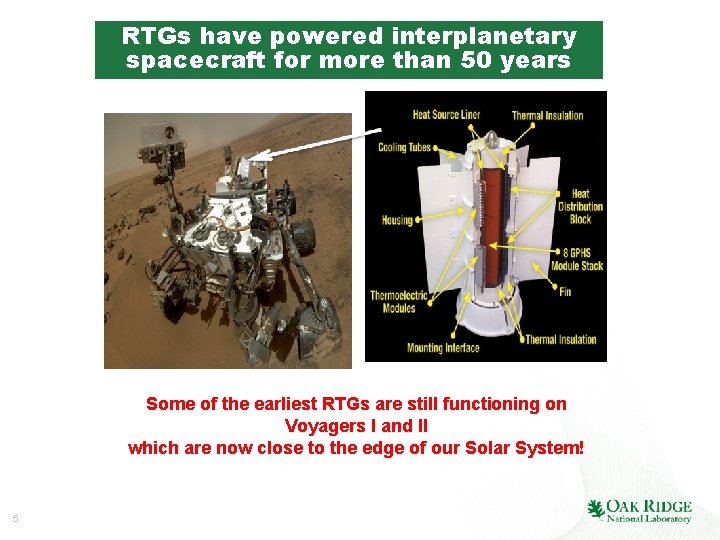
RTGs have powered interplanetary spacecraft for more than 50 years Some of the earliest RTGs are still functioning on Voyagers I and II which are now close to the edge of our Solar System! 5
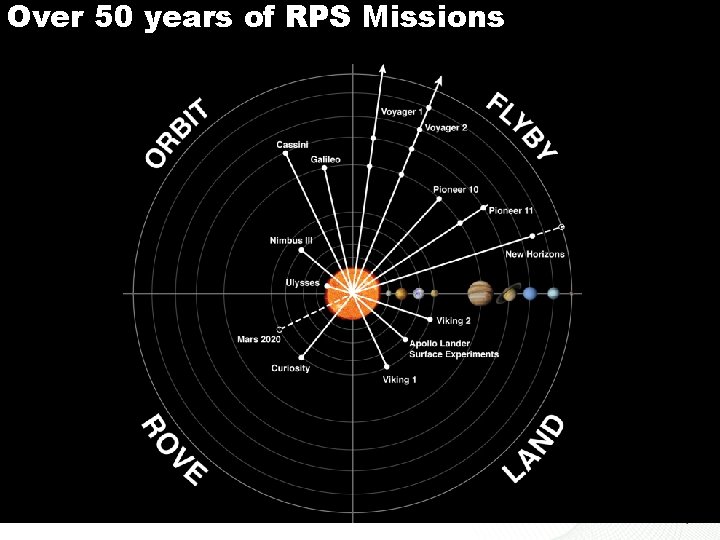
Over 50 years of RPS Missions 6
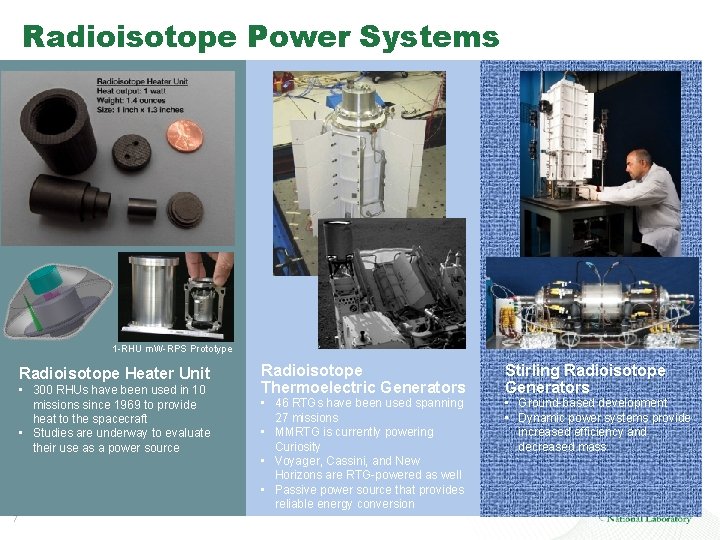
Radioisotope Power Systems 1 -RHU m. W-RPS Prototype Radioisotope Heater Unit • 300 RHUs have been used in 10 missions since 1969 to provide heat to the spacecraft • Studies are underway to evaluate their use as a power source 7 Radioisotope Thermoelectric Generators Stirling Radioisotope Generators • 46 RTGs have been used spanning 27 missions • MMRTG is currently powering Curiosity • Voyager, Cassini, and New Horizons are RTG-powered as well • Passive power source that provides reliable energy conversion • Ground-based development • Dynamic power systems provide increased efficiency and decreased mass
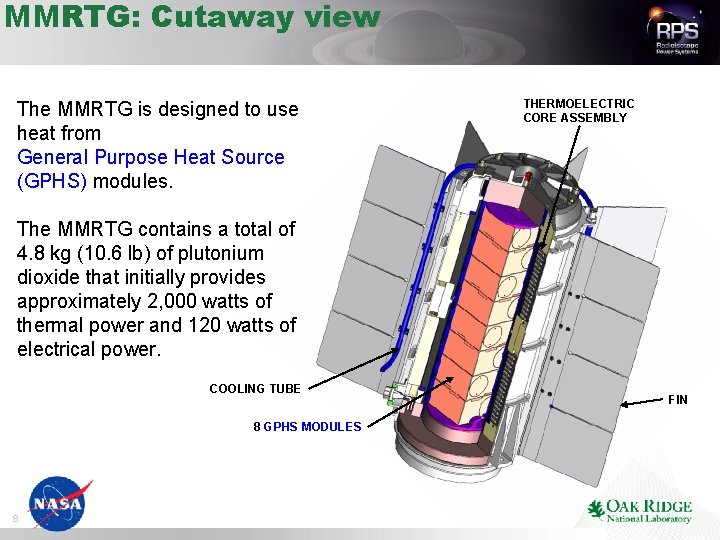
MMRTG: Cutaway view The MMRTG is designed to use heat from General Purpose Heat Source (GPHS) modules. THERMOELECTRIC CORE ASSEMBLY The MMRTG contains a total of 4. 8 kg (10. 6 lb) of plutonium dioxide that initially provides approximately 2, 000 watts of thermal power and 120 watts of electrical power. COOLING TUBE 8 GPHS MODULES 8 FIN
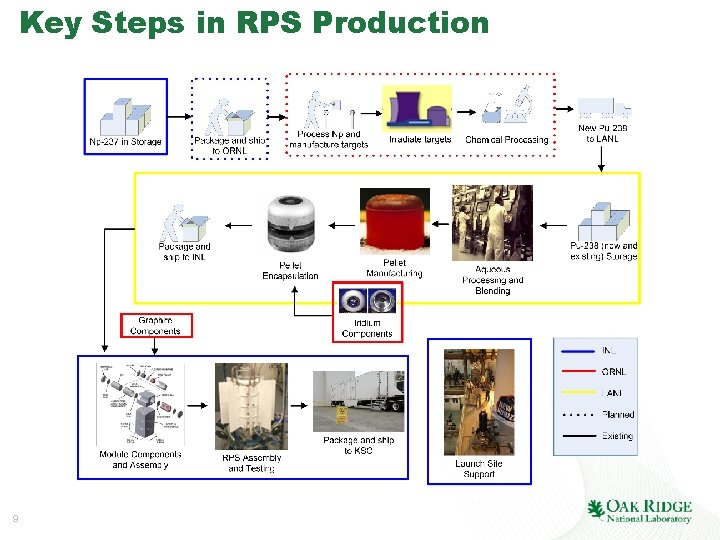
Key Steps in RPS Production 9
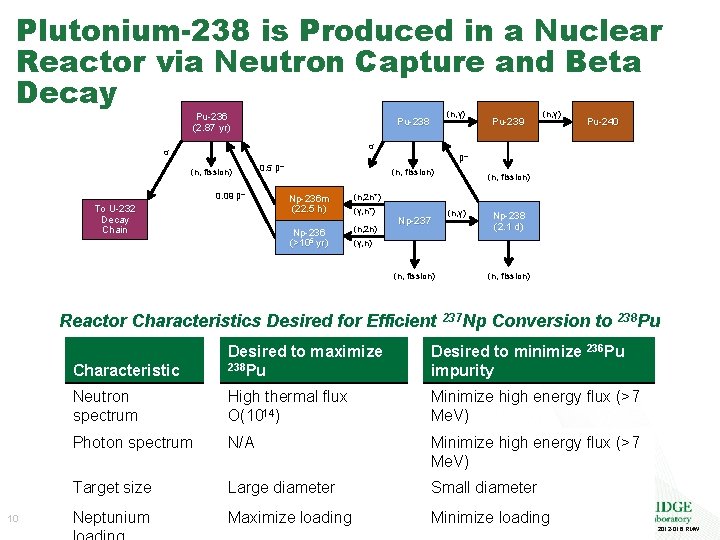
Plutonium-238 is Produced in a Nuclear Reactor via Neutron Capture and Beta Decay Pu-236 (2. 87 yr) (n, γ) Pu-238 Pu-239 (n, γ) Pu-240 α α β– (n, fission) 0. 09 β– To U-232 Decay Chain 0. 5 β– (n, fission) Np-236 m (22. 5 h) (n, 2 n*) (γ, n*) Np-236 (>105 yr) (n, 2 n) Np-237 (n, fission) (n, γ) Np-238 (2. 1 d) (γ, n) (n, fission) Reactor Characteristics Desired for Efficient 237 Np Conversion to 238 Pu 10 Characteristic Desired to maximize 238 Pu Desired to minimize 236 Pu impurity Neutron spectrum High thermal flux O(1014) Minimize high energy flux (>7 Me. V) Photon spectrum N/A Minimize high energy flux (>7 Me. V) Target size Large diameter Small diameter Neptunium Maximize loading Minimize loading 2012 -016 RMW
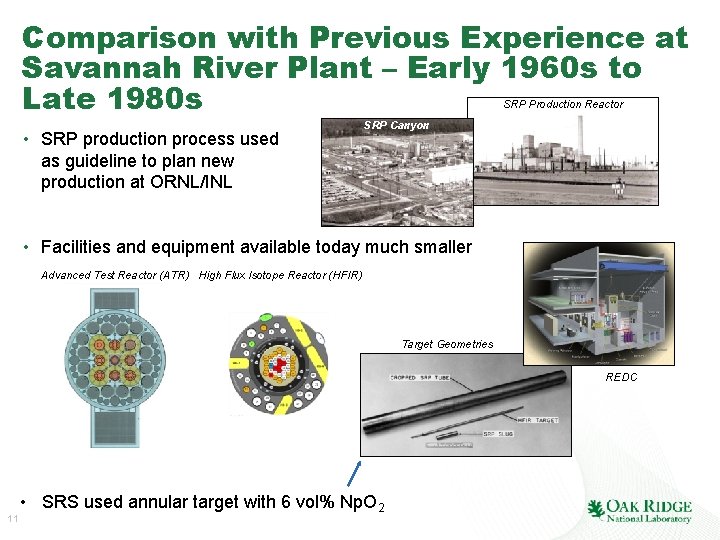
Comparison with Previous Experience at Savannah River Plant – Early 1960 s to Late 1980 s SRP Production Reactor • SRP production process used as guideline to plan new production at ORNL/INL SRP Canyon • Facilities and equipment available today much smaller Advanced Test Reactor (ATR) High Flux Isotope Reactor (HFIR) Target Geometries REDC 11 • SRS used annular target with 6 vol% Np. O 2
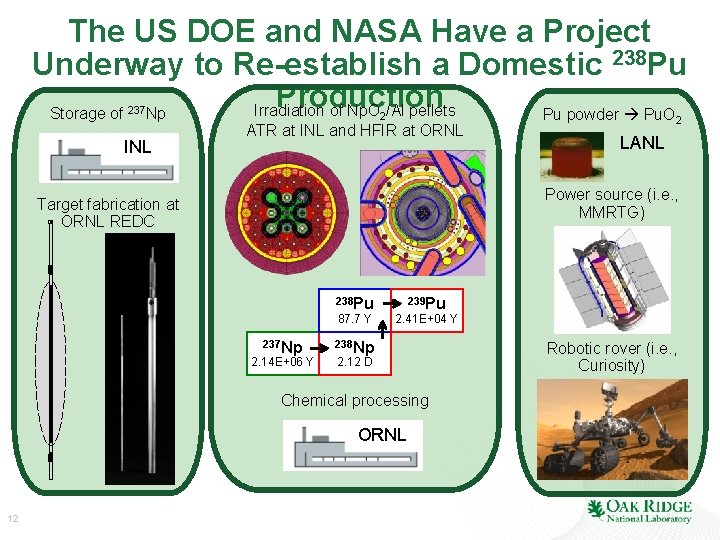
The US DOE and NASA Have a Project Underway to Re-establish a Domestic 238 Pu Production Irradiation of Np. O /Al pellets Storage of Np Pu powder Pu. O 237 INL 2 ATR at INL and HFIR at ORNL LANL Power source (i. e. , MMRTG) Target fabrication at ORNL REDC 238 Pu 87. 7 Y 237 Np 2. 14 E+06 Y 239 Pu 2. 41 E+04 Y 238 Np 2. 12 D Chemical processing ORNL 12 2 Robotic rover (i. e. , Curiosity)
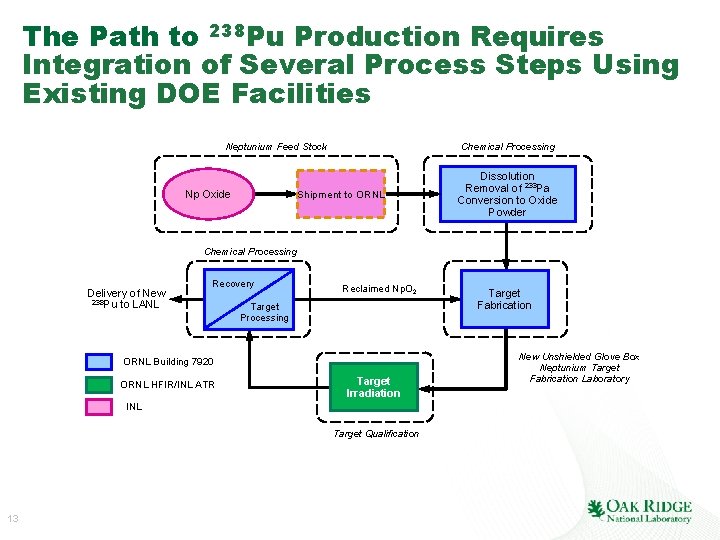
The Path to 238 Pu Production Requires Integration of Several Process Steps Using Existing DOE Facilities Neptunium Feed Stock Chemical Processing Shipment to ORNL Np Oxide Dissolution Removal of 233 Pa Conversion to Oxide Powder Chemical Processing Delivery of New 238 Pu to LANL Recovery Reclaimed Np. O 2 Target Processing ORNL Building 7920 ORNL HFIR/INL ATR Target Irradiation INL Target Qualification 13 Target Fabrication New Unshielded Glove Box Neptunium Target Fabrication Laboratory
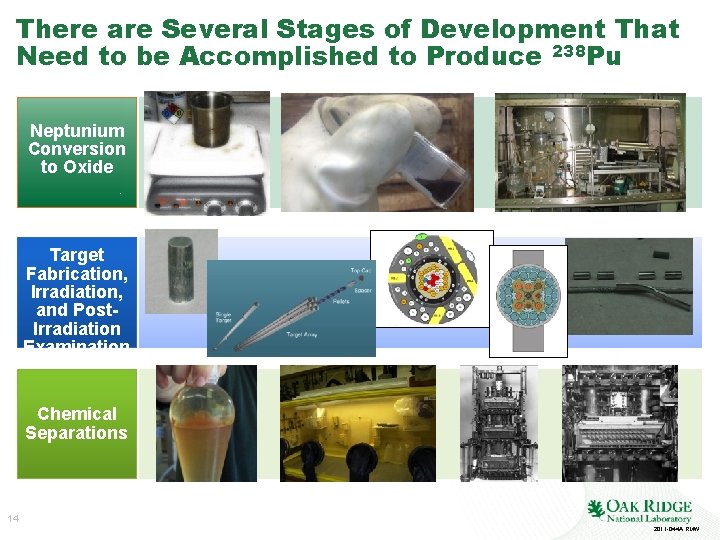
There are Several Stages of Development That Need to be Accomplished to Produce 238 Pu Neptunium Conversion to Oxide Target Fabrication, Irradiation, and Post. Irradiation Examination Chemical Separations 14 2011 -044 A RMW
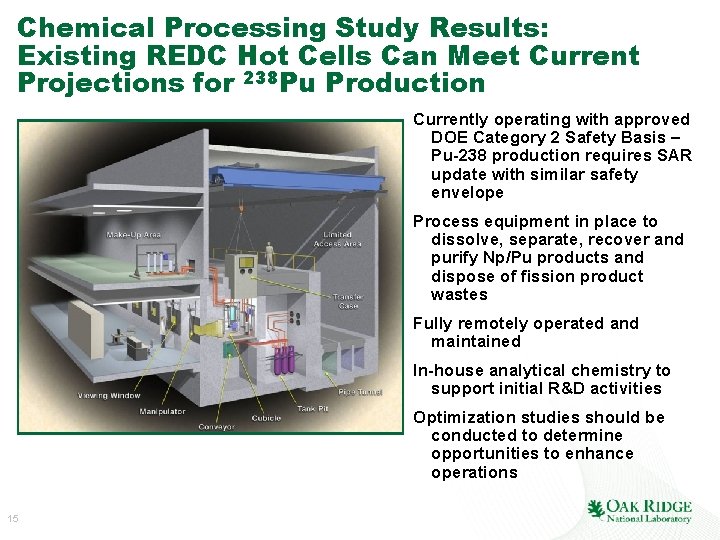
Chemical Processing Study Results: Existing REDC Hot Cells Can Meet Current Projections for 238 Pu Production Currently operating with approved DOE Category 2 Safety Basis – Pu-238 production requires SAR update with similar safety envelope Process equipment in place to dissolve, separate, recover and purify Np/Pu products and dispose of fission product wastes Fully remotely operated and maintained In-house analytical chemistry to support initial R&D activities Optimization studies should be conducted to determine opportunities to enhance operations 15
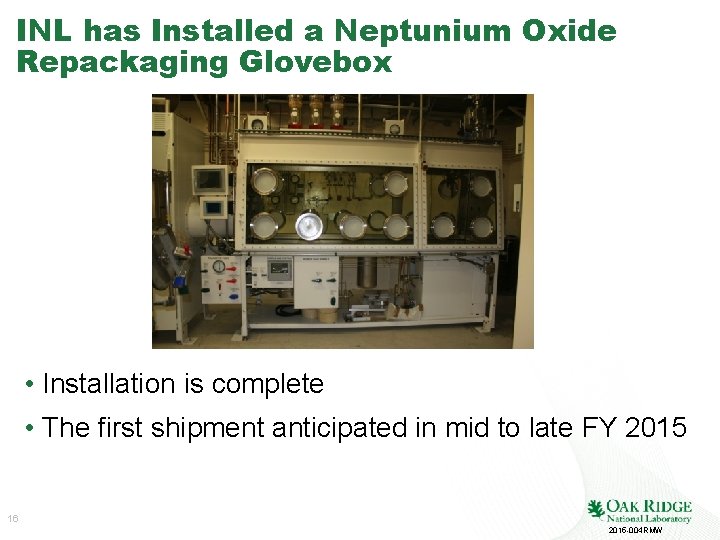
INL has Installed a Neptunium Oxide Repackaging Glovebox • Installation is complete • The first shipment anticipated in mid to late FY 2015 16 2015 -004 RMW
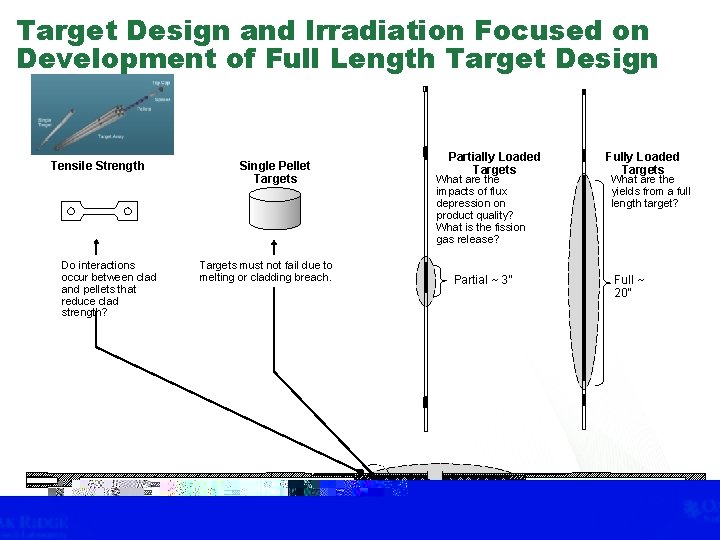
Target Design and Irradiation Focused on Development of Full Length Target Design Tensile Strength Do interactions occur between clad and pellets that reduce clad strength? 17 Single Pellet Targets must not fail due to melting or cladding breach. Partially Loaded Targets What are the impacts of flux depression on product quality? What is the fission gas release? Partial ~ 3” Fully Loaded Targets What are the yields from a full length target? Full ~ 20” Pellets 2012 -037 RMW
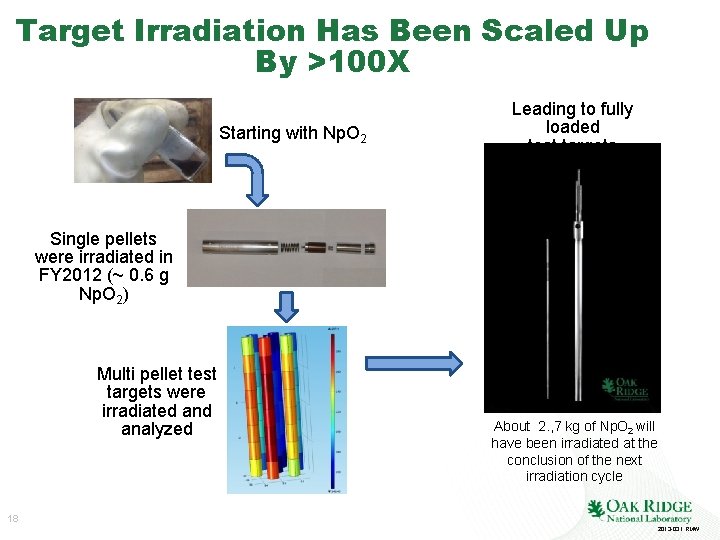
Target Irradiation Has Been Scaled Up By >100 X Starting with Np. O 2 Leading to fully loaded test targets Single pellets were irradiated in FY 2012 (~ 0. 6 g Np. O 2) Multi pellet test targets were irradiated analyzed About 2. , 7 kg of Np. O 2 will have been irradiated at the conclusion of the next irradiation cycle 18 2013 -031 RMW
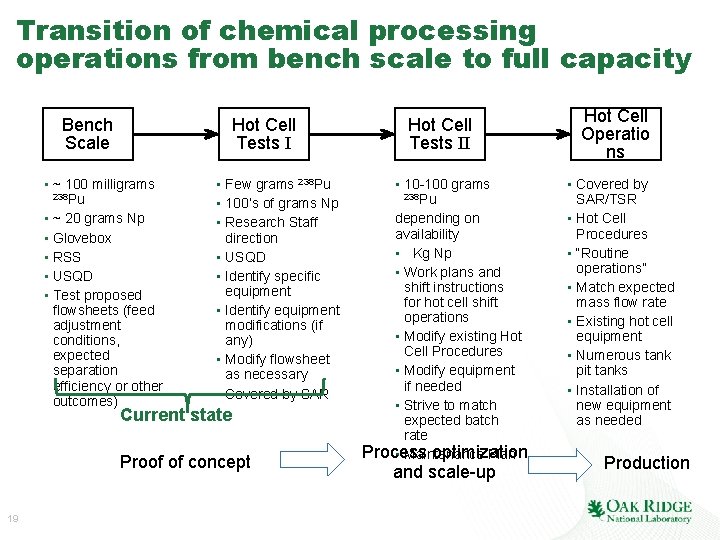
Transition of chemical processing operations from bench scale to full capacity Bench Scale Hot Cell Tests I • ~ 100 milligrams 238 Pu • ~ 20 grams Np • Glovebox • RSS • USQD • Test proposed flowsheets (feed adjustment conditions, expected separation efficiency or other outcomes) • Few grams 238 Pu • 100’s of grams Np • Research Staff direction • USQD • Identify specific equipment • Identify equipment modifications (if any) • Modify flowsheet as necessary • Covered by SAR Current state Proof of concept 19 Hot Cell Tests II • 10 -100 grams 238 Pu depending on availability • Kg Np • Work plans and shift instructions for hot cell shift operations • Modify existing Hot Cell Procedures • Modify equipment if needed • Strive to match expected batch rate Process optimization • Maintenance Plan and scale-up Hot Cell Operatio ns • Covered by SAR/TSR • Hot Cell Procedures • “Routine operations” • Match expected mass flow rate • Existing hot cell equipment • Numerous tank pit tanks • Installation of new equipment as needed Production
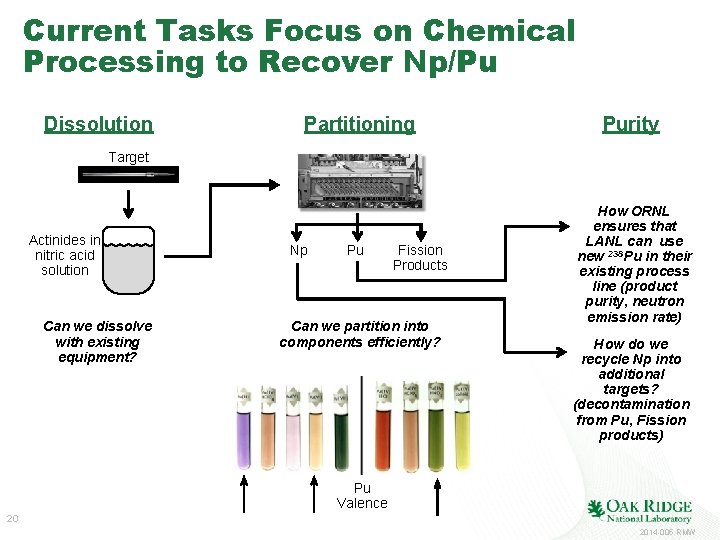
Current Tasks Focus on Chemical Processing to Recover Np/Pu Dissolution Partitioning Purity Target Actinides in nitric acid solution Can we dissolve with existing equipment? Np Pu Fission Products Can we partition into components efficiently? How ORNL ensures that LANL can use new 238 Pu in their existing process line (product purity, neutron emission rate) How do we recycle Np into additional targets? (decontamination from Pu, Fission products) Pu Valence 20 2014 -005 RMW
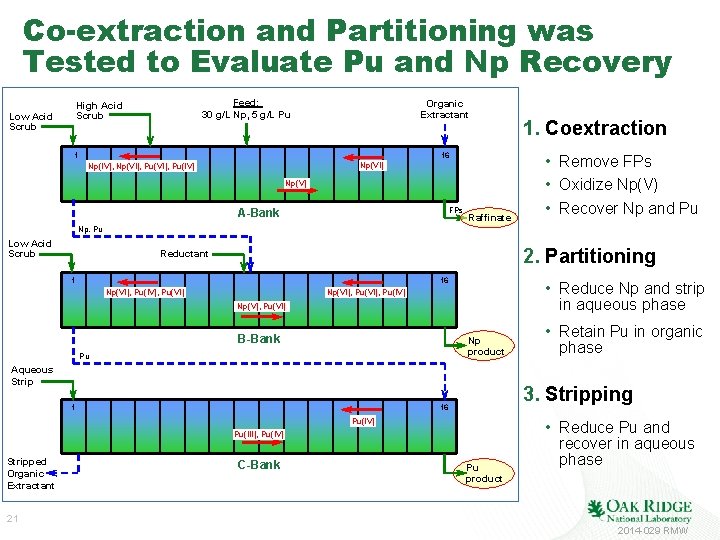
Co-extraction and Partitioning was Tested to Evaluate Pu and Np Recovery Feed: 30 g/L Np, 5 g/L Pu High Acid Scrub Low Acid Scrub Organic Extractant 16 1 Np(VI) Np(IV), Np(VI), Pu(IV) Np(V) FPs A-Bank Raffinate 1. Coextraction • Remove FPs • Oxidize Np(V) • Recover Np and Pu Np, Pu Low Acid Scrub 2. Partitioning Reductant 1 16 Np(VI), Pu(IV), Pu(VI) • Reduce Np and strip in aqueous phase Np(VI), Pu(IV) Np(V), Pu(VI) B-Bank Np product Pu Aqueous Strip 1 3. Stripping 16 Pu(IV) Pu(III), Pu(IV) Stripped Organic Extractant C-Bank • Retain Pu in organic phase Pu product • Reduce Pu and recover in aqueous phase 21 2014 -029 RMW
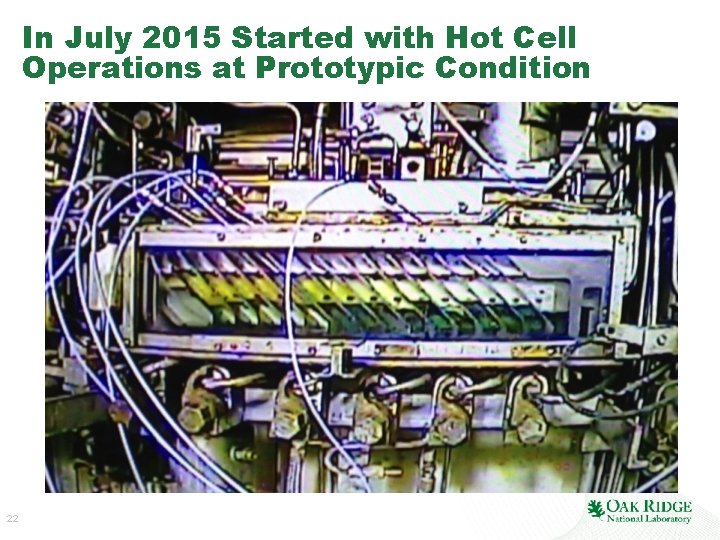
In July 2015 Started with Hot Cell Operations at Prototypic Condition 22
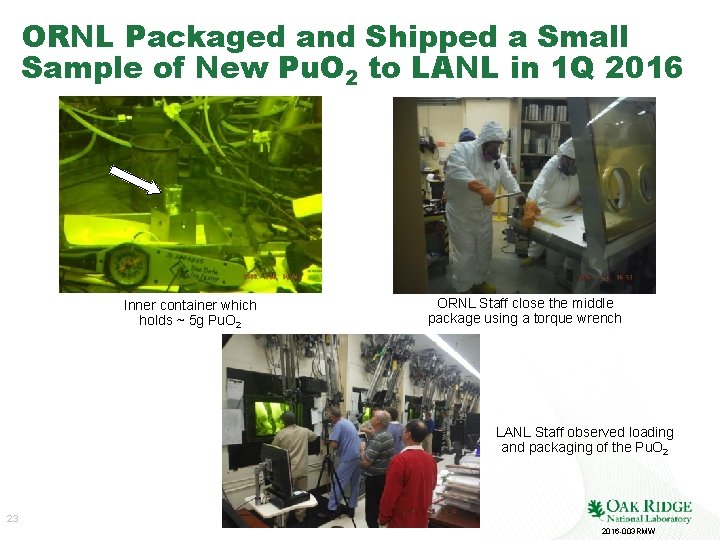
ORNL Packaged and Shipped a Small Sample of New Pu. O 2 to LANL in 1 Q 2016 Inner container which holds ~ 5 g Pu. O 2 ORNL Staff close the middle package using a torque wrench LANL Staff observed loading and packaging of the Pu. O 2 23 2016 -003 RMW
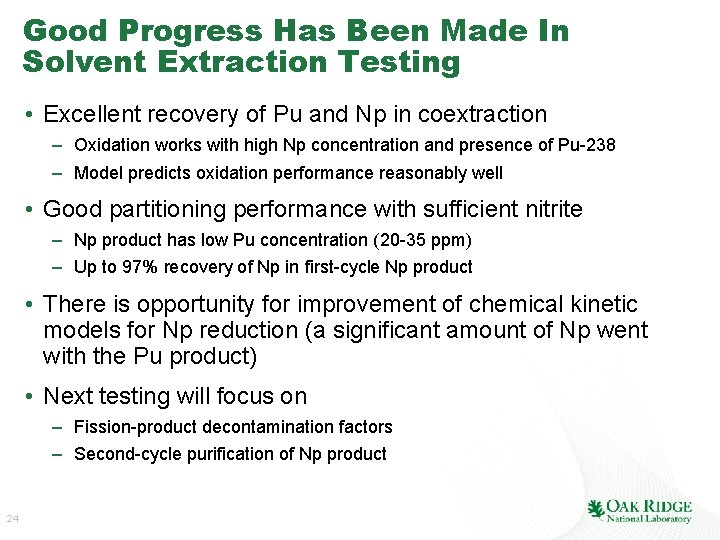
Good Progress Has Been Made In Solvent Extraction Testing • Excellent recovery of Pu and Np in coextraction – Oxidation works with high Np concentration and presence of Pu-238 – Model predicts oxidation performance reasonably well • Good partitioning performance with sufficient nitrite – Np product has low Pu concentration (20 -35 ppm) – Up to 97% recovery of Np in first-cycle Np product • There is opportunity for improvement of chemical kinetic models for Np reduction (a significant amount of Np went with the Pu product) • Next testing will focus on – Fission-product decontamination factors – Second-cycle purification of Np product 24
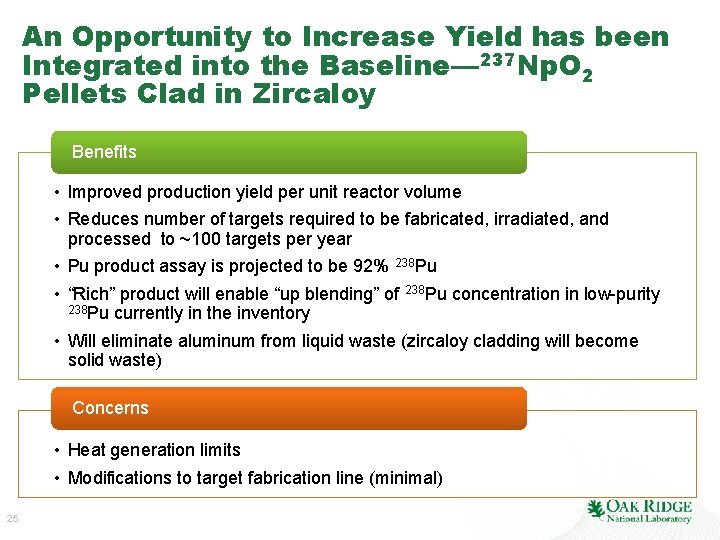
An Opportunity to Increase Yield has been Integrated into the Baseline— 237 Np. O 2 Pellets Clad in Zircaloy Benefits • Improved production yield per unit reactor volume • Reduces number of targets required to be fabricated, irradiated, and processed to ~100 targets per year • Pu product assay is projected to be 92% 238 Pu • “Rich” product will enable “up blending” of 238 Pu concentration in low-purity 238 Pu currently in the inventory • Will eliminate aluminum from liquid waste (zircaloy cladding will become solid waste) Concerns • Heat generation limits • Modifications to target fabrication line (minimal) 25
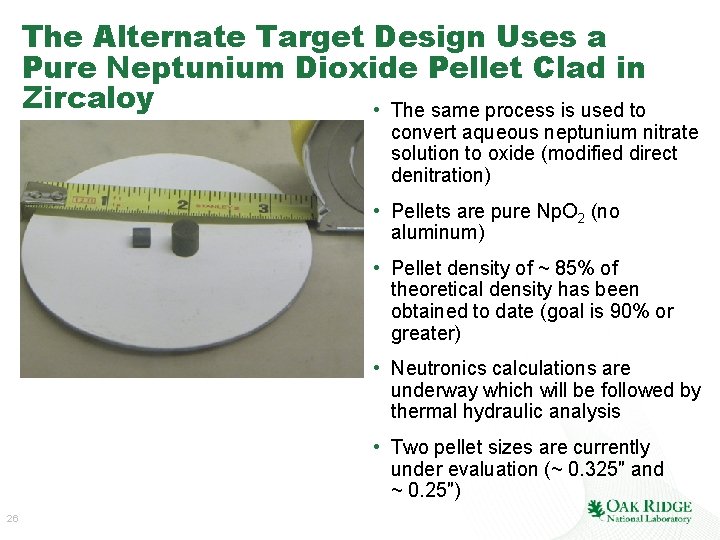
The Alternate Target Design Uses a Pure Neptunium Dioxide Pellet Clad in Zircaloy • The same process is used to convert aqueous neptunium nitrate solution to oxide (modified direct denitration) • Pellets are pure Np. O 2 (no aluminum) • Pellet density of ~ 85% of theoretical density has been obtained to date (goal is 90% or greater) • Neutronics calculations are underway which will be followed by thermal hydraulic analysis • Two pellet sizes are currently under evaluation (~ 0. 325″ and ~ 0. 25″) 26
There Have Been Several Significant Accomplishments Since the Project Started • Neptunium oxide repackaging capability for shipping containers to ORNL has been obtained at INL. • Target design and fabrication have been scaled up to prototypical targets; approximately 84 targets have been irradiated to date. • Chemical processing tests using approximately 500 gm Np/Pu at concentrations expected for production are underway to develop improved methods for separation and recovery of both neptunium and plutonium. 27
Acknowledgements • NASA Science Mission Directorate • Eight ORNL Research Divisions • US DOE Office of Space and Defense Power Systems, NE-75 28
- Slides: 28