
PTT 402 Biotechnology Facility Design Lecture 5 Utilities

PTT 402 Biotechnology Facility Design Lecture 5 Utilities Systems in Biotechnological Production Plant Zulkarnain Mohamed Idris zulkarnainidris@unimap. edu. my
Utilities Systems in Biotechnological Plant Design: An Overview Pharmaceutical water systems (water treatment system) Clean steam system Chilled water system Air and gas system
Pharmaceutical Water Systems Water used for the preparation or processing of pharmaceutical raw materials, drug products, or biopharmaceuticals must meet the requirements for the appropriate grade of pharmaceutical water or the needs of the process. The quality attributes for pharmaceutical waters are established by various national pharmacopeias such as British Pharmacopeia, European Community Pharmacopeia, Pharmacopeia of Japan and U. S. Pharmacopeia. These pharmacopeias establish a minimum requirement for chemical, microbial, and physical attributes that may affect the properties of the ingredients or preparation, or adversely affect patients. The most widely used grade of pharmaceutical water are Purified Water (PW) and Water For Injection (WFI). The major quality attributes for of PW and WFI are listed in Table 14. 3.
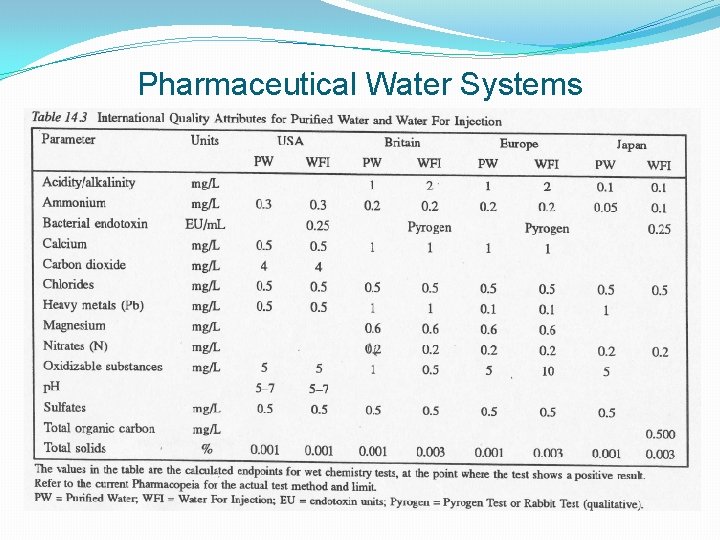
Pharmaceutical Water Systems Table 14. 3.
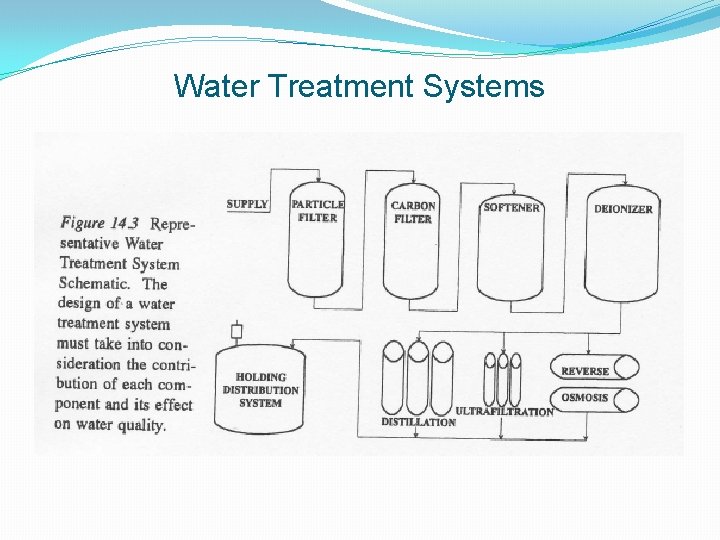
Water Treatment Systems Pharmaceutical water system are design to deliver an acceptable quality of water in a consistent and reproducible manner to the point of use. There are many unit operations and treatment sequences that may be specified and maintain to achieve the acceptable quality. The design of a possible water treatment system as shown in Figure 14. 3.
Water Treatment Systems
Water Treatment Systems Holding tanks: To hold treatment chemicals and to supply feed for process equipment. Need to protect the contents of treated water from chemical an microbial contamination. Airborne contaminants are excluded by closed vessels with air vents protected by microretentive filters. Softeners: An ion exchange unit operation used to reduce hardness in water by replacing calcium and magnesium ions with sodium ions. Regenerated using brine solution periodically. Backwashing the softener resin during regeneration may help to reduce the microbial contamination.
Water Treatment Systems Multimedia filters: Columns packed with sand quartz. Use for removal of slit and large particulates from feedwater. The media do not provide nutrients for bacterial growth, but the trapped material contains organic nutrients. Periodic backwashing of the media removes trapped slit and organics. The multimedia filters should be sanitized routinely with hot water, steam or chemicals. Carbon beds: Used to dechlorinate feedwater and remove low molecular weight organic compounds. The removal of the chlorine from water and the high nutrient level in the activated carbon promote microbial proliferation. The carbon bed should be sanitized using hot water or steam prior to backwashing, to minimize microbial contamination.
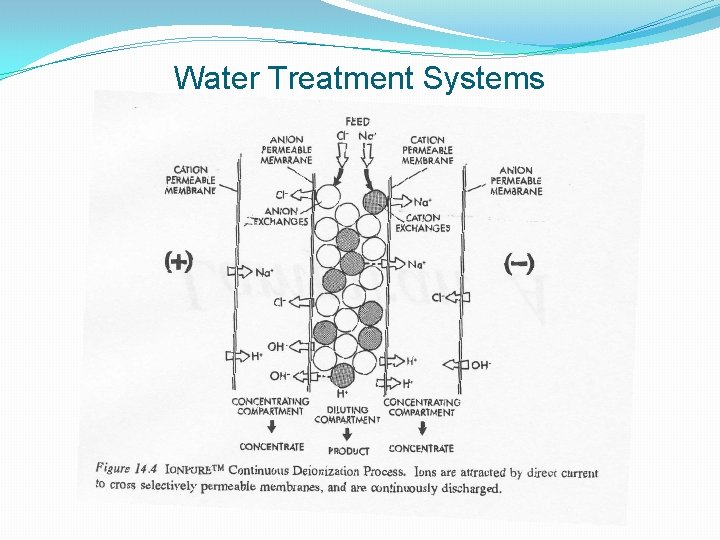
Water Treatment Systems Deionizers (Figure 14. 4): Use synthetic resin beads to bind inorganic salts in the water and discharge a stream with low conductivity. Two types of resins are used, anionic and cationic. Anionic resin- removes negatively charged ions such as bicarbonate, chloride, sulfate, and replace them with hydroxide ions. Cationic resin- removes positively charged ions such as calcium, magnesium, sodium, and replaces them with hydrogen ions. Do not reduce the levels of organic chemicals, endotoxin, or microorganisms. Strong acid and caustic are used to regenerate both resins, and are effective in sanitizing the beds. Membrane filters: Used to protect vents on tanks and treatment equipment, to filter compressed gases and to control microbial levels. The filters need to be sterilized daily to eliminate microbial contamination.
Water Treatment Systems
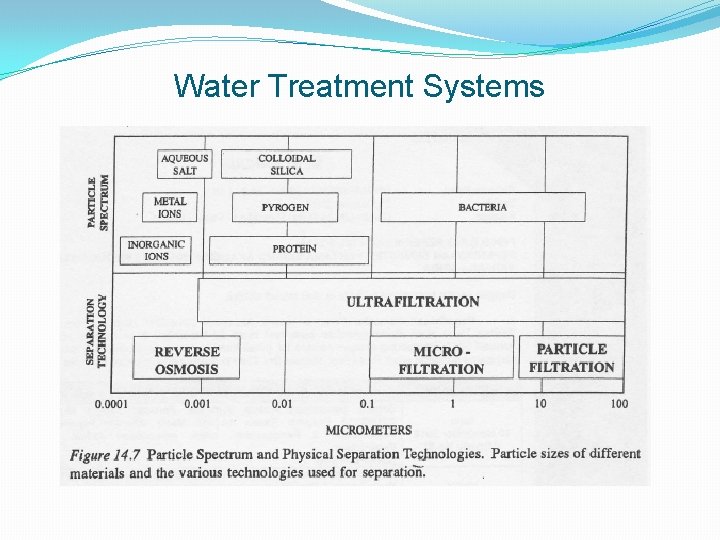
Water Treatment Systems Ultrafiltration: A physical separation process across a semipermeable membrane. The pores are 1 -20 nm, can separate high molecular weight species and particles, including colloids, particulates, microorganisms, endotoxin, and organic carbon (Figure 14. 7). Ultrafilters are periodically sanitized with chemical agents compatible with the filter membrane. Reverse osmosis: Applied external pressure to change the direction of the pressure gradient between low- and high concentration solutions across a nonporous semipermeable membrane. The increase in pressure forces water across the membrane, but ions, microorganisms, endotoxin, and low molecular weight organic carbon are retained (Figure 14. 7). The process is more economical than distillation, because less energy intensive, to produce Water For Injection (WFI). But the maintenance of the process is difficult to validate because of operational problems (such as membrane fouling, leak or rupture).
Water Treatment Systems
Water Treatment Systems Distillation: Used to produce Water For Injection (WFI). Impurities are left behind when the water evaporates into steam. Particulates, microorganisms, endotoxin, and most organic and inorganic chemicals do not evaporate, they remain in the blowdown stream. The water vapor is condensed (as WFI), and volatile constituents are not. The quality of feedwater to the still must be controlled to keep dissolved solids below 1 ppm (such solids can decrease the efficiency of the unit and lowering the distillate quality) A buildup of condensate with concentrated endotoxin and particulate matter can cause flooding of the column and contamination of the distillate.
Clean-Steam Systems Steam sterilization is the current method of choice for the sterilization of equipment, glassware and components. This method complies with the sterility requirements for FDAapprovable processes. Also used in a biotechnology facility for the decontamination of equipment, clothing, and components. Steam is used because of: Has high heat-transfer capacity Inherent moisture Highly lethal to microorganisms Adding no contaminants to the surface being sterilized Hot air is an alternative medium, but higher temperature and longer exposure time is required to obtain the same lethality as with clean steam.
Clean-Steam Systems Clean steam or pure steam is highly quality steam which is free from volatile additives (such as amines or hydrazine) and meets the USP (United States Pharmacopeia) specification for Water for Injection (WFI) in terms of constituents such as pyrogens, bacteria and dissolved solids. To produce this high-quality steam, high-purity feed water and specialized steam generation equipment are required. The equipment used to produce clean steam are: Kettle-type of clean-steam generator Thermosyphon-type clean-steam generator Dry-bottom type clean-steam generator
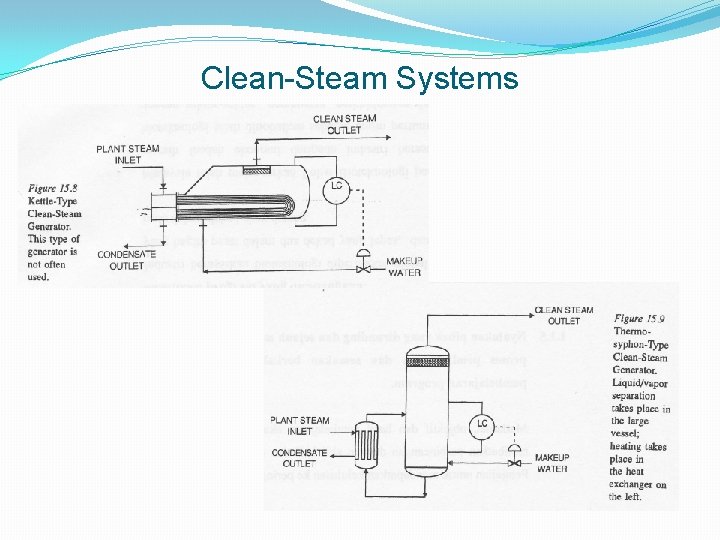
Clean-Steam Systems Kettle-type generator (Figure 15. 8): Is a simple design of clean-steam generator in which a heat exchanger tube bundle is submerged in water inside the pressure vessel (Figure 15. 8). Water droplets are removed from exiting steam at the top of the vessel by baffles or a mist eliminator pad. The removal of water droplets is essential to eliminate pyrogens. Therefore, the design of the mist elimination device is critical to ensure clean steam that meets specifications for pyrogens. Thermosyphon-type generator (Figure 15. 9): Has a vertical design; heat is transferred to the boiling water in a heat exchanger. An adjacent vessel provides feed water to the heat exchanger as well as vapor space where deentrainment of water droplets takes place. Make up water is introduced into the vessel upon a signal from the level controller.
Clean-Steam Systems
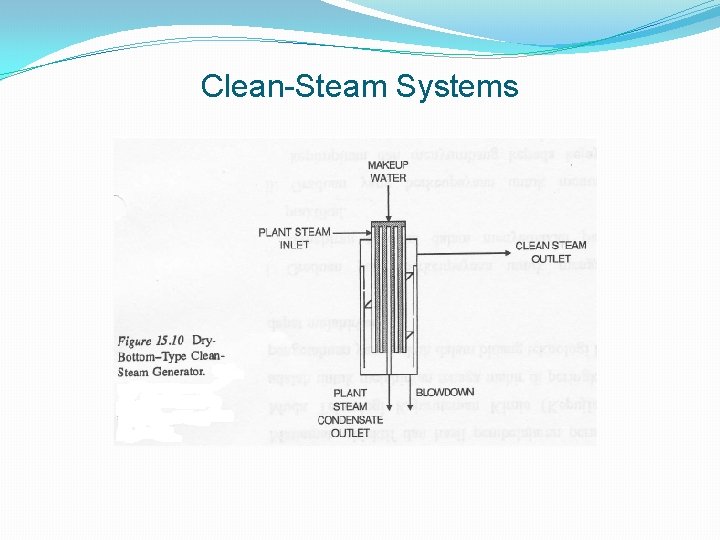
Clean-Steam Systems Dry bottom-type generator (Figure 15. 10): Feed water is introduced at the top of the unit and travels downward inside the tubes, vaporizing on its journey downward. At the bottom, the vapor reverses direction and travels upward, baffles guide it in spiral path; the centrifugal action forces droplets of water out of the vapor stream and into a collection zone. This action eliminates entrained water droplets from the vapor stream, and has been proven effective.
Clean-Steam Systems
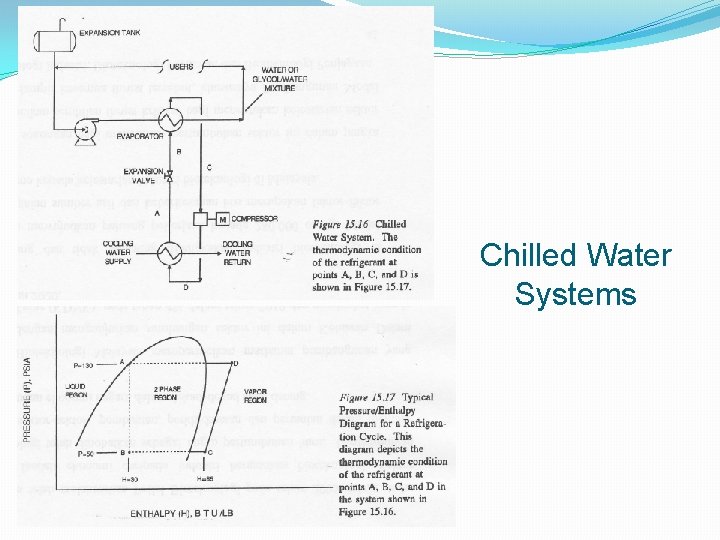
Chilled Water Systems Biotechnology facility need to include capabilities for low-temperature processing of biotechnology products, particularly if the product is derived from mammalian cells. The heating, ventilation and air conditioning (HVAC) system frequently use of chilled water to cool laboratory, office, and process areas. In chilled water system, water is not always the circulating medium. There is a lower limit (below 6°C or 42°F), which water cannot be used alone because of freezing in the heat exchanger when heat is rejected to the refrigerant. Below this temperature, a mixture of glycol and water is used. A schematic of chilled water system is shown in Figure 15. 16.
Chilled Water Systems
Air and Gas Systems Air has many uses in biotechnology facilities such as: Instrumentation and control purposes (pneumatic valve) Providing oxygen to a bioreactor A motive force for making transfers of liquid streams A cooling medium for vessels after sterilization A source of energy for air motors on agitators The air supplied by the compressor in biotechnology facilities is dry and oil-free. For a facility producing sterile product, the air is sterile-filtered, in addition to being dry and oil-free, to eliminate contamination by microorganisms. A commonly used design basis is dry air with a dew point of -40°F.
- Slides: 22