
PTSD Basics for Anyone Serving Survivors of Trauma
PTSD Basics for Anyone Serving Survivors of Trauma MELODY PEWITT ME. D. LPCC-S, NCC TRAUMA COUNSELOR PATHWAYS, INC. ASHLAND, KY
Learning Objectives To acquire basic knowledge about PTSD and its effect on survivors of trauma To establish means of providing some immediate help and support to survivors of trauma while beginning to instill hope of healing and recovery To explore special considerations to be made when working with survivors of trauma in any capacity To understand the signs of vicarious trauma and review possible remedies
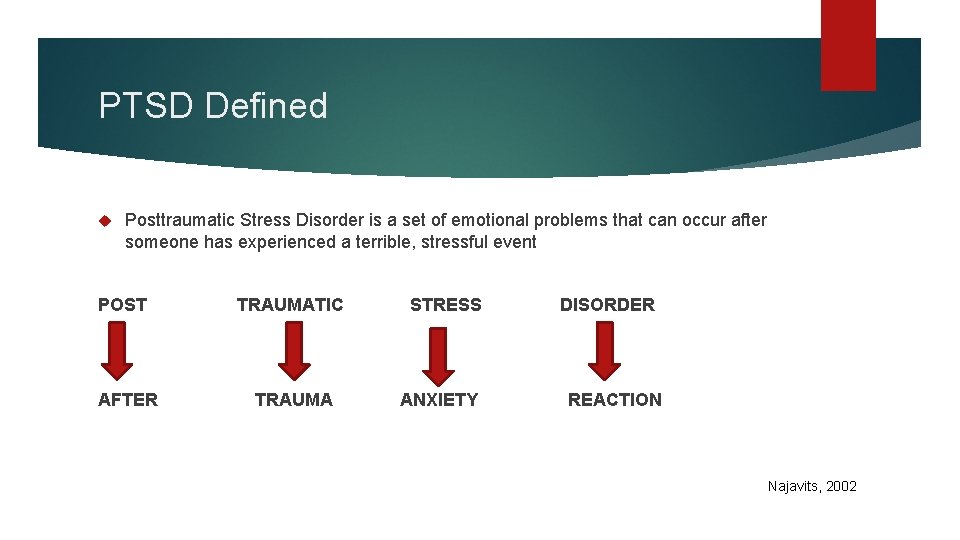
PTSD Defined Posttraumatic Stress Disorder is a set of emotional problems that can occur after someone has experienced a terrible, stressful event POST AFTER TRAUMATIC TRAUMA STRESS ANXIETY DISORDER REACTION Najavits, 2002

Potentially Traumatic Events and Stressors Intentional Human Unintentional Human Acts of Nature Schiraldi, 2009
Prevalence Rates of PTSD are higher among veterans and first responders Highest rates are found among survivors of rape, military combat, internment camps, and genocide Children and adolescents generally have displayed lower prevalence following exposure to serious traumatic events Prevalence of full-threshold PTSD appears to be lower among older adults compared with the general population https: //www. videoblocks. com/video/fire-truck-lights-flashing---looping-rwk 3 pqf DSM-5, 2013
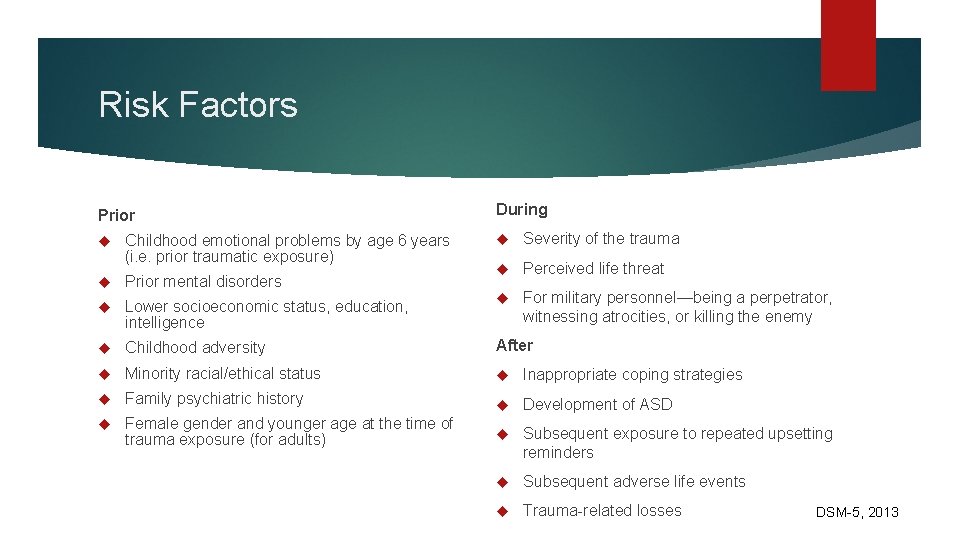
Risk Factors Prior During Severity of the trauma Perceived life threat For military personnel—being a perpetrator, witnessing atrocities, or killing the enemy Childhood emotional problems by age 6 years (i. e. prior traumatic exposure) Prior mental disorders Lower socioeconomic status, education, intelligence Childhood adversity After Minority racial/ethical status Inappropriate coping strategies Family psychiatric history Development of ASD Female gender and younger age at the time of trauma exposure (for adults) Subsequent exposure to repeated upsetting reminders Subsequent adverse life events Trauma-related losses DSM-5, 2013

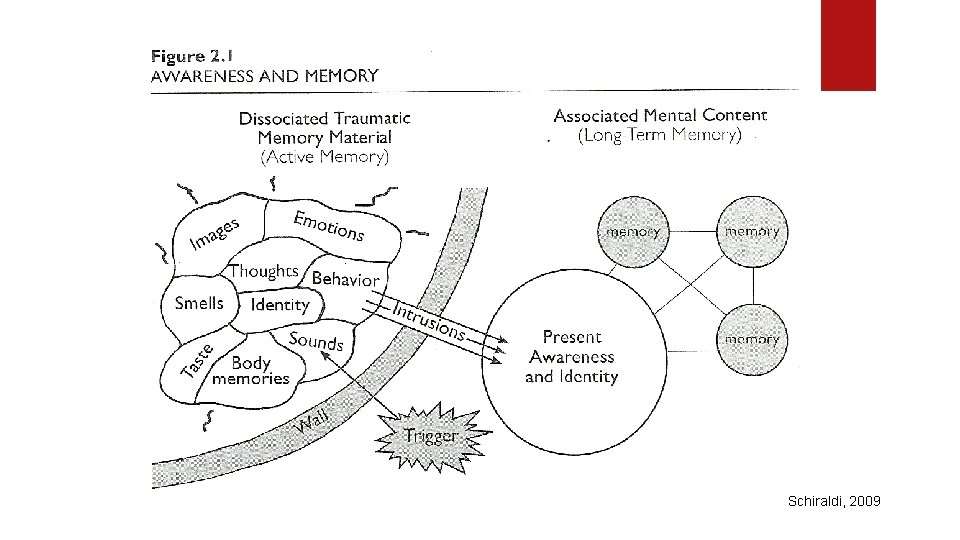
Symptoms of PTSD Explained Event re-experienced Intrusive memories Trigger may or may not be obvious Often elicit feelings of fear and vulnerability, rage at the cause, sadness, disgust or guilt Flashbacks Often a visual re-experience but can also involve sensations, behavior, or emotions Nightmares Accurate replays Symbolic Schiraldi, 2009
Schiraldi, 2009

Symptoms of PTSD Explained Cont. Arousal Sleep disturbance Irritability or anger outbursts Difficulty concentrating or remembering Hypervigilance Exaggerated startle response www. minddisorders. com Schiraldi, 2009

Symptoms of PTSD Explained Cont. Avoidance and Numbing Dissociation Depersonalization- Person can feel as if they are an outside observer of self Derealization- Looks at the event as if it is not really happening Dissociative Identity Disorder (DID)- People form at least two different personality states, or identities, in order to cope with unacceptable material Avoidance and numbing through behaviors Link between trauma and substance use PTSD can lead to substance use Substance use can lead to PTSD and substance use connected in a “downward spiral” Najavits, 2002 Schiraldi, 2009
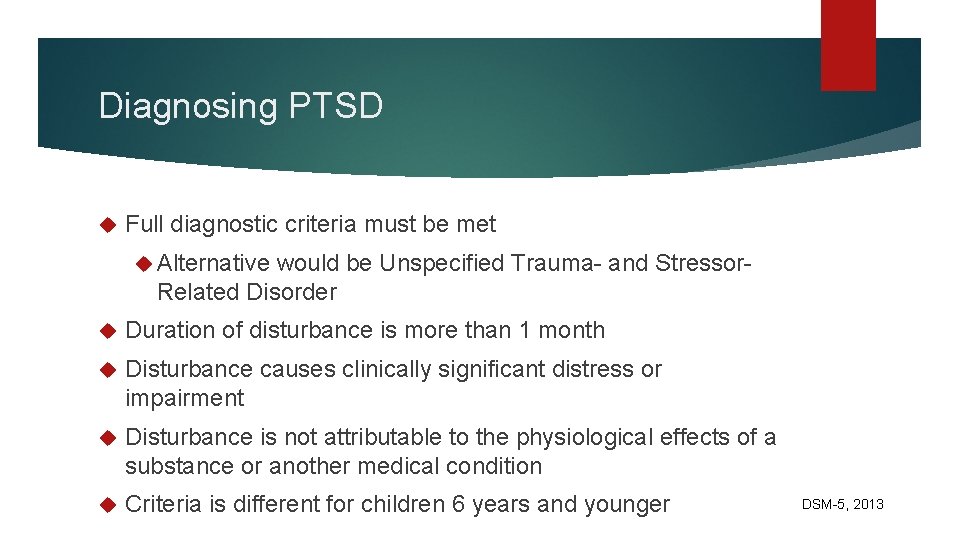
Diagnosing PTSD Full diagnostic criteria must be met Alternative would be Unspecified Trauma- and Stressor. Related Disorder Duration of disturbance is more than 1 month Disturbance causes clinically significant distress or impairment Disturbance is not attributable to the physiological effects of a substance or another medical condition Criteria is different for children 6 years and younger DSM-5, 2013

Trauma Assessment Instruments Traumatic Antecedents Questionnaire (TAQ) Self-administered Information about lifetime experiences at four different age periods Available for free at http: //www. traumacenter. org/products/instruments. php Trauma Focused Initial Adult Clinical Evaluation Structured clinical interview focusing on trauma history and associated symptomatology Also available for free at the Trauma Center website listed above Trauma Symptom Inventory (TSI) 100 items used to evaluate acute and chronic post-traumatic symptomatology Ordering information at https: //www. parinc. com/Products/Pkey/464 Curran, 2010
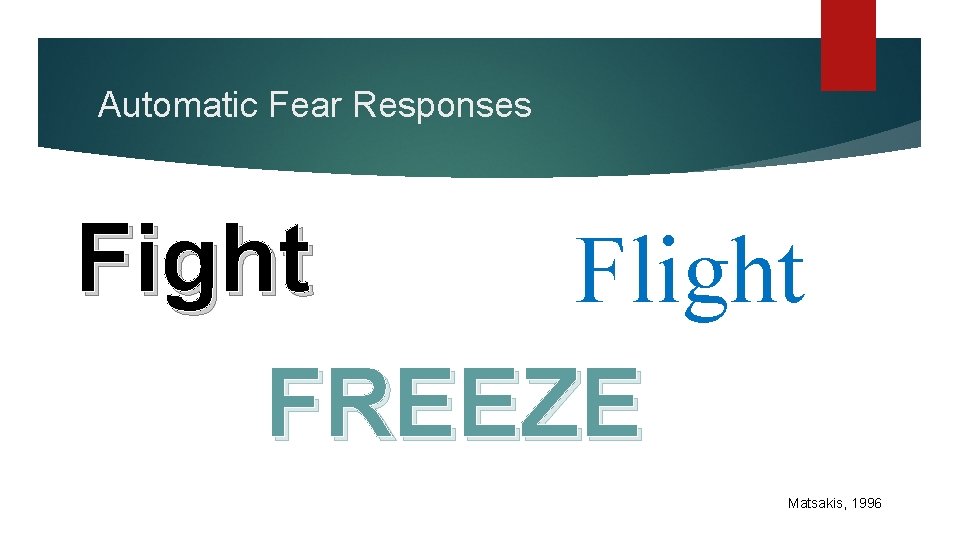
Automatic Fear Responses Fight Flight FREEZE Matsakis, 1996
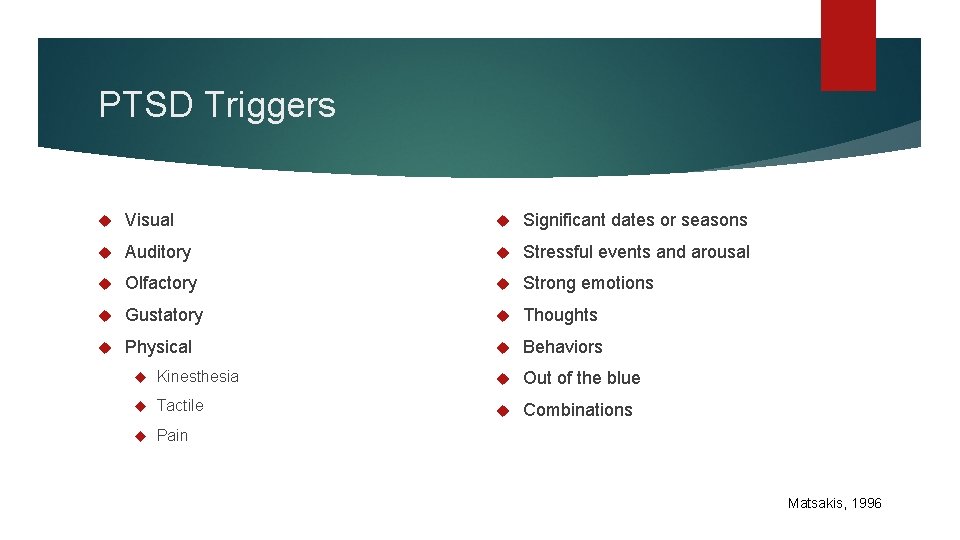
PTSD Triggers Visual Significant dates or seasons Auditory Stressful events and arousal Olfactory Strong emotions Gustatory Thoughts Physical Behaviors Kinesthesia Out of the blue Tactile Combinations Pain Matsakis, 1996
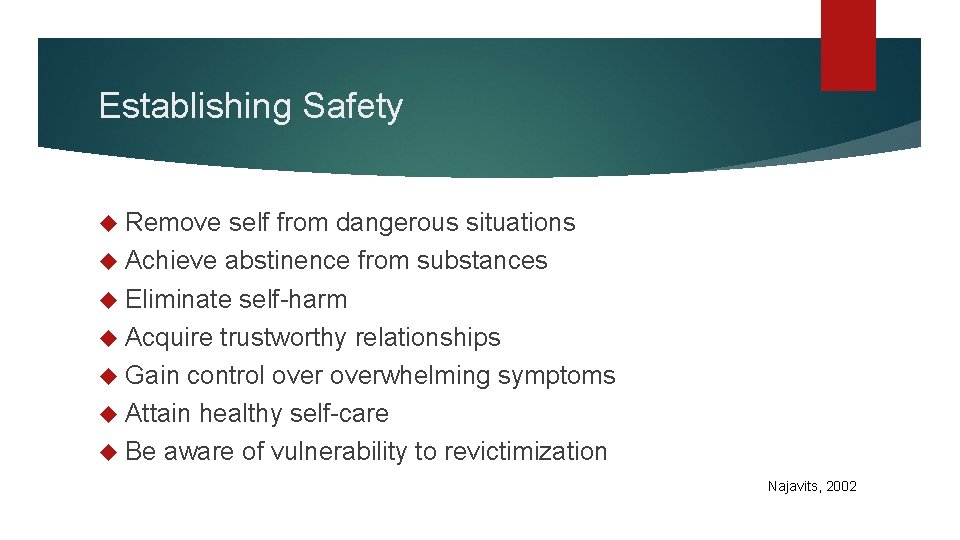
Establishing Safety Remove self from dangerous situations Achieve abstinence from substances Eliminate self-harm Acquire trustworthy relationships Gain control overwhelming symptoms Attain healthy self-care Be aware of vulnerability to revictimization Najavits, 2002
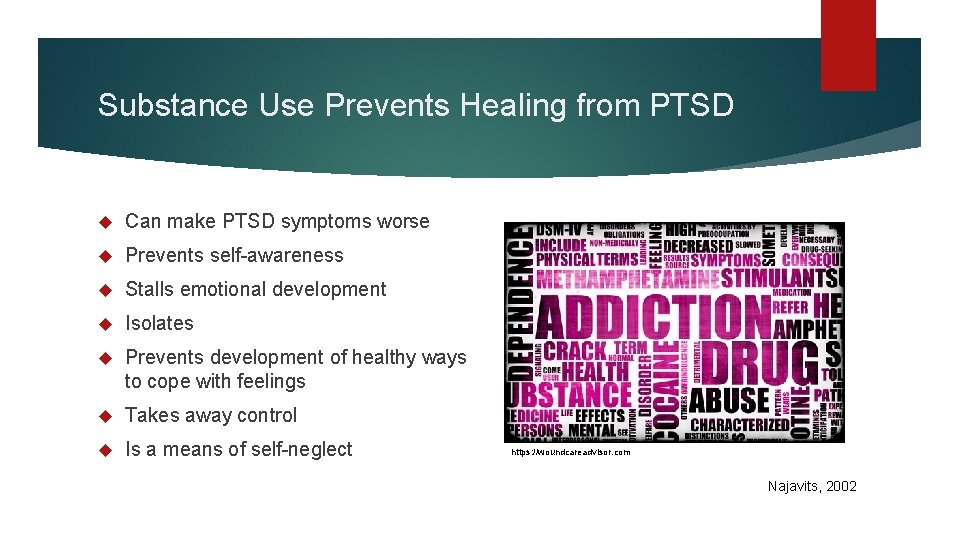
Substance Use Prevents Healing from PTSD Can make PTSD symptoms worse Prevents self-awareness Stalls emotional development Isolates Prevents development of healthy ways to cope with feelings Takes away control Is a means of self-neglect https: //woundcareadvisor. com Najavits, 2002
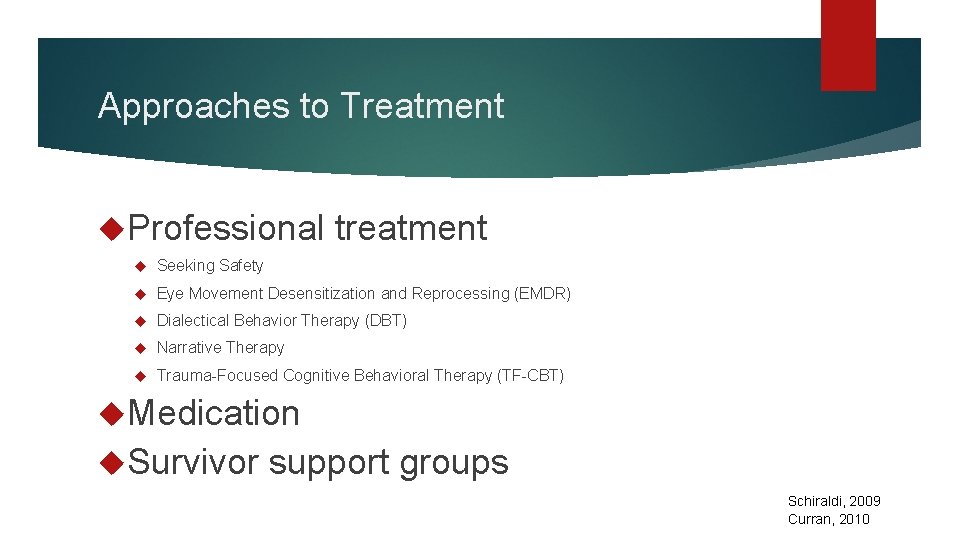
Approaches to Treatment Professional treatment Seeking Safety Eye Movement Desensitization and Reprocessing (EMDR) Dialectical Behavior Therapy (DBT) Narrative Therapy Trauma-Focused Cognitive Behavioral Therapy (TF-CBT) Medication Survivor support groups Schiraldi, 2009 Curran, 2010

Medication Helpful in the Treatment of PTSD Antidepressants- Zoloft, Paxil, Prozac, Celexa, Lexapro, Effexor, Cymbalta, Elavil Mood stabilizers and atypical antipsychotics - Risperdal, Zyprexa, Seroquel, Depakote Antiadrenergic agents- Propranolol, Prazosin Benzodiazepines- Valium, Ativan, Xanax, Klonopin Buspar www. accessdata. fda. gov Schiraldi, 2009
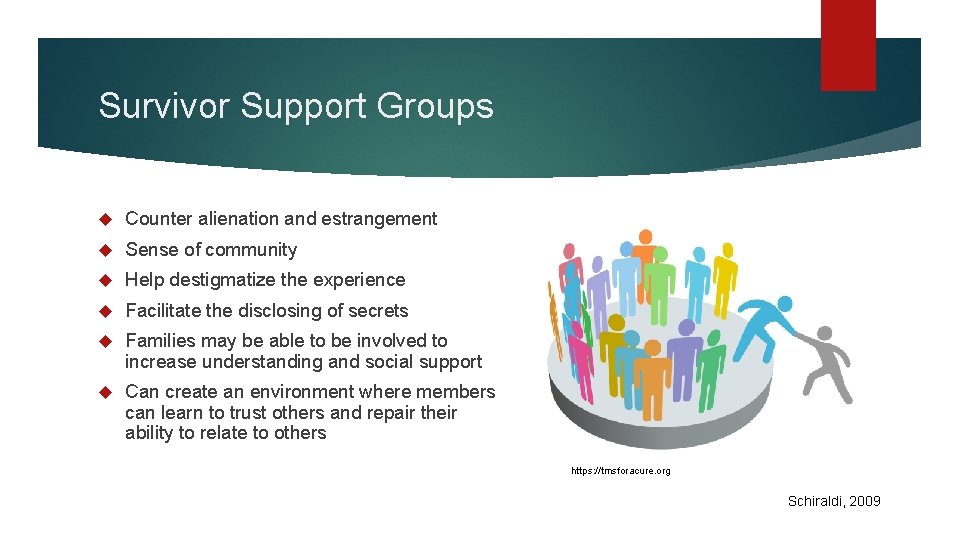
Survivor Support Groups Counter alienation and estrangement Sense of community Help destigmatize the experience Facilitate the disclosing of secrets Families may be able to be involved to increase understanding and social support Can create an environment where members can learn to trust others and repair their ability to relate to others https: //tmsforacure. org Schiraldi, 2009
Quick Interventions Subjective Units of Distress Scale (SUDs) Physical, mental, and soothing grounding techniques Breathing retraining Beginning to challenge cognitive distortions Schiraldi, 2009 Najavits, 2002
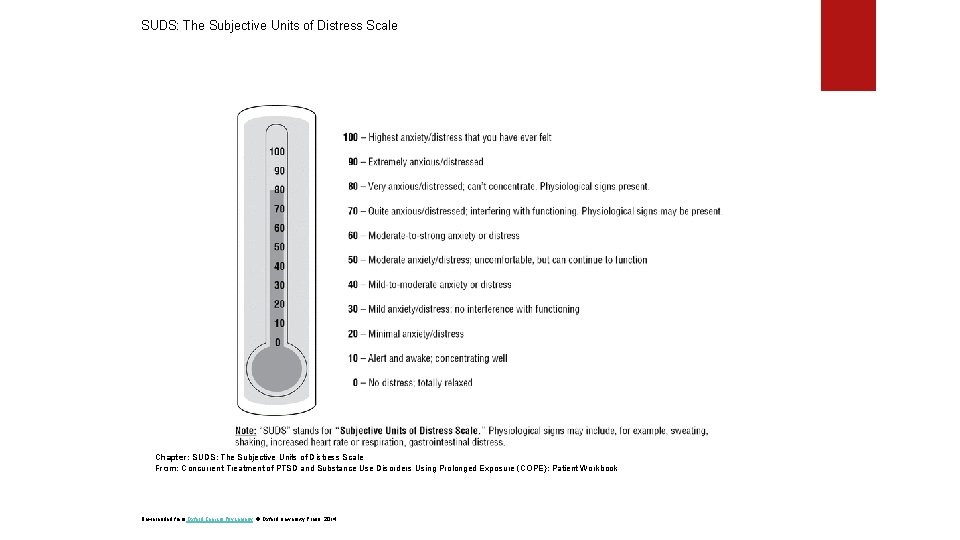
SUDS: The Subjective Units of Distress Scale Chapter: SUDS: The Subjective Units of Distress Scale From: Concurrent Treatment of PTSD and Substance Use Disorders Using Prolonged Exposure (COPE): Patient Workbook Downloaded from Oxford Clinical Psychology. © Oxford University Press, 2014
Physical, Mental, and Soothing Grounding Techniques The goal is to shift attention toward the external world, away from negative feelings Grounding is not a relaxation exercise Actively reduce negative feelings over a 6 on the SUDs scale Mental grounding- ex. Categories game, asking informational questions Physical grounding- ex. Exercise that engages all 5 senses (5 -see, 4 -touch, 3 hear, 2 -smell, 1 -taste) Soothing grounding- ex. Repeat positive affirmation on every exhale (i. e. “I am calm” or “I will get through this”) Najavits, 2002
Breathing Retraining Body and mind are connected in regards to anxiety When someone is hyperventilating, or over-breathing, they are engaging in rapid, shallow “chest” breathing Goal of breathing retraining is to change from erratic breathing to slow, regular, rhythmic abdominal breathing and to make this kind of breathing automatic Note that excessive caffeine, nicotine, and other stimulants can simulate an anxiety attack Schiraldi, 2009
Breathing Retraining Cont. To practice breathing retraining: Reclined or half-lying position and place a reasonable weight over abdomen Inhale through nose or through pursed lips Keep all of your body above your diaphragm relaxed and still, moving only your abdomen Suggested that individuals gradually work up to practicing twice a day or more, for five to ten minutes each time Using breathing retraining in response to acute anxiety attack: Start by emptying lungs completely Breathe in like breathing in through straw and exhale through mouth On exhales count (up to 10 and repeat or count indefinitely) or say a soothing word or phrase Schiraldi, 2009
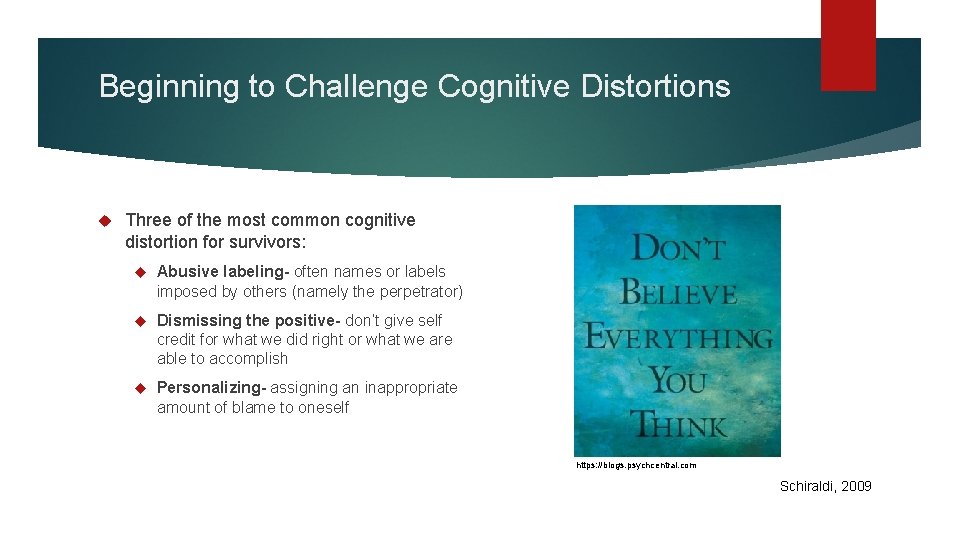
Beginning to Challenge Cognitive Distortions Three of the most common cognitive distortion for survivors: Abusive labeling- often names or labels imposed by others (namely the perpetrator) Dismissing the positive- don’t give self credit for what we did right or what we are able to accomplish Personalizing- assigning an inappropriate amount of blame to oneself https: //blogs. psychcentral. com Schiraldi, 2009
Signs of Recovery from PTSD Ability to talk about the trauma without feeling either very upset or numb Ability to function well in daily life Are safe (e. g. not suicidal or abusing substances) Are able to be in healthy relationships without feeling completely vulnerable or isolated Are able to take pleasure in life Take good care of body Can rely on self and others Can control the most overwhelming symptoms Believe that they deserve to take good care of themselves Have confidence that they can protect themselves Najavits, 2002

Special Considerations for Working with Survivors of Trauma https: //drkathleenyoung. wordpress. com
Practicing Cultural Humility and Awareness of Intersectionality One’s own cultural identities and experiences may limit their perspective and awareness in understanding the cultural experiences of others “Other-oriented” stance that includes openness, respect, consideration, humility and interest regarding their cultural identity and experiences Invite feedback from survivors regarding your perceived cultural humility and awareness of intersectionality “Does this individual experience me as culturally competent? ” Multicultural Competencies Self-Assessment Survey (MCSA) developed by Manivong Ratts Shaw, 2016
Special Considerations for Working with Survivors of Trauma Use their verbiage Allow individuals to decide what was traumatic for them The compassionate view is that the symptoms served a functional role Have “fidget” items available Refrain from making assumptions (i. e. gender of perpetrator, use of substances) Create a safe and supportive environment Allow survivors to remain in control and make their own decisions Najavits, 2002 Schiraldi, 2009
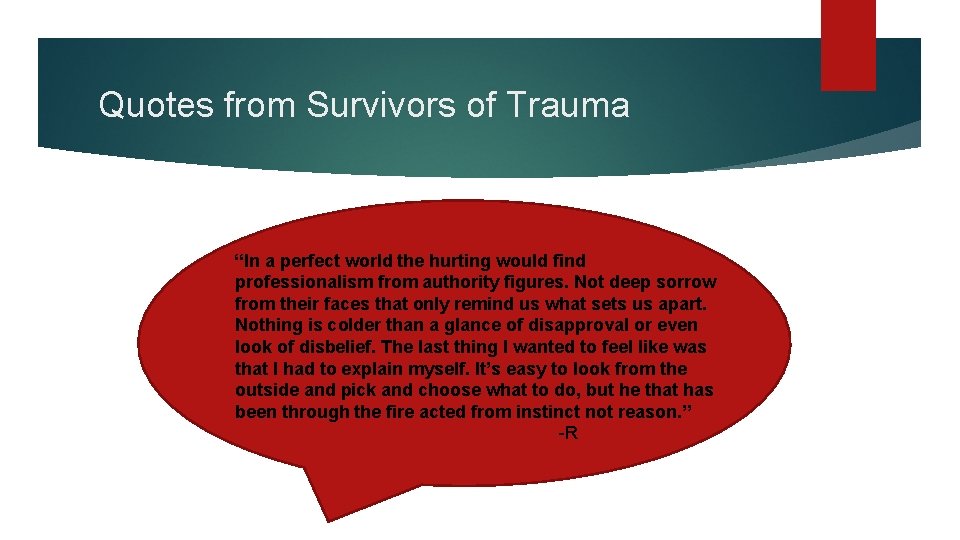
Quotes from Survivors of Trauma “In a perfect world the hurting would find professionalism from authority figures. Not deep sorrow from their faces that only remind us what sets us apart. Nothing is colder than a glance of disapproval or even look of disbelief. The last thing I wanted to feel like was that I had to explain myself. It’s easy to look from the outside and pick and choose what to do, but he that has been through the fire acted from instinct not reason. ” -R
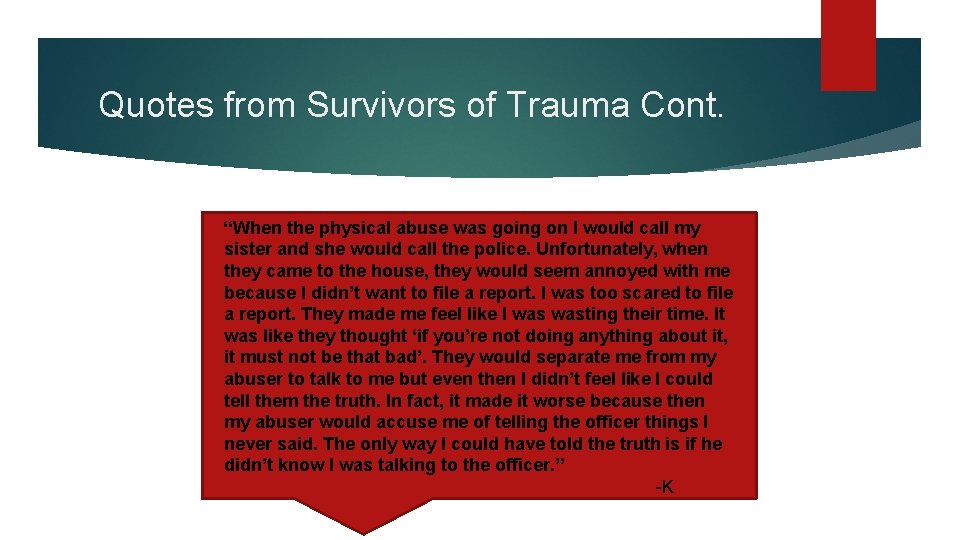
Quotes from Survivors of Trauma Cont. “When the physical abuse was going on I would call my sister and she would call the police. Unfortunately, when they came to the house, they would seem annoyed with me because I didn’t want to file a report. I was too scared to file a report. They made me feel like I wasting their time. It was like they thought ‘if you’re not doing anything about it, it must not be that bad’. They would separate me from my abuser to talk to me but even then I didn’t feel like I could tell them the truth. In fact, it made it worse because then my abuser would accuse me of telling the officer things I never said. The only way I could have told the truth is if he didn’t know I was talking to the officer. ” -K
Quotes from Survivors of Trauma Cont. “I understand that there are some things that the prosecutor’s office may know that they don’t want me to know but they really do need to communicate better. I don’t get called back. A victim has the right to know what’s going on. I was told I would be in the loop the whole time and I’m not at all. ” -J
Vicarious Trauma EFFECT ON ONE’S PHYSICAL, PSYCHOLOGICAL, EMOTIONAL AND SPIRITUAL HEALTH WHEN THEY LISTEN TO TRAUMATIC STORIES REPEATEDLY OR RESPOND TO TRAUMATIC SITUATIONS WHILE HAVING TO CONTROL THEIR REACTION KASAP, 2014
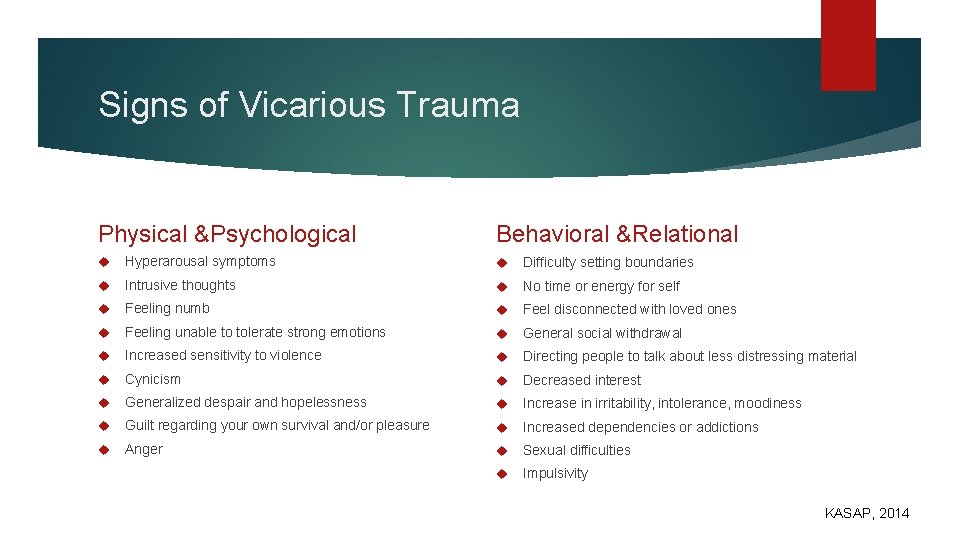
Signs of Vicarious Trauma Physical &Psychological Behavioral &Relational Hyperarousal symptoms Difficulty setting boundaries Intrusive thoughts No time or energy for self Feeling numb Feel disconnected with loved ones Feeling unable to tolerate strong emotions General social withdrawal Increased sensitivity to violence Directing people to talk about less distressing material Cynicism Decreased interest Generalized despair and hopelessness Increase in irritability, intolerance, moodiness Guilt regarding your own survival and/or pleasure Increased dependencies or addictions Anger Sexual difficulties Impulsivity KASAP, 2014
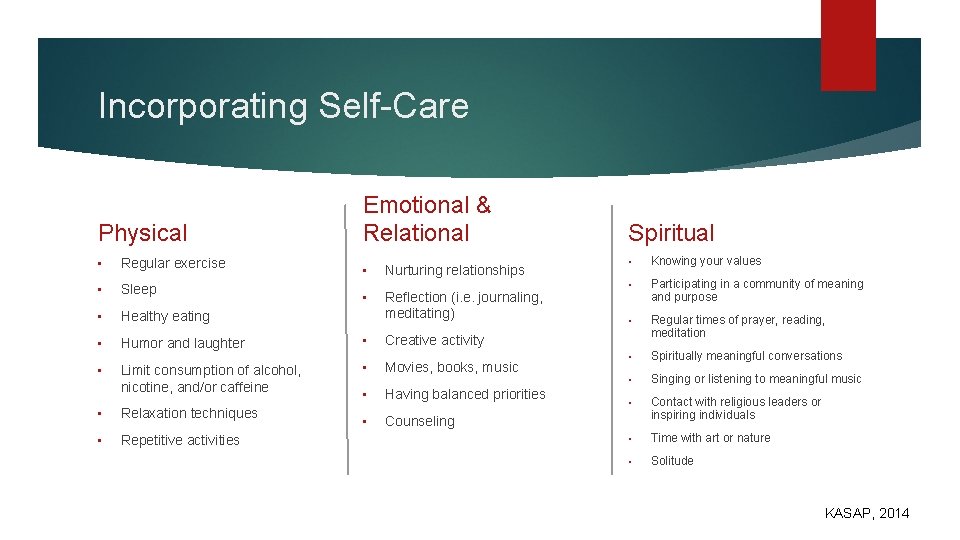
Incorporating Self-Care Physical Emotional & Relational • Regular exercise • Sleep • Healthy eating • Humor and laughter • Creative activity Limit consumption of alcohol, nicotine, and/or caffeine • Movies, books, music • Having balanced priorities • Counseling • • Relaxation techniques • Repetitive activities • Nurturing relationships • Reflection (i. e. journaling, meditating) Spiritual • Knowing your values • Participating in a community of meaning and purpose • Regular times of prayer, reading, meditation • Spiritually meaningful conversations • Singing or listening to meaningful music • Contact with religious leaders or inspiring individuals • Time with art or nature • Solitude KASAP, 2014
Combating Vicarious Trauma in the Workplace Maintain boundaries Review old thank you notes from survivors Manage expectations Utilize supervision and debriefing Do something fun with colleagues Don’t skimp on vacations and lunches Vary the work that you do Focus on what you did well Find rituals that help you transition in and out of work-mode Attend conferences and trainings http: //gflec. org KASAP, 2014 www. proqol. org
"Although the world is full of suffering, it is also full of the overcoming of it. " - Helen Keller https: //www. psychologytoday. com/us/blog/here-there-andeverywhere/201102/30 -quotes-healing
References Seeking Safety: A Treatment Manual for PTSD and Substance Abuse by Lisa M. Najavits Diagnostic and Statistical Manual of Mental Disorders: Fifth Edition (DSM-5) The Posttraumatic Stress Disorder Sourcebook: Second Edition: A Guide to Healing, Recovery and Growth by Glenn R. Schiraldi, Ph. D. Trauma Competency: A Clinician’s Guide by Linda A. Curran I Can’t Get Over It: A Handbook for Trauma Survivors: Second Edition by Aphrodite Matsakis, Ph. D. KASAP-provided lesson plan on vicarious trauma and self-care Practicing cultural humility by Sidney Shaw Concurrent Treatment of PTSD and Substance Use Disorders Using Prolonged Exposure (COPE): Patient Workbook by Sudie E. Back et al. www. narrativeapproaches. com http: //www. traumacenter. org/ www. proqol. org Drowning in Empathy: The Cost of Vicarious Trauma– Amy Cunningham—TED Talks, 2016

Melody Pewitt MEd, LPCC-S, NCC Pathways, Inc. Ashland, KY melody. pewitt@pathways-ky. org
- Slides: 39