
PTSD and Emergency Responders An overview of the
- Slides: 48
PTSD and Emergency Responders An overview of the literature
Goals • • Define what PTSD is (and isn’t) Symptoms of PTSD Triggers of PTSD and other influences Traumatic stress continuum Preventing PTSD Treating PTSD Taxonomy of research necessary to help manage PTSD in emergency responder community
Disclaimer • Many areas of literature are underdeveloped • The “best practices” were identified on the basis of a literature review only • As such, they would need to be validated with PTSD experts before implementation
What is PTSD? • Post-traumatic stress disorder can be defined as: • a condition where symptoms evolve in the aftermath of an extreme traumatic stressor that overwhelms the individual’s coping capacities • a progressive symptomatic response to traumatic stress that fails to recede after at least 30 days
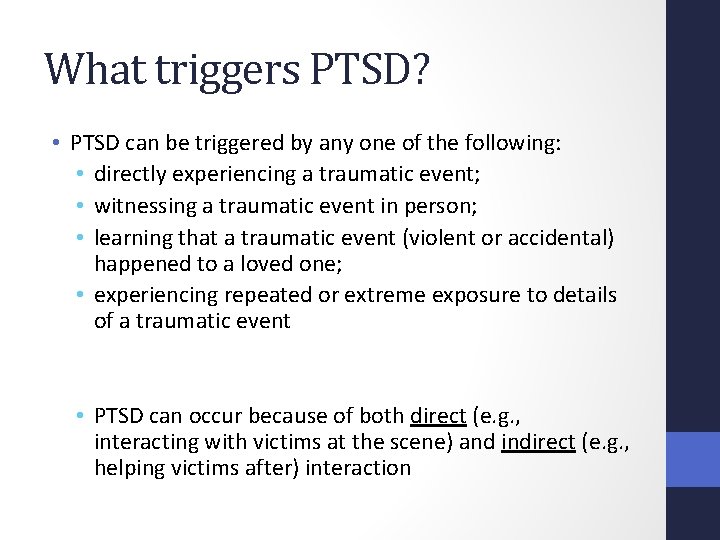
What triggers PTSD? • PTSD can be triggered by any one of the following: • directly experiencing a traumatic event; • witnessing a traumatic event in person; • learning that a traumatic event (violent or accidental) happened to a loved one; • experiencing repeated or extreme exposure to details of a traumatic event • PTSD can occur because of both direct (e. g. , interacting with victims at the scene) and indirect (e. g. , helping victims after) interaction
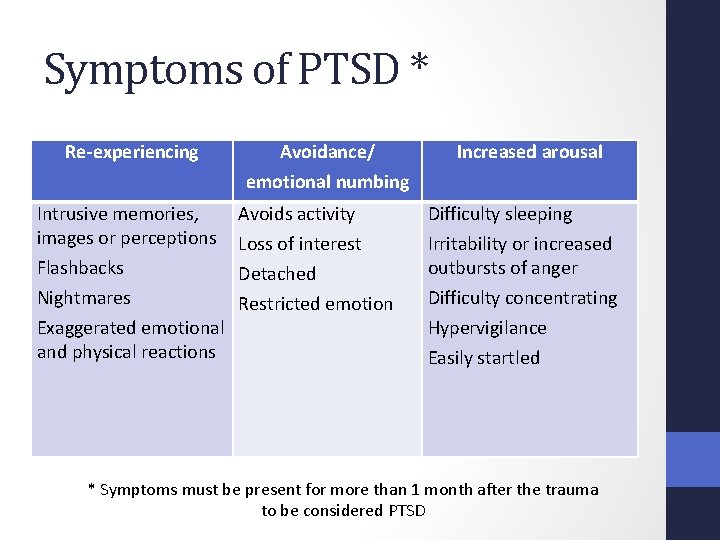
Symptoms of PTSD * Re-experiencing Avoidance/ Increased arousal emotional numbing Intrusive memories, images or perceptions Flashbacks Nightmares Exaggerated emotional and physical reactions Avoids activity Difficulty sleeping Loss of interest Detached Restricted emotion Irritability or increased outbursts of anger Difficulty concentrating Hypervigilance Easily startled * Symptoms must be present for more than 1 month after the trauma to be considered PTSD
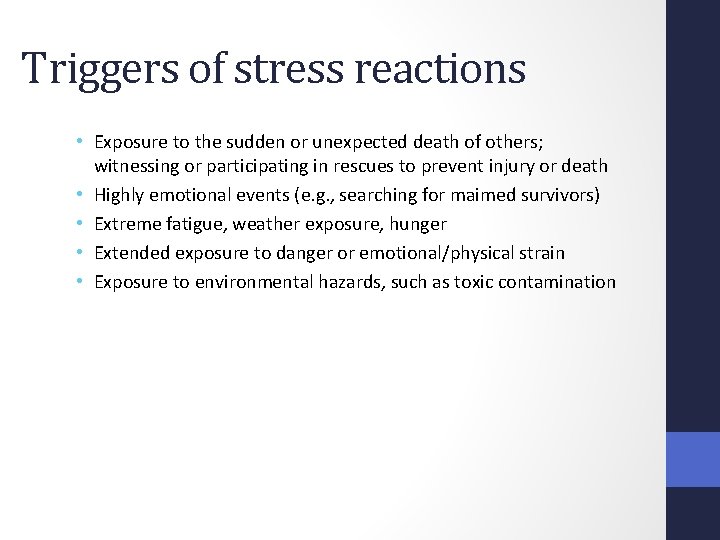
Triggers of stress reactions • Exposure to the sudden or unexpected death of others; witnessing or participating in rescues to prevent injury or death • Highly emotional events (e. g. , searching for maimed survivors) • Extreme fatigue, weather exposure, hunger • Extended exposure to danger or emotional/physical strain • Exposure to environmental hazards, such as toxic contamination
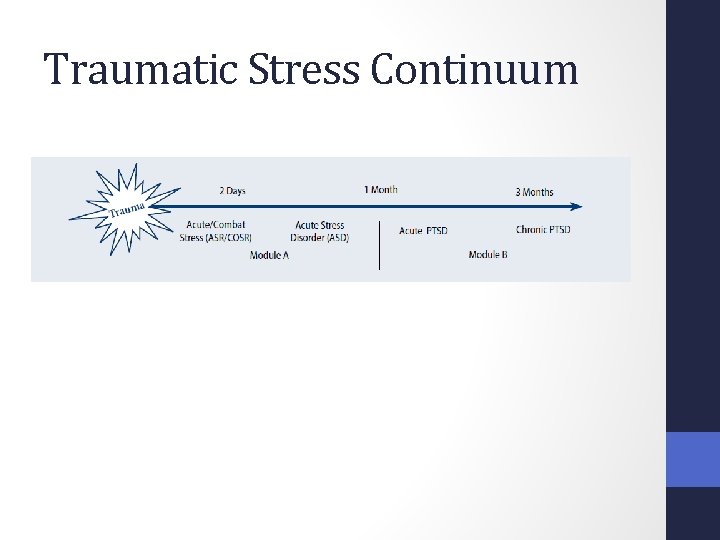
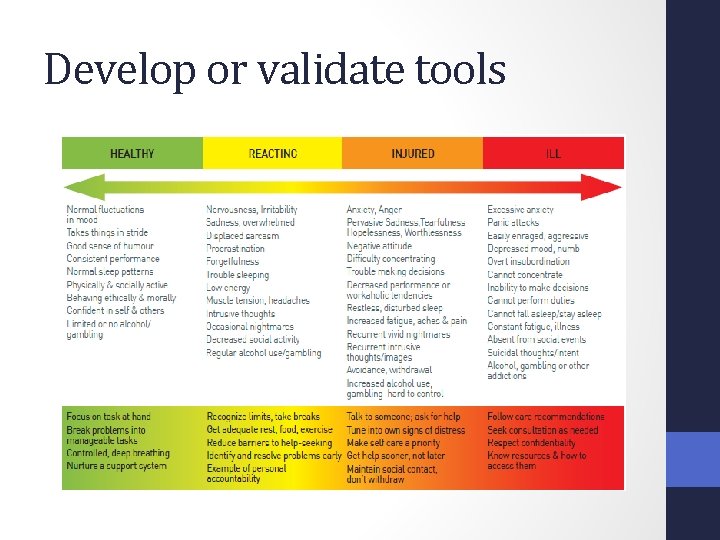
Traumatic Stress Continuum
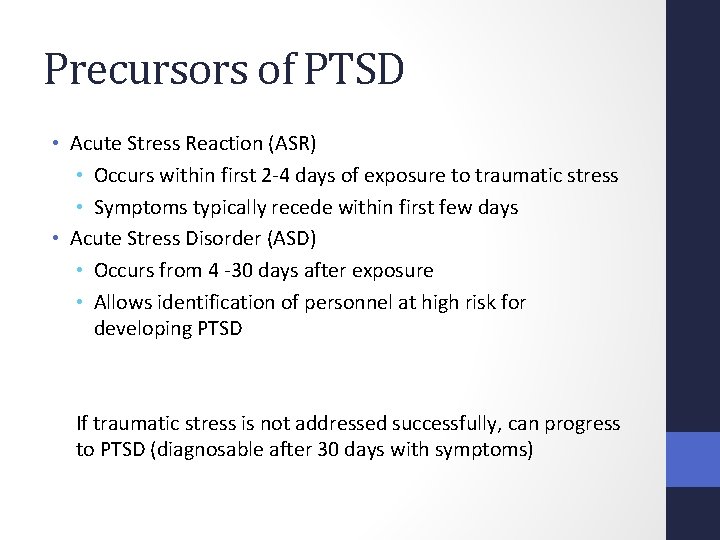
Precursors of PTSD • Acute Stress Reaction (ASR) • Occurs within first 2 -4 days of exposure to traumatic stress • Symptoms typically recede within first few days • Acute Stress Disorder (ASD) • Occurs from 4 -30 days after exposure • Allows identification of personnel at high risk for developing PTSD If traumatic stress is not addressed successfully, can progress to PTSD (diagnosable after 30 days with symptoms)
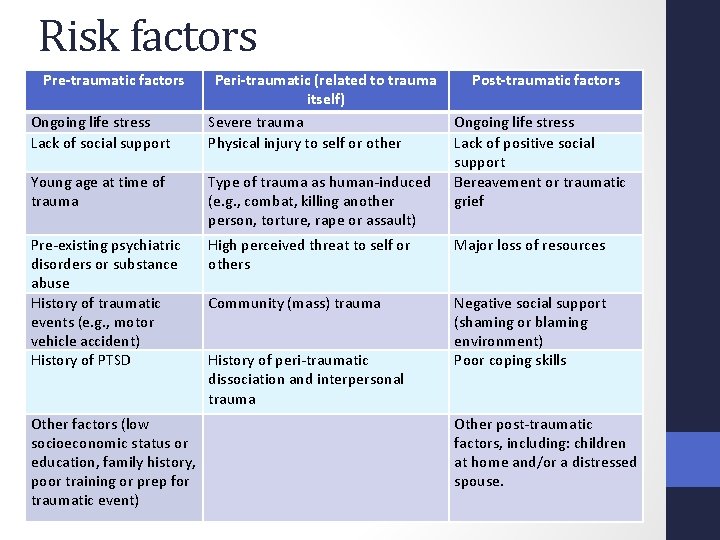
Risk factors Pre-traumatic factors Ongoing life stress Lack of social support Peri-traumatic (related to trauma itself) Severe trauma Physical injury to self or other Post-traumatic factors Ongoing life stress Lack of positive social support Bereavement or traumatic grief Young age at time of trauma Type of trauma as human-induced (e. g. , combat, killing another person, torture, rape or assault) Pre-existing psychiatric disorders or substance abuse History of traumatic events (e. g. , motor vehicle accident) History of PTSD High perceived threat to self or others Major loss of resources Community (mass) trauma Negative social support (shaming or blaming environment) Poor coping skills History of peri-traumatic dissociation and interpersonal trauma Other factors (low socioeconomic status or education, family history, poor training or prep for traumatic event) Other post-traumatic factors, including: children at home and/or a distressed spouse.
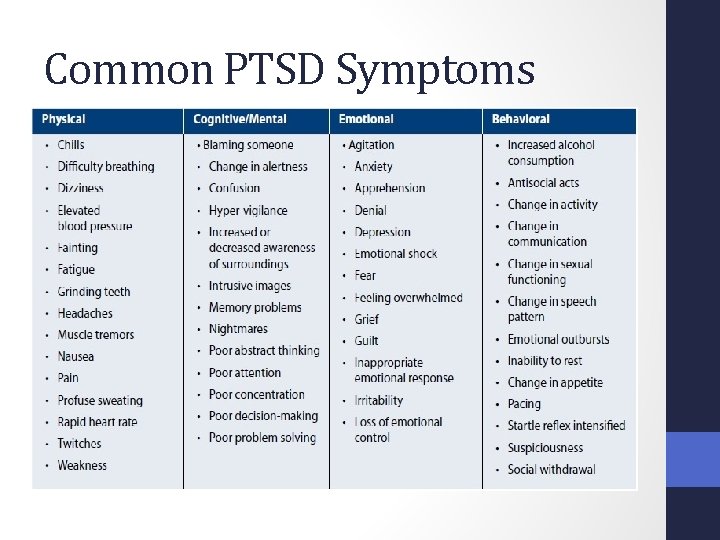
Common PTSD Symptoms
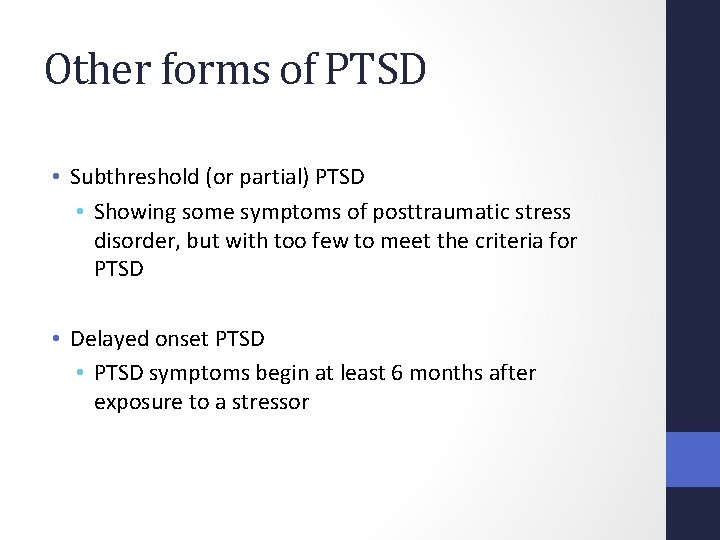
Other forms of PTSD • Subthreshold (or partial) PTSD • Showing some symptoms of posttraumatic stress disorder, but with too few to meet the criteria for PTSD • Delayed onset PTSD • PTSD symptoms begin at least 6 months after exposure to a stressor
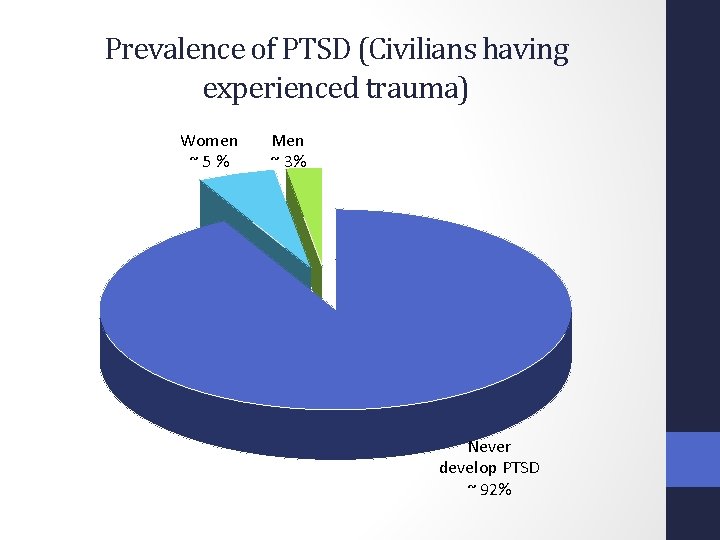
Prevalence of PTSD (Civilians having experienced trauma) Women ~ 5 % Men ~ 3% Never develop PTSD ~ 92%
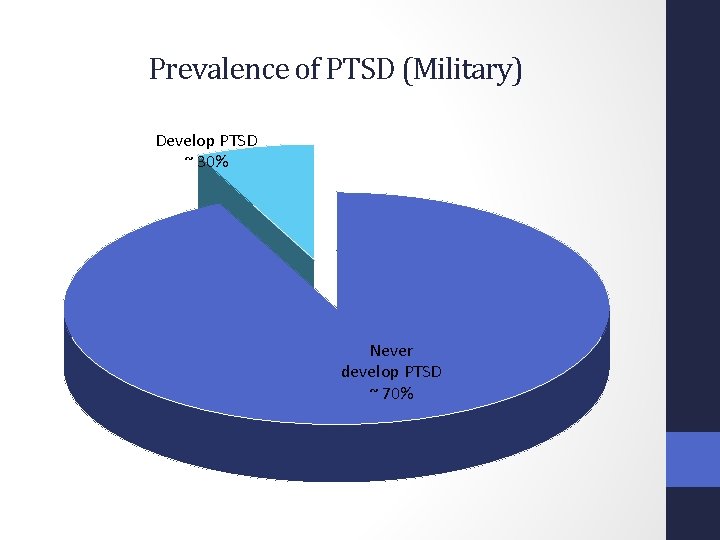
Prevalence of PTSD (Military) Develop PTSD ~ 30% Never develop PTSD ~ 70%
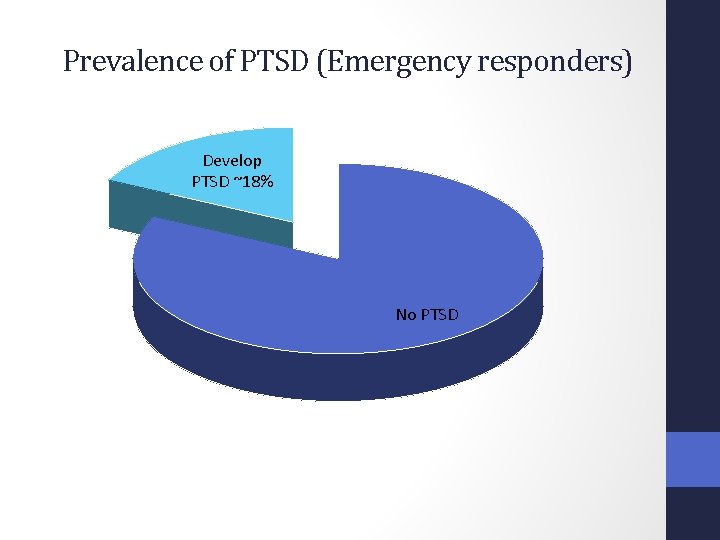
Prevalence of PTSD (Emergency responders) Develop PTSD ~18% No PTSD
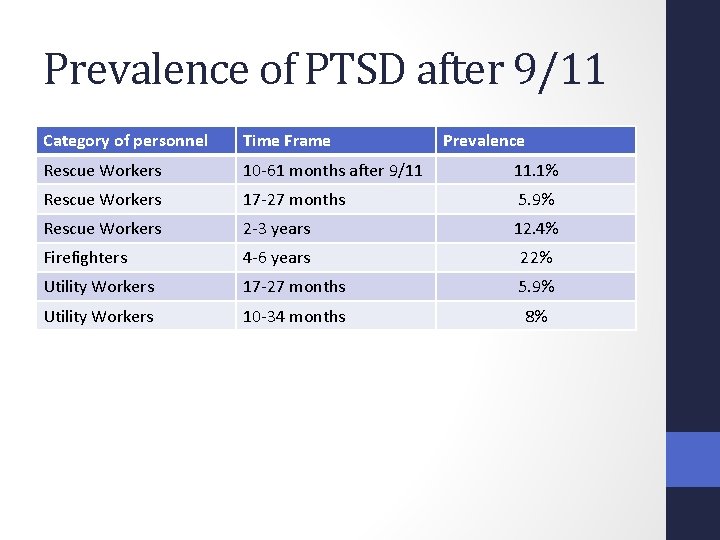
Prevalence of PTSD after 9/11 Category of personnel Time Frame Prevalence Rescue Workers 10 -61 months after 9/11 11. 1% Rescue Workers 17 -27 months 5. 9% Rescue Workers 2 -3 years 12. 4% Firefighters 4 -6 years 22% Utility Workers 17 -27 months 5. 9% Utility Workers 10 -34 months 8%
Co-occurring Conditions • Other challenges associated with PTSD: • Psychiatric: e. g. , depression, substance abuse disorders, suicide risk • Medical: e. g. , chronic pain, TBI, spinal cord injury • Psychosocial: e. g. , relationship problems, difficulties in social settings, intimate partner violence, child maltreatment, unemployment, homelessness, incarceration
“Take home” messages - 1 • PTSD must be deliberately and proactively managed • Most people do not get PTSD even after they experience traumatic stress • Traumatic stress is a continuum – managing earlier is better • Both first responders and receivers are susceptible • Onset of PTSD can be delayed by months • Risk of PTSD depends on kind of trauma encountered
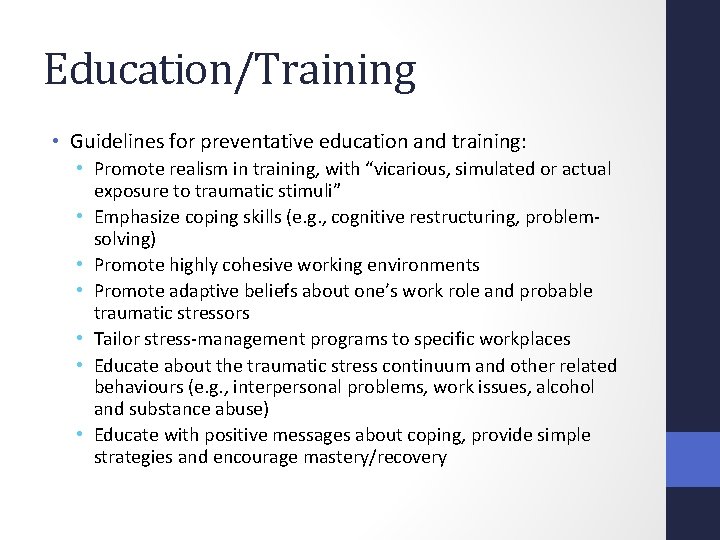
Prevention of PTSD • Prevention efforts can happen either before or after the traumatic event • Two routes to prevention: • Education and Training Programs • Screening for Trauma-Related Symptoms
Prevention of PTSD (before trauma) • “In high-risk occupations, for which the probability of trauma exposure is moderate or high, efforts should be undertaken to increase the psychological resilience of workers to the negative effects of traumatic exposure. ” (U. S. Department of Defense, 2010) • Unfortunately, although it is agreed to be important, not very well developed literature – no clear and easy way to prevent evident in the literature
Education/Training • Guidelines for preventative education and training: • Promote realism in training, with “vicarious, simulated or actual exposure to traumatic stimuli” • Emphasize coping skills (e. g. , cognitive restructuring, problemsolving) • Promote highly cohesive working environments • Promote adaptive beliefs about one’s work role and probable traumatic stressors • Tailor stress-management programs to specific workplaces • Educate about the traumatic stress continuum and other related behaviours (e. g. , interpersonal problems, work issues, alcohol and substance abuse) • Educate with positive messages about coping, provide simple strategies and encourage mastery/recovery
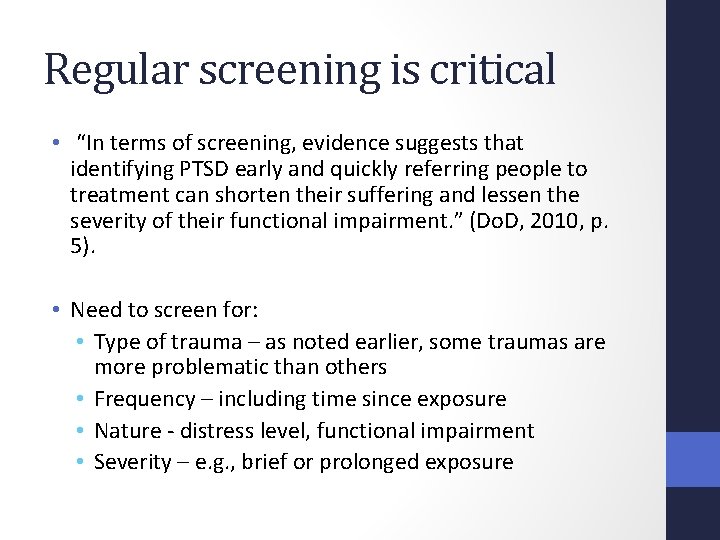
Regular screening is critical • “In terms of screening, evidence suggests that identifying PTSD early and quickly referring people to treatment can shorten their suffering and lessen the severity of their functional impairment. ” (Do. D, 2010, p. 5). • Need to screen for: • Type of trauma – as noted earlier, some traumas are more problematic than others • Frequency – including time since exposure • Nature - distress level, functional impairment • Severity – e. g. , brief or prolonged exposure
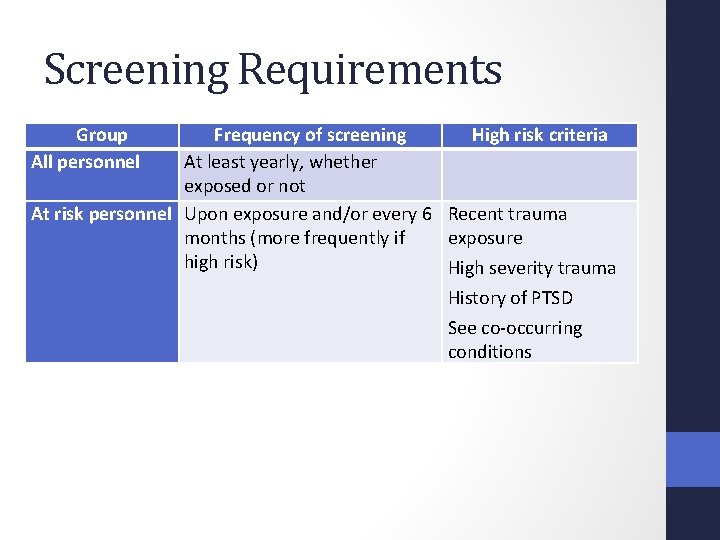
Screening Requirements Group All personnel Frequency of screening At least yearly, whether exposed or not At risk personnel Upon exposure and/or every 6 months (more frequently if high risk) High risk criteria Recent trauma exposure High severity trauma History of PTSD See co-occurring conditions
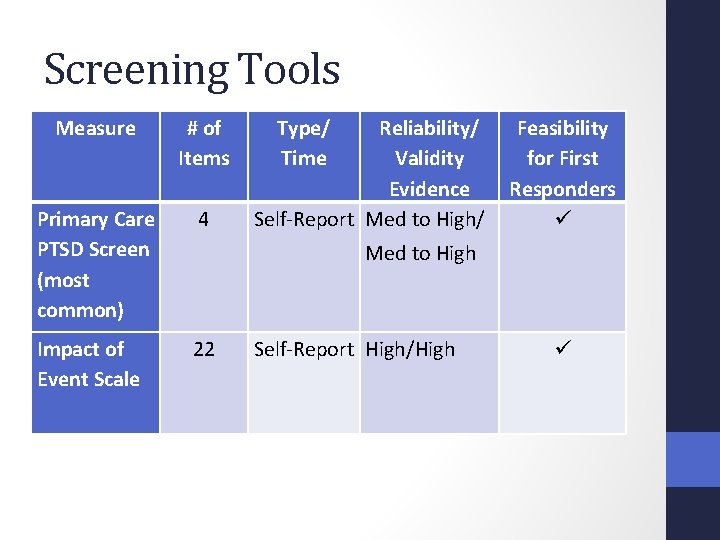
Screening Tools Measure # of Items Primary Care PTSD Screen (most common) 4 Impact of Event Scale 22 Type/ Time Reliability/ Validity Evidence Self-Report Med to High/ Feasibility for First Responders Med to High Self-Report High/High
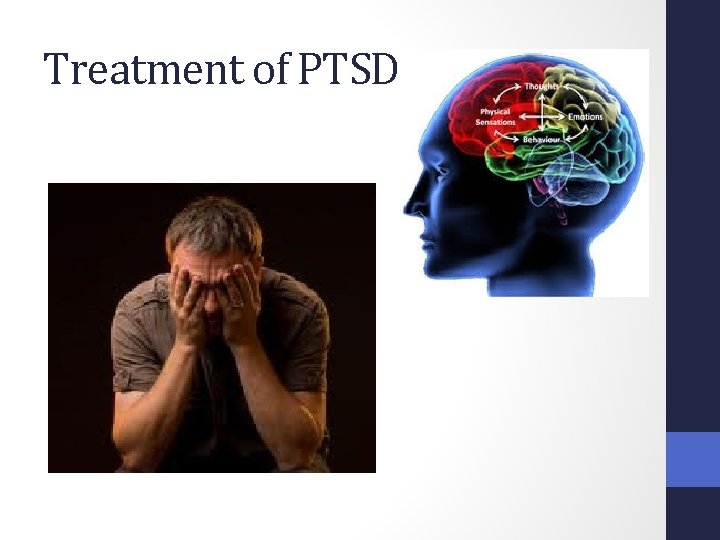
Treatment of PTSD
How should PTSD be treated? • Currently little strong research from emergency responder domain • Best advice is in military “best practice” guidelines – consistent with best practices in general but tailored to high-risk pragmatic domain • More research and validation of these guidelines for emergency responders is required
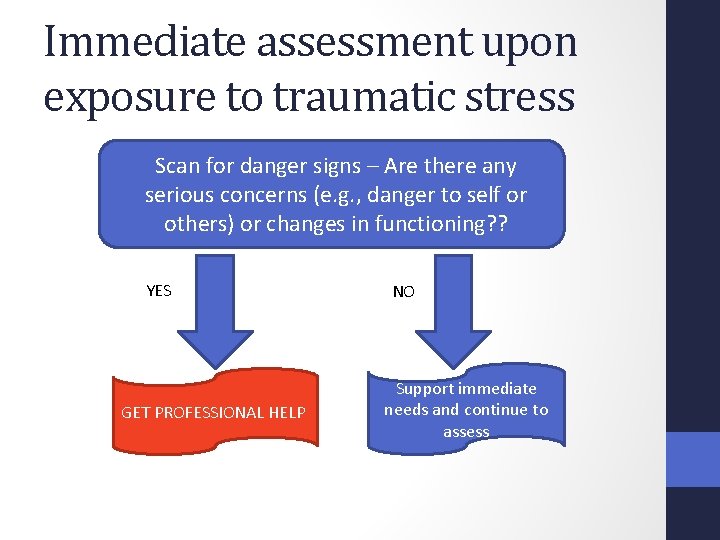
Immediate assessment upon exposure to traumatic stress Scan for danger signs – Are there any serious concerns (e. g. , danger to self or others) or changes in functioning? ? YES GET PROFESSIONAL HELP NO Support immediate needs and continue to assess
Treatment after initial exposure • If no danger signs, provide support (e. g. , food, shelter, communication with family, orientation) • For many personnel, symptoms will recede after 4 days, and just informal treatments may be enough
Treatments • • • Cognitive behaviour therapy (CBT) Psychoeducation/normalization Psychological first aid Social support systems Psychological debriefing Stress inoculation
Cognitive behaviour therapy (CBT) • Provided psychologists, therapists, mental health professionals • Many different kinds of overlapping forms of CBT • Targets problematic beliefs and tries to replace with more reality-based ones (e. g. , survivor guilt, fears) • Lessens avoidance by encouraging “safe trauma” • Trauma-focused therapy (TFT) is more effective than non -TFT • CBT is most effective and best understood technique for treating PTSD – described as “treatment of choice”
Stress inoculation • Focuses on helping people to better control their natural stress response (e. g. , through breathing and relaxation exercises, to control their thinking (e. g. , stopping negative thoughts) and using exposure techniques (e. g. , in-vivo simulation). • Some limited support for treating PTSD but not strong body of relevant evidence
Social support • Supports from one’s social system (e. g. , family members, friends, coworkers, peers, leaders) • Immediately after trauma exposure, preserve an interpersonal safety zone protecting basic personal space (e. g. , privacy, quiet, personal effects). • Some evidence of its effectiveness at reducing risk of PTSD
Psychoeducation/normalization • Teach about stress and coping and stress continuum • Teach that acute stress reactions are common but transient and “do not indicate personal failure or weakness, mental illness or health problems” • Some limited evidence of its effectiveness at reducing risk of PTSD
Psychological first aid • Defined as “provision of basic comfort, information, support and attendance to immediate practical and emotional needs” (p. 3). • Intended to help traumatized personnel to re-establish a sense of safety and self-efficacy and to reconnect with their natural support systems. • Some limited evidence of its effectiveness at reducing risk of PTSD
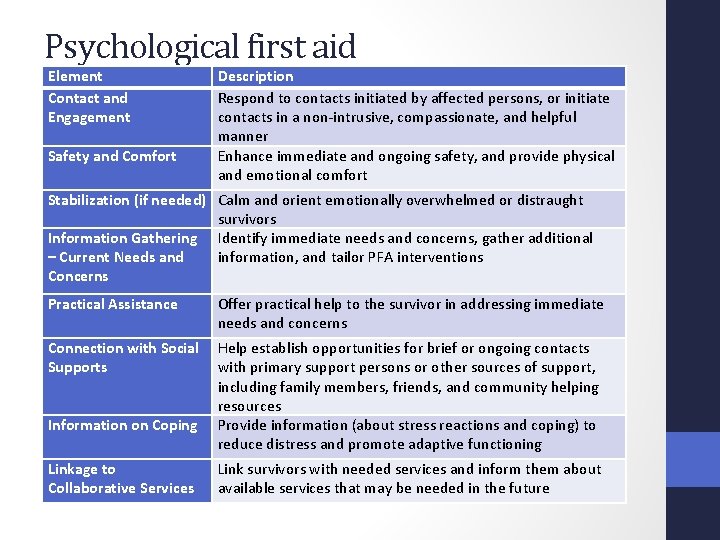
Psychological first aid Element Contact and Engagement Safety and Comfort Description Respond to contacts initiated by affected persons, or initiate contacts in a non-intrusive, compassionate, and helpful manner Enhance immediate and ongoing safety, and provide physical and emotional comfort Stabilization (if needed) Calm and orient emotionally overwhelmed or distraught survivors Information Gathering Identify immediate needs and concerns, gather additional – Current Needs and information, and tailor PFA interventions Concerns Practical Assistance Offer practical help to the survivor in addressing immediate needs and concerns Connection with Social Supports Help establish opportunities for brief or ongoing contacts with primary support persons or other sources of support, including family members, friends, and community helping resources Provide information (about stress reactions and coping) to reduce distress and promote adaptive functioning Information on Coping Linkage to Collaborative Services Link survivors with needed services and inform them about available services that may be needed in the future
Psychological debriefing • Most prominent form is Critical Incident Stress Debriefing (CISD) • Discussion led by a CISD facilitator (trained peer support person or mental health professional) helps to reduce stress and make sense of the event. Seven formal steps of CISD are: • • Introduction (ground rules and objectives) Facts (facts of the trauma reviewed) Thoughts and experience associated with event discussed Reactions phase – encouraged to vent feelings Review symptoms experienced Teaching – review of stress management strategies Re-entry phase – summary and wrap up
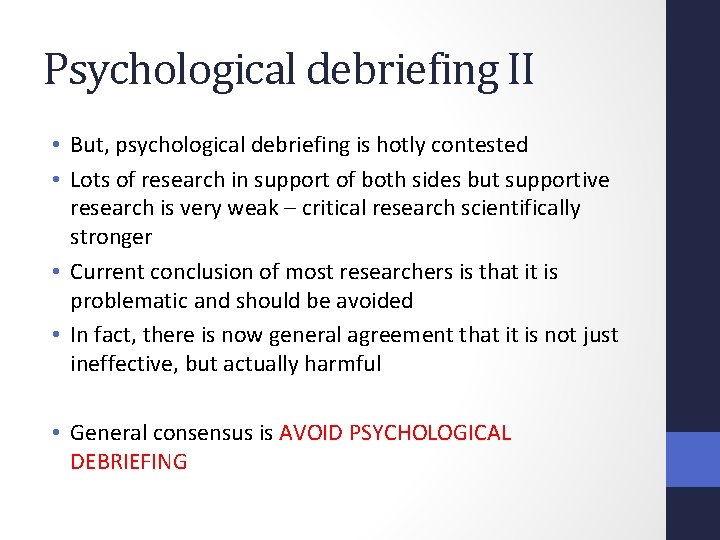
Psychological debriefing II • But, psychological debriefing is hotly contested • Lots of research in support of both sides but supportive research is very weak – critical research scientifically stronger • Current conclusion of most researchers is that it is problematic and should be avoided • In fact, there is now general agreement that it is not just ineffective, but actually harmful • General consensus is AVOID PSYCHOLOGICAL DEBRIEFING
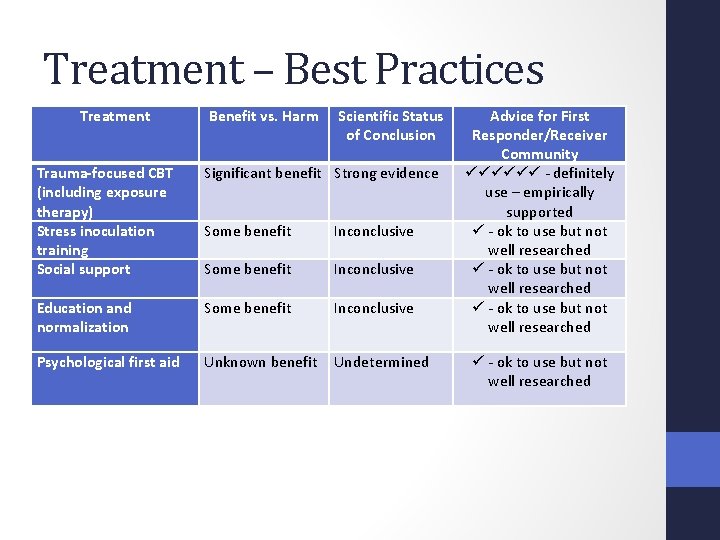
Treatment – Best Practices Treatment Benefit vs. Harm Scientific Status of Conclusion Trauma-focused CBT (including exposure therapy) Stress inoculation training Social support Significant benefit Strong evidence Some benefit Inconclusive Education and normalization Some benefit Inconclusive Psychological first aid Unknown benefit Undetermined Advice for First Responder/Receiver Community - definitely use – empirically supported - ok to use but not well researched
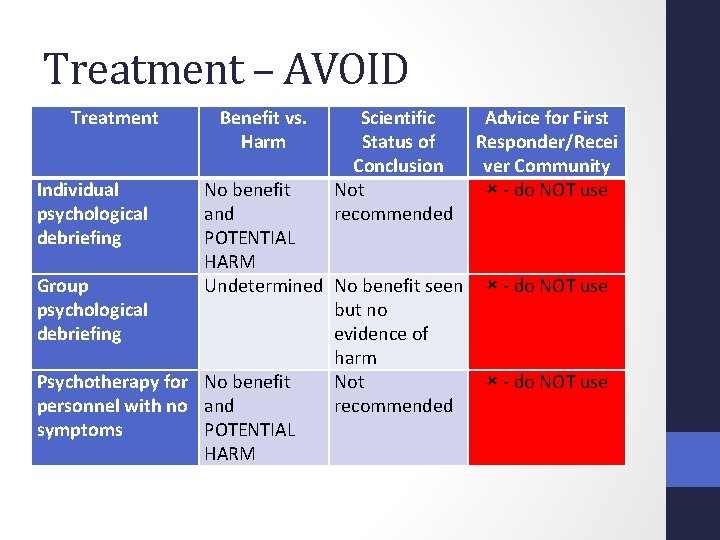
Treatment – AVOID Treatment Individual psychological debriefing Benefit vs. Harm Scientific Status of Conclusion Not recommended Advice for First Responder/Recei ver Community - do NOT use No benefit and POTENTIAL HARM Group Undetermined No benefit seen - do NOT use psychological but no debriefing evidence of harm Psychotherapy for No benefit Not - do NOT use personnel with no and recommended symptoms POTENTIAL HARM
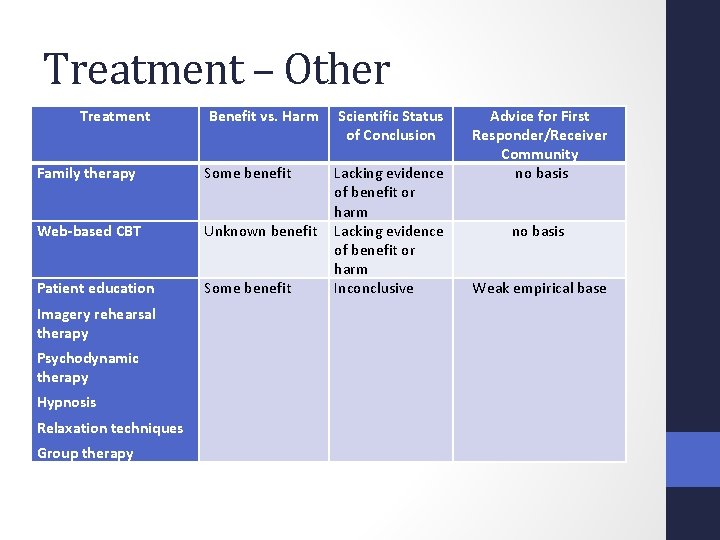
Treatment – Other Treatment Benefit vs. Harm Scientific Status of Conclusion Family therapy Some benefit Web-based CBT Unknown benefit Patient education Some benefit Lacking evidence of benefit or harm Inconclusive Imagery rehearsal therapy Psychodynamic therapy Hypnosis Relaxation techniques Group therapy Advice for First Responder/Receiver Community no basis Weak empirical base
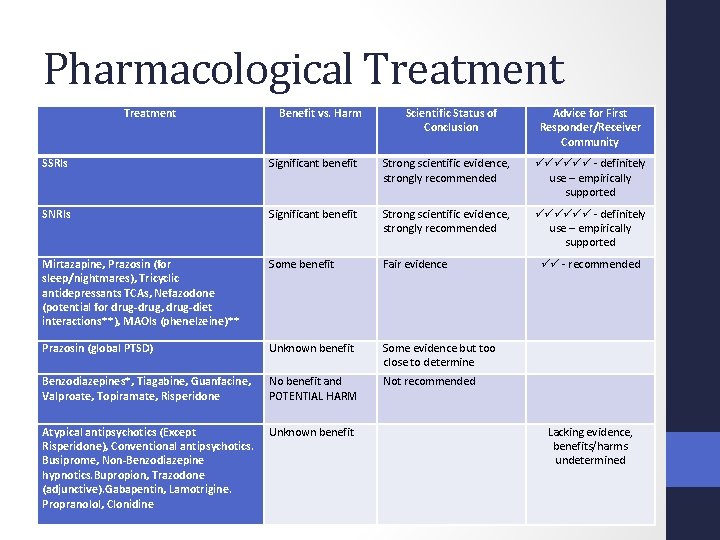
Pharmacological Treatment Benefit vs. Harm Scientific Status of Conclusion Advice for First Responder/Receiver Community SSRIs Significant benefit Strong scientific evidence, strongly recommended - definitely use – empirically supported SNRIs Significant benefit Strong scientific evidence, strongly recommended - definitely use – empirically supported Mirtazapine, Prazosin (for sleep/nightmares), Tricyclic antidepressants TCAs, Nefazodone (potential for drug-drug, drug-diet interactions**), MAOIs (phenelzeine)** Some benefit Fair evidence Prazosin (global PTSD) Unknown benefit Some evidence but too close to determine Benzodiazepines*, Tiagabine, Guanfacine, Valproate, Topiramate, Risperidone No benefit and POTENTIAL HARM Not recommended Atypical antipsychotics (Except Risperidone), Conventional antipsychotics. Busiprome, Non-Benzodiazepine hypnotics. Bupropion, Trazodone (adjunctive). Gabapentin, Lamotrigine. Propranolol, Clonidine Unknown benefit - recommended Lacking evidence, benefits/harms undetermined
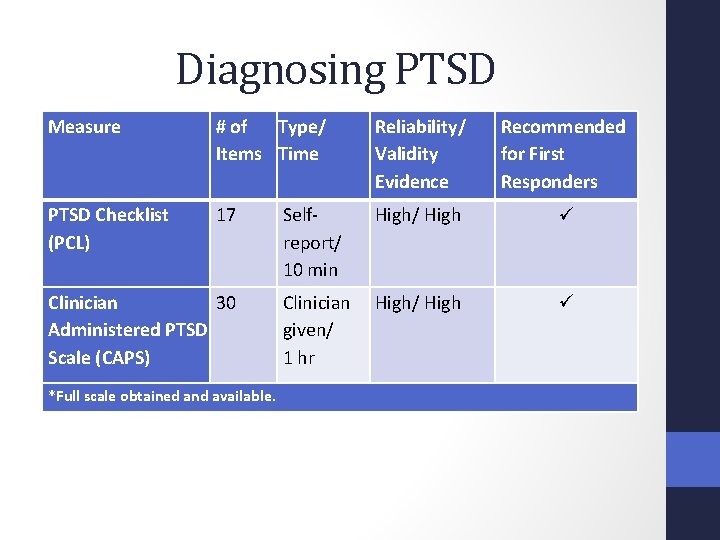
Diagnosing PTSD Measure # of Type/ Items Time Reliability/ Validity Evidence Recommended for First Responders PTSD Checklist (PCL) 17 High/ High Clinician High/ High given/ 1 hr Clinician 30 Administered PTSD Scale (CAPS) *Full scale obtained and available. Selfreport/ 10 min
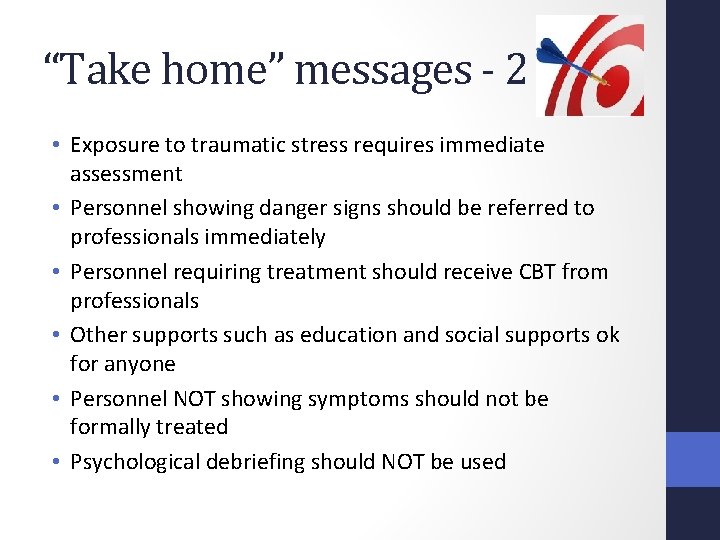
“Take home” messages - 2 • Exposure to traumatic stress requires immediate assessment • Personnel showing danger signs should be referred to professionals immediately • Personnel requiring treatment should receive CBT from professionals • Other supports such as education and social supports ok for anyone • Personnel NOT showing symptoms should not be formally treated • Psychological debriefing should NOT be used
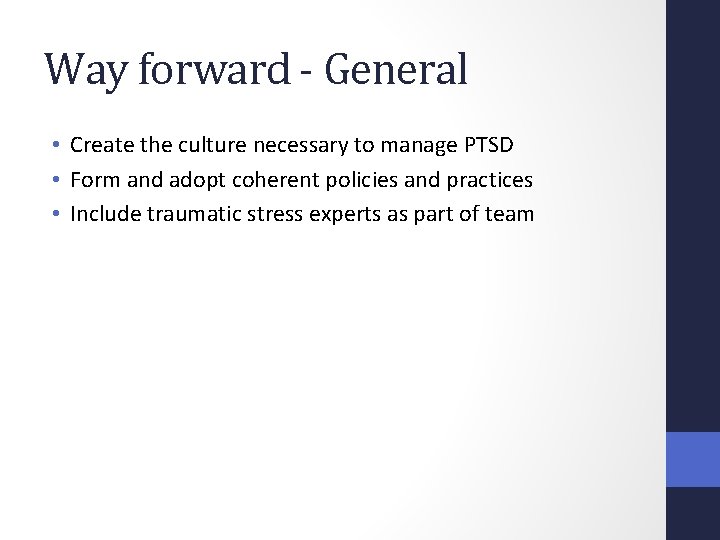
Way forward - General • Create the culture necessary to manage PTSD • Form and adopt coherent policies and practices • Include traumatic stress experts as part of team
Way forward - Specific • Baseline scan of emergency responder community PTSD practices and services • Validate “best practice” guidelines with experts • Scan PTSD services practices and services as implemented in military • Evaluate efficacy of prevention efforts • Develop or validate screening and diagnostic tools • Evaluate efficacy of PTSD treatments for emergency responders
Sample Projects • How much trauma and stress is too much? • What levels of exposure are safe? • Is it possible to create a tool for leaders to gauge cumulative exposure? • Tracking systems for identifying “at-risk” personnel
Develop or validate tools
Conclusion • Organizations required to expose their personnel to high levels of risk and potential trauma need to work to create a culture of acceptance around the traumatic stress continuum and to work to provide a safe and supportive place for personnel to work through their natural reactions to traumatic exposure. • This review is a signal of the increased interest and concern about PTSD within the emergency responder community and will hopefully contribute to further planning, conversation, and the use of evidence-based treatment that will protect and support emergency responders from traumatic stress and PTSD.