
PTC Can you taste it A learning activity



- Slides: 13
PTC: Can you taste it? A learning activity for Mendelian genetics
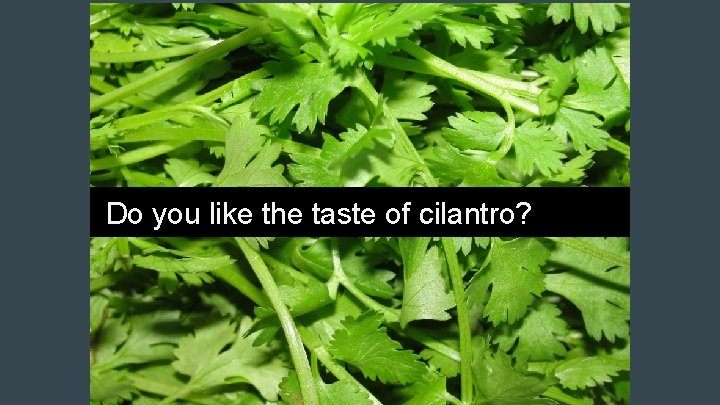
Do you like the taste of cilantro?
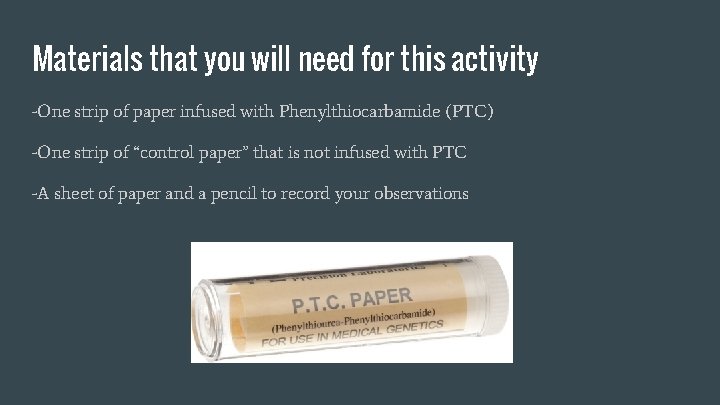
Materials that you will need for this activity -One strip of paper infused with Phenylthiocarbamide (PTC) -One strip of “control paper” that is not infused with PTC -A sheet of paper and a pencil to record your observations
Instructions 1. Label your control strip of paper “#1” 2. Label your PTC-infused strip of paper “#2” 3. Put strip #1 against your tongue and write down what it tastes like. 4. Put strip #2 against your tongue and write down what it tastes like.
What did strip #2 taste like? -Raise your hand if you could taste anything on strip #2 -Describe the taste to the rest of the classroom. Was it intense? Not so much?
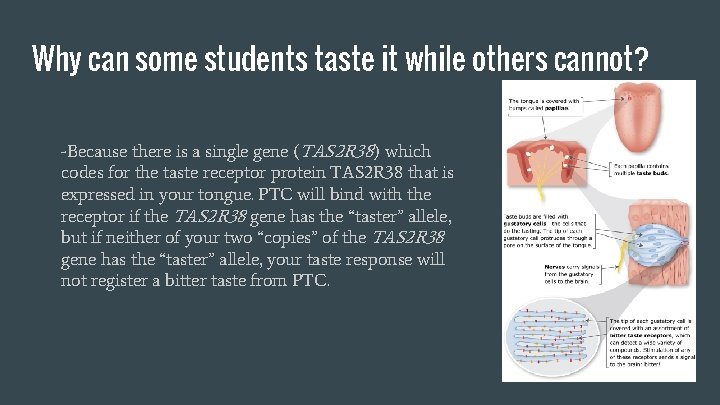
Why can some students taste it while others cannot? -Because there is a single gene (TAS 2 R 38) which codes for the taste receptor protein TAS 2 R 38 that is expressed in your tongue. PTC will bind with the receptor if the TAS 2 R 38 gene has the “taster” allele, but if neither of your two “copies” of the TAS 2 R 38 gene has the “taster” allele, your taste response will not register a bitter taste from PTC.
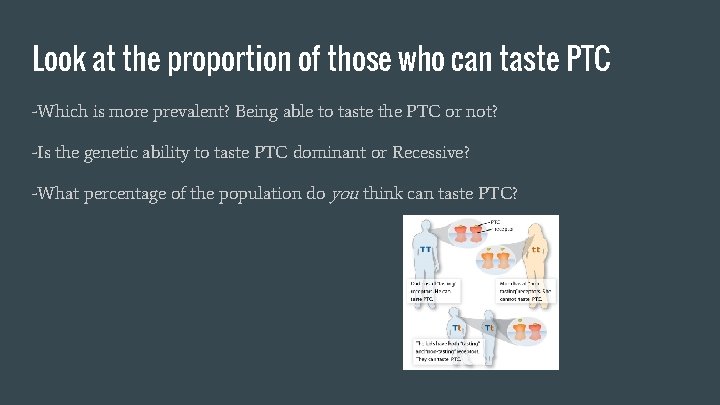
Example Punnett Square Paternal T Maternal t TT = homozygous dominant are “tasters” T Tt = heterozygous are “tasters” tt = homozygous recessive are “non-tasters” t
Look at the proportion of those who can taste PTC -Which is more prevalent? Being able to taste the PTC or not? -Is the genetic ability to taste PTC dominant or Recessive? -What percentage of the population do you think can taste PTC?
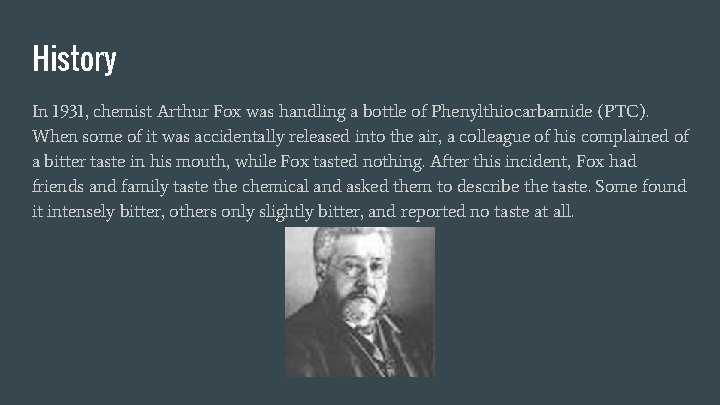
History In 1931, chemist Arthur Fox was handling a bottle of Phenylthiocarbamide (PTC). When some of it was accidentally released into the air, a colleague of his complained of a bitter taste in his mouth, while Fox tasted nothing. After this incident, Fox had friends and family taste the chemical and asked them to describe the taste. Some found it intensely bitter, others only slightly bitter, and reported no taste at all.
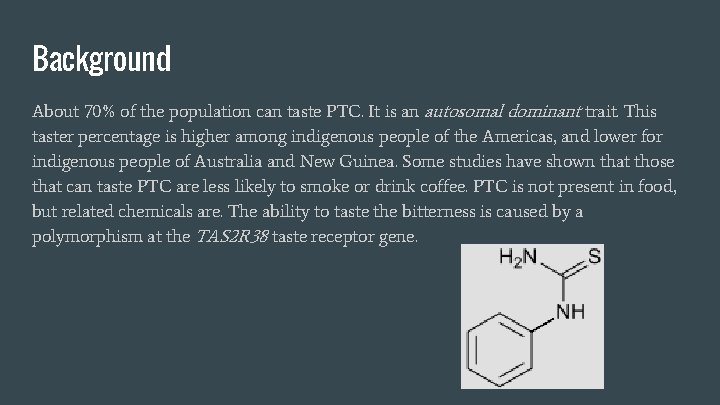
Background About 70% of the population can taste PTC. It is an autosomal dominant trait. This taster percentage is higher among indigenous people of the Americas, and lower for indigenous people of Australia and New Guinea. Some studies have shown that those that can taste PTC are less likely to smoke or drink coffee. PTC is not present in food, but related chemicals are. The ability to taste the bitterness is caused by a polymorphism at the TAS 2 R 38 taste receptor gene.
Discussion -If two parents are heterozygotes for the gene that allows for them to taste PTC, what is the probability that their child will also be able to taste it? (Hint: do a Punnett square) -Over recent evolutionary time, do you think the proportion of the PTC taster allele is expanding in the population, or decreasing? Why? (hint: is it an advantage? )
Record the Class’s Results on this Google Sheet goo. gl/0 n 1 ql. G http: //goo. gl/0 n 1 ql Compare your class’s results with the other SMILE groups!
References Figure 1: https: //msanader 23. files. wordpress. com/2015/03/ptc-paper. jpg Figure 2: http: //learn. genetics. utah. edu/content/inheritance/ptc/images/DSC 00100. jpg Figure 3: http: //learn. genetics. utah. edu/content/inheritance/ptc/images/Pedigree. jpg Figure 4: http: //learn. genetics. utah. edu/content/inheritance/ptc/images/DSC 00100. jpg Figure 5: https: //0. academia-photos. com/321416/134576/156544/s 200_arthur. fox. jpg Figure 6: https: //en. wikipedia. org/wiki/Phenylthiocarbamide [1] “PTC: Genes and Bitter Taste. ” [Online]. Available: http: //learn. genetics. utah. edu/content/inheritance/ptc/. [Accessed: 19 -Jul-2016].