
PTA 103 Vital Signs Review of Procedures Review
- Slides: 17
PTA 103 Vital Signs – Review of Procedures – Review of Pain Assessment tools – Pulse – Blood Pressure – Respiratory Rate – Pain
Pulse Measures heart rate (HR = pulse/min) Measured by palpation or auscultation (using stethoscope) Normal ranges – 60 -100/min in adults – 100 -130/min in infants – 80 -120/min in children 1 -7
Normal Factors Affecting Pulse Increases Age Gender (male>female) ↑ Environmental temp Infection Physical activity and activity tolerance Emotional status Some medications Cardiopulmonary disease
Documentation of Pulse HR standard is pulses/minute (best if measured over 30 -60 seconds) Site of measurement – Temporal, carotid, brachial, radial, femoral, popliteal, posterior tibial, pedal – Right or left – Radial pulse is most common (also allows for access to hospital ID bracelet for confirmation) Can include subjective quality descriptors – e. g. , strong, weak, regular, etc.
Identifying Pulse Strength A numbering system (0 -4+) can be used to document a description of pulse strength Refer to Table 22 -2 for descriptions and definitions
Role of PTA HR can be used to make comparisons with PT evaluation HR can be used to educate patients/clients in activity limits Abnormal HR readings at rest and in response to activity should result in communication back to the PT
Blood Pressure Important to establish baseline values and monitor patient response to activity Special populations to consider – Pts>65 yrs old; pts <=2 yrs old – Deconditioned/debilitated – Hx of cardiovascular problems – Hx of trauma or diseases which impact cardiovascular function
Key Words related to Blood Pressure Monitoring Diaphoresis – sweating Dyspnea – difficulty breathing Hypertension – high blood pressure Hypotension – low blood pressure SOB – shortness of breath Syncope – fainting Tachycardia – HR high (>100)
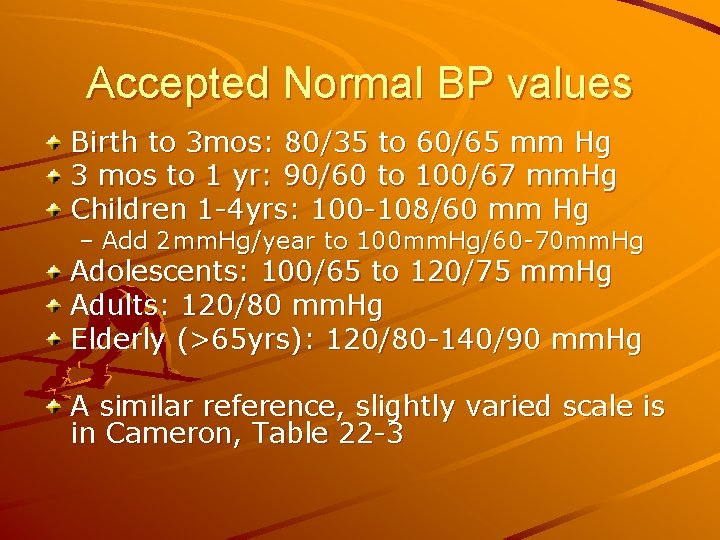
Accepted Normal BP values Birth to 3 mos: 80/35 to 60/65 mm Hg 3 mos to 1 yr: 90/60 to 100/67 mm. Hg Children 1 -4 yrs: 100 -108/60 mm Hg – Add 2 mm. Hg/year to 100 mm. Hg/60 -70 mm. Hg Adolescents: 100/65 to 120/75 mm. Hg Adults: 120/80 mm. Hg Elderly (>65 yrs): 120/80 -140/90 mm. Hg A similar reference, slightly varied scale is in Cameron, Table 22 -3
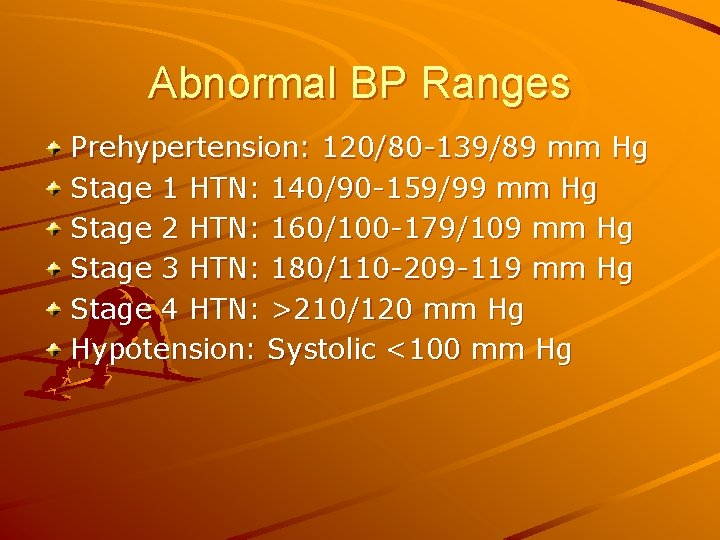
Abnormal BP Ranges Prehypertension: 120/80 -139/89 mm Hg Stage 1 HTN: 140/90 -159/99 mm Hg Stage 2 HTN: 160/100 -179/109 mm Hg Stage 3 HTN: 180/110 -209 -119 mm Hg Stage 4 HTN: >210/120 mm Hg Hypotension: Systolic <100 mm Hg
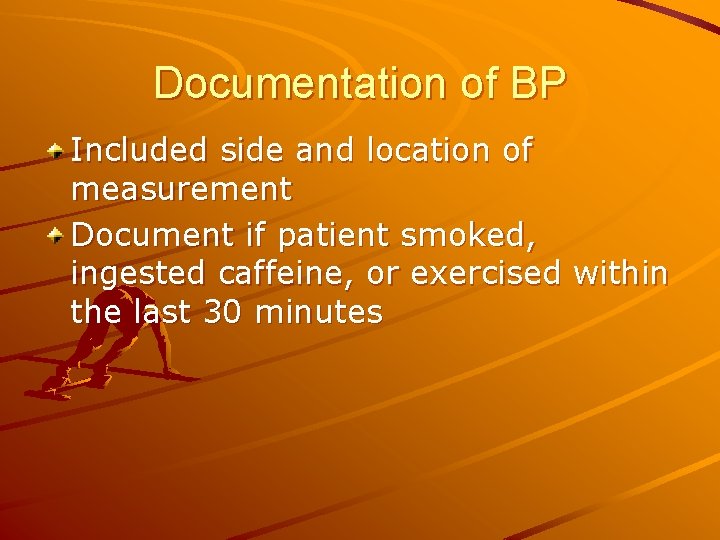
Documentation of BP Included side and location of measurement Document if patient smoked, ingested caffeine, or exercised within the last 30 minutes
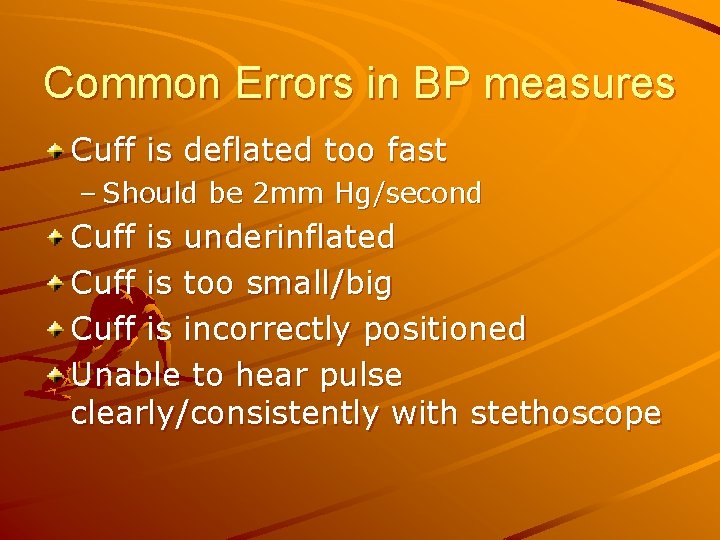
Common Errors in BP measures Cuff is deflated too fast – Should be 2 mm Hg/second Cuff is underinflated Cuff is too small/big Cuff is incorrectly positioned Unable to hear pulse clearly/consistently with stethoscope
Role of the PTAs should be aware of factors that affect BP – Educate at risk patients (smoking, obesity, sedentary) – Consider effects of age, medication, infection, gender/race on BP levels when selecting activity-based interventions – Plan for monitoring during bedside activities, positioning, or functional training
Documentation of Respiration RR = breaths (inhalation + exhalation) / min Note depth, rhythm, and character Avoid providing detailed information about measurement procedure to avoid abnormal measures
Documentation of %O 2 Sat May indicate progress with use of or need for supplemental oxygen – Supplemental O 2 is generally indicated for sat <=88% Quantify endurance capacity for activity in rehabilitation settings Indicate a need to communicate with PT/health care personnel to optimize stable O 2 Sat levels with activity
Documentation of Pain Onset Location Temporal (change over time) pattern Quality (sharp, shooting, constant, intermittent, etc. ) Intensity May include formal pain assessment – VAS, Mc. Gill, NRS, Faces Pain Rating Scale
Documentation of Vital Signs Vital sign measures are included in the ‘O’ of the SOAP note Data is optimally collected before, during and after activity Data is compared to document progress, verify safe progressions, or support a need to communicate with the primary PT.