
Pt SiSi interface structure and its dipole induced
- Slides: 1
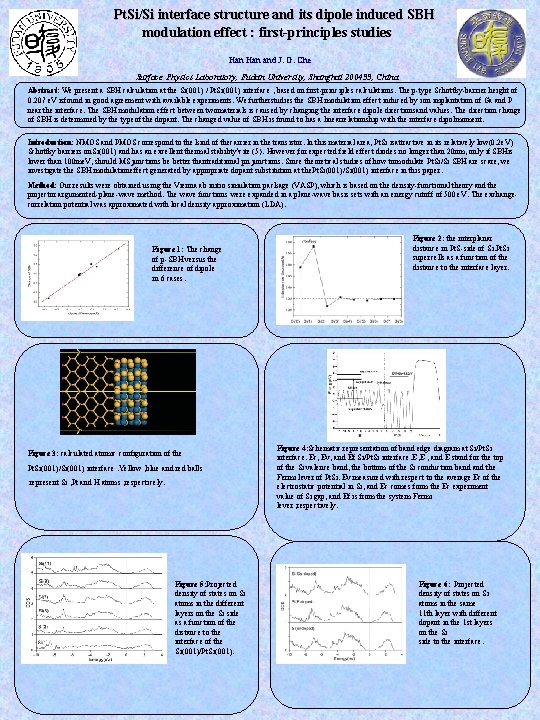
Pt. Si/Si interface structure and its dipole induced SBH modulation effect : first-principles studies Han and J. G. Che Surface Physics Laboratory, Fudan University, Shanghai 200433, China Abstract: We present a SBH calculation at the Si(001) / Pt. Si(001) interface , based on first-principles calculations. The p-type Schottky-barrier height of 0. 207 e. V isfound in good agreement with available experiments. We furtherstudies the SBH modulation effect induced by ion implantation of Ga and P near the interface. The SBH modulation effect between twomaterials is caused by changing the interface dipole directionsand values. The direction change of SBH is determined by the typeof the dopant. The changed value of SBH is found to has a linearrelationship with the interface dipolmoment. Introduction: NMOS and PMOS correspond to the kind of thecarrier in the transistor. In this material area, Pt. Si isattractive in its relatively low(0. 2 e. V) Schottky barriers on. Si(001) and has an excellent thermal stabilitycite{5}. However, for expected field effect diodes no longer than 20 nm, only if SBHis lower than 100 me. V, should MS junctions be better thantraditional pn junctions. Since theoretical studies of how tomodulate Pt. Si/Si SBH are scare, we investigate the SBH modulationeffect generated by appropriate dopant substitution at the. Pt. Si(001)/Si(001) interface in this paper. Method: Our results were obtained using the Vienna ab initio simulation package (VASP), which is based on the density-functional theory and the projector argumented-plane-wave method. The wave functions were expanded in a plane-wave basis sets with an energy cutoff of 500 e. V. The exchangecorrelation potential was approximated with local density approximation (LDA). Figure 1: The change of p-SBH versus the difference of dipole in 6 cases. Figure 3: calculated atomic configuration of the Pt. Si(001)/Si(001) interface. Yellow , blue and red balls represent Si , Pt and H atoms , respecticely. Figure 5: Projected density of states on Si atoms in the different layers on the Si side as a function of the distance to the interface of the Si(001)/Pt. Si(001). Figure 2: the interplanar distance in Pt. S-side of Si. Pt. Si supercells as a function of the distance to the interface layer. Figure 4: Schematic representation of band edge diagram at Si/Pt. Si interface. Ec, Ev, and Ef Si/Pt. Si interface. E , and E stand for the top of the Si valence band, the bottom of the Si conduction band the Fermi lever of Pt. Si. Ev measured with respect to the average Ec of the electrostatic potential in Si, and Ec comes form the Ec experiment value of Si gap, and Ef is from the system Fermi lever , respectively. Figure 6: Projected density of states on Si atoms in the same 11 th layer with different dopant in the 1 st layers on the Si side to the interface.