
Psychosocial Development in Middle Adulthood Chapter 22 Human
- Slides: 29
Psychosocial Development in (Middle) Adulthood Chapter 22 Human Development & Learning
Erikson’s Middle Adulthood The crisis of generativity vs stagnation Generativity -- adults’ desire to leave legacies of themselves to the next generation Stagnation -- develops when individuals sense that they have done nothing for the next generation also known as self-absorption (Petersen, 2002) Malignancies: Overextension & Rejectivity
Generativity Commitment to continuation and improvement of society as a whole Biological generativity -- bearing offspring Parental generativity -- nurturing children Work generativity -- skills to pass on Cultural generativity -- creating, renovating, and conserving some aspect of culture
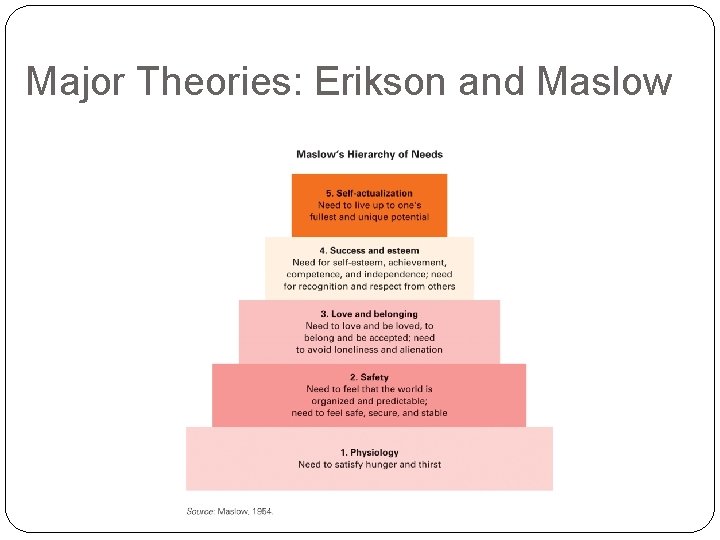
Continuity and Change, Again Maslow’s Stages • Abraham Maslow (1954) described five stages, which occur in sequence. • Movement occurs when people have satisfied their needs at one level and are ready for the next step. • In his later years, Maslow reassessed his final level, self-actualization. • He suggested another level after that, called selftranscendence, not attained till late in life.
Major Theories: Erikson and Maslow
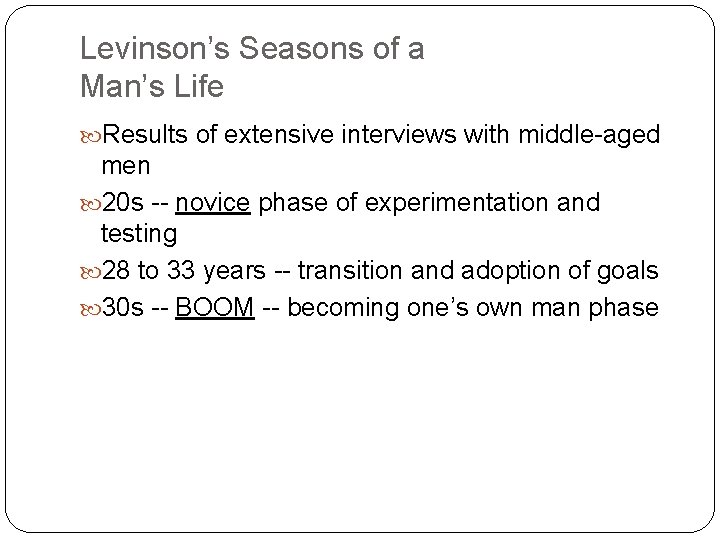
Levinson’s Seasons of a Man’s Life Results of extensive interviews with middle-aged men 20 s -- novice phase of experimentation and testing 28 to 33 years -- transition and adoption of goals 30 s -- BOOM -- becoming one’s own man phase
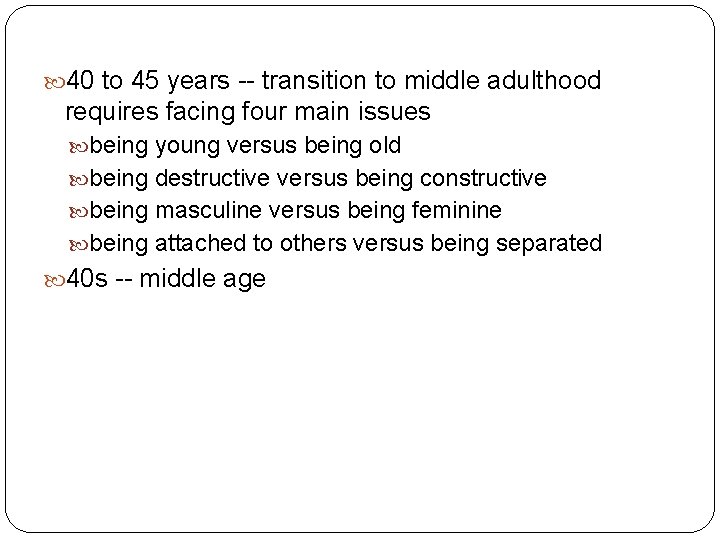
40 to 45 years -- transition to middle adulthood requires facing four main issues being young versus being old being destructive versus being constructive being masculine versus being feminine being attached to others versus being separated 40 s -- middle age
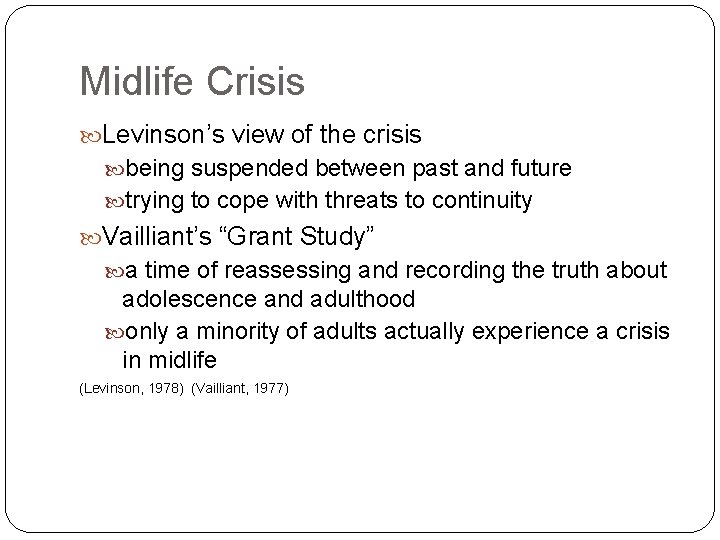
Midlife Crisis Levinson’s view of the crisis being suspended between past and future trying to cope with threats to continuity Vailliant’s “Grant Study” a time of reassessing and recording the truth about adolescence and adulthood only a minority of adults actually experience a crisis in midlife (Levinson, 1978) (Vailliant, 1977)
Critique of Stage Theories Stage theories place too much emphasis on crisis, especially in midlife They focus on universals and do not account for individual differences Some individuals experience crisis in one context of their lives but not in others
Life Events Approach Some events tax ability to cope and force personality change Contemporary life events approach emphasizes considering event as well as mediating factors, adaptation to the event, the life-stage context, and the historical context May overemphasize change and discount the importance of everyday stressors (Holmes & Rahe, 1967)
Stress in Midlife Do middle-agers experience stress differently than at other points in the life span? middle-aged adults experience fewer stressors that they cannot control frequent stressor is interpersonal tension and “crossover stressors” (simultaneous demands of multiple roles) (Clarke-Plaskie & Lachman, 1999)
Contexts of Midlife Development Historical contexts -- cohort effects cohort -- individuals born in the same year or time period cohort and context influence values, attitudes, expectations, and behavior social clock -- timetable according to which individuals are expected to accomplish life’s major tasks; provides a guide for life Variable clock? (Neugarten, 1986)
Personality Throughout Adulthood • Genes, parental practices, culture, and adult circumstances all contribute to personality. • Of these four, genes are probably the most influential, according to longitudinal studies. • Since genes do not change from conception through death, it is not surprising that every study finds substantial continuity in personality.
Personality Continued The Big Five • Openness – Imaginative, curious, artistic, creative, open to new experiences • Conscientiousness – Organized, deliberate, conforming, self-disciplined • Extroversion – Outgoing, assertive, active • Agreeableness – Kind, helpful, easygoing, generous • Neuroticism – Anxious, moody, self-punishing, critical
Stability and Change Evidence does not support the view that personality traits become completely fixed at a certain age in adulthood Cumulative personality model -- with time and age, people become more adept at interacting with their environment in ways the promote stability (ecological niche) Ages 30 to 50 are marked by more stability of personality than are other periods of life, though some people are likely to change more than others (Caspi & Roberts, 2001) (Mroczek, Spiro & Griffin, 2006)
Intimacy needs are lifelong. Adults meet their need for social connection through their relationships with relatives, friends, coworkers, and romantic partners. Social convoy Collectively, the family members, friends, acquaintances, and even “strangers” who move through life with an individual.
Friends and Acquaintances Friends The most crucial members of the social convoy Often able to provide practical help and useful advice when serious problems—death of a family member, personal illness, loss of a job—arise. Consequential “strangers“ People who are not close but do have an impact
Family Bonds Over the years of adulthood, parents and adult children typically increase in closeness, forgiveness, and pride as both generations gain maturity. Familism The belief that family members should support one another, sacrificing individual freedom and success, if necessary, in order to preserve family unity.
Family Bonds Family closeness can sometimes be destructive. Some adults wisely keep their distance from their blood relatives. Fictive kin Someone who is accepted as part of a family to which there is no blood relation Adults need kin, fictive or otherwise.
Intergeneration Relationships Middle-aged adults share experiences and transmit values to the younger generation As children become middle aged, they develop more positive perceptions of parents Family members maintain contact across generations Most common conflicts are interaction style, habits and lifestyle choices, child-rearing practices, and values (Bengtson, 2001; Miller-Day, 2004)
Sibling Relationships Sibling relationships persist over the entire life span Majority of adults have at least one living sibling Most have been found to be close Siblings who were not “close” tend not to become closer in midlife (Teti, 2001; White, 2001) (Cicirelli, 1991) (Dunn, 1984)
Committed Partners Adults everywhere seek committed sexual partnerships to help meet their needs for intimacy as well as to raise children, share resources, and provide care when needed. Less than 15 percent of U. S. residents marry before age 25, but by age 40, 85 percent have married.
Close Relationships Love and Marriage affectionate, companionate love increases in middle adulthood security, loyalty, and mutual emotional interest become more important as relationships mature even difficult marriages become better adjusted in middle adulthood married people express satisfaction
Empty Nest Empty nest syndrome -- decline in marital satisfaction after children leave the home; a time for pursuit of other interests, career, and time for each other Refilling of the nest when young adult children return home to save money or recover from career set-back Permaparenting -- reluctance to let go of adult children Parents continue to provide emotional and/or financial support
Sandwich or Squeeze Generation -- responsibilities for adolescent and young adult children and for aging parents Fewer middle-aged adults are sandwiched than the media portrays When necessary, responsibilities are assumed by daughters (Hoyer & Roodin, 2003)
Changing Jobs One recent change in the labor market that impedes generativity is an increased frequency of hiring and firing. Between ages 25 and 42, the average U. S. worker has five separate employers. Older workers find job changes particularly difficult (loss of seniority, lack of new skills, relocation).
Variable Schedules Schedule not fitting traditional 9 -to-5, Monday- through-Friday work-week. Flextime An arrangement in which work schedules are flexible so that employees can balance personal and occupational responsibilities.
Variable Schedules Telecommuting Working at home and keeping in touch with the office via computer, telephone, and fax. About one-third of all working couples who have young children and nonstandard schedules save on child care by having one parent at home while the other is at work.
Variable Schedules A major problem is that flextime and telecommuting are less available to those in certain jobs, such as construction. Part-time work is usually underpaid and offers no benefits. Shift work often creates sleep deprived people who are often cranky, impatient, and not clear thinkers.