
Psychophysical tuning curves measured in simultaneous and forward
- Slides: 8
Psychophysical tuning curves measured in simultaneous and forward masking Brian C. J. Moore J. Acoust. Soc. Am. , 1978 23 Feb 2009
Background • Phenomena of simultaneous and forward masking previously described • Some ambiguity about how the results of these methods for deriving psychophysical tuning curves differ • Goal: Investigate the frequency tuning curves produced by simultaneous vs. forward masking in a within-subject design • Consider effects of absolute probe threshold • Compare results to neural tuning curves
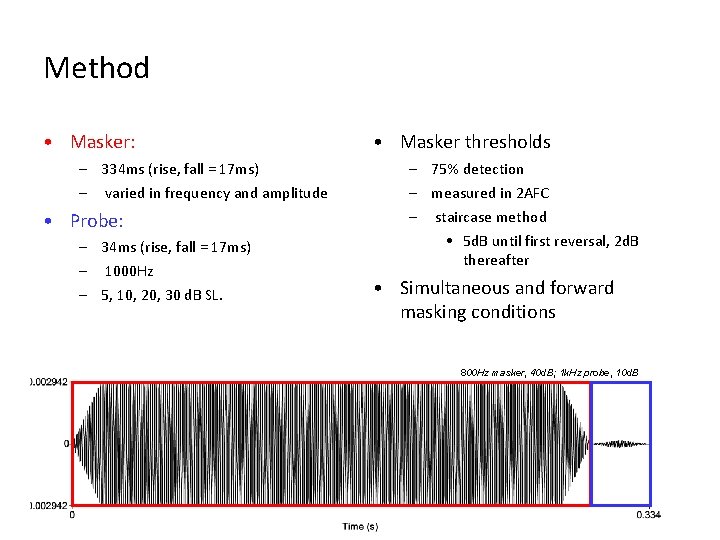
Method • Masker: – 334 ms (rise, fall = 17 ms) – varied in frequency and amplitude • Probe: – 34 ms (rise, fall = 17 ms) – 1000 Hz – 5, 10, 20, 30 d. B SL. • Masker thresholds – 75% detection – measured in 2 AFC – staircase method • 5 d. B until first reversal, 2 d. B thereafter • Simultaneous and forward masking conditions 800 Hz masker, 40 d. B; 1 k. Hz probe, 10 d. B
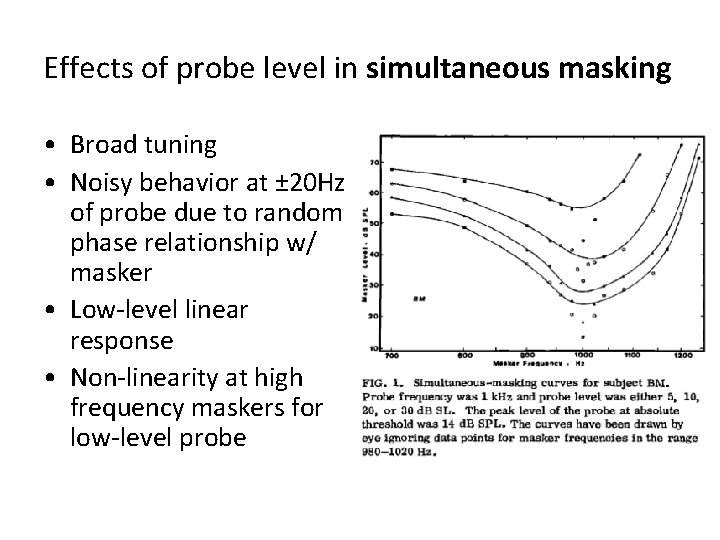
Effects of probe level in simultaneous masking • Broad tuning • Noisy behavior at ± 20 Hz of probe due to random phase relationship w/ masker • Low-level linear response • Non-linearity at high frequency maskers for low-level probe
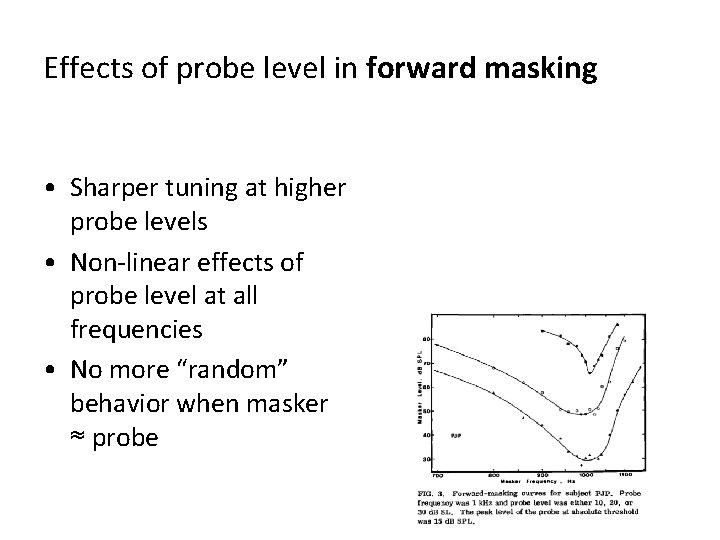
Effects of probe level in forward masking • Sharper tuning at higher probe levels • Non-linear effects of probe level at all frequencies • No more “random” behavior when masker ≈ probe
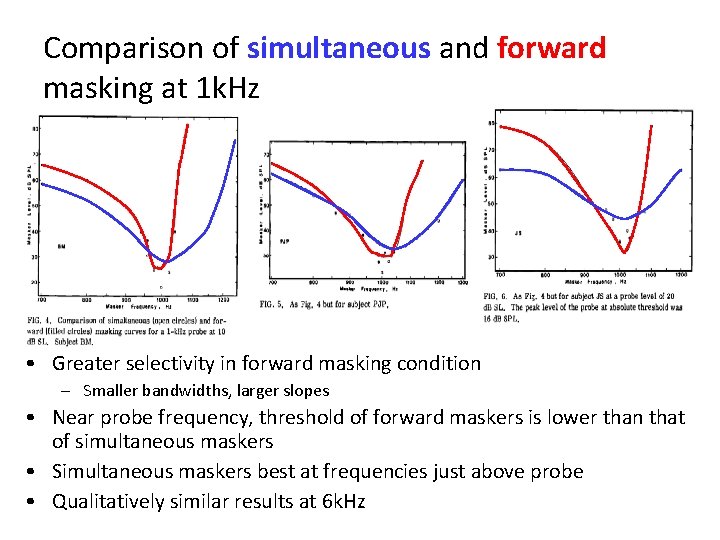
Comparison of simultaneous and forward masking at 1 k. Hz • Greater selectivity in forward masking condition – Smaller bandwidths, larger slopes • Near probe frequency, threshold of forward maskers is lower than that of simultaneous maskers • Simultaneous maskers best at frequencies just above probe • Qualitatively similar results at 6 k. Hz
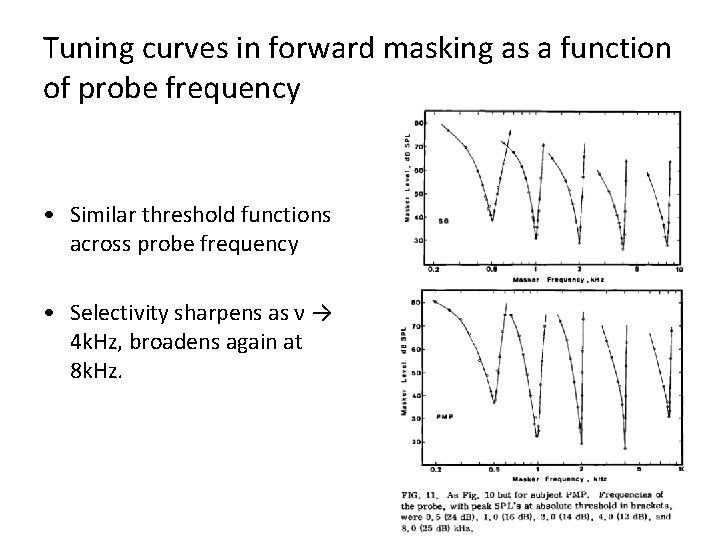
Tuning curves in forward masking as a function of probe frequency • Similar threshold functions across probe frequency • Selectivity sharpens as ν → 4 k. Hz, broadens again at 8 k. Hz.
Summary • Best simultaneous masking at frequencies just above probe frequency – Action of simultaneous masking may be in lateral suppression – Not analogous to neural tuning, but to “suppression areas” – Cf. two-tone suppression • Forward masking produces steeper slopes, narrower bandwidths (greater selectivity) than simultaneous masking – Similar to, but sharper than, neural tuning curves – Other factors besides sensory selectivity may play a role in psychophysical tuning curves • When probe and forward masker are close in frequency, detection may be based on fine temporal characteristics (absolute duration, AM).