
Psychopharmacology Khalid Bazaid MB BS FRCPC Assistant Professor
Psychopharmacology Khalid Bazaid, MB BS, FRCPC Assistant Professor Child & Adolescent Psychiatrist Department of Psychiatry College of Medicine King Saud University 10/2/2020 1
Outlines § The role of psychotropic in the mental health and its therapeutic indications § Identify specific cautions to be aware of the various psychotropic medications § Discuss the adherence to medication treatment § Psychotropic Medications Classifications 10/2/2020 2
Psychopharmacology The aim is learn how to choose a psychotropic drug that is more: • Effective • Less toxic • Better-tolerated • The most targeted therapeutic agents 10/2/2020 3
Psychotropic Drugs § Focus of all mental activity is the CNS (brain) § Origin of psychiatric illness caused by many factors: – Genetics – Neurodevelopment factors – Endocrinologic e. g. Hypothyroidism – Autoimmune system (infections) – Drugs – Psychosocial experiences, stressors … etc. § To date …Theories behind use of psychotropic drugs focuses on neurotransmitters and their receptors § Psychotropic drugs act by modulating neurotransmitters 10/2/2020 4
Use of psychotropic medications § Relieve or reduce symptoms/signs of dysfunctional thoughts, moods, or actions of mental illness § Improve client’s functioning § Increase compliance to otherapies 10/2/2020 5
Therapeutic Effects of Psychotropic Medications § Do not “cure” § Relieve or decrease symptoms § Prevent or delay return of S/S § Cannot be used as the sole treatment for disorders § Need informed consent before starting 10/2/2020 § Are broad spectrum and have effects on a large number of S/S § Initial effects are sedative in nature § May take weeks for effects to be seen 6
Reasons for Non- adherence: § Medications are expensive § Unpleasant side effects § Feel better and decide no longer need 10/2/2020 § Stigma associated with having a mental illness and taking medications § Paranoia or fears about medication usage particularly addition 7
Encouraging Compliance to Medication Regimen § Follow-up appointments With client to verify that client understands: the purpose, proper administration, intended effects, side and toxic effects of, and how to treat problems associated with medications § Appropriate lab tests must be conducted to prevent complications and assure correct levels of drugs § Encourage clients to participate in medication groups § Can use injections of antipsychotics which will last from 2 -4 weeks if clients are non-compliant 10/2/2020 8
Efficacy of Psychotropics with Children & Elderly § Use with great caution § Start low and go slow for both elders and children § Children are faster metabolizer whereas elders have decrease liver & renal function § Risk of injuries and falls with elderly 10/2/2020 9
Client & Family Teaching § Purpose of the meds and benefits, side effects and how to treat SE § What S/S indicate a toxic effect, and how to treat, and whom to call. § Specific instructions about how to take the medications 10/2/2020 10
Psychotropic Medications Classifications § Antipsychotics (Neuroleptics) § Mood Stabilizers § Antidepressants § Anxiolytics (antianxiety) 10/2/2020 § Sedatives § Hypnotics § Psychostimulants § Antihistamines, antimuscarinics, dopamine agonists 11
Psychotropic Medications Classifications … continued In many instances, drugs have multiple indications: • SSRIs (selective serotonin reuptake inhibitors) are both antidepressants and anxiolytics. • SDAs (serotonin-dopamine antagonists) are both antipsychotics and mood stabilizers. • Psychotropic drugs have also been organized according to structure (e. g. Tricyclic). • mechanism (e. g. monoamine oxidase inhibitor [MAOI])
Antipsychotics § Schizophrenia Disorders § Tourette’s Syndrome § Bipolar disorder § Delirium, Dementia, and Delusions § Major Depression with psychotic features § Control of intractable hiccups § Aggressive behavior 10/2/2020 13
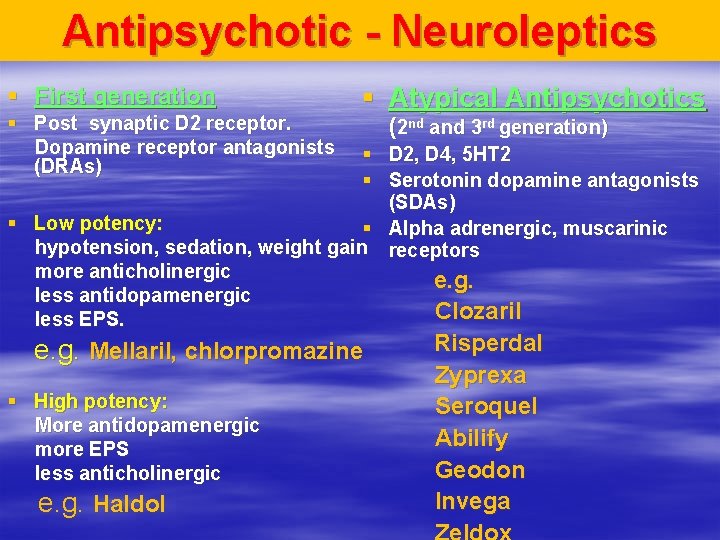
Antipsychotic - Neuroleptics § First generation § Post synaptic D 2 receptor. Dopamine receptor antagonists (DRAs) § Atypical Antipsychotics (2 nd and 3 rd generation) § D 2, D 4, 5 HT 2 § Serotonin dopamine antagonists (SDAs) § Low potency: § Alpha adrenergic, muscarinic hypotension, sedation, weight gain receptors more anticholinergic e. g. less antidopamenergic Clozaril less EPS. e. g. Mellaril, chlorpromazine § High potency: More antidopamenergic more EPS less anticholinergic e. g. Haldol Risperdal Zyprexa Seroquel Abilify Geodon Invega
First Generation Antipsychotic § Block predominantly dopamine activity – High incidence of abnormal movements § Blocks the H receptor for histamine – results in sedation and weight gain – little effect on serotonin (Also blocks acetylcholine, norepinephrine to some degree) 10/2/2020 15
Side Effects of 1 st Gen Drugs-1 § Dystonia (EPS) spasms of the eye, necktorticollis, back, tonguehappens within 72 hrs ( reversible) § Pseudoparkinson - S/S similar to Parkinson's-see in 1 -2 weeks. May disappear. TX. With Cogentin § Akathisia (EPS) restlessness § Tardive Dyskinesiabizarre facial and tongue movements (irreversible) 10/2/2020 16
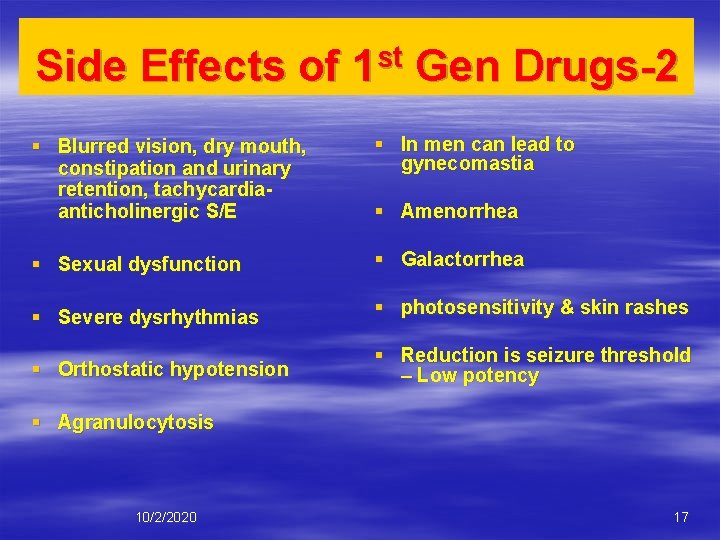
Side Effects of st 1 Gen Drugs-2 § Blurred vision, dry mouth, constipation and urinary retention, tachycardiaanticholinergic S/E § In men can lead to gynecomastia § Sexual dysfunction § Galactorrhea § Severe dysrhythmias § photosensitivity & skin rashes § Orthostatic hypotension § Reduction is seizure threshold – Low potency § Amenorrhea § Agranulocytosis 10/2/2020 17
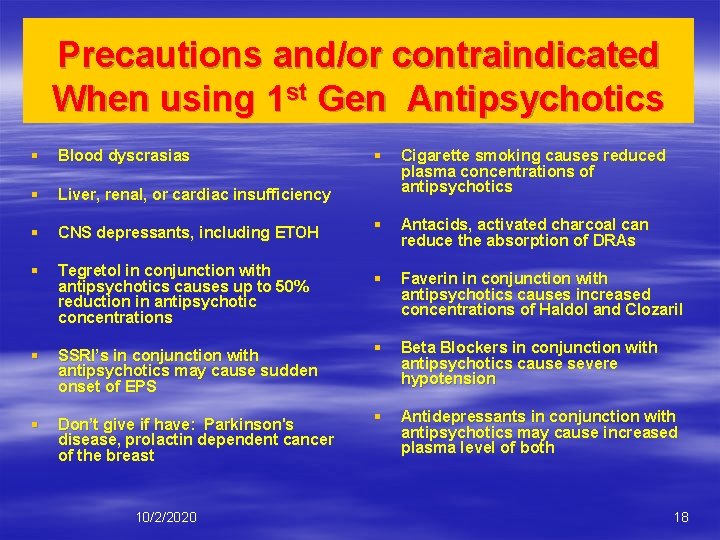
Precautions and/or contraindicated When using 1 st Gen Antipsychotics § Blood dyscrasias § Liver, renal, or cardiac insufficiency § CNS depressants, including ETOH § Tegretol in conjunction with antipsychotics causes up to 50% reduction in antipsychotic concentrations § SSRI’s in conjunction with antipsychotics may cause sudden onset of EPS § Don’t give if have: Parkinson's disease, prolactin dependent cancer of the breast 10/2/2020 § Cigarette smoking causes reduced plasma concentrations of antipsychotics § Antacids, activated charcoal can reduce the absorption of DRAs § Faverin in conjunction with antipsychotics causes increased concentrations of Haldol and Clozaril § Beta Blockers in conjunction with antipsychotics cause severe hypotension § Antidepressants in conjunction with antipsychotics may cause increased plasma level of both 18
First Generation Antipsychotic Medications § Are useful in getting out of control behavior under control quickly. § These can be given with lithium to get treat acute mania. § Seroquel is effective in the maintenance treatment of Bipolar-Depressive phase 10/2/2020 19
Atypical Antipsychotics § Action: Blocks dopamine receptors and to a lesser degree serotonin receptors, § Also block receptors for norepinephrine , histamine, acetylcholine § Nicer drugs and are used more § Decrease positive and negative S/S of Schizophrenia § Lower Incidence of abnormal movements § Biggest S/E is weight gain e. g. Zyprexa 10/2/2020 20
Positive & Negative S/S of Schizophrenia § Positive: – – – Hallucinations Delusions Abnormal thoughts Bizarre behavior Confused thoughts 10/2/2020 § Negative: – – Blunted affect Poverty of speech Social withdrawal Poor motivation 21
Atypical Antipsychotics-2 nd & 3 rd generation: Clozaril (clozapine) § low incidence of abnormal movements § Most common S/E: – Nausea, constipation, sedation, drowsiness, weight gain § Other S/E are: – hypersalivation, tachycardia, dizziness, seizure risk § possible fatal side effect: – bone marrow suppression & Agranulocytosis (rare) 10/2/2020 22
Atypical Antipsychotics-2 nd & 3 rd generation - 2 § Risperidone – Does not cause bone marrow suppression – Can cause at higher doses movement disorders – Available as a long acting injection – Can be used to treat mania 10/2/2020 § Seroquel (Quetiapine) – S/E sedation, weight gain and headache – Not associated with abnormal movements – May cause AV block 23
Atypical Antipsychotics-2 nd & 3 rd generation - 3 § Zyprexa (Olanzapine) – does not cause bone marrow suppression – Can cause weight gain & hyperglycemia – Drowsiness, dry mouth, constipation, and restlessness § Geodon (Ziprasidone) – Binds to multiple receptor sites – Drowsiness, headache, GI upset – Can prolong the QT interval-can be fatal if history of cardiac arrhythmias § Abilify (Aripiprazole) – – – Dopamine stabilizer Partial agonist at the D 2 receptor In areas of the brain with excess dopamine, it lowers dopamine In areas of low dopamine, it stimulates receptors to raise the dopamine level Main S/E are headache, somnolence, agitation, anxiety, insomnia, and GI upset 10/2/2020 24
Antipsychotics-Long acting preparation § Can be given as an IM injection (depot preparations) if have difficulty taking oral meds. § Can use lower doses when given IM, so less risk of tardive dyskinesia 10/2/2020 25
Neuroleptic Malignant Syndrome § Rare, but fatal complication from all antipsychotic drugs § See more with 1 st generation drugs § Severe muscle rigidity § High temperature § Associated S/S: Ø Tachycardia Ø Hypertension Ø Stupor Ø Coma Ø Abnormal labs including leukocytosis , Elevated Creatinine phosphokinase (CPK) & LFT 10/2/2020 26
Mood Stabilizers § Used in the treatment of Manic (Bipolar) disorder, and in some forms of depression § Drugs used: Lithium and Antiepileptic Drugs 10/2/2020 27
Lithium § Mechanism of action unknown § Alters electrical conductivity – potential threat to all body functions that are regulated by electrical currents 10/2/2020 § Can cause polyuria and polydipsa due to Na and K alterations § Has the lowest therapeutic index of all psych drugs § Have to monitor blood levels 28
Lithium § Maintenance blood levels of lithium are usually 0. 4 -1. 3 m. Eq (toxicity occurs with levels > 1. 5 m. Eq/L) § Client must eat a balanced diet with normal sodium intake and take in adequate fluid (about 2 -3 liters/day). § Sign of toxicity is a fine intention tremor that becomes more pronounced and coarse § Excretion is via renal system § Risk of thyroid & kidney disease § If toxic S/S occur discontinue the drug and notify health care provider § Dehydration and salt restriction can increase lithium levels & cause toxicity. § Takes 2 -3 weeks for lithium to become effective (may use antipsychotic until therapeutic levels are reached) § Lithium should be taken with food 10/2/2020 29
Signs & Symptoms of Lithium Toxicity § Fine hand tremors that progress into coarse tremors § Mild GI upset progressing to persistent upset § Slurred speech and muscle weakness progressing to mental confusion 10/2/2020 § Severe Toxicity: – decrease level of consciousness to stupor and finally coma – Seizures, severe hypotension, severe polyuria with dilute urine 30
Lithium § Lithium serum concentrations are increased by Flouxetine (Prozac), ACE inhibitors, Thiazide diuretics, and NSAIDs § Lithium serum concentrations are decreased by theophylline, osmotic diuretics, and urine alkalinizers 10/2/2020 31
Contraindications for Lithium § Renal disease § Cardiac disease § Severe dehydration § Sodium depletion § Brain damage § Pregnancy or lactation § Use with caution in the elderly or clients with diabetics, thyroid disorders, urinary retention, and seizures 10/2/2020 32
Anticonvulsants/Antiepileptic Drugs § Causes an increase in GABA in the CNS-which causes a decrease in anxiety. § Reduce the mood swings with bipolar 10/2/2020 33
Anticonvulsants/Antiepileptic Drugs § Tegretol (carbamazepine)-also used to treat severe pain (i. e. trigeminal neuralgia), cause agranulocytosis and aplastic anemia § Depakote (Valproic acid)-can cause hepatic failure, pancreatitis, & thrombocytopenia. Watch for liver failure § Klonopin (Clonazepam) § Lamictal (Lamotrigine)-can have a rare but fatal dermatological condition 10/2/2020 34
Toxic Effects of Anticonvulsants § Tegretol can cause agranulocytosis and aplastic anemia § Depakote can cause liver dysfunction, hepatic failure, and blood dyscrasias including thrombocytopenia § Depakote interacts with drugs that are metabolized by the liver 10/2/2020 35
Contraindications for Anticonvulsants § Hepatic or renal disease § Pregnancy § Lactation § Presence of blood dyscrasias 10/2/2020 36
Psychoeducation when using anticonvulsants § Monitor blood levels of mood stabilizers to prevent toxicity § Monitor liver, renal function tests and CBCs § Depakote must be swallowed whole, not cut, chewed, or crushed to prevent irritation 10/2/2020 37
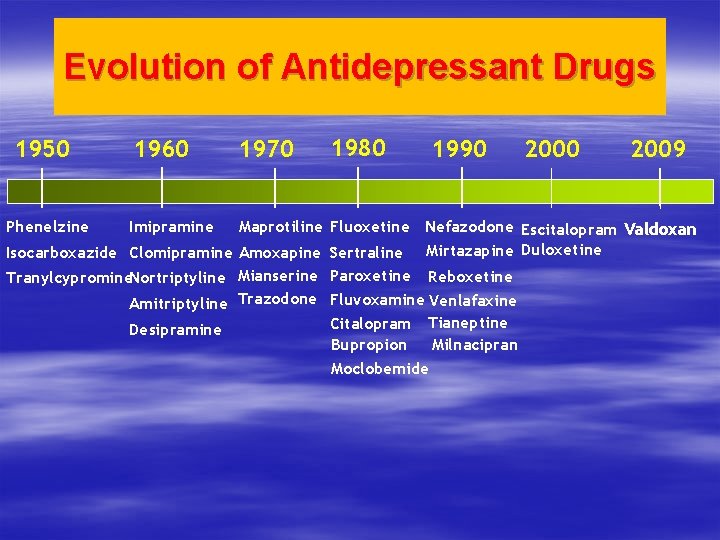
Evolution of Antidepressant Drugs 1950 1960 1970 1980 1990 2009 Maprotiline Fluoxetine Nefazodone Escitalopram Valdoxan Isocarboxazid Clomipramine Amoxapine Sertraline Mirtazapine Duloxetine Isocarboxazide Tranylcypromine. Nortriptyline Mianserine Paroxetine Reboxetine Amitriptyline Trazodone Fluvoxamine Venlafaxine Citalopram Tianeptine Desipramine Bupropion Milnacipran Moclobemide Phenelzine Imipramine
Antidepressants § Treatment of depressive moods, including bipolar disease § 4 categories: – Tricyclics (TCA) – MAOI’s – SSRI’S – Atypical Antidepressants 10/2/2020 39
Antidepressant Drugs § Tricyclics- Elavil, Tofranil § SSRI’s- Lustral, Seroxat § MAOI’s- Nardil, Parnate 10/2/2020 40
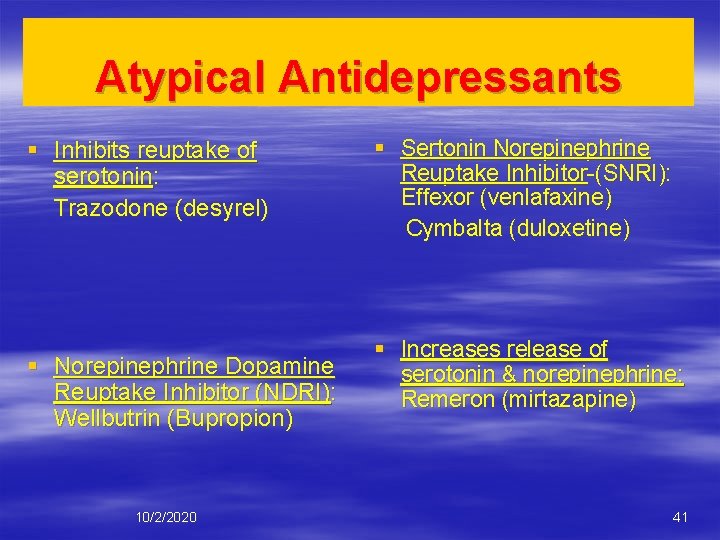
Atypical Antidepressants § Inhibits reuptake of serotonin: Trazodone (desyrel) § Norepinephrine Dopamine Reuptake Inhibitor (NDRI): Wellbutrin (Bupropion) 10/2/2020 § Sertonin Norepinephrine Reuptake Inhibitor-(SNRI): Effexor (venlafaxine) Cymbalta (duloxetine) § Increases release of serotonin & norepinephrine: Remeron (mirtazapine) 41
Atypical Antidepressants § Trazodone: alternative to TCA’s, may cause orthostatic hypotension, sedation, and priapism in males § Remeron: causes sedation, weight gain, dry mouth, constipation § Wellbutrin (zyban): rarely causes sedation, weight Gain, or sexual dysfunction – Used for smoking cessation. Most common S/E are headaches, insomnia & nausea – May lower seizure threshold 10/2/2020 42
Atypical Antidepressants: serotonin norepinephrine reuptake inhibitor (SNRI) § SNRI-blocks uptake of serotonin and norepinephrine § Skipping 1 dose can cause withdrawal S/S § Drugs include Effexor & Cymbalta § Very effective in treating severe depression § Good for clients with anxiety § S/E: GI, sexual dysfunction, insomnia, agitation 10/2/2020 § Cymbalta is effective in treating somatic symptoms e. g. pain 43
Major Indications for Antidepressants § Major Depressive disorder § Bipolar depression § Anxiety disorders: Ø Ø Ø Panic disorder Obsessive-Compulsive Phobic disorders § PTSD 10/2/2020 § § § § Substance Abuse Chronic Pain Tourette’s Disorder ADHD Eating disorders Sleep disorders Migraines Enuresis 44
Tri. Cyclic. Antidepressant (TCA): Tryptizol, Pamelor, Tofranil, Anafranil, Aventyl, Asendin, Sinequan § Blocks the reuptake of norepinephrine and serotonin § Tricyclic drugs block the muscarine receptors causing anticholinergic side effects 10/2/2020 § Other side effects: – Orthostatic hypotension – Sedation – Weight gain – Confusion-esp. elderly – Arrhythmias 45
TCA’s Contraindications § Do not mix with ETOH (none of the psych drugs should be mixed with ETOH) § § § Dementia Suicidal clients Cardiac disease Pregnancy Seizure disorders Urinary retention 10/2/2020 § Dose for elderly should be ½ of adult dose § TCA’s and MAOIs are effective in treatment of depression – are not as safe nor well tolerated as the newer antidepressants § Toxic Effects: possibility of cardiac toxicity in overdose 46
SSRI’s § Prozac, Lustral, Seroxat, Faverin, Cipralex, Serzone § Blocks the reuptake of serotonin into the neuron § Are very safe and are not lethal in overdose § Good choice with the elderly-very few side effects § If used with MAOI’s may cause Serotonin Syndrome: seizure, death § If used with TCA’s may cause TCA toxicity § Takes 2 weeks to feel effects § Side-effect: GI, CNS however the biggest is sexual dysfunction & weight § Contraindication: Cardiac dysrhythmias gain 10/2/2020 47
MAOI’s § Nardil, Parnate § Inhibits MAO, thus interfering with breakdown of norepinephrine, dopamine, and serotonin § Avoid foods with tyramine (aged cheese, red wine, beer, chocolate, etc. ) § MAOI’s don’t play well with other drugs!! § Toxic effects: hypertensive crises 10/2/2020 48
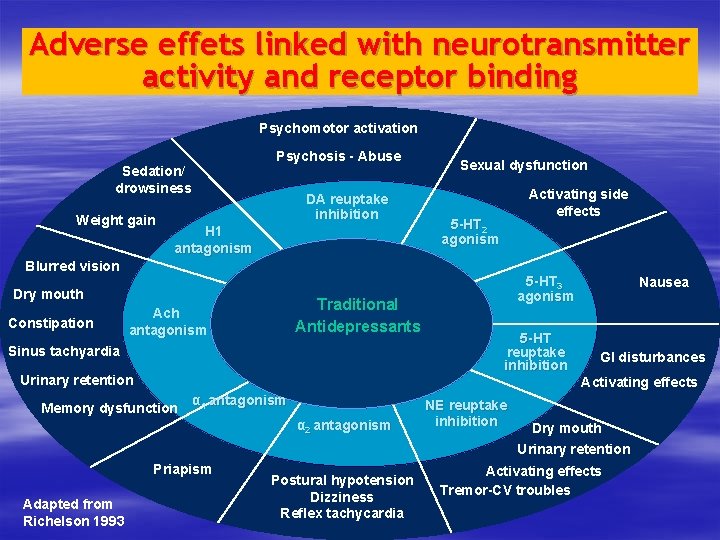
Adverse effets linked with neurotransmitter activity and receptor binding Psychomotor activation Psychosis - Abuse Sedation/ drowsiness Weight gain DA reuptake inhibition H 1 antagonism Sexual dysfunction Activating side effects 5 -HT 2 agonism Blurred vision Dry mouth Constipation Traditional Antidepressants Ach antagonism Sinus tachyardia Urinary retention 5 -HT 3 agonism 5 -HT reuptake inhibition Nausea GI disturbances Activating effects Memory dysfunction α 1 antagonism α 2 antagonism NE reuptake inhibition Dry mouth Urinary retention Priapism Adapted from Richelson 1993 Postural hypotension Dizziness Reflex tachycardia Activating effects Tremor-CV troubles
Antianxiety/Anxiolytic Drugs § GABA exerts an inhibitory effect on neurons § These drugs enhance its effect and produce a sedative effect § Therefore reduce anxiety § The most common used drugs here are the Benzodiazepines 10/2/2020 50
Benzodiazepines § Valium, Xanax, Ativan , Librium, Lexotanil § Risk of dependency § Avoid ETOH § Dalmane, Halcion (used as sleep aides-short term) § Causes sedationdon’t drive!! § Used for anxiety disorders, ETOH withdrawal, muscle spasm, sedation, insomnia, and epileptics/seizures 10/2/2020 51
Benzodiazepines § Side Effects – Drowsiness, confusion, sedation, and lethargy § Toxic Effects – Respiratory depression esp. with ETOH use! § Contraindications – – Combination with other CNS depressants Renal or hepatic dysfunction (may use Ativan) History of drug abuse or addiction Depression and suicidal tendencies § Teaching – – Use short term due to risk of drug dependency Avoid ETOH and other CNS depressants Can impair ability to drive Sudden D/C of benzodiazepines might cause withdrawal s/s 10/2/2020 52
Non-benzodiazepine Anxiolytic § § § Bu. Spar (Buspirone) Reduces anxiety without strong sedative-hypnotic properties Not a CNS depressant Takes 2 weeks to feel effects No potential for addiction § Side Effects – Dizziness, dry mouth, nervousness, diarrhea, headache, excitement § Toxic Effects – Lethal dose is 160 -550 times the daily recommended dose § Contraindications – – Use with caution in PG women Nursing mothers Clients with renal or hepatic disease Anyone taking MAOs 10/2/2020 53
Sedative/Hypnotic Drugs § Anxiolytic and hypnotic § Can lead to tolerance and dependency § Use for short term § Drugs used benzodiazepines: Dalmane, Restoril, Halcion Non-benzodiazepines: Ambien, Sonata, Lunestra 10/2/2020 54
Psychoeducation when using Benzodiazepine Teaching § Use short term(1 -2 weeks) § Carefully need to taper these off-never stop cold turkey § Do not take with other meds without talking to provider first § Do not drive if sedated on these!! 10/2/2020 55
Client Teaching for Non-benzodiazepines § Long term use not recommended § Do not drive when taking § Can repeat Sonata up to 4 hours before arising 10/2/2020 56
ADD/ADHD-Psychostimulants § S/E: wt. loss, anorexia, insomnia, headache, long§ Ritalin, Adderall, Dexedrine, Concerta, term growth suppression § Daytrana § Potential for abuse § Action= § Also used to treat increasing the release narcolepsy and blocking the reuptake of monoamines (dopamine, norepinephrine) 10/2/2020 57
ADD/ADHD-Psychostimulants § Intended effects: – – – Increased attention span & concentration Decreased distractibility, hyperactivity, and impulsivity Treatment of ADHD, ADD, & narcolepsy § S/E: – – – Anorexia Wt. loss Growth retardation in children Insomnia Headache Cardiovascular effects-high blood pressure, dysrhythmias § Contraindications: – Hx of drug abuse & dependency, severe anxiety, anorexia, MAIOIs 10/2/2020 58
ADD/ADHD- Non-Stimulants § Strattera (atomoxetine) – Controls symptoms thru selective inhibition of norepinephrine – Takes 1 -3 weeks to feel effects – No abuse potential and is not considered a controlled substance 10/2/2020 59
Meds used to Treat Extrapyramidal SE § § § § Cogentin Benadryl Artane Symmetrel Requip Akineton Kemadrin 10/2/2020 § These meds should be taken simultaneously with antipsychotic meds to prevent EPS 60
Herbal Medicines § § § Ginkgo biloba-helps with memory Kava-Kava St. John’s Wart 10/2/2020 61
Questions after lecture? § Please e-mail (kbazaid@ksu. edu. sa) or call (01 467 1717) § Interested in learning more about child and adolescent psychiatry? – – Arrange to attend OPD Consider an elective rotation during internship or otherwise 10/2/2020 62 62
Meds for Alzheimer’s § Drugs here are used to § Memantine slow the progression of (Namenda, Ebixa) the disease § Cognex (tacrine) § Aricept (donepezil) § Exelon (Rivastigmine) § Razadyne (galantamine) 10/2/2020 63
PET Scan=positron-emission tomography (PET) scans § Useful in identifying physiological and biochemical changes as they occur in living tissue – i. e. clients with schizophrenia PET scans show a decrease of glucose in the frontal lobes of unmedicated clients, also can indicate mood disorders, ADHD § Radioactive substance is injected, travels to the brain, and illuminates the brain. Have 3 D visualizations of the CNS 10/2/2020 64
- Slides: 64