
Psychopharmacology 120807 Jared Van Snellenberg Department of Psychology
Psychopharmacology 12/08/07 Jared Van Snellenberg Department of Psychology Columbia University
Drugs • The War on Drugs 12/08/07 Jared Van Snellenberg Department of Psychology Columbia University
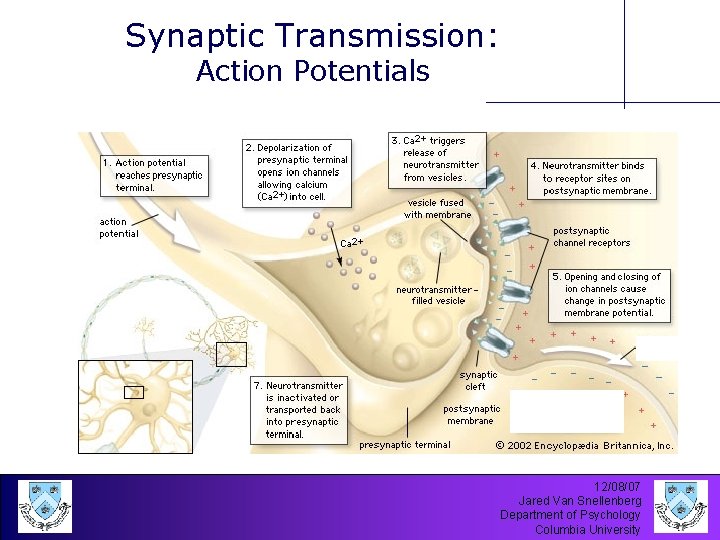
Synaptic Transmission: Action Potentials 12/08/07 Jared Van Snellenberg Department of Psychology Columbia University
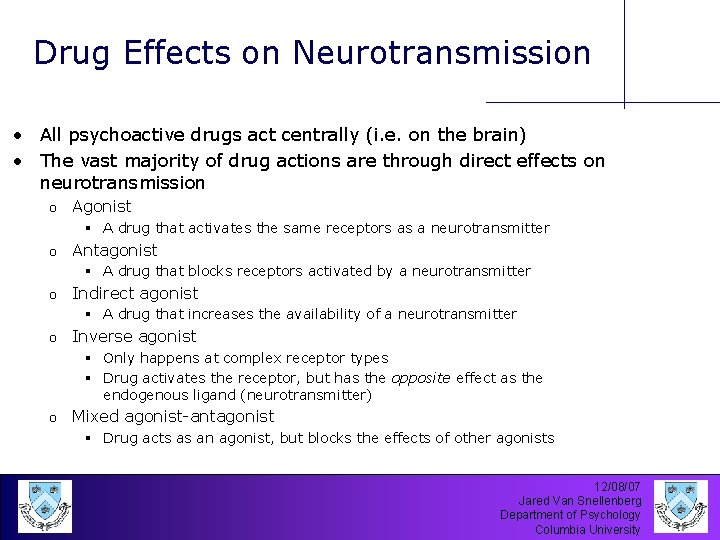
Drug Effects on Neurotransmission • All psychoactive drugs act centrally (i. e. on the brain) • The vast majority of drug actions are through direct effects on neurotransmission o Agonist § A drug that activates the same receptors as a neurotransmitter o Antagonist § A drug that blocks receptors activated by a neurotransmitter o Indirect agonist § A drug that increases the availability of a neurotransmitter o Inverse agonist § Only happens at complex receptor types § Drug activates the receptor, but has the opposite effect as the endogenous ligand (neurotransmitter) o Mixed agonist-antagonist § Drug acts as an agonist, but blocks the effects of other agonists 12/08/07 Jared Van Snellenberg Department of Psychology Columbia University
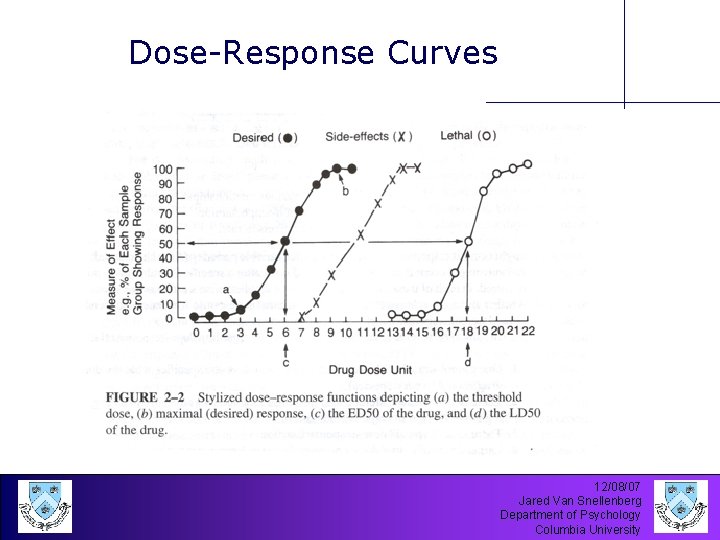
Dose-Response Curves 12/08/07 Jared Van Snellenberg Department of Psychology Columbia University
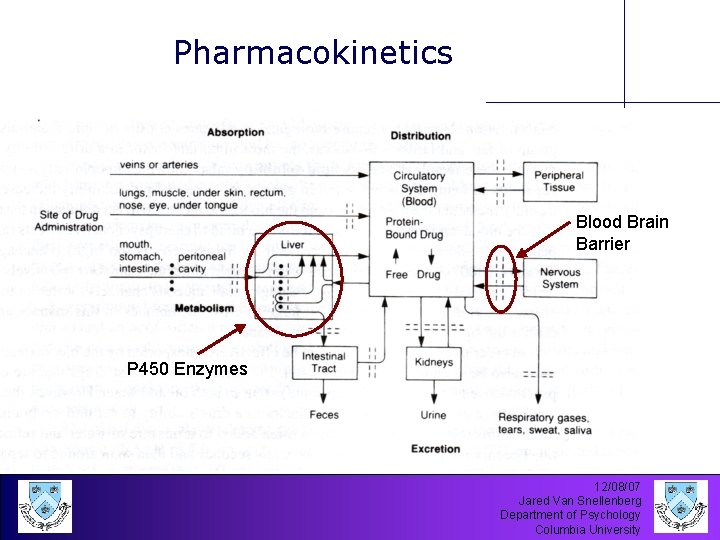
Pharmacokinetics Blood Brain Barrier P 450 Enzymes 12/08/07 Jared Van Snellenberg Department of Psychology Columbia University
Pharmacokinetics • Blood Brain Barrier Blocks many chemicals in general circulation from entering the brain o The capillaries that supply blood to the brain have tightly packed lipid endothelial cells that block many chemicals o § Acids § Lipid-insoluble chemicals § Chemicals bound to plasma proteins Also blocks many hormones from acting centrally o Some role may be also be played by astrocytes o § Astrocytes have processes that contact capillary walls, and others that contact neurons 12/08/07 Jared Van Snellenberg Department of Psychology Columbia University
Pharmacokinetics • Liver P 450 Enzymes o Everything absorbed from the GI tract passes through the liver before entering general circulation § Results in first-pass metabolism § Also metabolizes drugs already in circulation o Levels of P 450 enzymes can change in response to long-term drug use § Can be a factor in the development of drug tolerance o Important in many drug interactions § If two drugs (e. g. barbiturates and ethanol) share a common metabolic pathway, the presence of one will reduce metabolism of the other 12/08/07 Jared Van Snellenberg Department of Psychology Columbia University
Pharmacokinetics • Liver P 450 Enzymes (cont. ) o Levels of the ~50 P 450 enzymes in humans can vary widely between individuals (and ethnicities) § In some people one might be missing entirely § Important for individual differences in drug reactions o Some P 450 enzymes actually activate drugs § Codeine is actually turned into morphine by these enzymes o Many drug metabolites are active compounds themselves § Can cause side effects, especially ‘hangover’ effects in long-lasting drugs 12/08/07 Jared Van Snellenberg Department of Psychology Columbia University
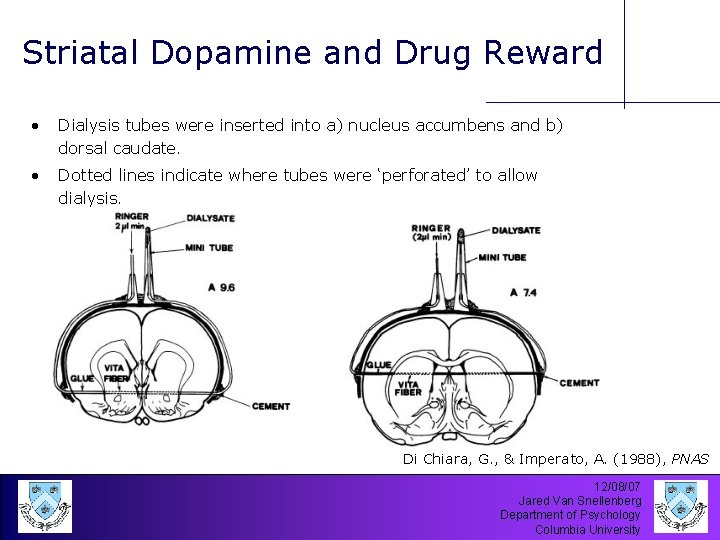
Striatal Dopamine and Drug Reward • Dialysis tubes were inserted into a) nucleus accumbens and b) dorsal caudate. • Dotted lines indicate where tubes were ‘perforated’ to allow dialysis. Di Chiara, G. , & Imperato, A. (1988), PNAS 12/08/07 Jared Van Snellenberg Department of Psychology Columbia University
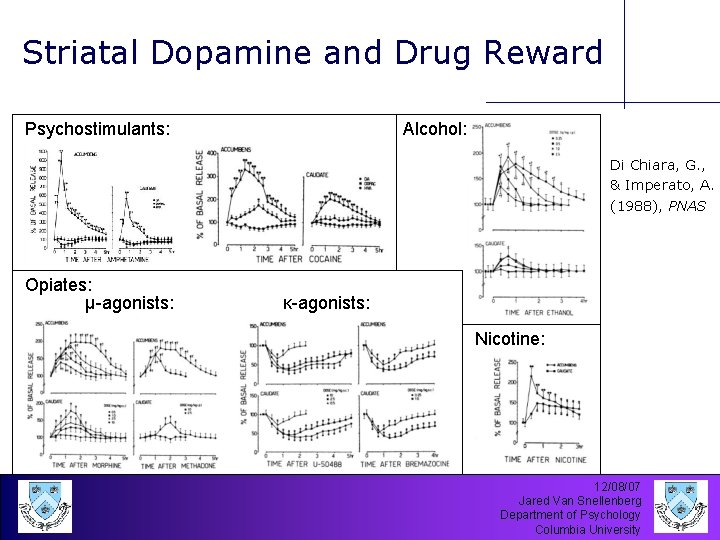
Striatal Dopamine and Drug Reward Psychostimulants: Alcohol: Di Chiara, G. , & Imperato, A. (1988), PNAS Opiates: μ-agonists: κ-agonists: Nicotine: 12/08/07 Jared Van Snellenberg Department of Psychology Columbia University
Striatal Dopamine and Drug Reward • Additionally, the following drugs had no effect on extracellular DA levels: Imipramine (a tricyclic antidepressant) o Atropine (a. k. a. Belladonna, an ACh antagonist at muscarinic receptors) o Diphenhydramine (an antihistamine) o • Finally, haloperidol (an antipsychotic) did increase extracellular DA levels in both accumbens and caudate. o However, haloperidol is a potent D 2 receptor antagonist. 12/08/07 Jared Van Snellenberg Department of Psychology Columbia University
Radioligand binding studies • Aside from hemodynamic applications, PET can be also be used with any radioligand with a reasonably short half-life. • [11 C]raclopride competes with endogenous DA for receptor binding. • Thus, [11 C]raclopride binding can be used as a measure of endogenous DA release (greater signal means less DA). 12/08/07 Jared Van Snellenberg Department of Psychology Columbia University
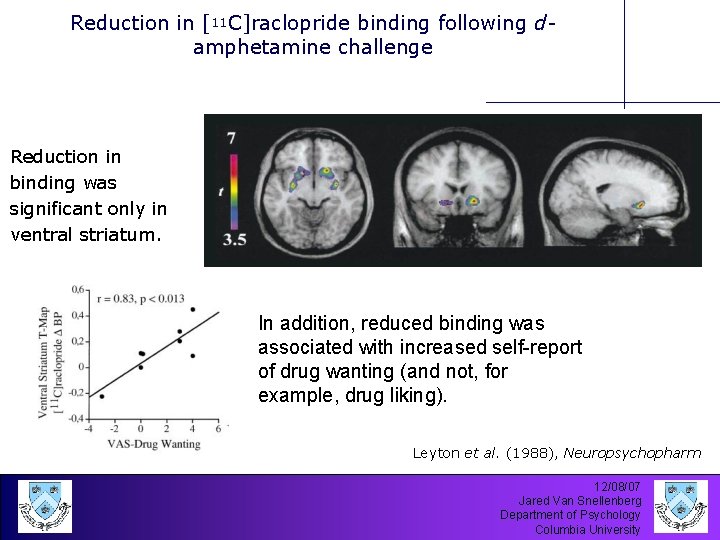
Reduction in [11 C]raclopride binding following damphetamine challenge Reduction in binding was significant only in ventral striatum. In addition, reduced binding was associated with increased self-report of drug wanting (and not, for example, drug liking). Leyton et al. (1988), Neuropsychopharm 12/08/07 Jared Van Snellenberg Department of Psychology Columbia University
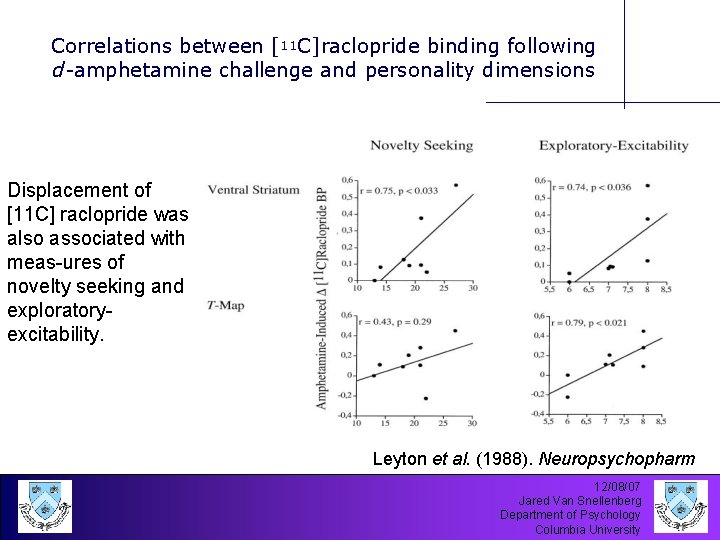
Correlations between [11 C]raclopride binding following d-amphetamine challenge and personality dimensions Displacement of [11 C] raclopride was also associated with meas-ures of novelty seeking and exploratoryexcitability. Leyton et al. (1988). Neuropsychopharm 12/08/07 Jared Van Snellenberg Department of Psychology Columbia University
Before we begin… • “It should be made clear that all psychotropic drugs can be safe or harmful, depending on the circumstances in which they are used, how frequently they are used, or how much is used. ” Grilly (2002), Drugs and Human Behavior 12/08/07 Jared Van Snellenberg Department of Psychology Columbia University
Sedative-Hypnotics (depressants) • Ethanol (alcohol) Formed during the interaction of yeast and sugar o Small, neutrally charged molecule o § Readily absorbed from the GI tract § Highly water-soluble, but still crosses the BBB § Not fat-soluble q This is part of why women have a lower alcohol tolerance: ethanol will not enter fat cells, and women have a higher proportion of body fat than men § Metabolized by a P 450 enzyme known as alcohol dehydrogenase (ADH) q o Women have about half the ADH as men do on average; again, lower tolerance It is metabolized in the liver at a fairly constant rate § First-pass metabolism also occurs at an upper GI site 12/08/07 Jared Van Snellenberg Department of Psychology Columbia University
Sedative-Hypnotics (depressants) • Ethanol (cont. ) o Alters nearly every aspect of conduction and synaptic neurotransmission § Acts directly on neuronal cell membrances, making them more “fluid” q This can interfere with the flow of sodium and potassium ions at extremely high doses § Enhances GABA activity, allowing more chlorine to enter, hyperpolarizing cells (making them less likely to be active) § Inhibits glutamate at NMDA receptors, reducing the flow of calcium and sodium, making it less likely that cells will depolarize 12/08/07 Jared Van Snellenberg Department of Psychology Columbia University
Sedative-Hypnotics (depressants) • Ethanol (cont. ) o Psychological effects appear to be heavily moderated by expectations o Has large effects on judgments and decision making, and fine and gross motor control § In approximately half of all homicide, robbery, rape, arson, and domestic violence cases, either the perpetrator or victim was determined to be under the influence of alcohol § Roughly 40% of all fatal traffic accidents in North America and Europe involve alcohol 12/08/07 Jared Van Snellenberg Department of Psychology Columbia University
Sedative-Hypnotics (depressants) • Ethanol (cont. ) o Effects of chronic use § Cirrhosis of the liver q Not due to poor nutrition § Slight cognitive impairments q Memory q Abstract reasoning q Problem solving q Perceptual motor functions § These impairments may be a result of liver damage q Normal functioning (except for memory) after receiving a liver transplant § Korsakoff’s syndrome q Profound anterograde and retrograde amnesia q Due to a B vitamin deficiency 12/08/07 Jared Van Snellenberg Department of Psychology Columbia University
Sedative-Hypnotics (depressants) • Ethanol (cont. ) o Famous study of all-cause mortality and drinking § Heavy drinkers had highest mortality § Followed by abstainers § Lowest mortality in people having 1 -3 drinks/day o No evidence that this moderate level of drinking has adverse effects § Except on a developing fetus…. § Although apparently a recent report has linked alcohol to…cancer! 12/08/07 Jared Van Snellenberg Department of Psychology Columbia University
Sedative-Hypnotics (depressants) • Barbiturates o Have largely been replaced by benzodiazepines o High abuse potential o Effects are very similar to alcohol o Variety of uses: § General anesthetics § Anxiolytics § Sleeping pills § Anticonvulsants 12/08/07 Jared Van Snellenberg Department of Psychology Columbia University
Sedative-Hypnotics (depressants) • Barbiturates (cont. ) o Like alcohol, they enhance GABA activity, increasing the amount of chlorine able to enter cells o Although used as a sleeping pill, it leads to much less REM sleep than normal § As does alcohol 12/08/07 Jared Van Snellenberg Department of Psychology Columbia University
Sedative-Hypnotics (depressants) • Benzodiazepines o You’ve probably heard of Valium (diazepam) and Xanax (alprazolam) § Xanax has replaced Valium as the anxiolytic of choice, primarily because of the abuse potential of Valium Very similar effects to barbiturates, although they can not be used as a general anesthetic o Much less likely to cause fatality than barbiturates o Have highly selective actions on a widely distributed set of receptors that seem to enhance GABA activity at other receptor sites (again, increase in chlorine and hyperpolarization) o § Many of the endogenous ligands for the benzodiazepine receptors are still unknown, but some have been identified q Some inhibit panic reactions, some seem to induce them 12/08/07 Jared Van Snellenberg Department of Psychology Columbia University
Psychostimulants • This class of drugs, in low to moderate doses, generally have the following effects o Heightened mood (euphoria) o Increase vigilance and alertness o Reduce fatigue o Keep you awake • In order of prevalence of use o Caffeine (the most widely used psychotropic in the world) o Nicotine o Amphetamines/Cocaine 12/08/07 Jared Van Snellenberg Department of Psychology Columbia University
Psychostimulants • Caffeine Typical adult in the US consumes 200 -300 mg/day o Two cups of coffee has roughly the same mood-elevating and fatigue-reducing properties as a threshold dose of amphetamine o § However, larger doses to do not continue to elevate mood in the same way as amphetamine o Improves psychomotor performance § Reaction time § Sustained attention In low doses can improve capacity for muscular work and ‘sustained intellectual effort’ o Many effects are biphasic (that is, they go away or reverse at higher doses) o Unclear as to whether these beneficial effects exist only in regular users o 12/08/07 Jared Van Snellenberg Department of Psychology Columbia University
Psychostimulants • Caffeine (cont. ) o Primary mechanism of action is antagonism of adenosine receptors § Adenosine is a powerful inhibitor § Antagonism of adenosine receptors leads to much greater activity in the reticular activating system (a subcortical monoamine neurotransmitter system intimately linked with arousal and wakefulness) Also appears to act on catecholamine neurotransmitters (norepinephrine and epinephrine) o Tolerance develops due to upregulation of adenosine receptors o Withdrawal symptoms after heavy use (upwards of 500 mg/day) o § Headache, fatigue, reduced alertness, sleepiness o Note that nicotine increases the metabolic rate of caffeine § So if you try to quit smoking, decrease your coffee consumption! 12/08/07 Jared Van Snellenberg Department of Psychology Columbia University
Psychostimulants • Nicotine o Normal doses are similar to caffeine in psychostimulant effects § § § Reaction time Sustained attention Motor tracking Short-term memory retrieval Reduction of transient aversive states (boredom, anxiety) These benefits are largely only seen in habitual users o Has a biphasic effect such that it can be either stimulating or anxiolytic depending on the dosage o § Users titrate dosage to achieve desired effect 12/08/07 Jared Van Snellenberg Department of Psychology Columbia University
Psychostimulants • Nicotine (cont. ) o Nicotinic Ach receptor agonist § These are often presynaptic autoreceptors, leading to increased neurotransmission in a variety of neurotransmitter systems o Withdrawal symptoms are quite aversive § § § § Irritability Hunger Sleep disturbance GI disturbances Drowsiness Headache Impairment of concentration, judgment, and psychomotor performance Much of the reinforcing properties of nicotine may be due to alleviation of withdrawal o These symptoms do not appear to be directly related to blood-plasma levels of nicotine – probably largely psychological rather than physiological o 12/08/07 Jared Van Snellenberg Department of Psychology Columbia University
Psychostimulants • Amphetamine, etc o Considered to be one of the most abusable drugs o Initially marketed as Benzedrine (“Bennies”), the dextro (damphetamine) isomer is considerably more potent and is marketed as Dexedrine o The addition of a methyl group created methamphetamine o Drugs used to treat ADHD (e. g. methylphenidate) are modifications of amphetamine § The idea is that people with ADHD have a chronically underaroused nervous system q q Leads to hyperactivity in order to push CNS activity into the normal range – essentially seeking stimulation Psychostimulants increase CNS activity so that additional stimulation is not needed 12/08/07 Jared Van Snellenberg Department of Psychology Columbia University
Psychostimulants • Amphetamine, etc (cont. ) o Usually taken orally § Or intranasally in recreational use § Most amphetamines do not vaporize when smoked, although methamphetamine does § Smoking leads to much faster rises in blood plasma levels Cause increased release of catecholamines o Inhibit MAO o § Which inactivates monoamines o High doses can deplete catecholamines § May be responsible for development of tolerance and mood disturbances 12/08/07 Jared Van Snellenberg Department of Psychology Columbia University
Psychostimulants • Amphetamine, etc (cont. ) o Low to moderate doses § Facilitate performance on sustained attention tasks, and those requiring physical quickness or strength q Especially if fatigued § Increased energy, concentration, alertness, self-confidence, and mood § Social interactions may be enhanced § Suppresses appetite o High doses generally interfere with performance § Also can lead to dysphoria, social withdrawal, and depression 12/08/07 Jared Van Snellenberg Department of Psychology Columbia University
Psychostimulants • Amphetamine, etc (cont. ) o Extremely high doses or chronic use can lead to amphetamine-induced psychosis § Almost indistinguishable from paranoid schizophrenia o Simple movements are often repeated for long periods § E. g. continuous chewing, teeth grinding, tongue movements § In animals these are called ‘stereotypies’ Chronic use leads to marked tolerance and, in chronic users, the administration of very high doses o However, chronic use seems to sensitize individuals to stereotyped behaviors and psychosis o 12/08/07 Jared Van Snellenberg Department of Psychology Columbia University
Psychostimulants • Cocaine No currently accepted medical uses o Although pharmacodynamics differ from amphetamines, the effects are very similar o § One study showed that users were unable to distinguish the drugs when both were administered intravenously q Except that cocaine is much shorter acting Cross-tolerance can develop with amphetamine o Not well absorbed from the GI tract, so it’s usually taken intranasally o § Has local anesthetic properties that make it easily distinguishable from substances that do not induce anesthesia q Users will rub a small amount on their gums to check purity § Long-term use can lead to nasal damage due to ischemia 12/08/07 Jared Van Snellenberg Department of Psychology Columbia University
Psychostimulants • Cocaine (cont. ) o Sometimes smoked, but volatilization degrades it, reducing potency § Consequently a method for converting it to an alkaloid was developed q o This is crack, which has a much more rapid onset Often combined with alcohol § Results in higher plasma concentrations of cocaine § Results in a psychoactive metabolite, cocaethylene q Enhances and prolongs euphoric and cardiovascular effects Primary action is to inhibit reuptake of DA o Compared to amphetamine, has greater effects on DA and less on NE o 12/08/07 Jared Van Snellenberg Department of Psychology Columbia University
Psychostimulants • Cocaine (cont. ) o Can induce very strong psychological dependence in the short term § Effects only last 30 minutes or so, and users may have very strong cravings when the effects wear off o Can induce strong physical dependence as well, but apparently only after several years of continued use o Appears that some of its effects develop tolerance, while other sensitize § This is all pretty unclear § One theory is that tolerance develops to “liking” of the drug, but there is sensitization to “wanting” 12/08/07 Jared Van Snellenberg Department of Psychology Columbia University
Opioids (Narcotics) • All extracts of the opium poppy, and related synthetic compounds, are referred to as opiates, opioids, or narcotics • These drugs all act on receptors for endorphins (endogenous morphine), enkephalins, and dynorphins • Placebo analgesia has been shown to be due to endorphin release • Heroin is one of the most potent opiates simply because of its pharmacokinetic properties o Passes the BBB much faster than other narcotics • Many opiates are used medically to reduce pain o By far the most potent analgesics available 12/08/07 Jared Van Snellenberg Department of Psychology Columbia University
Opioids (Narcotics) • In addition to analgesia, they induce euphoria in most users • IV administration results in what is subjectively described as a “wholebody orgasm” or “rush” in most users o Currently no explanation for this phenomenon • Even chronic use has not been observed to damage the body directly o Poor health in abusers is due to poor nutrition, use of adulterated drugs, and concomitant use of other drugs • Side effects include pupil dilation, constipation, reduced sex drive and impotence o Tolerance does not develop to these • Chronic use may permanently change the synthesis and regulation of endorphins o Psychological processes such as pain perception, mood, and pleasure may be permanently altered 12/08/07 Jared Van Snellenberg Department of Psychology Columbia University
Opioids (Narcotics) • Legal factors (from Grilly, 2002, Drugs and Human Behavior) 12/08/07 Jared Van Snellenberg Department of Psychology Columbia University
Hallucinogens • Also known as psychotomimetics or psychedelics • Four major classes Monoamine-related (e. g. LSD, psilocybin, MDMA, DMT) o Cannibinoids (marijuana derivatives) o Anticholinergics (e. g. Belladonna) o Dissociative anesthetics (e. g. phencyclidine, ketamine) o • Recreational use appears to occur because of effects on consciousness and perception, rather than any direct reward properties of these drugs • Potency of monoamine hallucinogens is strongly predicted by their affinity for 5 -HT 2 A receptors 12/08/07 Jared Van Snellenberg Department of Psychology Columbia University
Hallucinogens • LSD and related compounds Hofmann (1979), LSD: My Problem Child o Following this, it was thought LSD could elucidate the neurochemical basis of psychosis o § This failed o Was then used as an adjunct to psychotherapy § One study of over 100 alcoholics reported that over half of those in the high-dose LSD treatment group were still abstaining 6 months later § Other work showed that terminal cancer patients had improvements in physical and emotional status after LSD treatment Anecdotal reports indicate that it was popular in academia in the 50’s and 60’s o It became prevalent in youth culture and became to be seen as a public health problem, and was made illegal o 12/08/07 Jared Van Snellenberg Department of Psychology Columbia University
Hallucinogens • LSD and related compounds (cont. ) o Effects are incredibly dependent on context and expectations o Users frequently report developing insights that they had never had before § They describe a stripping away of preconceived notions of who they are and the meaning of their existence o Visual, auditory, and tactile hallucinations are common at high doses § Lower doses lead to perceptual distortions o Dysphoric reactions occur, especially with larger doses § User may feel that they’re losing control and may never return to normal o Effects dissipate after 6 -12 hours, but a small minority of users may continue to experience mental confusion and perceptual distortions for days or weeks 12/08/07 Jared Van Snellenberg Department of Psychology Columbia University
Hallucinogens • LSD and related compounds (cont. ) o Some evidence that hallucinogens can cause a schizophrenialike reaction in individuals vulnerable to psychosis o Antipsychotic drugs (used in treating psychosis) can block most of the effects of these drugs o Some users report “flashbacks” weeks or months after use § Not literally a flashback § Altered visual perception such as geometric pseudohallucinations, illusory movement, “tracers”, flashes of color § These have never been experimentally validated, and their cause is unknown (the drug does not stay in the body long enough) 12/08/07 Jared Van Snellenberg Department of Psychology Columbia University
Hallucinogens • Methylenedioxymethamphetamine (MDMA; “ecstasy”) o Has both amphetamine-like effects and hallucinogenic effects o Initially synthesized by a pharmaceutical company in the 20’s o Reported effects are: § Changes in feelings and emotions § Enhanced communication and empathy § Insight § Euphoria § Perceptual distortions or hallucinations § Transcendental/religious experiences o Potentiates the release of 5 -HT and DA § Causes acute depletion of 5 -HT in cortex 3 -6 hours after administration § An additional depletion may occur days later 12/08/07 Jared Van Snellenberg Department of Psychology Columbia University
Hallucinogens • MDMA (cont. ) o Adverse effects include: § Depression § Unsociability § Irritability § Sleep disturbance § Memory disturbance o Dependence and psychotic reactions appear to be very uncommon § Tolerance to positive effects develop, but sensitization to adverse effects develops o Evidence exists that MDMA destroys axonal processes in serotonergic cells § Some claim that this evidence is controversial, I don’t really know 12/08/07 Jared Van Snellenberg Department of Psychology Columbia University
Hallucinogens • Cannabinoids o Evidence that it may have been used over 4700 years ago o Marijuana is a plant containing over 400 chemicals, about 60 of which are cannabinoids o Delta-9 -tetrahydrocannabinol (THC) is the major psychoactive compound § However, pure THC is reported to be quite unpleasant, so the other active compounds appear to be important 12/08/07 Jared Van Snellenberg Department of Psychology Columbia University
Hallucinogens • Cannabinoids (cont. ) o Set and setting are critical for mood and behavioral effects § Dose-dependent impairment of memory and cognition § Speech can become fragmented, and the speaker often forgets what others have recently said § Loosening of associations § Insight q These may turn out to be mundane or useless once the drug effect is over Some of the deficits may be due to lack of motivation o Tolerance to the cognitive deficits may also develop o Less detrimental to motor abilities and decision making than alcohol, but still a causal factor in some accidents o § Seems to make drivers more cautious, which ameliorates the deleterious effects on motor skills 12/08/07 Jared Van Snellenberg Department of Psychology Columbia University
Hallucinogens • Cannabinoids (cont. ) Has a sedative-like effect in most people o Dysphoric reactions may occur with high doses o § More common with oral administration, probably because the user can’t titrate the dosage as tightly o Appears to have culturally-dependent effects on sexual behavior and appetite § North Americans report increased appetite and enhanced sexual stimulation § Used as a sexual depressant in India § Used as an appetite suppressant in Jamaica o Evidence of effects on attention, memory, and psychomotor skills for 12 -24 hours after use 12/08/07 Jared Van Snellenberg Department of Psychology Columbia University
Hallucinogens • Cannabinoids (cont. ) o More than 30 metabolites of THC, and over 20 each of canabinol and cannabidiol § Many of these are psychoactive § At least one is more active than THC Extremely lipid-soluble, so they remain in the body for weeks or more o Fluidizes cell membranes, similar to the effect of alcohol (but to a lesser degree) o Binds to receptors for a fatty-acid neurotransmitter known as anandamide (ananda is sanskrit for “bliss”) o § Only discovered very recently § It was not known that fatty-acids could even be neurotransmitters until the discovery of anandamide 12/08/07 Jared Van Snellenberg Department of Psychology Columbia University
Hallucinogens • PCP Powerful anesthetic o Effects o Hallucinations Feeling of drunkenness and euphoria, “floating” Distortions of body image Feelings of depersonalization Schizophrenia-like psychosis in some cases (maybe as much 1/3!) § Can lead to severe depression and violence § § § Antagonizes the NMDA receptor o Inhibits 5 -HT reuptake o Ketamine is very similar o 12/08/07 Jared Van Snellenberg Department of Psychology Columbia University
Hallucinogens • Anticholinergics Muscaranic ACh antagonists, as the name implies o E. g. belladonna (atropine), jimson weed (datura), mandrake (mandragora), and henbane o Not controlled substances, because abuse potential is low o § Lots of side effects, and potentially lethal (though the safety margin is actually quite high) Can cause blurred vision and constipation o Can lead to a feeling of “floating” o § Or “flying” – some people believe the origin of “witches flying on broomsticks” was because some women in this time would boil belladonna leaves and other plants, and apply them to genital tissue with a wooden implement 12/08/07 Jared Van Snellenberg Department of Psychology Columbia University
- Slides: 51