
Psychoneuroimmunology Introduction The immune system recognizes responds to





- Slides: 18
Psychoneuroimmunology
Introduction: The immune system recognizes, responds to and remembers substances that threaten health (antigens). The immune system has two branches according to mechanism of action: like navy and foot army
The humoral branch like navy because it operates through B cell that circulates in the blood b) The cellular branch like foot army because it operates through T cell that can leave the blood stream and more through the tissues. Memory B cells and T cells remain to provide immunity (B cells from bone marrow and T cells from thymus gland). The immune has also two responses: according to type of lymphocyte
A) Non-specific Response
Where non-specific lymphocytes are the front line – – Both Natural Killers (Nk-cells) that destroy tumors and viruses. Macrophages that attack bacteria and pass information about the antigen to specific Helper T cells. Specific Response – Where specific lymphocytes used the information passes few macrophages to produce T Killer cells and B cells become plasma cells that secrete antibodies.
Definition: Psychoneuroimmunology is the field concerned with relationships among the mind (psycho), the nervous and endocrine systems (neur) and the immune system (immunology). The central idea is that psychosocial factors can influence immune responses through the brain as a master regulator for bodily system.
The Role of the Brain: The immune system for the body like an army to the nation and the brain is the leader, who communicate with it they: 1. The hypothalamus, locus ceruleus, and the limbic system: areas of the brain that are most related to immune function. Activity in different brain regions can regulate the homeostasis of the immune system by either enhancing or inhibiting it.
2. The brain also communicates directly with individual lymphocytes. Lymphocytes have receptor sites on their surfaces for certain hormones and the neurotransmitter catecholamine. 3. The autonomic nervous system: the sympathetic nervous system fibers provide a direct link between the brain and the lymphocytes, spleen and thymus.
4. Activation of the hypothalamicpituitary-adrenal connection: this is the same general pathway for physiological response to stress. 5. Feedback from hormones and other chemicals produced by lymphocytes and macrophages. 6. Classical conditioning as one mechanism where psychosocial factors affect the immune system
ADDICTION Biopsychosocial Model
Definitions: 1 - General: Addiction involves devoting oneself to a habit, appetite or behaviour but it does not exclude choice and responsibility. 2 - Specific: Addiction, to psychoactive substance is based on their ability to affect the brain’s homeostasis. Trials have failed to solve this problem on international or national level. Proper confrontation, now, should be planned on individual basis.
I. The biomedical model of addiction
This model defines addiction as a disease characterized by physical dependence (tolerance and withdrawal), and focuses on biological factors only. - Tolerance: Increased doses are required to achieve the desired effect. - Withdrawal: Uncomfortable symptoms due to discontinuation of substance after prolonged use. Labeling addiction as a disease reduces blaming, guilt, stigma and encourage abusers to enter treatment.
II. The biopsychosocial model of addiction
This model is comprehensive and takes into account the role of the brain, motivation, learning and social influences.
The Brain: Responsible for pleasure and pain or Reward and punishment - Limbic system: The median forebrain bundle runs through the hypothalamus. - Hypothalamus : Having centers for primary drives as thirst, hunger, aggression and sex. These primary drives generate mild feeling of discomfort that push one for satisfaction which is experienced as reduced discomfort or pleasure (Reward).
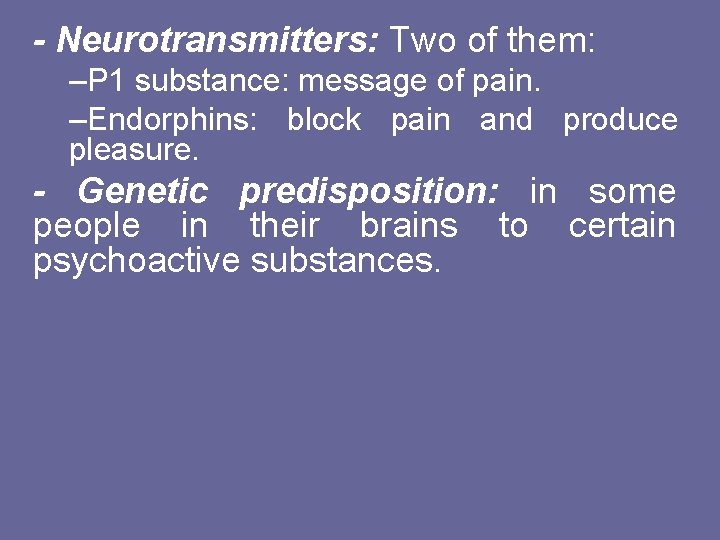
- Neurotransmitters: Two of them: –P 1 substance: message of pain. –Endorphins: block pain and produce pleasure. - Genetic predisposition: in some people in their brains to certain psychoactive substances.
Motivation: –The use of substance is a motivated choice –People decide to use a substance according to their expectations that pleasure will outweigh painful consequences. They may not be aware about this process. –People who experience little stimulation should be vulnerable to use a stimulant like cocaine, while those who have too much arousal should be vulnerable to use a sedative like valium. Both try to improve their mood through “self regulation” of the brain.