
Psychometric Validation of the Cardiac Rehabilitation Barriers Scale
Psychometric Validation of the Cardiac Rehabilitation Barriers Scale (CRBS) Shamila Shanmugasegaram, MSc CRCARE: Cardiac Rehab Care Continuity through Automatic Referral Evaluation

Measuring CR Barriers n n Patient, provider, and health system-level barriers to CR utilization have been identified (Grace et al. , 2004) To date, there are 3 validated scales assessing CR: q Beliefs About Cardiac Rehabilitation (BACR) (Cooper et al. , 2007) q Cardiac Rehabilitation Preference Form - Revised (Fernandez et al. , 2007) q Cardiac Rehabilitation Enrollment Obstacles (CREO) (Fernandez et al. , 2008) n n Two subscales: “Patient-related obstacles” and “Health servicerelated obstacles” The purpose of this study is to psychometrically validate the CRBS 2

CRBS: I did not attend a CR program, or if I did attend, I missed some sessions because: 1. …of distance (e. g. , not located in your area, too far to travel) 2. …of cost (e. g. , parking, gas) 3. …of transportation problems (e. g. , access to car, public transportation) 4. …of family responsibilities (e. g. , caregiving) 5. …I didn’t know about cardiac rehab (e. g. , doctor didn’t tell me about it) 6. …I don’t need cardiac rehab (e. g. , feel well, heart problem treated, not serious) 7. …I already exercise at home, or in my community 8. …severe weather 9. …I find exercise tiring or painful 10. …travel (e. g. , holidays, business, cottage) 11. …of time constraints (e. g. , too busy, inconvenient class time) 12. …of work responsibilities 13. …I don’t have the energy 14. …other health problems prevent me from going 15. …I am too old 16. …my doctor did not feel it was necessary 17. …many people with heart problems don’t go, and they are fine 18. …I can manage my heart problem on my own 19. …I think I was referred but the rehab program didn’t contact me 20. …it took too long to get referred and into the program 21. …I prefer to take care of my health alone, not in a group • Rated on a 5 point Likert scale from 1=strongly disagree to 5=strongly agree (Grace et al. , 2004; Grace et al. , 2009 a; Grace et al. , 2009 b) 3
Objectives To investigate the: 1) Factor structure through factor analysis 2) Reliability 3) Criterion validity with regard to CR enrollment and participation 4) Convergent validity with an adapted version of the “practical barriers” subscale of the BACR scale and the CREO scale 5) Test-retest reliability 6) Socially-desirable responding 4
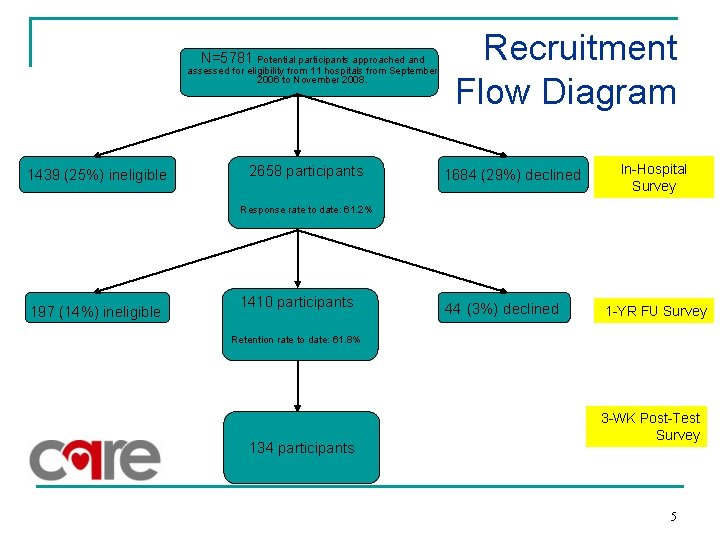
N=5781 Potential participants approached and assessed for eligibility from 11 hospitals from September 2006 to November 2008. 1439 (25%) ineligible 2658 participants Recruitment Flow Diagram 1684 (29%) declined In-Hospital Survey Response rate to date: 61. 2% 197 (14%) ineligible 1410 participants 44 (3%) declined 1 -YR FU Survey Retention rate to date: 61. 8% 134 participants 3 -WK Post-Test Survey 5

Participants §Diagnosis Inclusion Criteria Exclusion Criteria (inhospital) Exclusion Criteria (1 year follow-up) of Acute Coronary Syndrome, heart failure, and/or valve replacement §Undergone Percutaneous Coronary Intervention and/or Coronary Artery Bypass Graft surgery §Eligibility for CR based on guidelines of the CACR §Participation in CR within the past 2 years §Significant orthopedic, neuromuscular, visual, cognitive or non-dysphoric psychiatric condition §Patient moved, so unable to contact §Too ill to participate §Deceased 6

Participants Cont’d Characteristics of participants at 1 year follow-up (n=1410) Age (mean±SD) 65. 6± 10. 4 Sex (% female) 338 (24. 0) Ethnocultural background (% minority) 209 (15. 5) Education (% greater than high school) 651 (47. 8) Employment (% full or part-time) 471 (34. 8) Family income (% $50, 000 or more) 558 (49. 1) Marital status (% married) 1084 (77. 8) Rurality (% yes) 177 (12. 6) 7

Procedure & Measures Assessment Point Measures §Sociodemographic in-hospital §Medical data §CR 1 year follow-up utilization (self-report) §CRBS §Marlowe-Crowne Social Desirability Scale (MCSDS) (Leite & Beretvas, 2005) §CRBS §Beliefs 3 week post-test Scale (BACR) (Cooper et al. , 2007) §Enrollment Obstacles Scale (CREO) (Fernandez et al. , 2008) 8
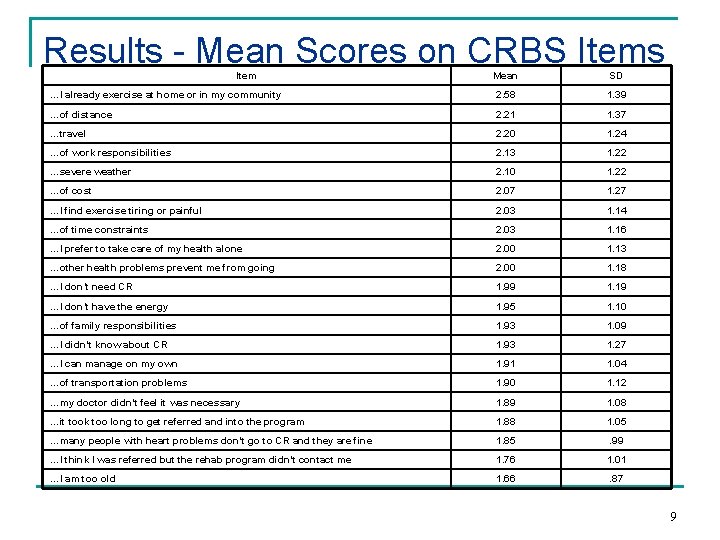
Results - Mean Scores on CRBS Items Item Mean SD …I already exercise at home or in my community 2. 58 1. 39 …of distance 2. 21 1. 37 …travel 2. 20 1. 24 …of work responsibilities 2. 13 1. 22 …severe weather 2. 10 1. 22 …of cost 2. 07 1. 27 …I find exercise tiring or painful 2. 03 1. 14 …of time constraints 2. 03 1. 16 …I prefer to take care of my health alone 2. 00 1. 13 …other health problems prevent me from going 2. 00 1. 18 …I don’t need CR 1. 99 1. 19 …I don’t have the energy 1. 95 1. 10 …of family responsibilities 1. 93 1. 09 …I didn’t know about CR 1. 93 1. 27 …I can manage on my own 1. 91 1. 04 …of transportation problems 1. 90 1. 12 …my doctor didn’t feel it was necessary 1. 89 1. 08 …it took too long to get referred and into the program 1. 88 1. 05 …many people with heart problems don’t go to CR and they are fine 1. 85 . 99 …I think I was referred but the rehab program didn’t contact me 1. 76 1. 01 …I am too old 1. 66 . 87 9
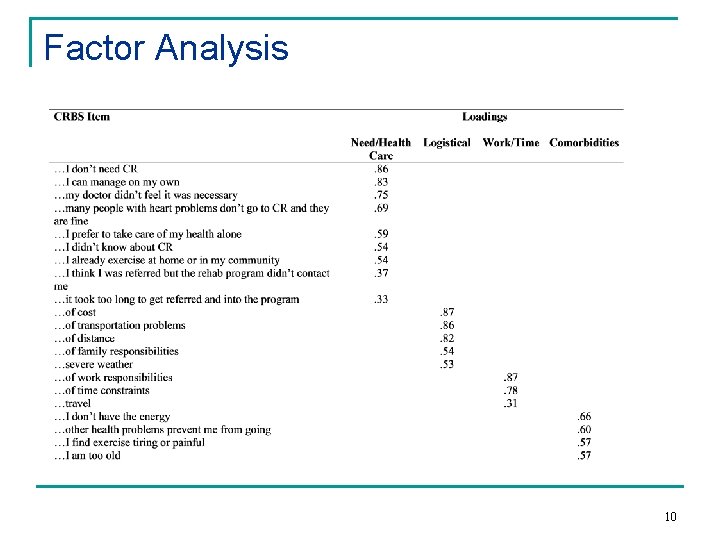
Factor Analysis 10
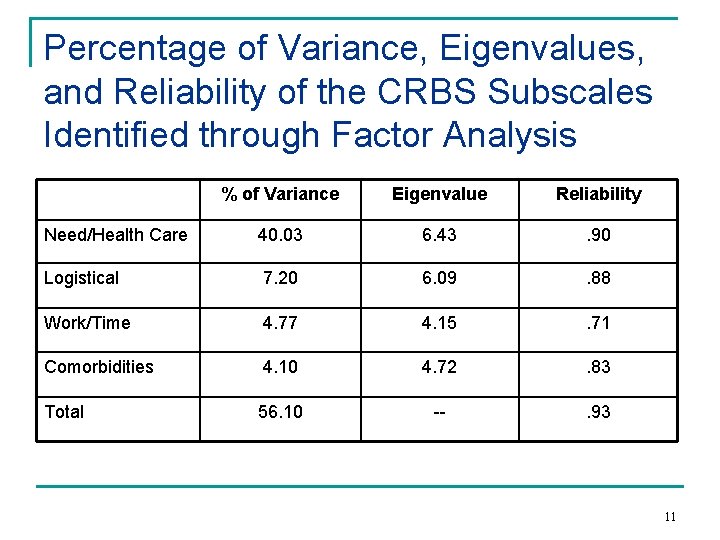
Percentage of Variance, Eigenvalues, and Reliability of the CRBS Subscales Identified through Factor Analysis % of Variance Eigenvalue Reliability Need/Health Care 40. 03 6. 43 . 90 Logistical 7. 20 6. 09 . 88 Work/Time 4. 77 4. 15 . 71 Comorbidities 4. 10 4. 72 . 83 Total 56. 10 -- . 93 11

Criterion Validity of the CRBS Total/Subscale Enrollees Non. Enrollees M SD t Total CR barriers 1. 76 . 68 2. 47 . 60 -14. 75* Need/Health Care 14. 37 6. 09 23. 52 5. 62 -21. 89* Logistical 9. 32 4. 86 12. 02 4. 85 -7. 26* Work/Time conflicts 6. 32 3. 05 6. 39 2. 67 -. 35 Comorbidities/Functional status 6. 88 3. 36 9. 06 3. 63 -8. 94* Note. *p<. 001 12

Criterion Validity of the CRBS Cont’d Total/Subscale Percentage of CR Sessions Attended Total CR barriers -. 36** Need/Health Care -. 34** Logistical -. 27** Work/Time conflicts -. 21** Comorbidities/Functional status -. 35** Note. **p<. 001; *p<. 01 13
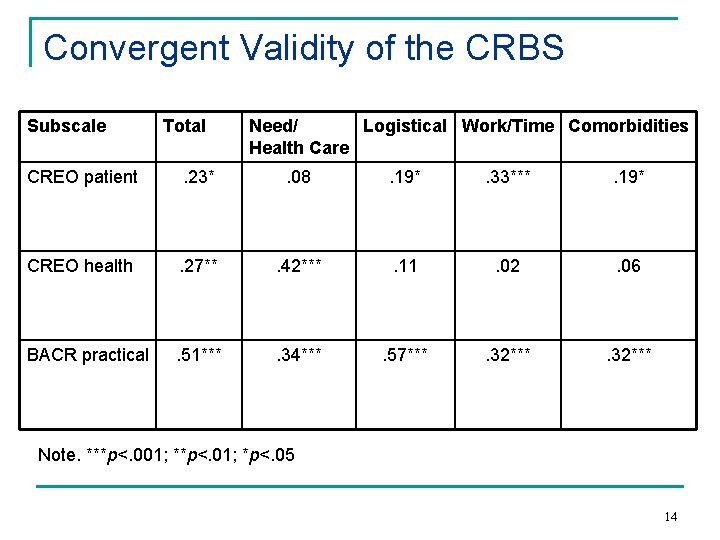
Convergent Validity of the CRBS Subscale Total Need/ Logistical Work/Time Comorbidities Health Care CREO patient . 23* . 08 . 19* . 33*** . 19* CREO health . 27** . 42*** . 11 . 02 . 06 BACR practical . 51*** . 34*** . 57*** . 32*** Note. ***p<. 001; **p<. 01; *p<. 05 14
Test-Retest Reliability of the CRBS n Test-retest reliability of the CRBS was acceptable (r =. 65; p <. 001) 15
Socially Desirable Responding n Total Social Desirability Scale was significantly related to total CRBS (r = -. 08; p <. 05) 16
Limitations n Self-report data n Recall bias q Time elapsed between in-hospital & 1 year follow-up 17
Discussion n CRBS consists of 4 reliable subscales q q n Consistent with previous samples tested by our group Wary of social desirability bias, although correlations low Compared to the CREO Scale, the CRBS has several advantages: q q Validated in more domains n Used broader and larger cardiac sample than the CREO scale n More types (convergent validity and test-retest reliability) More detailed assessment of patient-level barriers than the CREO scale n q CRBS = 3 versus CREO = 1 Assesses both CR enrollment and participation barriers n Barriers to participation in CR have not yet been tested for CREO 18
Acknowledgments Co-PIs: Dr. Sherry Grace & Dr. Donna E. Stewart MSc Cttee: Dr. Lucia Gagliese, Dr. Veronica Jamnik, & Dr. Mary Fox CRCARE Co-investigators: Terry Fair, Dr. Glenn Holder, Ms. Rimmy Kaur, Dr. Ellen Rukholm, Dr. David Alter, Dr. James Rush, Dr. Sonia Anand, Dr. Karen Williamson, Dr. Paula Harvey, Dr. Paul Oh, Dr. Steve Bunker, & Dr. Milan Gupta STUDY FUNDING: STUDENT FUNDING: Study coordinator: Lori Van Langen, MSc Grace Lab 19
- Slides: 19